Astuvansalmi Rock Paintings
Finland's largest Stone Age rock art, painted above a lake of buried offerings
Understand sacred places, explore living traditions, and learn how to engage respectfully with Pilgrim Map.
Access has not been verified. Check current local guidance before planning a visit.
Mikkeli (Ristiina), South Savo, Finland
Read the sources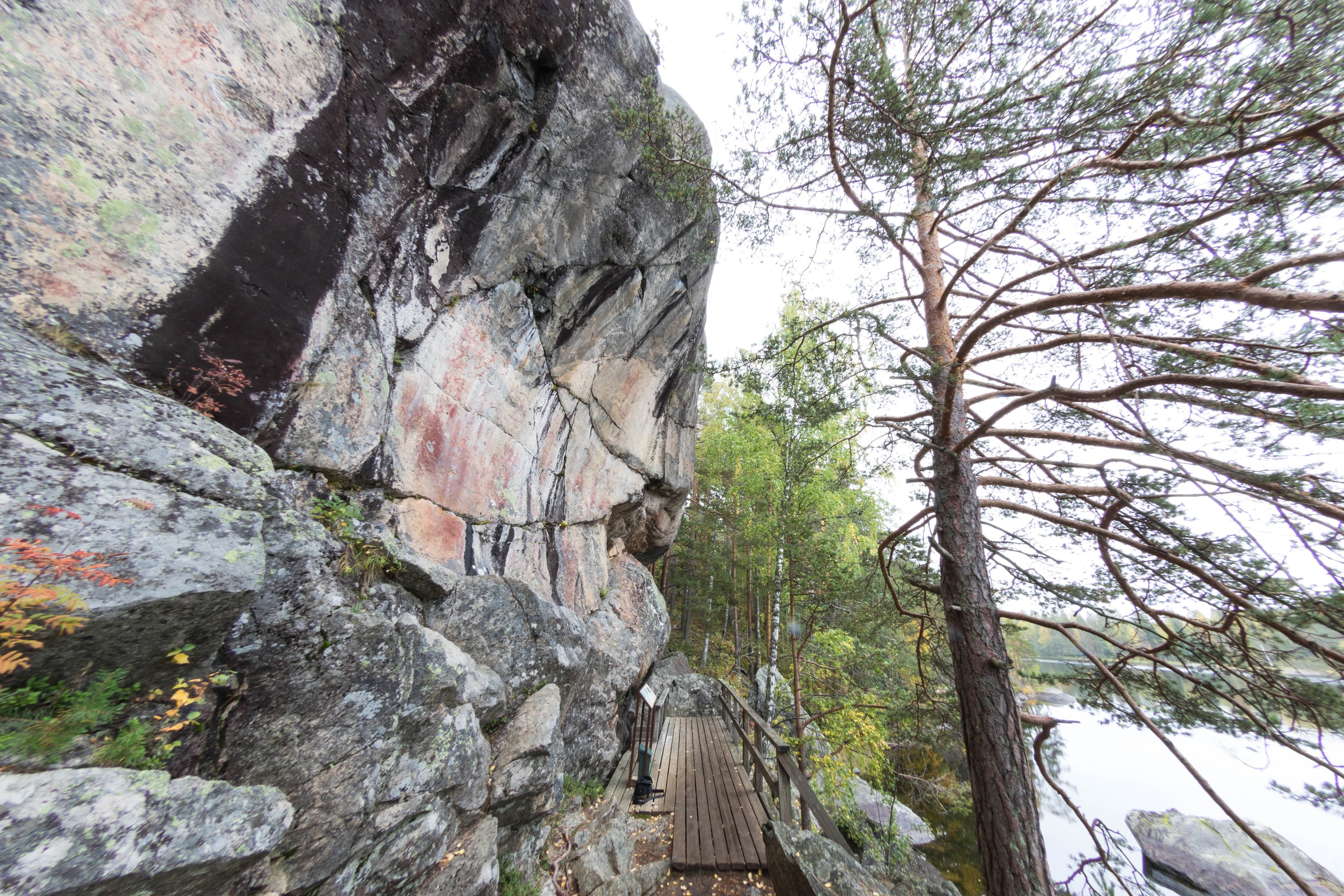
Image of Astuvansalmi Rock Paintings. Image source
Visit essentials
A quick read before you go
- Duration
- 1.5-2.5 hours round trip on foot including trail time and viewing; a scheduled Saimaa Geopark…
- Access
- By land: from national road 15, follow the signed route 4323 through Ristiina village (about 20…
Overview
Astuvansalmi is reached much as it likely was in the Stone Age: on foot through quiet forest or by boat across open water. From afar it is a grey granite face on Lake Yövesi, within South Savo's vast Saimaa lake system. Approach reveals red-ochre moose, nearly all facing one direction, human and spirit forms, boats, and dozens of hand and animal-track impressions roughly 7 to 12 metres above today's water.
This is Northern Europe's largest known concentration of prehistoric rock art and one of its oldest. Underwater excavation directly beneath the panel recovered amber pendants and stone points, material evidence that generations returned to this exact place to leave something behind.
Why this place is sacred
What holds Astuvansalmi together as a place of continued significance is the correspondence between what is on the rock and what was found in the water beneath it. The paintings are dominated by moose — the primary prey animal of Subneolithic Saimaa communities — alongside boats, human and spirit-like figures, and handprints.
Underwater excavation in front of the cliff recovered amber pendants, some carved into human-like forms, a bear-head-shaped amber piece, an antler fragment, and worked quartz and slate points, deposited across a span of well over a millennium — arrowhead types found in the sediment range from the Late Neolithic to the Early Metal Period.
Amber was a valuable, traded material; its presence at the lake bottom rather than in a settlement or grave has been read by archaeologists as intentional offering rather than accidental loss. Read together, the site suggests a place returned to specifically because it already held meaning — a lakeside threshold where hunting magic, animal-spirit mediation, and material sacrifice converged in one location for as long as living memory of that meaning persisted.
A ritual site connected to hunting magic: red-ochre imagery of moose, boats, and human/spirit figures paired with votive deposition of amber, antler, and stone objects in the lake below the painted panel.
From an active Subneolithic-Neolithic ritual site (paintings from c. 3000-2500 BCE onward; offerings continuing through c. 500 BCE) to a place known locally but archaeologically undocumented for millennia, to its official 1968 discovery, and now to a protected ancient monument, geopark interpretive site, and subject of ongoing scientific imaging research.
Experience and orientation
The approach is part of the encounter. From the parking area off route 4323 near Ristiina, a forest trail of roughly 2.2 to 2.5 kilometres leads through mixed woodland, past lakes and low cliffs, to a small rest area with a dry toilet and a boat dock facing the painted cliff.
Alternatively, arriving by boat — as prehistoric visitors necessarily did — brings the panel into view gradually across open water, the cliff resolving out of the treeline before the paintings themselves become visible. Once at the site, patience matters more than proximity: the ochre has faded over five millennia, and many figures are easiest to see in low, raking morning or evening light, or pointed out by someone who already knows where to look.
Visitors are asked to view the panel from the shore platform or from the water rather than approaching the rock directly. In winter, when the surrounding lake ice takes visitors close to the cliff face on foot — a route locals describe as risky and generally inadvisable — the rock formation is said to take on the shape of a human head, a piece of visual folklore layered onto the older, painted one.
Read the context and thinness sections before visiting — the site itself carries no on-cliff explanation beyond signage at the trailhead, and the paintings are visually faint enough that knowing what to look for changes the experience substantially.
Context and lineage
The paintings were made by Stone Age communities living around Lake Saimaa, using red ochre likely mixed with blood or animal fat, applied either from a boat or, in winter, from the lake ice. No named culture or individual can be attached to the work beyond the general Subneolithic/Neolithic populations of the region.
The panel's oldest layer is now dated to roughly 3000-2500 BCE by scholarly analysis, though the wider popular range cited for the site (4,500-6,000 years) reflects continued dating uncertainty across the whole ensemble. One painted female figure carrying a bow has become popularly linked to Tellervo, a forest deity's daughter in the Kalevala — Elias Lönnrot's 19th-century compilation of Finnish oral poetry — though this is a modern interpretive association rather than evidence the prehistoric painters shared that later mythology.
Subneolithic/Neolithic ritual site (c. 3000 BCE onward) → votive use into the Early Metal Period (to roughly 500 BCE) → dormant, locally known site through the historical period → officially documented 1968 → protected ancient monument, UNESCO Tentative List entry, and Saimaa Geopark geosite today
Traditions and practice
The paintings depict moose in strong majority — most facing the same direction — alongside boats, human and spirit-like figures, hand and animal-track impressions, and a scatter of geometric marks. Archaeologists read this as hunting-magic imagery, intended to secure future hunting success and mediate between the human community and the animal world it depended on.
Beneath the panel, underwater excavation recovered amber pendants (some carved into anthropomorphic or animal forms, including a bear's head), an antler fragment, and worked quartz and slate points spanning multiple prehistoric periods — evidence that offerings were made into the water repeatedly over more than a thousand years, likely as part of the same ritual complex as the painting itself.
No ritual practice continues. The site functions as a protected archaeological monument, a stop on the Council of Europe's Prehistoric Rock Art Trails, and a geosite within the Saimaa UNESCO Global Geopark, with active scientific research ongoing.
Make the approach on foot rather than only by boat if time allows — the forest trail's slow reveal of lake and cliff mirrors, however imperfectly, the deliberateness of reaching a place that mattered enough to visit repeatedly for a thousand years. At the shore platform, resist the urge to photograph immediately; let your eyes adjust to the ochre's faintness first, and look for the moose forms before the fainter human and boat figures.
Consider what is not visible — the amber and stone still resting in the lake bed, or possibly recorded on the rock face itself, since 2025 imaging research suggests more paintings may remain hidden beneath centuries of mineral crust.
Finnish Subneolithic/Neolithic Hunting-Ritual Tradition
HistoricalAstuvansalmi is the primary evidentiary site for a hunting-ritual complex linking rock painting to underwater votive offering in prehistoric Finland, sustained across more than a millennium.
Ochre painting of moose, boats, and human/spirit figures on the cliff; deposition of amber pendants, antler, and worked stone into the lake below.
Archaeological and Geoscientific Heritage
ActiveSince 1968, Astuvansalmi has become Finland's flagship rock-art heritage site, recognized within the Saimaa UNESCO Global Geopark and the Council of Europe's Prehistoric Rock Art Trails, with active imaging research continuing as of 2025.
Academic survey and imaging research, geopark-guided interpretation, boat cruises, and forest-trail heritage tourism.
Perspectives and open questions
Astuvansalmi sits comfortably within mainstream Finnish and Nordic archaeology as a foundational site, while still holding open questions about the exact ritual mechanics that connected the painted cliff to the offerings beneath it.
Scholarly perspective
Astuvansalmi is regarded as the largest and most thoroughly documented rock painting site in Northern Europe, and a cornerstone case for the hunting-ritual interpretation of Finnish Subneolithic rock art. Its inclusion on Finland's UNESCO World Heritage Tentative List and on the Council of Europe's Prehistoric Rock Art Trails (the first Finnish site so recognized, in 2019) reflects this scholarly standing. Dating estimates continue to be refined; oldest-layer dates of roughly 3000-2500 BCE circulate alongside broader popular figures citing 4,500-6,000 years.
Living and traditional perspectives
No continuous folk-religious or indigenous community maintains an unbroken devotional relationship with the site. The popular association of one figure with Tellervo of the Kalevala reflects 19th- and 20th-century Finnish national-romantic engagement with the site rather than a surviving prehistoric belief.
Alternative interpretations
Tourism and popular writing about Astuvansalmi sometimes describes the site in explicitly shamanic terms — 'shamans,' named spirits, a definite ceremonial script — with more certainty than the archaeological record supports. This framing is consistent with, but goes beyond, the mainstream shamanistic-ritual hypothesis held by researchers such as Antti Lahelma.
Open questions
It remains unclear exactly how painting and underwater offering related as a single ritual act versus separate, recurring practices repeated across generations. The identity or meaning of specific figures — the bow-carrying female form, the dog-like shape — is inferred, not confirmed. Ongoing 2025 hyperspectral imaging research may still reveal further paintings hidden beneath mineral crust, meaning the full extent of the panel is not yet fully known.
Plan your visit
Access and arrival
By land: from national road 15, follow the signed route 4323 through Ristiina village (about 20 km) to a parking area at Suurlahdentie 2039, Mikkeli; from there a forest trail of roughly 2.2-2.5 km (30-60 minutes each way) leads to a rest area, dry toilet, small boat dock, and the shore viewing point. By water: reachable by private boat, or by scheduled summer cruises departing Mikkeli harbor (e.g. the M/S Aino Saimaa Geopark cruise).
Mobile signal specifically at the site was not confirmed by any source consulted at time of writing; South Savo's lakeland is generally well covered by Finnish mobile networks, but visitors relying on connectivity for navigation on the forest trail should not assume signal is guaranteed in the cove itself.
The site is unstaffed, free, and open year-round, though the trail can be difficult and unsafe to walk in winter — no formal seasonal closure exists, but winter access is a genuine caution rather than a technicality.
Mikkeli city, roughly 20-30 km away, offers the widest range of hotels and services. Ristiina village, much closer to the site, has more limited lodging; summer cruise packages departing from Mikkeli harbor can be booked as a combined transport-and-visit option.
Respectful visit
No dress requirements. Sturdy footwear is recommended for the forest trail, which can be muddy in wet weather and icy or hazardous in winter.
Photography is permitted and encouraged; no restrictions are documented.
Leaving objects at the site, including modern symbolic gestures, is not sanctioned. Removing anything from the site or lakebed is prohibited under Finland's Antiquities Act, which protects the site as an ancient monument.
Do not touch the painted rock. View the panel from the marked shore platform or from a boat rather than approaching the cliff face directly.
Never touch the painted surface — skin oils and abrasion actively degrade the pigment. Do not attempt to climb or approach the cliff face directly. The winter ice route some locals use to reach the cliff is explicitly described as risky and is not recommended for visitors unfamiliar with the lake.
Location
Map loads as you approach this section.
Pilgrim reflections
A portrait of encounter, not a score
Pilgrims describe what they felt, how present they could become, and whether the place would shape a journey. There are no stars and no ranking of traditions.
No reviewed reflections yet
The first pilgrims can help describe the character of being here.
Share a reflection
Available after an account-backed “Been there.” Every reflection is reviewed before publication.
Nearby sacred places
Explore other sacred places in the region. Proximity does not establish access or travel time; check each place’s guidance.
References
Sources consulted for this page. Source categories describe the publication, not a guarantee that every claim is verified. Traditional accounts and outside interpretations may differ.
- 01Astuvansalmi Rock Paintings - Saimaa Geopark — Saimaa UNESCO Global GeoparkofficialOfficial geopark/geosite documentation, siting within the broader Saimaa Geopark network
- 02Astuvansalmi Rock Paintings | PRAT / CARP — PRAT (Prehistoric Rock Art Trails) / CARPacademicCouncil of Europe Prehistoric Rock Art Trails network documentation; underwater amber pendant finds
- 03Fennoscandia archaeologica XXIII (2006) - abstract (Society for Finnish Archaeology) — Suomen Muinaismuistoyhdistys / Fennoscandia ArchaeologicaacademicPeer-reviewed archaeological journal reference confirming underwater excavation campaigns at Finnish rock painting sites
- 04Astuvansalmi rock paintings - Wikipedia — Wikipedia contributorsencyclopediaDiscovery history, figure inventory, dating ranges, underwater finds, UNESCO tentative status, Tellervo/Kalevala reference
- 05Astuvansalmi leads you to the ancient mysteries of Lake Saimaa - Visit Mikkeli — Visit MikkeliofficialMunicipal tourism authority overview, boat cruise access details
- 06The Rock paintings of Astuvansalmi at Ristiina: Former UNESCO Tentative Site Travel Guide — worldheritagesite.orgofficialUNESCO Tentative List status and travel documentation
- 07Astuvansalmi Rock Paintings | Book boat cruise to Astuvansalmi - Visit Saimaa — Visit SaimaaguideRegional tourism board; boat cruise scheduling and pricing
- 08The Astuvansalmi rock paintings - Turku Tales — Turku TalesblogDetail on underwater amber pendants and quartz/slate arrow point finds; used with light epistemic framing
- 09Finest rock art in Finland at Astuvansalmi - Out in the Nature — Out in the NatureguideIndependent travel/hiking account; trail length, parking, terrain description
- 10Astuvansalmi rock paintings - Visit Lake Korpijärvi — Visit Lake KorpijärviguideRegional visitor information corroborating access route and facilities
Share a photo
Help visitors recognize Astuvansalmi Rock Paintings. Every submission is reviewed before publication.