Syrjäsalmi Rock Painting
Ochre marks on gneiss nearly two billion years older than the paint itself
Understand sacred places, explore living traditions, and learn how to engage respectfully with Pilgrim Map.
Access has not been verified. Check current local guidance before planning a visit.
Puumala, South Savo, Finland
Read the sourcesImage of Syrjäsalmi Rock Painting. Image source
Visit essentials
A quick read before you go
- Duration
- 20–30 minutes for the walk in from the road and time spent at the viewing point.
- Access
- Located in Puumala, South Savo, on the shore of Ummistonvesi at the edge of Lake Saimaa, in a…
Overview
Syrjäsalmi asks its visitors to hold two timescales at once. The rock itself — veined gneiss, streaked with lighter granite intrusions — formed 1.9 billion years ago, a span of time that makes the site's Stone Age paintings, at most six thousand years old, look almost recent by comparison. The paintings were identified on a bay of Ummistonvesi called Syrjälahti, tucked behind Syrjäsaari island.
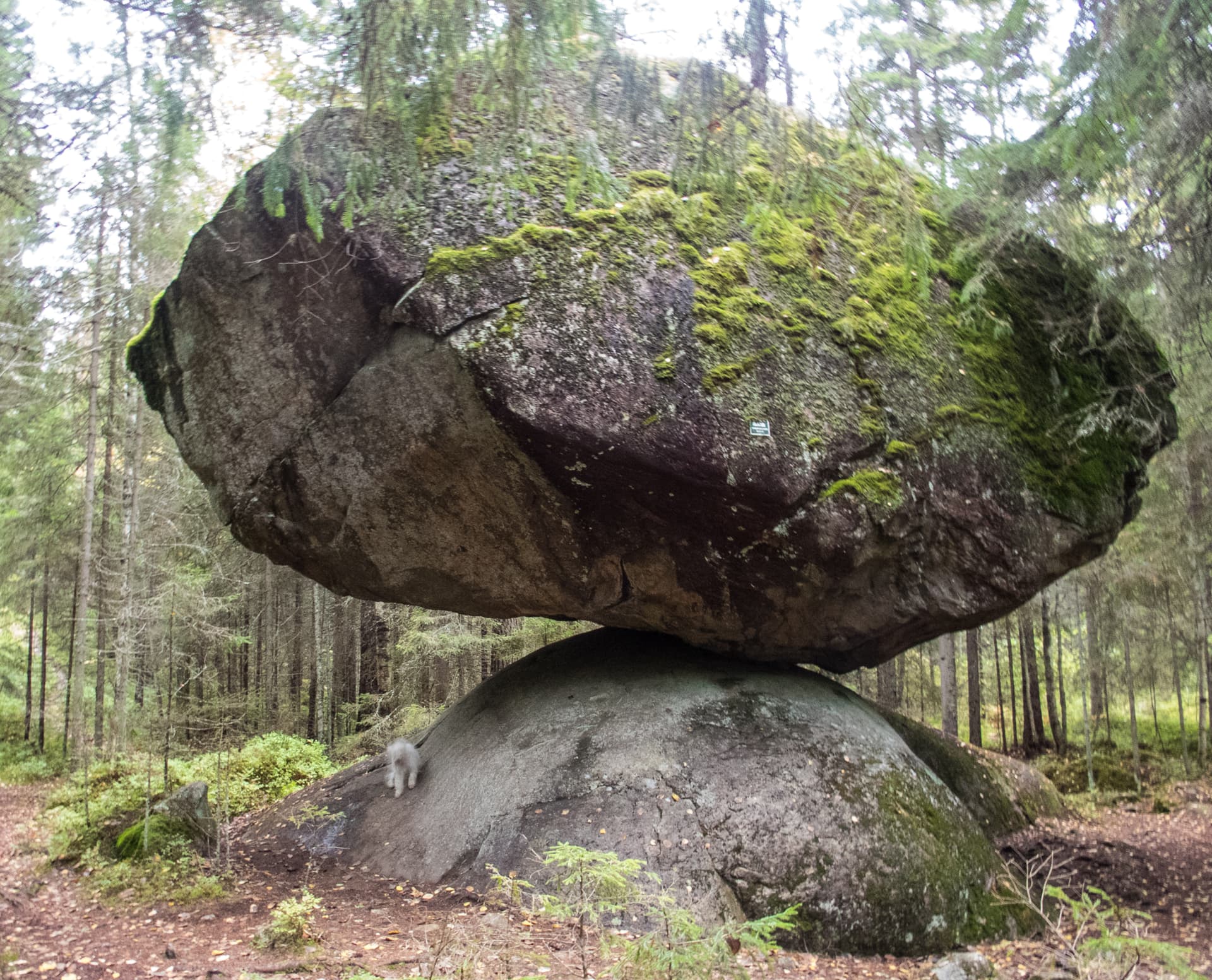
Today the Saimaa UNESCO Global Geopark maintains the site as one of its official geosites, with a marked 200-meter trail leading in from road 15169, passing between two large erratic boulders that stand at the trailhead like informal gateposts.
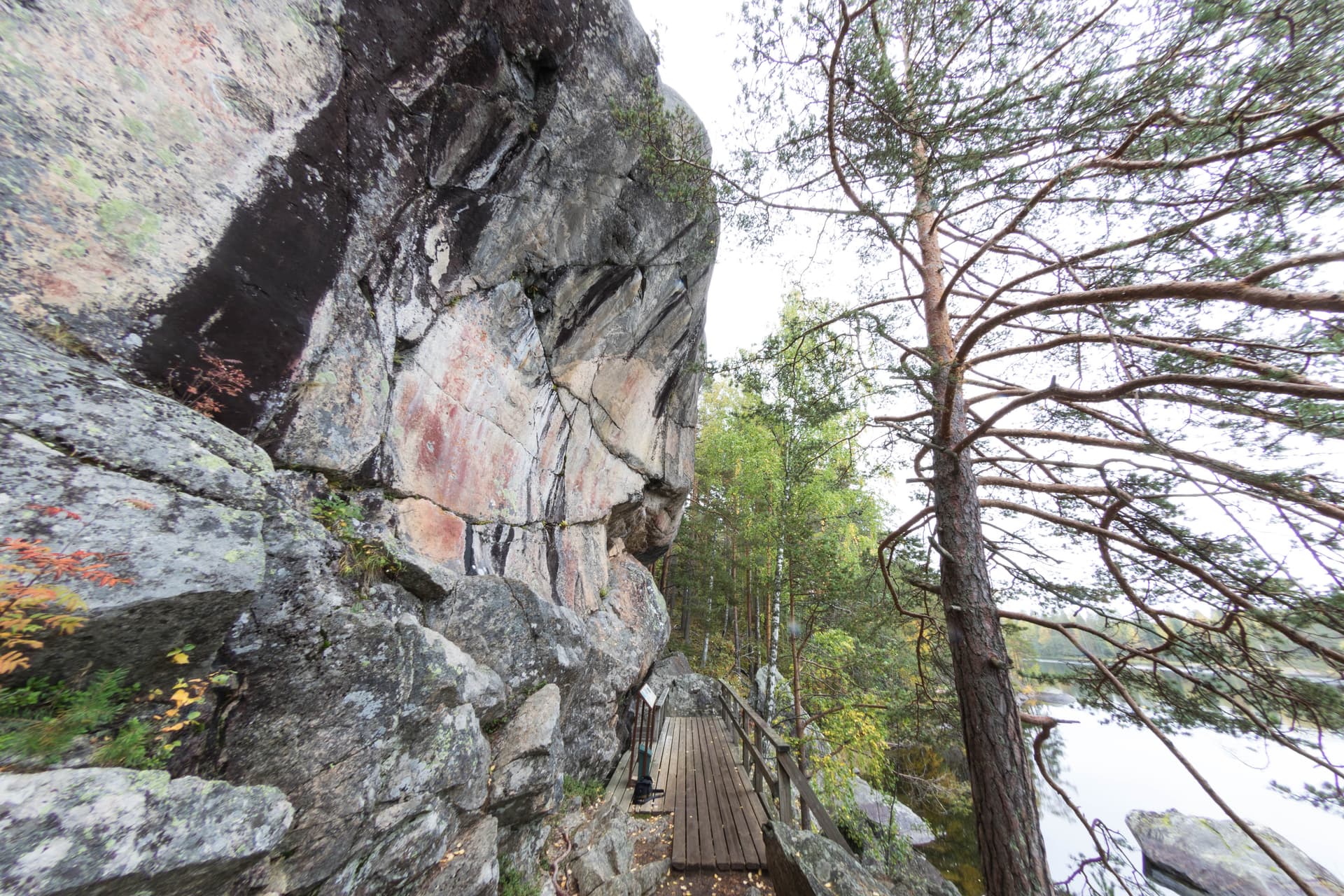
Two groups of figures occupy the rock face across three distinct height levels: on the left, simple stick figures roughly 5.5 meters above today's water; on the right, a more extensive composition spanning all three levels — a worn moose, a round-headed human figure, and a scatter of less legible marks, with the lowest level dominated by a broad patch of red pigment whose original form has been lost to weathering.
Why this place is sacred
Puumala's tourism office describes the municipality, with some justification, as being 'at the forefront of rock painting discoveries in Finland' — nine separate sites are documented within its borders, of which Syrjäsalmi is among the most accessible and best interpreted.
What sets it apart from a purely archaeological curiosity is the explicit geological framing the Saimaa Geopark brings to the site: the gneiss the figures are painted on predates the paintings by roughly 1.9 billion years, a number so large it resists intuitive comprehension, set beside a human mark that is, by any other measure, extremely old in its own right.
The pigment itself is thought to have been mixed with a binder — blood, fat, or egg yolk — a detail that ties the abstract red patches and stick figures back to bodily and animal substance, however faded the visible trace has become.
The three-level composition on the right side of the panel, its highest figures dating older than the lowest by virtue of the lake's slow retreat, gives the site an unusual legibility: you can, in effect, read the water's own history in how high or low a given figure sits.
Likely tied to travel, hunting, or invocatory ritual associated with the lake, consistent with the pigment's probable organic binder and the site's direct relationship to the historical shoreline.
Painted in the Stone Age, between roughly 4000 and 1500 BCE, based on shore-displacement dating of the three height levels; subsequently documented by the Finnish Rock Art Association and Ismo Luukkonen; formally developed as a marked, signed geosite of the Saimaa UNESCO Global Geopark.
Experience and orientation
Turn off road 15169 onto the marked path, and the first thing you meet is not the painting but the two erratic boulders standing at the trailhead — glacial deposits that predate the site's human history by their own long measure, and a fitting overture to a place that keeps asking you to think in centuries and then, without warning, in billions of years. The 200-meter trail is needle-lined and easy underfoot in the warmer months.
At the rock face, take the geopark's signage seriously rather than skipping to the painting itself: knowing that the gneiss beneath the ochre is 1.9 billion years old changes how the human marks read against it. Locate the left-hand group of stick figures first, roughly 5.5 meters above today's water — simple, upright forms with little ambiguity.
Then move to the right-hand group, more extensive and harder to parse: a moose worn nearly to a suggestion of itself, a round-headed human figure, and, at the lowest level, a broad field of red pigment whose original shape has dissolved into a stain. Spend time with that lowest patch in particular — it is the least legible element and, in its illegibility, the most honest record of what six thousand years does to red ochre on open rock.
Read the geopark's geological signage before or alongside the archaeological detail; let the two timescales inform each other rather than treating the geology as background.
Context and lineage
The paintings at Syrjäsalmi were made by Stone Age hunter-fisher-gatherer communities living around what is now Ummistonvesi bay, at a time when Lake Saimaa's water level stood measurably higher than today. The three height levels on the right-hand group of figures directly reflect that retreating shoreline, allowing archaeologists to sequence the images chronologically using the same shore-displacement method applied across the wider Saimaa rock-art corpus.
Stone Age hunter-fisher-gatherer culture of the Saimaa/Ummistonvesi basin → later identification and documentation → national ancient monument protection → formal incorporation into the Saimaa UNESCO Global Geopark's geosite network
Traditions and practice
The surviving evidence is entirely visual: red ochre pigment, likely mixed with a binder such as blood, fat, or egg yolk, applied to a face of veined gneiss across two groups and three height levels — stick figures, a worn moose, a round-headed human figure, and a dominant red patch at the lowest, oldest-water level. No ceremonial or narrative record survives beyond the imagery and its geological context.
None; the site has no living ritual use, though it functions actively as a public geological and archaeological interpretive site within the Saimaa Geopark network.
Walk the trail slowly enough to notice the two erratic boulders at its start as a deliberate threshold, not merely a landmark. At the rock face, resist looking only for the most legible figure — the worn moose or the stick figures — and give the lowest, least legible red patch equal attention; its very illegibility is part of what six millennia of weather has done here.
If your schedule allows, pair the visit with one of Puumala's other eight documented rock-painting sites, or with Astuvansalmi about an hour away, to sense the density of this rock-art landscape.
Stone Age Ummistonvesi Rock Painting Tradition
HistoricalOne of nine documented rock-painting sites in Puumala, with two groups of figures spanning three height levels dated between roughly 6,000 and 3,500 years old via shore-displacement chronology.
Red ochre pigment, likely mixed with an organic binder, applied to a face of 1.9-billion-year-old veined gneiss at Ummistonvesi bay.
Archaeological Heritage & Geopark Interpretation
ActiveFormally recognized as a geosite of the Saimaa UNESCO Global Geopark, with a marked trail, signage, and active geological and archaeological interpretation for the public.
Site inventory and photographic documentation; geopark signage and trail maintenance; ongoing regional rock-art scholarship.
Perspectives and open questions
Syrjäsalmi is distinguished less by any single dramatic image than by the explicit, geopark-framed juxtaposition of a nearly two-billion-year-old rock face and a several-thousand-year-old human mark upon it.
Scholarly perspective
Finnish rock-art specialists and the Saimaa UNESCO Global Geopark place Syrjäsalmi within the well-documented regional corpus of Saimaa Stone Age red ochre paintings, dated via shore-displacement chronology to roughly 4000–1500 BCE, and interpreted through the same subsistence- and travel-related ritual frameworks applied across the basin.
Living and traditional perspectives
No living community traces direct descent from the site's creators; it is held as shared Finnish national prehistoric heritage and actively promoted as part of a UNESCO-affiliated geological and cultural heritage story.
Alternative interpretations
Geopark and tourism material emphasizes the site's deep-time geological framing as a way of making the human history legible to visitors, a pedagogical device rather than an esoteric claim about the site's meaning.
Open questions
The specific ceremonial context linking the two groups of figures across three height levels, and the original form of the large red patch at the lowest, most weathered level, remain unresolved.
Plan your visit
Access and arrival
Located in Puumala, South Savo, on the shore of Ummistonvesi at the edge of Lake Saimaa, in a bay called Syrjälahti behind Syrjäsaari island. A marked trail of approximately 200 meters leads from road 15169 to the site, passing between two large erratic boulders at the trailhead, with a Saimaa Geopark information sign posted at the location.
No mobile phone signal information was available at time of writing; for current access guidance, contact Visit Puumala at visit@puumala.fi or +358 44 902 3455, weekdays 9:00–16:00. No specific seasonal closure was found in research; the trail is designed for general foot access, though winter snow and ice will affect conditions.
Puumala village offers the nearest lodging and services, with the municipal tourism office (Keskustie 14, 52200 Puumala) able to advise on visiting multiple rock-art sites in the area.
Respectful visit
Sturdy walking shoes are recommended for the boulder-strewn, needle-lined approach path.
Photography is permitted and actively encouraged as part of the geopark's interpretive mission.
None are appropriate; leaving objects or markings at the site risks violating its protected status.
Touching or scraping the pigment is prohibited under the Finnish Antiquities Act; visitors should remain on the marked trail rather than venturing off-path toward the rock face.
Do not touch or attempt to enhance the pigment. Stay on the marked trail to avoid damaging surrounding terrain and vegetation.
Location
Map loads as you approach this section.
Pilgrim reflections
A portrait of encounter, not a score
Pilgrims describe what they felt, how present they could become, and whether the place would shape a journey. There are no stars and no ranking of traditions.
No reviewed reflections yet
The first pilgrims can help describe the character of being here.
Share a reflection
Available after an account-backed “Been there.” Every reflection is reviewed before publication.
Nearby sacred places
Explore other sacred places in the region. Proximity does not establish access or travel time; check each place’s guidance.


References
Sources consulted for this page. Source categories describe the publication, not a guarantee that every claim is verified. Traditional accounts and outside interpretations may differ.
- 01Rock paintings – Visit Puumala — Visit Puumala (municipal tourism office)officialOfficial municipal tourism page; confirms nine documented rock painting sites in Puumala and general regional context
- 02Syrjäsalmen kalliomaalaus / Syrjäsalmi Rock Painting – Saimaa Geopark — Saimaa UNESCO Global GeoparkofficialOfficial UNESCO-affiliated geopark page with geological context, coordinates, and pigment composition
- 03Syrjäsalmen kalliomaalaus – Wikipedia — Wikipedia contributorsencyclopediaPrimary overview: coordinates, discovery, figure descriptions, dating
- 04Syrjäsalmi, Puumala – Suomen kalliotaideyhdistys — Suomen kalliotaideyhdistys (Finnish Rock Art Association)academicSpecialist association entry
- 05Syrjäsalmi – ismoluukkonen.net kalliotaide — Ismo LuukkonenacademicSpecialist rock-art documentation site
- 06Syrjäsalmi rock painting – Biotope and geotope, Outdooractive — OutdooractiveguideVisitor-facing listing with precise GPS coordinates and trail access description
Share a photo
Help visitors recognize Syrjäsalmi Rock Painting. Every submission is reviewed before publication.