Haukkavuori Rock Painting
A handprint and an inverted figure on a canoe route through Stone Age Sarkavesi
Understand sacred places, explore living traditions, and learn how to engage respectfully with Pilgrim Map.
Access has not been verified. Check current local guidance before planning a visit.
Mäntyharju, South Savo, Finland
Read the sourcesImage of Haukkavuori Rock Painting. Image source
Visit essentials
A quick read before you go
- Duration
- The painting stop itself takes 15–30 minutes; the surrounding Mäntyharju–Repovesi canoe route…
- Access
- Reachable only by canoe or small boat along the Mäntyharju–Repovesi paddling route; the three…
Overview
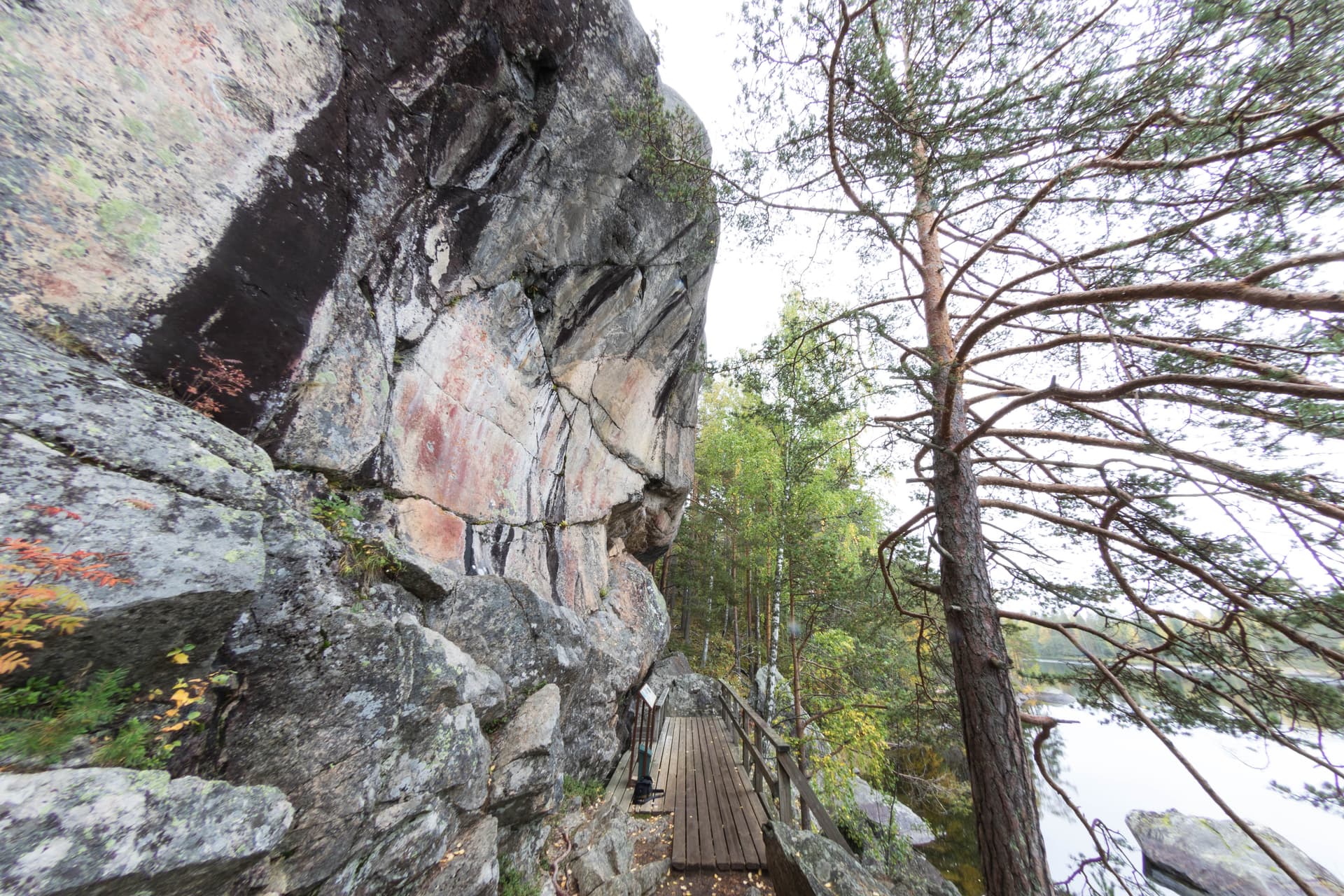
Haukkavuori has no shore path or parking area and can be reached only by water, probably also the approach of its Stone Age painters. Across 4–5 meters of steep rock wall on Sarkavesi in Mäntyharju, three red-ochre image clusters sit at different heights; Finnish shore chronology dates their long span from roughly 3500 BCE into the early centuries CE.
Image Field III preserves a clear handprint beside an upside-down human figure, head toward the water, knees bent, arms raised, and a vertical pigment line descending from the neck. Other fields hold a moose with concave back and ambiguous ears or antlers, plus boats dense with crew-lines. Archaeologist Timo Miettinen formally verified the paintings in 1975 after a handprint tip revealed a much more layered composition.
Why this place is sacred
What makes Haukkavuori distinctive within the Finnish rock-painting corpus is less any single image than the range of time it seems to compress. The three image fields sit at different heights corresponding to different eras of Sarkavesi's water level, meaning the wall was returned to — or at least added to — across a span that may cover two thousand years or more of hunting-culture presence in this lake corridor.
Within that span, the inverted human figure in Image Field III carries the clearest interpretive weight. Head-down human postures appear elsewhere in circumpolar rock art and are generally read as images of falling, dying, or passing into an inverted or underworld state — the kind of imagery associated with shamanic cosmology, in which the practitioner's spirit crosses into a realm where ordinary orientation no longer applies.
Beside this figure of transformation sits the handprint: not a symbol requiring interpretation but the unmediated trace of an actual hand, pressed directly to the same rock. The pairing of the most abstract image at the site with its most literal one is, whether intentional or accidental, one of the more affecting juxtapositions in Finnish prehistoric art.
Likely tied to hunting-culture ritual along a lake corridor that served as a major transit route when water levels stood higher — invocation, marking of passage, or a shamanic record of transformation.
Painted across an extended span from roughly 3500 BCE to as late as 500 CE, reflecting repeated use or return to the site by Stone Age and possibly early Iron Age hunter-fisher-gatherer communities; formally verified by archaeologist Timo Miettinen in 1975; later studied by Pekka Kivikäs (2005) and Antti Lahelma (2008); now a protected ancient monument and a marked stop on the modern Mäntyharju–Repovesi canoe route.
Experience and orientation
There is no substitute for the approach by water. Paddling the Mäntyharju–Repovesi route, the rock wall at Haukkavuori rises steeply from the lake with no obvious sign of what it holds until you are close enough to distinguish pigment from natural staining. Slow down here rather than passing through.
The handprint in Image Field III is the easiest image to locate first — its outline is unusually crisp for a mark this old — and once your eye has calibrated to the rock's texture, the inverted human figure beside it becomes legible: the lowered head, the raised arms, the thin trailing line of color. Take time with the moose in the adjacent field too; its concave back and ambiguous ear-or-antler shapes reward slow looking rather than a quick glance.
The boats in Image Field II, dense with parallel crew-lines, suggest travel and passage in a way that resonates with your own canoe beneath you — a rare case where the visitor's mode of arrival mirrors the imagery's own subject matter. Because access is entirely water-dependent, plan for the paddling itself to be part of the experience rather than an obstacle to it.
Time your visit to the canoe route's daylight window; approach the rock wall slowly and scan low across the water rather than expecting the images to announce themselves from a distance.
Context and lineage
Sarkavesi lay along a water corridor that Stone Age and later hunter-fisher-gatherer communities used heavily when the region's lake levels stood higher than today.
The three image fields at Haukkavuori occupy different heights on the same rock wall, a pattern Finnish archaeologists read as evidence that the location was returned to across a long period rather than painted in a single episode — possibly by successive generations of the same community, possibly by different groups drawn to the same prominent, southwest-facing rock over centuries.
Stone Age hunter-fisher-gatherer culture of the Sarkavesi corridor, with use potentially extending into the early Iron Age → undocumented until 1975 verification → national ancient monument protection → incorporation into contemporary canoe-tourism infrastructure
Traditions and practice
The surviving evidence is entirely visual — no record of accompanying ceremony, song, or ritual gesture survives alongside the imagery described above. The interpretive weight rests on the images' posture and the site's long span of apparent use, not on any written or oral account.
None; the site has no living ritual use and functions today purely as a protected monument and canoe-route waypoint.
Paddle the final approach slowly rather than gliding past at speed, and let the handprint be your anchor point before searching out the inverted figure beside it — the two images reward being read together rather than separately. Rest your paddle for a moment once you have both in view, and notice how the boats in the neighboring field echo the vessel you are sitting in.
If time allows, extend the visit into the wider Repovesi landscape the canoe route passes through, letting the painting sit within the same water corridor its makers used.
Stone Age Sarkavesi Rock Painting Tradition
HistoricalA long-used rock wall bearing three distinct image clusters — handprint, moose, boats, and an inverted human figure — spanning an unusually wide dating range from roughly 3500 BCE to 500 CE.
Application of red ochre pigment to a steep southwest-facing lakeside rock wall at heights corresponding to different water-level eras.
Archaeological Heritage & Canoe-Route Interpretation
ActiveThe site is preserved as a protected ancient monument and actively promoted as a heritage waypoint on the modern Mäntyharju–Repovesi canoe route.
Site inventory and photographic documentation by the Finnish Heritage Agency; municipal tourism promotion and access guidance; ongoing scholarly study.
Perspectives and open questions
Haukkavuori's long dating range and its juxtaposition of a literal handprint with an image of inversion give it a distinctive place in Finnish rock-art scholarship, even as the specific ritual meaning of its images remains debated.
Scholarly perspective
Finnish rock-art researchers, drawing on Timo Miettinen's 1975 verification and later analysis by Pekka Kivikäs (2005) and Antti Lahelma (2008), treat the site's three-height composition as evidence of sustained or repeated use across a long span of hunting-culture presence on Sarkavesi, and read the inverted human figure within a broader shamanic-cosmology framework common to circumpolar rock art.
Living and traditional perspectives
No living community traces direct cultural descent from the site's creators; it belongs to shared Finnish national prehistoric heritage rather than an actively practiced tradition.
Alternative interpretations
Some general travel and outdoor-recreation writing describes the inverted figure in loosely mystical terms without engaging the specific interpretive literature; this framing is noted but treated cautiously here.
Open questions
Whether the three image fields represent one community returning across generations or successive unrelated groups is unresolved, as is the precise significance of the inverted posture and its trailing line of color.
Plan your visit
Access and arrival
Reachable only by canoe or small boat along the Mäntyharju–Repovesi paddling route; the three image fields sit 1 to 1.5 meters above water level across a 4- to 5-meter span of rock. No mobile phone signal information was available at time of writing; parts of the surrounding Repovesi/Sarkavesi lake-and-forest landscape are remote, so paddlers should plan accordingly and inform someone of their route.
For current route conditions and access guidance, contact Mäntyharju municipality tourism office at +358 40 640 2603 or matkailu@mantyharju.fi.
Mäntyharju town offers the nearest lodging and canoe-rental services; the Repovesi National Park area also has camping and cabin accommodation oriented to paddlers and hikers.
Respectful visit
Practical paddling attire and a personal flotation device, given that access is exclusively by canoe or small boat.
Photography is welcomed and is the primary way most visitors document the site, given the difficulty of any other form of engagement.
None are appropriate; leaving objects or markings at the site risks violating its protected status.
Do not touch or trace the painted surfaces. Avoid winter ice approach due to documented current hazards near the rock wall.
Do not touch or trace the pigment. Avoid approaching the rock wall during winter ice conditions, when currents near the site have been flagged as hazardous by the municipality. Wear a personal flotation device, as access is water-only.
Location
Map loads as you approach this section.
Pilgrim reflections
A portrait of encounter, not a score
Pilgrims describe what they felt, how present they could become, and whether the place would shape a journey. There are no stars and no ranking of traditions.
No reviewed reflections yet
The first pilgrims can help describe the character of being here.
Share a reflection
Available after an account-backed “Been there.” Every reflection is reviewed before publication.
Nearby sacred places
Explore other sacred places in the region. Proximity does not establish access or travel time; check each place’s guidance.

References
Sources consulted for this page. Source categories describe the publication, not a guarantee that every claim is verified. Traditional accounts and outside interpretations may differ.
- 01Mäntyharjun Haukkavuoren kalliomaalaus (osa) – Museovirasto / Finna.fi — Museovirasto (Finnish Heritage Agency)officialOfficial heritage agency photographic record
- 02Mäntyharju 507010002 Haukkavuori – Kulttuuriympäristön palveluikkuna — Museovirasto / Kyppi.fiofficialOfficial ancient monument register entry
- 03Mäntyharjun Haukkavuoren kalliomaalaukset – Wikipedia — Wikipedia contributorsencyclopediaPrimary overview: location on Sarkavesi, discovery, figure descriptions, dating range
- 04Haukkavuoren kalliomaalaukset Mäntyharjulla – Visit Mikkeli — Visit Mikkeli (regional tourism board)guideOfficial regional tourism visitor information, canoe route access, municipal contact
- 05Haukkavuori – ismoluukkonen.net kalliotaide — Ismo LuukkonenacademicSpecialist rock-art documentation site by a leading Finnish rock-art researcher
- 06Sarkaveden Haukkavuori – Suomen muinaistaideseura — Suomen muinaistaideseura (Finnish Rock Art Society)academicSpecialist rock-art society entry, disambiguates the Sarkavesi Haukkavuori from other Haukkavuori landmarks
Share a photo
Help visitors recognize Haukkavuori Rock Painting. Every submission is reviewed before publication.