Ugyen Cholling Monastery
A 14th-century estate in the Tang Valley where Longchenpa meditated and Dorje Lingpa's descendants still live, now Bhutan's first private museum
Understand sacred places, explore living traditions, and learn how to engage respectfully with Pilgrim Map.
Access has not been verified. Check current local guidance before planning a visit.
Baylamsharang, Samdrup Jongkhar, Bhutan
Read the sources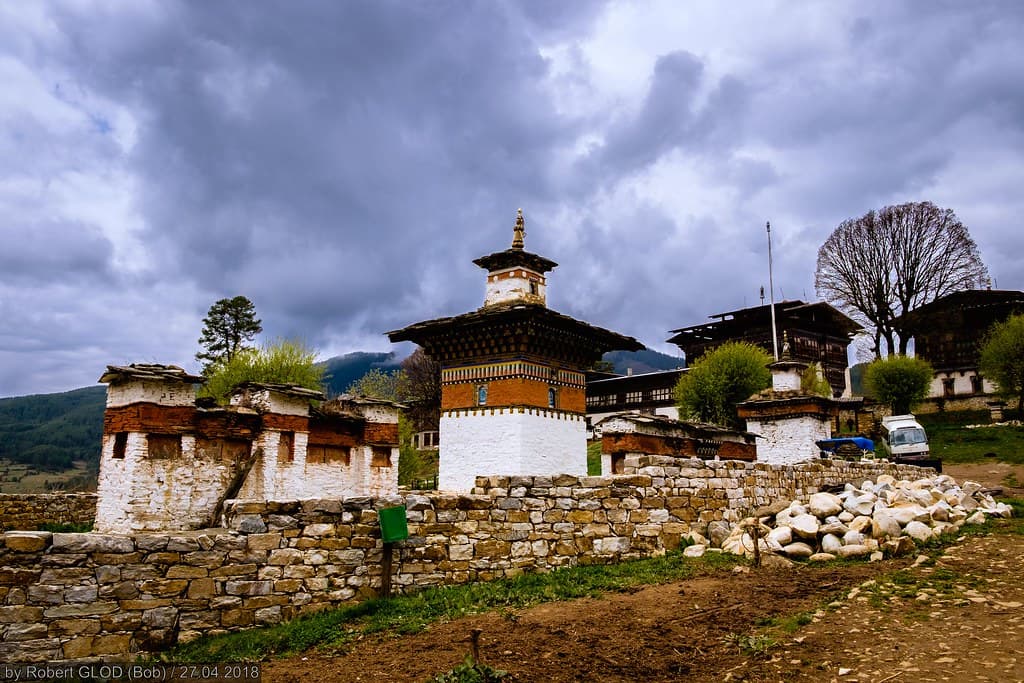
Image of Ugyen Cholling Monastery. Image source
Visit essentials
A quick read before you go
- Duration
- Half day for the museum and cave.
- Access
- 37 km from Jakar, Bumthang District, in the upper Tang Valley.
Overview
Tang is the most secluded of Bumthang's four valleys, and Ogyen Choling stands near its upper end, thirty-seven kilometres from the nearest town. Tradition says its hill resembles an elephant's head. Longchen Rabjam, or Longchenpa—the great 14th-century systematizer of Dzogchen, the Nyingma tradition's highest teaching—meditated in a cave near its summit.
Dorje Lingpa (1346-1405), a celebrated Nyingma treasure revealer, later made Ogyen Choling one of his primary residences. His descendants have remained for more than fifteen generations, maintaining a place imprinted by two of Nyingma's most revered masters.
After an 1897 earthquake damaged the original monastery, Tshokye Dorje, the Trongsa Penlop and fifteenth blood-descendant of Dorje Lingpa, built the current manor in 1898. In 2001 the family converted its central tower into Bhutan's first private museum, displaying traditional clothing, agricultural tools, Buddhist musical instruments, and artifacts of centuries of religious-aristocratic life.
The heritage house offers rooms. Guests sleep within an unbroken lineage's compound, walk to Longchenpa's cave, and briefly share a domestic tradition in which devotion and daily life have never been separate.
Why this place is sacred
Most sacred sites are maintained by institutions — monasteries, temple committees, government agencies. Ogyen Choling is maintained by a family. Fifteen generations of Dorje Lingpa's descendants have lived in these buildings, worshipped in these temples, and walked to the meditation cave above. The continuity is not institutional but biological, passed from parent to child along with the land, the responsibilities, and the stories.
Longchenpa meditated in the cave above the estate in the 14th century. He was the great systematizer of Dzogchen — the highest and most direct teaching of the Nyingma tradition, a practice that points to the nature of mind itself. Dorje Lingpa, who came after him, was a treasure revealer — someone who discovered teachings hidden by Guru Rinpoche in the landscape.
To have both figures associated with a single site is to stand at the intersection of systematized wisdom and spontaneous revelation.
The conversion to museum and guesthouse in 2001 and 2016 was not a break with tradition but an adaptation of it. The family chose to share what had been private, opening the compound to visitors without abandoning their own presence within it.
To stay in the heritage house is not to visit a museum but to be a guest in someone's home — a home that happens to be seven centuries old and blessed by two of the most important figures in Bhutanese Buddhism.
Meditation site for Longchenpa in the 14th century, subsequently the residence and religious center of Dorje Lingpa and his descendants.
From meditation cave and terton's residence to religious aristocratic estate to Bhutan's first private museum and heritage guesthouse. The family's continuous presence bridges all these phases.
Experience and orientation
Reaching Ogyen Choling requires dedication. The road from Jakar climbs into the Tang Valley and narrows as it ascends. The landscape grows quieter. By the time the estate appears — a cluster of traditional buildings on an elephant-shaped hill — the distance from Bumthang's other, more visited monasteries is palpable.
The museum occupies the central tower of the manor. The galleries are lit by natural light — best between 9 AM and 2 PM — and display objects from the family's centuries of aristocratic and religious life: traditional clothing, agricultural tools, Buddhist ritual instruments, texts. The interpretation is in English and provides context without overwhelming the objects. Access is via steep internal staircases.
Above the estate, a trail leads to the meditation cave of Longchenpa. The walk is short but the shift in register is immediate. The cave is not a tourist attraction. It is a hole in rock where one of the great minds of Vajrayana Buddhism sat and practiced. The silence there is of a particular quality.
For those who stay overnight, the experience extends into something rarer. The heritage house rooms blend original ambiance with modern comfort. Evening settles over the Tang Valley, and the compound — temple, museum, guesthouse, family home — becomes a single organism in which the categories of sacred, domestic, historical, and present dissolve.
Visit the museum first for context. Then walk to the meditation cave. If staying overnight, allow the evening and morning to become part of the experience — the compound at rest is as instructive as the compound by day. Ask the hosts about the estate's history; their family perspective adds dimensions that no guidebook captures.
Context and lineage
Longchen Rabjam (1308-1363) came to meditate in a cave on the elephant-shaped hill. Dorje Lingpa (1346-1405), a great treasure revealer, subsequently made the site one of his primary residences. His descendants have maintained the estate ever since, through earthquakes, political change, and the transformation of Bhutanese society.
Nyingma tradition through Longchenpa and Dorje Lingpa. The family's unbroken descent from Dorje Lingpa through more than fifteen generations constitutes a living lineage maintained by blood rather than institutional succession.
Longchen Rabjam (Longchenpa)
Meditated in the cave in the 14th century; systematizer of Dzogchen, the highest Nyingma teaching
Dorje Lingpa
Treasure revealer (terton) who made Ogyen Choling one of his primary residences
Tshokye Dorje
15th blood-descendant of Dorje Lingpa, Trongsa Penlop, who rebuilt the manor in 1898
Traditions and practice
Temple worship on the grounds continues. Community rituals connected to the Dorje Lingpa tradition are maintained by the family. The meditation cave of Longchenpa is accessible to visitors.
Museum exhibitions of traditional religious and domestic material culture. Heritage house guesthouse operations since 2016. Village livelihood activities — agriculture, weaving — continue around the estate.
Stay overnight to experience the compound as a living place rather than a day-visit destination. Visit the meditation cave of Longchenpa. Engage with the village activities if invited. Ask the family about the estate's history — their perspective bridges the scholarly and the personal.
Nyingma
ActiveAssociated with Longchenpa (Dzogchen master) and Dorje Lingpa (treasure revealer). Family maintains unbroken descent from Dorje Lingpa through 15+ generations.
Temple worship, meditation at Longchenpa's cave, community rituals, heritage preservation
Perspectives and open questions
Ogyen Choling can be understood as a family's devotion sustained across centuries, as a meeting point of two great Nyingma masters, and as a model for heritage preservation through lived continuity.
Scholarly perspective
The SOAS doctoral study of Ogyen Choling's temple art documents the site in scholarly detail. The Journal of Bhutan Studies has published on Dorje Lingpa's significance here. The estate is recognized as one of the most important examples of a Bhutanese religious aristocratic compound.
Living and traditional perspectives
For the family and community, Ogyen Choling is not a historical artifact but a living home where religious practice, agricultural work, and ancestral heritage coexist as they have for centuries. The conversion to museum was an act of preservation, not abandonment.
Alternative interpretations
Longchenpa's association with Dzogchen (the direct recognition of mind's nature) and Dorje Lingpa's association with terma (hidden and revealed treasure) place Ogyen Choling at the intersection of formalized wisdom and spontaneous revelation — two complementary approaches to the same truth.
Open questions
The full contents of the meditation cave and the extent of Dorje Lingpa's unrevealed treasures in the Tang Valley remain subjects of speculation within the tradition.
Plan your visit
Access and arrival
37 km from Jakar, Bumthang District, in the upper Tang Valley. The final section of road is unpaved. Bumthang is accessible by road from Thimphu (10-11 hours via Trongsa) or by domestic flight to Bathpalathang Airport.
Heritage house on site with 14 rooms in 3 buildings, blending original ambiance with modern facilities. Additional hotels and guesthouses in Jakar, 37 km away.
Respectful visit
Modest clothing. Shoes removed in temples.
Generally permitted in the museum and grounds. Ask before photographing in temples or private family areas.
Possible in the temples.
Shoes removed in temples | Respect family privacy | Museum best visited 9 AM to 2 PM | Steep stairs not suitable for limited mobility
The remote location means planning is necessary. The museum stairs are steep and not suitable for those with limited mobility. Natural light is best between 9 AM and 2 PM.
Location
Map loads as you approach this section.
Pilgrim reflections
A portrait of encounter, not a score
Pilgrims describe what they felt, how present they could become, and whether the place would shape a journey. There are no stars and no ranking of traditions.
No reviewed reflections yet
The first pilgrims can help describe the character of being here.
Share a reflection
Available after an account-backed “Been there.” Every reflection is reviewed before publication.
Nearby sacred places
Explore other sacred places in the region. Proximity does not establish access or travel time; check each place’s guidance.




References
Sources consulted for this page. Source categories describe the publication, not a guarantee that every claim is verified. Traditional accounts and outside interpretations may differ.
- 01Ogyen Choling Official Website — Ogyen Choling FoundationSource contextOfficial site with history and visitor information
- 02Ogyen Choling Heritage House - Visit Bhutan — Visit BhutanSource contextOfficial tourism board listing
- 03Dorje Lingpa and His Rediscovery of the Gold Needle in Bhutan — Journal of Bhutan StudiesacademicScholarly article on Dorje Lingpa
- 04Ogyen Choling Heritage House - About — Ogyen Choling Heritage HouseSource contextHeritage house history and operations
- 05Ogyen Choling in Bhutan: an Interpretation of the Temple and its Art — SOAS University of LondonacademicAcademic study of the temple and art
- 06Ogyen Choling Palace and Museum - Atlas Obscura — Atlas ObscuraguideOverview and history
Share a photo
Help visitors recognize Ugyen Cholling Monastery. Every submission is reviewed before publication.