Torretrencada
A taula sanctuary rising from Menorca's Iron Age heartland
Understand sacred places, explore living traditions, and learn how to engage respectfully with Pilgrim Map.
Access has not been verified. Check current local guidance before planning a visit.
Ciutadella de Menorca, Balearic Islands, Spain
Read the sources
Visit essentials
A quick read before you go
- Access
- Approximately 6 km from Ciutadella de Menorca; reached via a short walk from a nearby rural road…
- Etiquette
- Standard heritage-site conduct applies: stay on visible paths, do not climb or touch the…
Overview
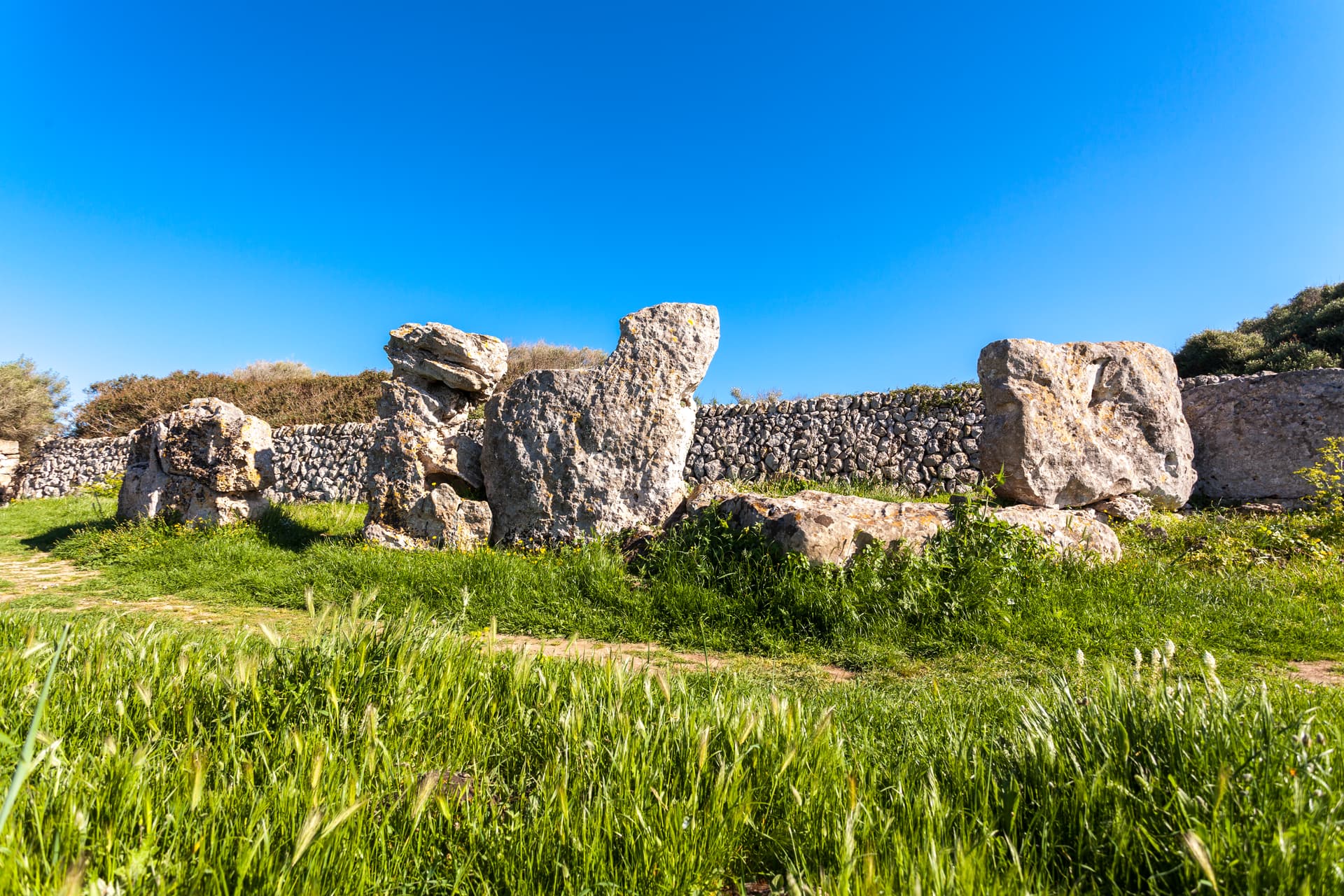
In open farmland outside Ciutadella de Menorca, Torretrencada forms part of the UNESCO-listed Talayotic Menorca landscape. Its defining taula, a two-stone T-shaped monument centered in a horseshoe-shaped ritual enclosure, has a detail almost unique on the island: post-Talayotic builders, roughly 650-123 BC, braced a second vertical pilaster against its back to stop the capstone toppling.
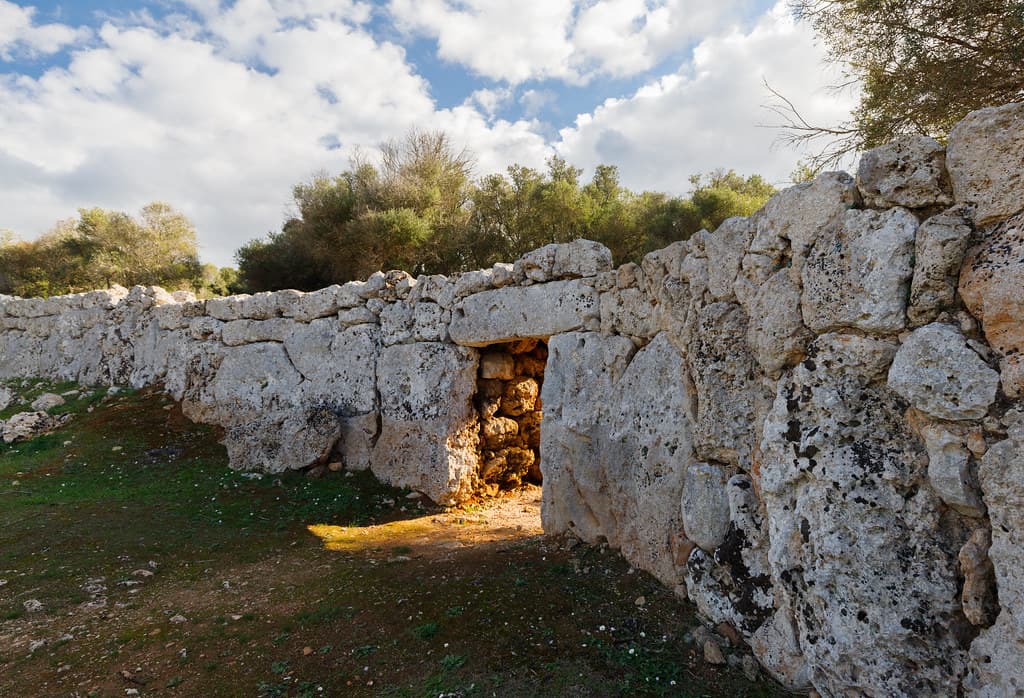
The settlement also holds a talayot, the round or square tower that named the culture; a hypostyle room roofed with stone slabs on a central pillar; a hewn burial cave; and anthropomorphic tombs cut into bedrock. Sources indicate continued use into the Middle Ages, although the later occupation lacks a precise documented chronology. Together these remains show how one Talayotic community organized defense, shelter, burial, and communal ritual within a single settlement.
Why this place is sacred
There is no legend or named cult attached to Torretrencada in the available record — its claim on attention is physical and architectural rather than narrative.
The taula's second support pilaster is the detail every source returns to: taulas elsewhere on Menorca (at Trepucó, at Torralba d'en Salord) rely on the single T-shaped pairing of upright and capstone, but here the builders added extra bracing, a small engineering choice that has kept this particular monument standing more completely than most of its counterparts.
The hypostyle room — a slab-roofed chamber held up by a central stone column — is described as the best-preserved hall of its kind on Menorca, which gives visitors a rare sense of what these covered communal spaces actually felt like enclosed, rather than as roofless outlines.
Combined with a talayot, a burial cave, and rock-cut anthropomorphic tombs, the site lets you read an entire settlement's structure — defensive, domestic, funerary, ritual — in one place, which is what distinguishes it from single-monument sites nearby.
A fortified Talayotic village whose central taula enclosure served the community's ceremonial or religious functions; the surrounding talayot provided defensive height, the hypostyle chamber likely served communal or storage purposes, and the burial cave and rock-cut tombs served funerary needs.
Talayotic construction and use gave way to a documented post-Talayotic phase (650-123 BC) in which the taula reached its present form; sources note occupation evidence into the Middle Ages, though the nature of that later use is not detailed. The site later passed into modern heritage protection, culminating in its inclusion in the 2023 UNESCO inscription of Talayotic Menorca.
Experience and orientation
The walk in is short and unshaded, across farmland typical of Menorca's interior, so the site is visible from a distance before its details separate out. The taula announces itself first: two massive limestone slabs forming a T against the sky, with the extra bracing stone visible only once you're close enough to see the join.
The horseshoe enclosure around it is intact enough that its shape is unmistakable underfoot — you can trace where an assembled group would once have stood or sat. A short distance away, the talayot's rounded bulk is now partly obscured by centuries of collapsed stone, and the hypostyle chamber requires bending to enter, its slab roof low enough to change how you stand and speak inside.
The burial cave and the rock-cut anthropomorphic tombs sit at a further remove, quieter and easy to miss if you don't look for the low openings in the exposed bedrock. Nothing here is roped off or elaborately signed; the experience is closer to fieldwork than tourism — closer looking rewarded with more legible structure.
Begin at the taula enclosure, the most visually complete structure, then move to the talayot before finishing at the hypostyle chamber and burial features, which are easiest to overlook without deliberate attention.
Context and lineage
No founding narrative survives for Torretrencada specifically; it is understood through the broader arc of Talayotic culture, which built fortified settlements with talayots and later, in the post-Talayotic period (650-123 BC), added taula ritual enclosures like the one here. Occupation evidence extending into the Middle Ages is noted in heritage sources but not further explained.
Part of the same Talayotic building tradition documented at Trepucó and Torralba d'en Salord, Menorca's other major taula sanctuaries; together these sites define the taula as a monument type unique to the island.
Talayotic builders (unnamed)
Original settlement founders and taula constructors, working within the shared Talayotic architectural tradition of Menorca
Consell Insular de Menorca / Talayotic Menorca World Heritage team
Present-day heritage body coordinating conservation and the 2023 UNESCO World Heritage inscription covering Torretrencada
Museu de Menorca
Repository holding artefacts recovered during the site's excavation
Traditions and practice
Scholarly consensus holds that taula enclosures served communal or religious ceremonial functions for Talayotic society, though the specific rites performed at Torretrencada are not recorded in available sources.
None; the site is preserved and visited as an archaeological monument rather than used for any current ceremony.
Move through the site in the order the builders likely intended — approach the taula enclosure directly, sit or stand within its horseshoe footprint, then walk to the talayot and duck into the hypostyle chamber, noticing how its low slab roof changes your posture and how sound behaves in the enclosed stone space. Finish at the rock-cut tombs, where the anthropomorphic shaping in the bedrock is easy to miss without pausing to look closely.
Talayotic Culture
HistoricalTorretrencada was a fortified, ceremonially-centred settlement of the Talayotic culture, the indigenous Bronze-to-Iron Age civilization of Menorca and Mallorca; its taula enclosure is one of the finest surviving examples of a monument type unique to Talayotic Menorca.
Communal or religious ceremonial use of the taula enclosure is inferred by scholarly consensus for the post-Talayotic period (650-123 BC); specific rites are not documented for this site.
Archaeological and Heritage Conservation Stewardship
ActiveTorretrencada is actively maintained and interpreted as a protected component of the UNESCO World Heritage site Talayotic Menorca (inscribed 2023), with artefacts from its excavation held at the Museu de Menorca.
Ongoing heritage management and public interpretation under the Consell Insular de Menorca and the Talayotic Menorca World Heritage coordination body.
Perspectives and open questions
Torretrencada is read almost entirely through an archaeological lens; no competing traditional, indigenous, or esoteric interpretation has survived to challenge or supplement the scholarly account.
Scholarly perspective
Archaeologists place Torretrencada within the standard Talayotic settlement plan — talayot, taula enclosure, hypostyle chamber, hypogea — and date its taula to the post-Talayotic period (650-123 BC), noting its unusual second support pilaster as a rare structural solution among Menorca's taulas. The site's 2023 inclusion in the UNESCO World Heritage inscription of Talayotic Menorca formalizes this scholarly consensus about its significance.
Living and traditional perspectives
No continuous indigenous or folk tradition survives to offer a perspective distinct from the archaeological record; the Talayotic culture that built the site did not persist as an unbroken community into later periods.
Open questions
The precise ceremonial function of taula enclosures — whether primarily religious, communal-political, or both — remains unresolved among archaeologists, and no source specific to Torretrencada settles the question for this site in particular.
Plan your visit
Access and arrival
Approximately 6 km from Ciutadella de Menorca; reached via a short walk from a nearby rural road (per Descobreix Menorca and local guide descriptions). No admission fee, ticketing, or booking requirement is documented. Mobile phone signal at the site was not addressed in available sources — no signal information was available at time of writing; check Consell Insular de Menorca / Talayotic Menorca heritage authorities for current access details.
As the site sits in open farmland near a paved road within a few kilometres of Ciutadella, emergency access should be straightforward via the nearest road into the city.
Respectful visit
No specific dress requirements are documented; practical footwear is advisable given the uneven, unpaved ground across open farmland.
No restrictions on photography were found in sourced material; the open-air site appears freely photographable.
No offering practices are associated with the site, past or present.
Do not climb on the taula, talayot, or enclosure walls; do not enter the burial cave or rock-cut tombs beyond permitted viewing points; take no stones or artefacts from the site.
Treat all standing stones and rock-cut features as fragile: do not climb the taula, talayot, or enclosure walls, and do not enter the burial cave or tombs beyond what is clearly permitted for viewing.
Location
Map loads as you approach this section.
Pilgrim reflections
A portrait of encounter, not a score
Pilgrims describe what they felt, how present they could become, and whether the place would shape a journey. There are no stars and no ranking of traditions.
No reviewed reflections yet
The first pilgrims can help describe the character of being here.
Share a reflection
Available after an account-backed “Been there.” Every reflection is reviewed before publication.
Nearby sacred places
Explore other sacred places in the region. Proximity does not establish access or travel time; check each place’s guidance.


References
Sources consulted for this page. Source categories describe the publication, not a guarantee that every claim is verified. Traditional accounts and outside interpretations may differ.
- 01TALAYOTIC MENORCA WORLD HERITAGE SITE (press dossier) — Consell Insular de Menorca / Talayotic Menorca World HeritageofficialOfficial UNESCO World Heritage press material for the 'Talayotic Menorca' inscription (2023), which includes Torretrencada among its component sites; confirms official heritage status.
- 02Torretrencada | Megalithic monuments of Menorca — Descobreix Menorca (official Menorca tourism/heritage site)guideDescribes taula with lateral support pilaster, horseshoe enclosure, talayot, hypostyle room (best-preserved on the island), man-made burial cave, anthropomorphic rock-cut tombs, cyclopean wall section; notes occupation evidence into the Middle Ages; Museu de Menorca holds excavated artefacts; site is ~6 km from Ciutadella.
- 03Torretrencada — Wikipédia — Wikipedia contributorsencyclopediaConfirms site in municipality of Ciutadella, Menorca; Iron Age Talayotic culture; contains talayot, taula enclosure, circular houses, hypostyle chamber, hypogea; taula dated to post-Talayotic period (650-123 BC) with a distinctive second vertical pilaster for stability; part of 2023 UNESCO 'Talayotic Menorca' inscription (9 territorial areas); Spain first proposed the broader site for UNESCO tentative list in 2013.
- 0415 talayots and archaeological sites in Menorca — ZigZag on EarthguideConfirms Torretrencada's taula as one of the island's most impressive, with supporting column and well-preserved horseshoe enclosure; notes two talayots and cyclopean wall remnants.
- 05Talaiot — Wikipedia — Wikipedia contributorsencyclopediaGeneral background on Talayotic culture (Balearic Bronze/Iron Age) and taula ritual enclosures (c. 600-300 BC), naming Trepucó, Torralba d'en Salord, and Torretrencada as the best-preserved taula sanctuaries on Menorca.
- 06Torre Trencada [Torretrencada] Ancient Village or Settlement — The Megalithic PortalSource contextCrowd-sourced megalithic sites database entry; used to cross-check approximate coordinates (39.989°N, 3.926°E) for the site near Ciutadella.
Share a photo
Help visitors recognize Torretrencada. Every submission is reviewed before publication.