Naveta des Tudons
Menorca's upturned stone boat — the best-preserved prehistoric building in Europe
Understand sacred places, explore living traditions, and learn how to engage respectfully with Pilgrim Map.
Access has not been verified. Check current local guidance before planning a visit.
Ciutadella de Menorca, Balearic Islands, Spain
Read the sources
Visit essentials
A quick read before you go
- Duration
- A brief visit — roughly 20 to 40 minutes — covering the walk from the car park, exterior…
- Access
- Located beside the Me-1 road between Maó and Ciutadella, at approximately kilometre 40 of the…
Overview
Naveta means 'little boat' in Catalan, describing curved, corbelled walls that narrow like an overturned hull. Naveta des Tudons is Menorca's most recognizable Talayotic monument and, by most measures, the best-preserved prehistoric building standing anywhere on the continent.
Built in the Bronze Age at the hinge between the pre-Talayotic and early Talayotic periods, it served as a collective burial place for several centuries, within a broad active-use window of roughly 1200 to 750 BC. It held a community's dead across generations—at least a hundred individuals—whose bones were moved and rearranged as new burials arrived; bronze bracelets and bone and ceramic buttons accompanied them.
Unique to Menorca, the naveta form appears here as a horseshoe-shaped chamber block behind a boat-shaped façade. Unmortared limestone walls rise in corbelled courses beneath massive roof flagstones. Largely as built for roughly three thousand years, it is protected within the Talayotic Menorca UNESCO World Heritage property, which recognizes the island's exceptional concentration of Bronze Age cyclopean monuments.
Why this place is sacred
Most Bronze Age tombs survive as footprints: a scatter of stones, a filled-in mound, an outline that requires expert reconstruction to read as a building at all. Naveta des Tudons is different. Its walls stand largely intact, its corbelled roofline is legible from the ground, and its boat-shaped profile is unmistakable from a distance — which is why it is so often described as the oldest fully preserved prehistoric building in Europe.
Standing before it, you are not looking at ruins that require imagination to complete. You are looking, largely, at the finished thing.
What that finished thing was built to do is equally direct: it held the dead of a community across several centuries. At least a hundred individuals were interred here, their remains handled in two stages inside the structure's two internal chambers — an arrangement that speaks to a considered, repeated ritual process rather than a single act of burial. Grave goods accompanied them: bronze bracelets, bone and ceramic buttons, pottery.
Whatever beliefs organized this treatment of the dead did not survive in writing; the Talayotic culture was pre-literate, and no myth or origin account has come down attached to this specific building. What remains is the structure and its contents — direct evidence of care, repetition, and communal memory extended across generations, without the words that once explained it.
The field setting adds a third quality of thinness. There is no town wall, no modern building crowding the horizon — only the open Menorcan countryside, a short walk from a roadside car park to the monument itself. The absence of elaboration lets the boat-shaped mass of the naveta stand alone against the sky much as it must have stood for the community that built it.
A collective burial monument (ossuary) for a Bronze Age community at the transition from the pre-Talayotic to early Talayotic period. The upper chamber is thought to have been used to dry or prepare recently deceased bodies; the lower chamber held the disarticulated bones of the long dead, together with grave goods.
Built and used across the Bronze Age, with sources placing active use somewhere within roughly 1200-750 BC (one radiocarbon estimate narrows this to approximately 1130-820 BC). The monument was formally listed in the Spanish national heritage register on 3 June 1931, then excavated and restored by archaeologist Lluís Pericot García in 1959-1960 — the excavation that recovered the burials and grave goods now held at the Museu de Menorca.
Since 18 September 2023, the site sits within the 'Talayotic Menorca' UNESCO World Heritage property; multiple tourism and heritage sources place it within that property's 'Llanos de Ciutadella' grouping of monuments alongside Torretrencada and Torrellafuda, though this research could not directly verify that zone attribution against the primary UNESCO listing text itself.
Experience and orientation
The naveta sits back from the Me-1 road between Maó and Ciutadella, about five kilometres out from Ciutadella, and is reached by a short walk across fields from a car park at the roadside. There is no dramatic gateway, no visitor centre gate to pass through — just a path across open ground, and the structure rising ahead of you as you walk.
What comes into focus first is the shape: the long, low, upturned-hull silhouette that gives the naveta its name. Up close, the scale becomes clearer — roughly 13.6 metres long and 6.4 metres wide, standing today at about 4.5 metres though originally closer to 6 metres tall.
The walls are built of limestone blocks dressed with a hammer and fitted without mortar, packed with rubble between the outer faces — a technique that has kept the structure standing, largely undisturbed, for millennia.
The entrance sits at the squared-off front of the boat shape; the horseshoe-curved rear, opposite the entrance, is where the two internal chambers lie, linked by a narrow corridor and roofed with flagstones heavy enough to act as structural beams.
None of this interior is open to visitors today — entry is closed as a conservation measure — so the encounter with Naveta des Tudons is necessarily an exterior one: walking its perimeter, tracing the corbelled courses of stone with your eyes, registering the weight and precision of blocks set without mortar and still holding.
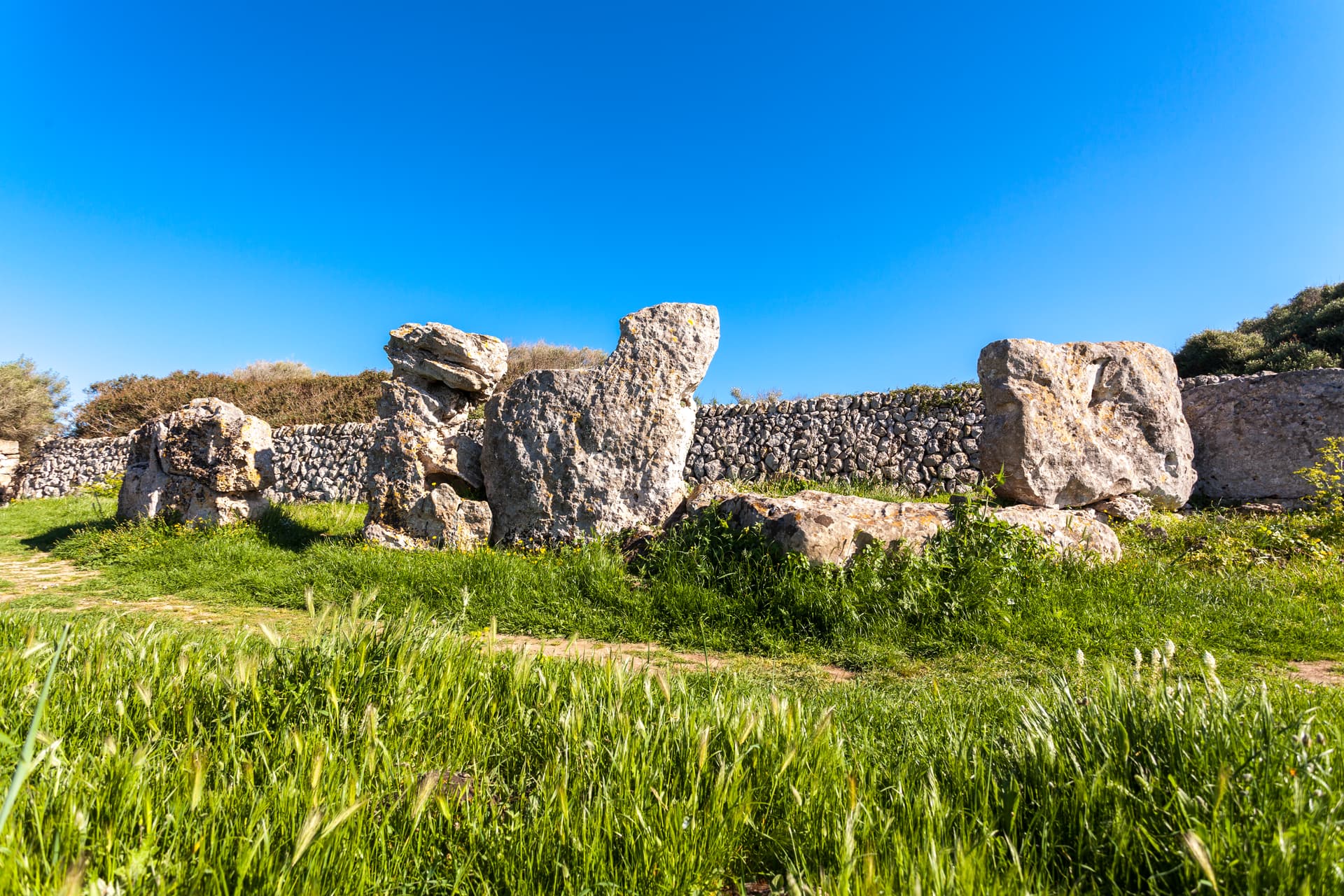
The field setting itself does some of the work that interpretation panels elsewhere try to do. There is little else here — open ground, low stone walls at field boundaries, the road at a distance — so the naveta stands without competition, its form fully legible against the sky in a way that would be harder to achieve in a more built-up or heavily interpreted site.
No public transport serves the site directly; access is by car via the Me-1 road, with a car park followed by a short walk across uneven field ground. Sturdy footwear is recommended. There are no on-site facilities, so bring water, particularly in summer.
Context and lineage
No written record survives from the Talayotic culture that built Naveta des Tudons — the culture was pre-literate, and no myth or founding account has come down attached specifically to this monument. What is known comes entirely from the material record: the building's form, the burials it contained, and the grave goods placed with the dead.
The naveta form itself is unique to Menorca among Bronze Age Mediterranean cultures, and this example is understood as its clearest and most completely preserved expression. Construction falls at the hinge point between the pre-Talayotic and early Talayotic periods, with continued use as a collective ossuary across a broad Bronze Age window — sources place this somewhere within roughly 1200 to 750 BC, with radiocarbon evidence from bone material suggesting use around 1130-820 BC specifically.
The monument passed formally into modern heritage protection when it was listed in the Spanish national heritage register on 3 June 1931. Its excavation and restoration came decades later, in 1959-1960, under archaeologist Lluís Pericot García, whose work uncovered the burials — at least a hundred individuals — and the grave goods now held at the Museu de Menorca in Maó.
Naveta des Tudons belongs to the Talayotic culture of Menorca, a Bronze Age society whose cyclopean monuments — navetas, talaiots, and taula-settlement sites — are concentrated on the island in one of the highest densities of prehistoric archaeological sites found anywhere in inhabited territory. Since September 2023, the wider body of these monuments has been recognized as the 'Talayotic Menorca' UNESCO World Heritage property, covering roughly 280 sites across nine territorial areas.
Naveta des Tudons is widely described by tourism and heritage sources as the best-preserved and most emblematic funerary monument within that property, and is commonly grouped with the nearby settlement sites of Torretrencada and Torrellafuda under the 'Llanos de Ciutadella' area — though this research was not able to confirm that precise zone grouping directly against the primary UNESCO listing document.
Lluís Pericot García
Spanish archaeologist who excavated and restored Naveta des Tudons in 1959-1960, recovering the burials and grave goods that established the monument's significance for Talayotic studies
Traditions and practice
The two internal chambers of the naveta point to a two-stage mortuary process. The upper chamber is thought to have served for drying or otherwise preparing bodies of the recently deceased; the lower chamber held the disarticulated bones of the longer dead, gathered and rearranged as new burials arrived over the generations the monument was in use.
Grave goods — bronze bracelets, bone and ceramic buttons, pottery — were placed with the dead, suggesting the burial process involved more than disposal: some form of provisioning or marking of the individual persisted even within a collective, repeatedly reopened tomb.
No ritual practice occurs at the site today. What continues is scholarly and institutional: ongoing archaeological interest in Talayotic mortuary practice, conservation management of the standing structure, and its promotion as a stop on official 'Megalithic Menorca' heritage routes maintained by the Consell Insular de Menorca.
Because the interior is closed, a visit here is necessarily a practice of looking rather than entering. Walk the full perimeter before settling anywhere; the boat-shaped form reads differently from the front, where the squared entrance sits, than from the curved horseshoe rear where the burial chambers lie hidden inside. Notice the fit of the unmortared stones — how blocks this large hold together, still, without binding material, three thousand years on.
The field setting rewards slowing down: there is little to interpret beyond the structure itself and the ground it stands on, which is closer to the encounter its builders would have had with finished stone than most heritage sites now offer.
Talayotic Culture (pre-Talayotic to early Talayotic Bronze Age mortuary tradition)
HistoricalThe naveta is a megalithic collective-burial building type unique to Menorca. Naveta des Tudons is its best-preserved surviving example and one of the most completely preserved prehistoric buildings in Europe, holding the remains of more than a hundred people interred across several generations.
Two-stage mortuary treatment: drying or preparation of the recently deceased in an upper chamber, followed by disarticulation and collective ossuary storage of the bones in a lower chamber, together with grave goods such as bronze bracelets, bone and ceramic buttons, and pottery.
Modern Archaeological Heritage and UNESCO Stewardship
ActiveFormally protected since its 1931 listing in the Spanish national heritage register, and excavated and restored in 1959-1960 by Lluís Pericot García, Naveta des Tudons has been a cornerstone reference site for Talayotic studies. Since September 2023 it sits within the 'Talayotic Menorca' UNESCO World Heritage property recognizing the island's exceptional density and preservation of Talayotic cyclopean monuments.
Ongoing conservation management, closure of the interior chamber to protect the structure, and inclusion in official 'Megalithic Menorca' visitor routes promoted by the Consell Insular de Menorca.
Perspectives and open questions
Naveta des Tudons is interpreted primarily through archaeological and heritage-conservation lenses; because the Talayotic culture left no surviving written tradition, most of what can be said about the monument's meaning rests on the physical evidence of its construction and contents rather than on competing belief traditions.
Scholarly perspective
Archaeologists agree that Naveta des Tudons is a collective burial monument of the naveta type unique to Menorca, built at the transition from the pre-Talayotic to early Talayotic Bronze Age and used as an ossuary across several centuries within a broad window generally placed between roughly 1200 and 750 BC.
Its 1959-1960 excavation and restoration under Lluís Pericot García recovered the remains of at least a hundred individuals along with grave goods including bronze bracelets, bone and ceramic buttons, and pottery, now held at the Museu de Menorca. It is consistently described as the best-preserved example of its building type and among the most completely preserved prehistoric buildings anywhere in Europe.
Living and traditional perspectives
No continuous indigenous or devotional tradition survives from the Talayotic culture. On Menorca today, Naveta des Tudons functions instead as a foundational symbol of local and island identity — a widely recognized emblem of the island's prehistory and a centerpiece of its Talayotic Menorca UNESCO heritage recognition.
Alternative interpretations
No significant body of esoteric or alternative-spirituality interpretation specific to this monument was found in the sources consulted, beyond the general resonance megalithic burial sites often hold as places of ancestral or 'deep time' connection.
Open questions
The exact social organization behind the monument's construction and centuries of maintenance, the precise ritual sequence by which bodies were dried, disarticulated, and reburied, and the reasons for the site's eventual abandonment around 750 BC all remain incompletely understood — the Talayotic culture left no writing to explain any of it.
Plan your visit
Access and arrival
Located beside the Me-1 road between Maó and Ciutadella, at approximately kilometre 40 of the road, about 5 km from Ciutadella. Reached by car, with a car park at the roadside followed by a short walk across open fields. No public transport serves the site directly.
Mobile phone signal reliability at the site itself was not confirmed in research consulted; given its proximity to the main Me-1 road between Menorca's two largest towns, coverage is likely but should not be assumed for remote or emergency use — no official confirmation was found, so check with local providers or Consell Insular de Menorca tourism information for current details. No booking or keyholder is required; the exterior grounds are freely and permanently accessible during daylight.
Accommodation is concentrated in Ciutadella (roughly 5 km away), which offers the widest range of hotels and guesthouses on this side of the island. No specific accommodation information at or immediately adjacent to the site itself was available at time of writing; check Ciutadella tourism listings for current options.
Respectful visit
No formal dress code. Closed, sturdy footwear is recommended for the uneven field path.
Permitted for personal use from the exterior.
Not applicable — the site has no active devotional community and no tradition of visitor offerings.
The interior chamber is closed to visitors for conservation reasons. Do not climb on or touch the stonework. Stay on the marked path across the field.
There are no on-site facilities, shade, or water available; carry your own, especially in summer heat. The approach path crosses uneven field ground — footing can be uncertain in wet weather.
Location
Map loads as you approach this section.
Pilgrim reflections
A portrait of encounter, not a score
Pilgrims describe what they felt, how present they could become, and whether the place would shape a journey. There are no stars and no ranking of traditions.
No reviewed reflections yet
The first pilgrims can help describe the character of being here.
Share a reflection
Available after an account-backed “Been there.” Every reflection is reviewed before publication.
Nearby sacred places
Explore other sacred places in the region. Proximity does not establish access or travel time; check each place’s guidance.



References
Sources consulted for this page. Source categories describe the publication, not a guarantee that every claim is verified. Traditional accounts and outside interpretations may differ.
- 01Naveta des Tudons | Megalithic Menorca — Consell Insular de Menorca / Descobreix Menorca (official Menorca tourism board)officialOfficial island tourism board page; confirms use period 1200-750 BC, construction technique, visitor access (no interior entry), location detail (km 40 Maó-Ciutadella road), nearby sites Torretrencada and Torrellafuda.
- 02Naveta d'Es Tudons - Wikipedia — Wikipedia contributorsencyclopediaMost detailed single source found: coordinates, dimensions, excavation by Lluís Pericot García 1959-1960, 1931 Spanish heritage listing, construction materials/technique, grave goods, burial count.
- 03Talayotic Menorca: Ultimate UNESCO Heritage Guide — Machu Picchu (heritage travel guide publisher)guideDescribes Naveta des Tudons as the most famous/best-preserved example within the Talayotic Menorca UNESCO World Heritage property (inscribed 18 Sept 2023, 45th WH Committee session, Riyadh); notes 280 sites across nine territorial areas but does not itself name the specific zone.
- 04Talayotic Menorca is now a UNESCO World Heritage Site — Excursions Barco MenorcaguideConfirms 2023 inscription, nine territorial areas / 280 sites, culture chronology from cyclopean construction c.1600 BCE to Romanization 123 BCE.
- 05Naveta des Tudons, the Oldest Fully Preserved Prehistoric Building in Europe — La Brújula VerdenewsArchaeology-focused news outlet; corroborates status as oldest fully preserved prehistoric building in Europe, boat-shaped form, collective ossuary function.
- 06Naveta d'es Tudons - Discovering the Talayotic culture of Menorca — Heather on her TravelsguideTravel-writer account; places the naveta in the wider Llanos de Ciutadella grouping of Talayotic sites alongside Torretrencada and Torrellafuda; general visitor-experience texture.
- 07Naveta des Tudons in Ciutadella, Menorca | Atlas Obscura — Atlas ObscuraguideVisitor-experience and setting description; confirms narrow corridor / small chamber layout, boat-shaped structure, rural setting, access via car.
- 08These are the Talayotic monuments of Menorca to see in autumn — BinissaidaguideSupplementary corroboration of Naveta des Tudons within the broader Talayotic Menorca monument set and seasonal-visit framing.
Share a photo
Help visitors recognize Naveta des Tudons. Every submission is reviewed before publication.