Torrellafuda
A shaded Talayotic village hidden in a wild-olive grove near Ciutadella
Understand sacred places, explore living traditions, and learn how to engage respectfully with Pilgrim Map.
Access has not been verified. Check current local guidance before planning a visit.
Ciutadella de Menorca, Balearic Islands, Spain
Read the sources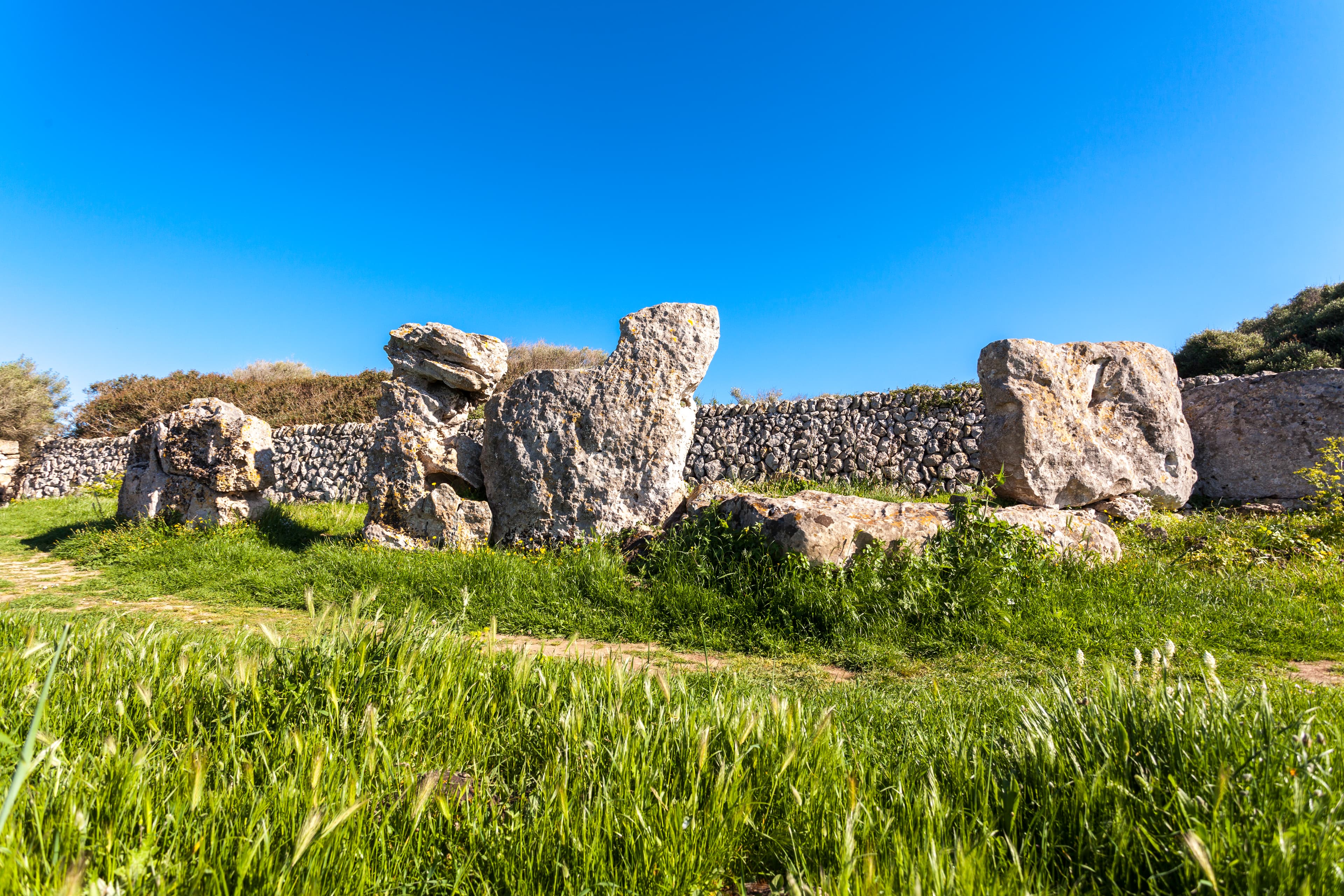
Image of Torrellafuda. Image source
Visit essentials
A quick read before you go
- Access
- Located in Ciutadella municipality on western Menorca, about 9 km from Ciutadella, just south of…
- Etiquette
- Standard heritage-site conduct applies: stay on the marked farm track and site paths, do not…
Overview
South of the Me-1 between Maó and Ciutadella, an unpaved farm track through the Son Sintes estate leads to Torrellafuda. Wild olive and holm oak shade the ruins year-round, making this settlement emerge from dappled cover rather than the open glare of many Menorcan Talayotic sites.
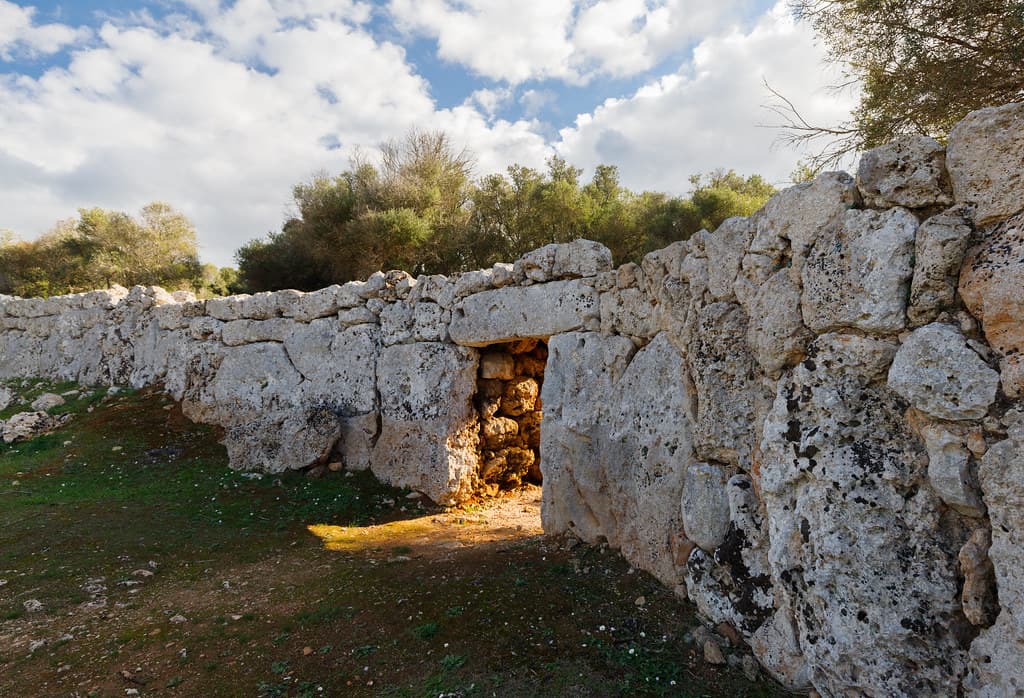
At its center stand a large talayot, among the island's more prominent cone-shaped towers though a later dry-stone wall partly hides its base, and a taula enclosure, the T-shaped ritual form unique to Menorcan Talayotic culture. Its broken support pilaster reportedly exceeds three metres. Attached dwellings and a rubble-filled perimeter wall with two gates encircle the settlement, although later dry-stone work rebuilt much of that wall.
Four nearby rock-cut hypogea form the necropolis; Roman-era lead sling bullets from one show use continued after the Talayotic period. Torrellafuda is protected as a Bien de Interés Cultural and is a component of Talayotic Menorca, inscribed as UNESCO World Heritage in 2023.
Why this place is sacred
No origin myth or named devotional tradition survives for Torrellafuda; what draws attention is architectural and spatial rather than narrative. The taula enclosure's broken pilaster, still exceeding three metres despite its damage, gives a sense of the monument's original scale even in its fractured state, and the T-shaped capital groove near its entrance is a detail repeatedly noted by researchers documenting Menorca's taula tradition.
The necropolis is unusual for what it preserves in sequence: four hypogea cut directly into bedrock, one holding lead sling bullets from the Roman period, meaning the site's use did not end cleanly with the close of Talayotic culture but continued, in some form, through the arrival of Rome and — per some sources — into later medieval occupation.
The wild-olive and holm-oak grove surrounding the ruins is itself part of what gives the site its distinct atmosphere: sources describe the shade as creating a hushed, semi-dark environment that separates the settlement from the open farmland around it, an effect not shared by Menorca's more exposed talayotic sites.
A fortified Talayotic settlement whose taula enclosure served as a focus for communal ceremonial gathering — the type of monument unique to Menorca among Talayotic-era Balearic cultures — with the talayot providing height and visibility, attached dwellings for domestic life, and the four hypogea serving as a communal necropolis.
Built and occupied during the Talayotic period (Bronze Age into Iron Age); occupation continued through the Roman period, evidenced by lead sling bullets recovered from one of the hypogea, and some sources describe continued use into later medieval or Islamic-era occupation, though the precise chronology of that later phase is not detailed in available sources. The perimeter wall was substantially rebuilt using later dry-stone technique over the original rubble-filled Talayotic construction.
The site now falls under modern heritage protection as a Bien de Interés Cultural and as a component of the 2023 UNESCO World Heritage inscription of Talayotic Menorca.
Experience and orientation
Reaching Torrellafuda means leaving the Me-1 highway near its kilometre 37 marker and following an unpaved farm track through the Son Sintes estate — a walk of a few hundred metres to just over a kilometre depending on where the track is joined, across land still worked for agriculture.
The grove itself is the first change you notice: wild olive and holm oak close in overhead, cutting the glare that defines most Menorcan Talayotic sites, and the temperature and light both drop noticeably as you enter. The talayot appears first, its bulk still commanding even though a later dry-stone wall now obscures part of its base.
Beyond it, the taula enclosure holds the broken pilaster at its centre, the T-shaped capital groove visible near where visitors would once have entered. Dwelling remains cluster around the enclosure, low walls now more suggestion than structure. The four hypogea sit apart from the main cluster, cut into exposed bedrock and easy to pass without noticing unless you deliberately look for the low openings.
Nothing here is staffed or elaborately interpreted; the shade, the quiet, and the need to actively seek out each feature give the visit a slower, more attentive character than a signposted monument would.
Begin at the talayot, the most visually commanding structure, then move to the taula enclosure to see the broken pilaster and capital groove, and finish at the hypogea, which are set apart and easiest to overlook without deliberate searching.
Context and lineage
No founding narrative survives specific to Torrellafuda; it is understood through the broader arc of Talayotic settlement building on Menorca, in which fortified villages combining a talayot, a taula ritual enclosure, dwellings, and a necropolis were established during the Bronze and Iron Ages. Occupation evidence extending through the Roman period, and possibly later, is noted in heritage sources without further chronological detail.
Part of the same Talayotic building tradition documented at nearby Torretrencada and at Torralba d'en Salord and Trepucó elsewhere on Menorca; together these sites define the taula as a ceremonial monument type found only on this island among Talayotic-era Balearic cultures.
Talayotic builders (unnamed)
Original settlement founders who raised the talayot, taula enclosure, and dwellings using the shared architectural tradition of Menorcan Talayotic culture
Consell Insular de Menorca
Present-day heritage authority responsible for the site's protection as a Bien de Interés Cultural and for coordinating its inclusion in the 2023 UNESCO World Heritage inscription of Talayotic Menorca
Menorca Talaiòtica heritage information project
Documents and publishes archaeological detail on Torrellafuda's structures for researchers and visitors
Traditions and practice
Scholarly consensus holds that taula enclosures across Menorca served communal or religious ceremonial functions for Talayotic society, though the specific rites performed at Torrellafuda are not recorded in available sources.
None; the site is preserved and visited as an archaeological monument rather than used for any current ceremony. One source notes limited supervised opening hours (Sundays 9am-2pm), while others describe free, unrestricted access — current arrangements should be verified locally before visiting.
Move through the grove at a slower pace than the open terrain elsewhere on Menorca invites; the shade and the enclosed feeling of the wild-olive canopy reward lingering rather than a quick pass-through. Approach the talayot first, then spend time at the taula enclosure noting the scale of the broken pilaster against the modest footprint of the surrounding enclosure.
Seek out the four hypogea deliberately — their low bedrock openings do not announce themselves — and consider that one held lead sling bullets from a period centuries after the settlement was first built, a small, concrete sign of how long this place remained in use.
Talayotic Culture
HistoricalTorrellafuda was a fortified, ceremonially-centred settlement of the Talayotic culture, the indigenous Bronze-to-Iron Age civilization of Menorca and Mallorca; its combination of talayot, taula enclosure, dwellings, and four-hypogea necropolis makes it one of the most complete surviving Talayotic settlement plans on the island.
Communal or religious ceremonial use of the taula enclosure is inferred by scholarly consensus for Talayotic and post-Talayotic society; specific rites are not documented for this site. Burial practice in the hypogea continued into the Roman period, evidenced by recovered lead sling bullets.
Archaeological and Heritage Conservation Stewardship
ActiveTorrellafuda is maintained and interpreted as a protected component of the UNESCO World Heritage site Talayotic Menorca (inscribed 2023) and holds designation as a Bien de Interés Cultural.
Ongoing heritage management and public interpretation under the Consell Insular de Menorca and the Talayotic Menorca World Heritage coordination body.
Perspectives and open questions
Torrellafuda is read almost entirely through an archaeological and heritage-conservation lens; no competing traditional, indigenous, or esoteric interpretation has survived to challenge or supplement the scholarly account.
Scholarly perspective
Archaeologists place Torrellafuda among the most complete surviving examples of a Talayotic settlement plan on Menorca, combining a talayot, taula enclosure, dwellings, and necropolis within a single footprint. Its inclusion in the 2023 UNESCO World Heritage inscription of Talayotic Menorca formalizes this scholarly recognition, and the wider inscription notes astronomical orientations and visual interconnections among prehistoric structures across the island, suggesting possible cosmological considerations in site placement generally, though no alignment specific to Torrellafuda has been documented.
Living and traditional perspectives
No continuous indigenous or folk tradition survives to offer a perspective distinct from the archaeological record; the Talayotic culture that built the settlement did not persist as an unbroken community into later periods.
Open questions
The precise ceremonial function of taula enclosures — whether devoted to a specific deity, ancestor veneration, or communal assembly — remains debated among researchers, and no source specific to Torrellafuda settles the question for this site. The circumstances and chronology of the settlement's continued occupation into the Roman and possibly later periods are likewise not fully detailed in available sources.
Plan your visit
Access and arrival
Located in Ciutadella municipality on western Menorca, about 9 km from Ciutadella, just south of the Me-1 Maó-Ciutadella highway near kilometre 37. Reached via an unpaved track through the Son Sintes estate, followed by a walk that sources describe as ranging from roughly 150 metres to about 1 km depending on where the road is joined. No public transport serves the site; a car is required.
Admission is free; one source (Menorca Talaiòtica) notes opening supervised only on Sundays 9am-2pm, while others (Descobreix Menorca, Atlas Obscura) describe unrestricted, free access at any time — this discrepancy is unresolved in available sources and current arrangements should be verified with the Consell Insular de Menorca before visiting.
Mobile phone signal at the site was not addressed in available sources — no signal information was available at time of writing; check with Consell Insular de Menorca / Talayotic Menorca heritage authorities for current details. As the site sits a short distance off a major highway a few kilometres from Ciutadella, emergency access should be straightforward via the Me-1.
Respectful visit
No specific dress requirements are documented; sturdy footwear is advisable given the unpaved farm track and uneven ground within the grove.
No restrictions on photography were found in sourced material; the open-air site appears freely photographable.
No offering practices are associated with the site, past or present.
Do not climb on the talayot, taula enclosure, or perimeter wall; do not enter the hypogea beyond permitted viewing points; take no stones or artefacts from the site; keep to the farm track and respect the Son Sintes estate's crops, fences, and gates.
Treat the talayot, taula enclosure, and hypogea as fragile: do not climb on standing stones or walls, and do not enter the burial caves beyond what is clearly permitted for viewing. The approach crosses working agricultural land at the Son Sintes estate; keep to the marked track and respect fences, crops, and any livestock.
Location
Map loads as you approach this section.
Pilgrim reflections
A portrait of encounter, not a score
Pilgrims describe what they felt, how present they could become, and whether the place would shape a journey. There are no stars and no ranking of traditions.
No reviewed reflections yet
The first pilgrims can help describe the character of being here.
Share a reflection
Available after an account-backed “Been there.” Every reflection is reviewed before publication.
Nearby sacred places
Explore other sacred places in the region. Proximity does not establish access or travel time; check each place’s guidance.



References
Sources consulted for this page. Source categories describe the publication, not a guarantee that every claim is verified. Traditional accounts and outside interpretations may differ.
- 01Poblat talayótic Torrellafuda — Consell Insular de Menorca / Menorca.orgofficialOfficial island institutional archaeology page; provides coordinates, access route via Son Sintes estate, structural description
- 02Talayotic Menorca - UNESCO World Heritage Centre — UNESCOofficialConfirms 2023 inscription of Talayotic Menorca (nine component parts, 280 sites total across Migjorn and Tramuntana regions) as UNESCO World Heritage; describes cyclopean structures, hypogea, talayots, and taula enclosures generally, with noted astronomical/cosmological orientations across the broader property
- 03Talayotic settlement of Torrellafuda — Menorca Talaiòtica (heritage information project)Source contextDetailed archaeological summary: talayot, taula enclosure, four hypogea (one with Roman-era lead sling bullets), visiting hours (Sundays 9am-2pm, free), access via Me-1 km 37
- 04Torrellafuda talaiotic village — Descobreix MenorcaSource contextVisitor guide: unrestricted/free access, occupation through Roman period, nearby sites, practical access notes (no public transport, farmland walk)
- 05Poblat talaiòtic de Torrellafuda in Ciutadella de Menorca — Atlas ObscuraSource contextDescribes burial chambers, talayot, taula enclosure with dwelling remains, rubble-filled perimeter wall with two gates, wild-olive grove setting
- 06Torrellafuda - Wikidata — Wikidata contributorsacademicConfirms site identity and general geolocation as an archaeological site in Ciutadella, Balearic Islands
Share a photo
Help visitors recognize Torrellafuda. Every submission is reviewed before publication.