Son Catlar
The only Talayotic wall in the Balearics still standing whole
Understand sacred places, explore living traditions, and learn how to engage respectfully with Pilgrim Map.
Access has not been verified. Check current local guidance before planning a visit.
Ciutadella de Menorca, Balearic Islands, Spain
Read the sources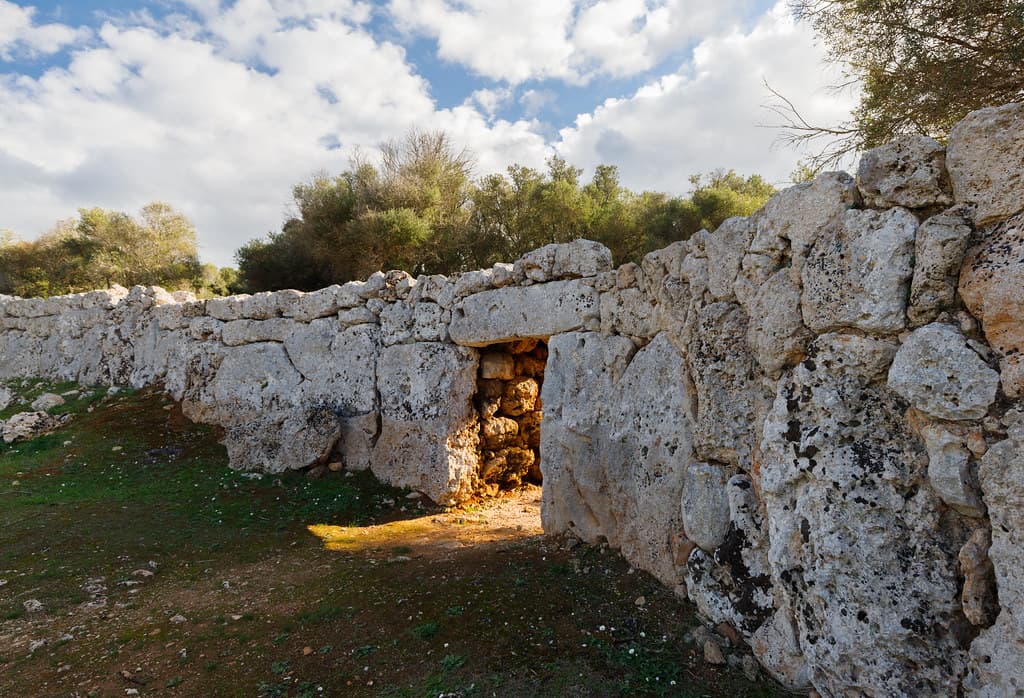
Image of Son Catlar. Image source
Visit essentials
A quick read before you go
- Duration
- Not documented for this specific site; comparable open-air Talayotic settlements are typically…
- Access
- Reached via the Camí de Sant Joan de Missa, about 7.5 km south of Ciutadella de Menorca,…
Overview
South of Ciutadella de Menorca, an almost-kilometer limestone wall circles an open field, its mortarless blocks fitted in the Talayotic builders' cyclopean technique. Son Catlar is Menorca's largest prehistoric settlement and the only one with a largely intact full defensive perimeter, preserving a rare legible boundary for the community's world.
Four talayots—the massive towers naming the culture—rise among fallen room walls. A taula enclosure contains one of the island's largest documented ceremonial precincts. Occupation ran from roughly 1000 BCE through Rome's annexation of Menorca in 123 BCE. In 2021, excavation near a gateway found Roman-era weapons and tools, extending the story beyond conventional Talayotic history. Son Catlar belongs to Talaiotic Menorca, the island's prehistoric heritage on the UNESCO World Heritage List.
Why this place is sacred
Nothing about Son Catlar depends on a founding myth or a named deity — its weight comes from the wall itself. Where most Talayotic settlements on Menorca survive as fragments, their perimeters robbed for field boundaries or eroded past reading, Son Catlar's roughly one-kilometer circuit of stacked, unmortared limestone remains close to whole, two meters thick in places, with defensive bastions still attached and a formal entrance passage on the north side.
That completeness turns the site into something closer to a legible plan than a ruin: walking it, you can trace where the community drew the line between itself and the world beyond, in a way no other Talayotic site on the island allows.
Inside that boundary, four talayots and a large taula enclosure attest to a settlement substantial enough, over thirteen centuries, to require monumental defense and a considerable shared ceremonial space — though the ceremonies themselves are known only through the general archaeological record of taula precincts elsewhere on Menorca, not through anything specific to Son Catlar.
A fortified Talayotic settlement combining domestic space, defensive architecture, and communal ceremonial structures.
Occupied by Talayotic-culture communities from around 1000 BCE; a 2021 find of Roman military equipment near one gateway, dated to about 100 BCE, indicates a Roman presence at the site not long after Rome's conquest of Menorca in 123 BCE, after which the settlement's occupation ends in the documented record.
Experience and orientation
The recommended way to take in Son Catlar is to walk its perimeter rather than head straight for the center. The wall is the argument the site makes for itself, and following it — climbing where it survives to shoulder height, tracing the north-side entrance passage, counting the bastions set into its face — gives a physical sense of scale that the interior, mostly collapsed room foundations and scattered fallen stone, does not.
The four talayots rise unevenly above the field, and the taula enclosure, with its standing capital stones, sits as the settlement's clear ceremonial focus even without a marked path guiding you to it. The land is open and largely unshaded, exposed to Menorca's wind and summer sun, and the ground is uneven underfoot; sturdy shoes matter more here than at more manicured heritage sites.
There is no ticket booth, no visitor center, and often no other visitors, which leaves the wall and the field to speak for the site largely unmediated.
Begin at the northern entrance passage in the wall, then walk the exterior circuit before crossing into the interior toward the talayots and taula enclosure.
Context and lineage
Part of the broader Talayotic culture that built fortified settlements, talayots, and taula enclosures across Menorca and Mallorca from the late second millennium BCE, of which Son Catlar is considered one of the largest and best-preserved examples.
Talayotic-culture builders
Original builders and inhabitants of the fortified settlement, unnamed in the historical record
Fernando Prados
Archaeologist, University of Alicante (INAPH), who led the 2021 excavation that uncovered a cache of Roman military equipment near one of the settlement's gateways
Universities of Alicante, Murcia, Granada, and Cadiz
Collaborating research institutions in ongoing archaeological investigation of the site, alongside the Ciutadella Museum
Museu de Menorca
Museum body marking a century of excavation work at Son Catlar and stewarding its archaeological record
Traditions and practice
The taula enclosure is understood, from the broader Talayotic archaeological record, as a communal ceremonial space, though no practice specific to Son Catlar's taula is documented.
A 2021 find near one gateway — arrowheads, knives, surgical implements, and a bronze spatula, dated to around 100 BCE — has been interpreted by the excavation team as possible evidence of ritual acts performed by Roman soldiers at the threshold, tentatively linked to Janus, the Roman god of passages, though this remains an interpretation rather than a settled finding.
Ongoing archaeological research and museum-led interpretation constitute the site's active tradition; there is no devotional or ceremonial practice conducted here today.
Walk the wall's full circuit before entering the interior. At the taula enclosure, take the time the site itself withholds in signage: sit with the capital stones and consider the scale of communal effort a stone precinct like this required, thirteen centuries before Rome arrived.
Talayotic Culture
HistoricalSon Catlar is considered the largest Talayotic settlement in the Balearic Islands and the only one to retain its full cyclopean perimeter wall largely intact, along with four talayots and one of the island's largest taula enclosures.
No practice specific to Son Catlar's taula precinct is documented beyond the general archaeological understanding that taula enclosures across Menorca served a ceremonial, communal function.
Archaeological and heritage-conservation tradition
ActiveSince a partial excavation in 1923, Son Catlar has remained an active subject of research, most recently through a multi-university excavation (Alicante, Murcia, Granada, Cadiz) with the Ciutadella Museum, which uncovered a Roman weapons cache in 2021.
Ongoing excavation, museum-led interpretation, and heritage stewardship as part of the UNESCO-recognized Talaiotic Menorca designation.
Perspectives and open questions
Son Catlar is read primarily through an archaeological lens, with the site's Roman-era finds opening a second, more speculative line of interpretation about what happened at its threshold after Talayotic society gave way to Roman rule.
Scholarly perspective
Archaeologists treat Son Catlar as the most architecturally complete surviving example of Talayotic fortification technique in the Balearics, valuable for what its intact wall reveals about settlement planning, defense, and scale of communal labor across roughly thirteen centuries of occupation, ending with the Roman conquest of Menorca in 123 BCE.
Alternative interpretations
The 2021 discovery of Roman military equipment near one of the settlement's gateways has led the excavation team to propose — as an interpretation, not a proven fact — that Roman soldiers performed ritual acts there, possibly associated with Janus, god of passages and beginnings.
Open questions
The results of the original 1923 excavation were never fully documented, leaving open questions about the interior's room-by-room use; the full chronology of the settlement's founding and its final abandonment after the Roman weapons deposit also remain incompletely established.
Plan your visit
Access and arrival
Reached via the Camí de Sant Joan de Missa, about 7.5 km south of Ciutadella de Menorca, continuing toward the Son Saura beaches. Access is free and unrestricted, with no keyholder or booking required. Mobile phone signal reliability at the site itself was not documented in available sources; the surrounding rural road network and nearby Ciutadella de Menorca have standard coverage, so signal should not be assumed to be strong directly at the ruins.
In an emergency, Ciutadella de Menorca, roughly 7.5 km north, is the nearest settlement with reliable services and signal.
Respectful visit
No specific dress code; sturdy, closed footwear is advisable given uneven, unshaded terrain.
No restrictions documented.
Not applicable — the site has no active devotional practice.
No stated restrictions beyond general conservation etiquette: avoid climbing on or removing stones from the wall, talayots, or taula enclosure.
The interior is uneven and partially collapsed; take care underfoot and avoid climbing on standing stones, including the talayots and taula capitals.
Location
Map loads as you approach this section.
Pilgrim reflections
A portrait of encounter, not a score
Pilgrims describe what they felt, how present they could become, and whether the place would shape a journey. There are no stars and no ranking of traditions.
No reviewed reflections yet
The first pilgrims can help describe the character of being here.
Share a reflection
Available after an account-backed “Been there.” Every reflection is reviewed before publication.
Nearby sacred places
Explore other sacred places in the region. Proximity does not establish access or travel time; check each place’s guidance.


References
Sources consulted for this page. Source categories describe the publication, not a guarantee that every claim is verified. Traditional accounts and outside interpretations may differ.
- 01Talaiotic Menorca - UNESCO World Heritage Centre — UNESCOofficialUNESCO listing for Talaiotic Menorca (inscribed 2023), of which Son Catlar is a constituent site. Page could not be fully retrieved but is the official record.
- 02Son Catlar. Ciutadella, Menorca. — ResearchGate (academic publication record)academicAcademic publication record on Son Catlar; confirms site as subject of scholarly archaeological study. Full text not retrieved in this research pass.
- 03Son Catlar: 100 years of archaeological excavations — Museu de MenorcaofficialMuseum-run activity page marking a century of excavation work at the site, indicating first documented excavation around 1923.
- 04Son Catlar | Megalithic monuments of Menorca — Descobreix Menorca (Consell Insular de Menorca tourism portal)guideOfficial regional tourism/heritage site; details wall dimensions, talayot count, access, taula enclosure.
- 05Trove of Roman Weapons Unearthed at Ancient Settlement in Spain — Smithsonian MagazinenewsReports July 2021 discovery of Roman military equipment (projectiles, arrowheads, knives, surgical tools, bronze spatula) near a bent gateway, dated c. 100 BCE; dig led by Fernando Prados (University of Alicante/INAPH) with universities of Murcia, Granada, Cadiz and the Ciutadella Museum.
- 06Talayotic settlement — Wikipedia contributorsencyclopediaGeneral background on Talayotic culture typology: talayots, taula enclosures, hypogea, cyclopean architecture, chronology (late 2nd/early 1st millennium BCE).
- 07Roman weapons deposit unearthed at Son Catlar prehistoric settlement — HeritageDailynewsCorroborates Smithsonian coverage of the 2021 Roman weapons find.
Share a photo
Help visitors recognize Son Catlar. Every submission is reviewed before publication.