Torre d'en Galmés
The largest Talayotic settlement in the Balearic Islands
Understand sacred places, explore living traditions, and learn how to engage respectfully with Pilgrim Map.
Access has not been verified. Check current local guidance before planning a visit.
Alaior, Balearic Islands, Spain
Read the sources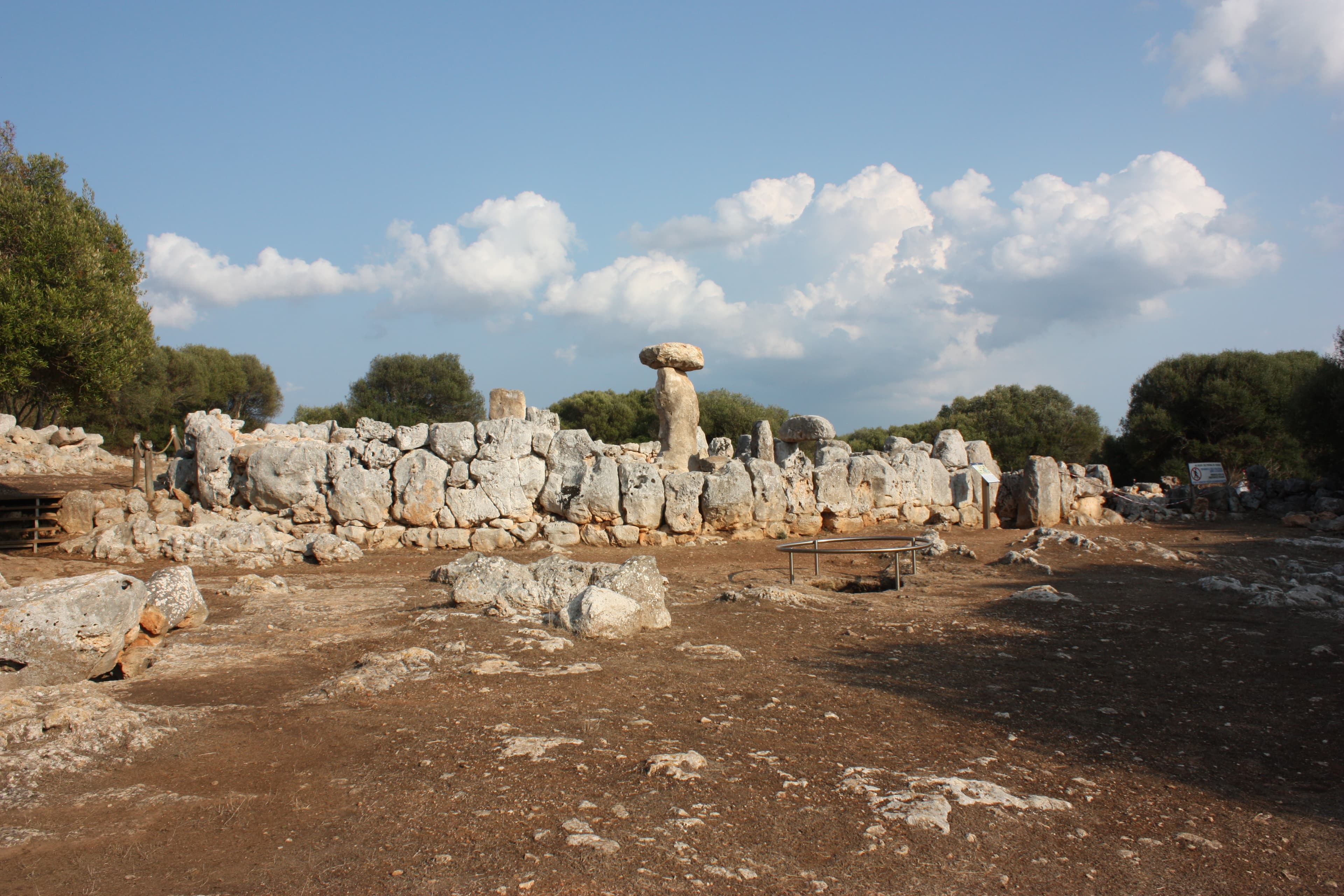
Image of Torre d'en Galmés. Image source
Visit essentials
A quick read before you go
- Duration
- No specific recommended visit duration was found in the sources reviewed; the site's scale — the…
- Access
- Located on the road connecting Alaior and Son Bou, in the municipality of Alaior, Menorca.
Overview
On a low hill between Alaior and Son Bou on Menorca's south coast, Torre d'en Galmés holds the Balearic Islands' most extensive documented concentration of Talayotic remains.
This was a working settlement, not a single monument: three talayots once used as watchtowers; a taula enclosure whose T-shaped central stone identifies a sanctuary form unique to Menorcan prehistory; courtyard houses ringed by monolithic columns; a hypostyle hall; and underground cisterns that gathered and filtered rainwater where no other reliable freshwater source existed.
Occupation began in the pre-Talayotic Naviform period and continued through the Talayotic and Post-Talayotic phases into Roman times, with sporadic reuse in the medieval Islamic period. In September 2023 the site joined Talayotic Menorca, the UNESCO World Heritage property recognizing 280 sites across nine island territories. Here Talayotic Menorca is legible at its largest scale in one place.
Why this place is sacred
There is no origin myth attached to Torre d'en Galmés and no continuous community to explain what its builders believed. What makes the hill significant is legibility: within a compact area, a visitor can move from defensive talayots at the summit to domestic courtyard houses on the slopes to a taula enclosure set apart within its own horseshoe-shaped precinct, and finally down to the water-storage system carved into the bedrock at the settlement's edge.
Archaeologists read the taula — the vertical stone slab and its capital, raised inside a walled enclosure — as evidence that this community set aside a distinct space for something other than shelter, storage, or defense, though the specific content of what happened there has not survived in any written or oral form. The Talayotic culture left no texts.
Everything known about ritual, belief, or cosmology at Torre d'en Galmés is inferred from the architecture itself, from comparison with other taula sites across Menorca, and from artifacts recovered in excavation, including a small bronze figurine of the Egyptian god Imhotep found on the site in 1974 and dated to the 4th–3rd century BCE, which points to Mediterranean trade contact reaching this settlement centuries before the Roman arrival.
A fortified hilltop settlement combining domestic housing, defensive towers, a religious/ritual sanctuary (the taula enclosure), and communal water infrastructure for a Talayotic community.
Occupation began in the Naviform period and continued through the Talayotic and Post-Talayotic phases into the Roman era; the settlement saw later, more limited reuse during the Islamic period (12th century CE) before its final abandonment and eventual transition into a protected archaeological site under Spanish Ministry of Culture ownership.
Experience and orientation
The hill gives Torre d'en Galmés away before you reach it: the talayots stand above the surrounding maquis, visible from the approach road. Walking the site means climbing gradually — from the courtyard houses near the entrance, with their monolithic columns still standing around what were once open patios, up toward the three talayots at the summit, then back down to the taula enclosure, set apart in its own walled precinct rather than at the settlement's highest point.
That separation is worth noticing: the taula was not built for defense or visibility in the way the towers were, but was given its own boundary. At the southern edge of the settlement, the ground opens into the water-storage system — a sequence of cisterns cut into the rock and linked by channels, with a filtration point where pebbles once strained sediment from collected rainwater.
Standing here, in a place with no year-round river or spring nearby, the scale of the engineering becomes as legible as the architecture above it. From the talayots, the view carries south toward Menorca's coast and, on clear days, toward the mountains of Mallorca — the same sightline the settlement's builders would have used to watch the approach from the sea.
Enter from the Alaior–Son Bou road; the site rises gradually from courtyard houses near the entrance to the talayots at the summit, with the taula enclosure and water-cistern system on separate paths off the main circuit.
Context and lineage
No founding narrative survives. Occupation is traced archaeologically to the Naviform period, predating the Talayotic culture proper, with the settlement's defining monuments — the three talayots and the taula enclosure — built in later phases (the talayots roughly 1000–700 BCE, the taula structure roughly 650–123 BCE, according to Menorca's official tourism authority). The community continued into the Roman period before eventual abandonment, with a later, more limited episode of Islamic-period reuse in the 12th century CE.
Part of the broader Talayotic culture that spread across Menorca and Mallorca from roughly 1600 BCE, characterized by cyclopean stone construction, talayot towers, taula sanctuaries, navetas, and hypogea; Torre d'en Galmés is documented as the largest single settlement of this culture identified in the Balearic Islands.
The Talayotic community of Torre d'en Galmés
Original builders and inhabitants
Fundació Foment del Turisme de Menorca
Site manager and steward
Spanish Ministry of Culture
Legal owner
UNESCO World Heritage Committee
International heritage recognition
Traditions and practice
The taula enclosure is interpreted by archaeologists as having hosted some form of religious or communal ritual, given its architectural separation from domestic and defensive structures, but the Talayotic culture left no written record, and the specific content of what took place there — offerings, gatherings, seasonal observances — is not known and should not be presumed.
The site is maintained as a managed archaeological park with self-guided and guided walking access; ongoing archaeological research and conservation work constitute the site's living tradition today, in place of any devotional practice.
Walk the site in the order its builders likely used it: from the courtyard houses, up to the talayots for the long coastal view, then to the taula enclosure — pausing at its threshold rather than its center, since this was evidently a space set apart — and finally down to the cisterns, where the practical intelligence of the settlement is as apparent as its religious life.
Notice the acoustics inside the hypostyle hall, where the stone roof and columns still stand; notice, too, how the taula's isolation from the rest of the settlement shapes how you approach it, even without knowing what happened there.
Talayotic Culture
HistoricalTorre d'en Galmés is the largest Talayotic settlement documented in the Balearic Islands, occupied from the Naviform/early Bronze Age period through the Talayotic and Post-Talayotic phases into Roman times, making it one of the principal sites for understanding indigenous Menorcan prehistoric society, architecture, and — through its taula enclosure — ritual practice.
Construction and use of a taula sanctuary enclosure, communal water storage via underground cisterns, domestic life organized around courtyard houses with monolithic columns, and use of hypostyle halls for storage or communal functions.
Archaeological and heritage stewardship
ActiveTorre d'en Galmés continues as an active site of archaeological study and heritage management, formalized by its September 2023 inscription as a component of the UNESCO World Heritage property Talayotic Menorca.
Ongoing conservation, public access management, and interpretation by the Fundació Foment del Turisme de Menorca on behalf of the Spanish Ministry of Culture, within the framework of the Talayotic Menorca World Heritage designation.
Perspectives and open questions
Torre d'en Galmés can be read through several lenses at once — archaeological, heritage-institutional, and speculative — which do not always agree on what its taula enclosure meant, but do agree on the settlement's scale and importance.
Scholarly perspective
Archaeologists consistently identify Torre d'en Galmés as the largest known Talayotic settlement in the Balearic Islands, with an occupation sequence running from the Naviform period through the Talayotic and Post-Talayotic phases into Roman times.
The taula enclosure is understood as a religious or ceremonial sanctuary structure distinctive to Menorcan Talayotic culture — a building type not found in the parallel Talayotic culture of Mallorca — and the site's water-management system is treated as evidence of sophisticated communal planning uncommon at this scale elsewhere in the Talayotic world.
Living and traditional perspectives
No indigenous community or oral tradition has continued from the Talayotic period to the present to interpret the site from within; what is known rests entirely on archaeological inference rather than living testimony.
Alternative interpretations
The 1974 discovery of a small bronze figurine of the Egyptian god Imhotep at the site is sometimes cited in popular accounts as striking evidence of how far Mediterranean trade networks reached into Talayotic Menorca. This is best understood as a documented artifact demonstrating long-distance contact and exchange, not as evidence of any Egyptian religious presence or belief at the site itself.
Open questions
What actually took place inside the taula enclosure — whether offerings, gatherings, seasonal rites, or something else — is not recorded and cannot be reconstructed with confidence. The precise reasons the settlement was finally abandoned after its later, limited Islamic-period reuse are likewise undocumented in the sources reviewed for this research.
Plan your visit
Access and arrival
Located on the road connecting Alaior and Son Bou, in the municipality of Alaior, Menorca. On-site parking is available. Managed by the Fundació Foment del Turisme de Menorca on behalf of the Spanish Ministry of Culture, which owns the site (contact: +34 971 157 800, per menorca.es). No information on mobile phone signal reliability at the site was available at time of writing; check with the Fundació Foment del Turisme de Menorca for current conditions.
As the site sits directly on a road between two towns, emergency access via the Alaior–Son Bou road should be straightforward, but no specific emergency-access guidance was found in sources reviewed. No booking or keyholder requirement is documented — access appears to be direct, subject to posted opening hours, but no explicit hours or seasonal closure dates were found in the sources reviewed; check menorca.es or visitalaior.com for current opening hours before visiting.
Respectful visit
No photography restrictions are documented in available sources; standard heritage-site courtesy applies.
Climbing onto or into the ancient structures — the talayots, houses, and taula — is prohibited, for both conservation of the fragile stonework and visitor safety.
Visitors may not climb onto or into the ancient structures, for both conservation and safety reasons.
Location
Map loads as you approach this section.
Pilgrim reflections
A portrait of encounter, not a score
Pilgrims describe what they felt, how present they could become, and whether the place would shape a journey. There are no stars and no ranking of traditions.
No reviewed reflections yet
The first pilgrims can help describe the character of being here.
Share a reflection
Available after an account-backed “Been there.” Every reflection is reviewed before publication.
Nearby sacred places
Explore other sacred places in the region. Proximity does not establish access or travel time; check each place’s guidance.


References
Sources consulted for this page. Source categories describe the publication, not a guarantee that every claim is verified. Traditional accounts and outside interpretations may differ.
- 01Torre d'en Galmés — Wikipedia — Wikipedia contributorsacademicConfirms coordinates (39.902395°N, 4.115174°E), location between Alaior and Son Bou, three talayots, one taula, defensive walls, hypostyle hall, sophisticated underground cistern water-storage system, Bronze Age origin (c. 1400 BCE) through Roman period, later Islamic-era reoccupation, and the bronze Imhotep figurine find.
- 02Archaeological Site Poblat de la Torre d'en Galmés (Menorca) — Illes Balears Tourist Board — Agència de Turisme de les Illes BalearsofficialOfficial Balearic Islands regional tourist board listing for the site; corroborates it as the largest Talayotic settlement in Menorca.
- 03Archaeological heritage of Alaior in Talayotic Menorca — Visit Alaior — Ajuntament d'Alaior (Alaior Town Council) / Fundació Foment del Turisme de MenorcaofficialConfirms Torre d'en Galmés as the largest Talayotic settlement in Menorca (six hectares), lists three talayots, a taula enclosure, hypostyle room, water-catchment system, and four hypogea; notes Initial Bronze Age occupation (c. 1600 BCE) continuing to Roman-era peak.
- 04Torre d'en Galmés talayotic settlement — Menorca.es (official island tourism portal) — Fundació Foment del Turisme de MenorcaofficialOfficial Menorca tourism board page; confirms three talayots (dated c. 1000-700 BCE), a taula structure (c. 650-123 BCE), circular residential buildings, hypostyle storage buildings, rainwater collection cisterns, Naviform-period origins (1700-1400 BCE), Roman-era and later 12th-century Islamic-period remains, and the 1974 discovery of a bronze figurine of the Egyptian god Imhotep (dated 4th-3rd century BCE). States site is owned by the Spanish Ministry of Culture and managed by the Fundació Foment del Turisme de Menorca; ascent onto structures is prohibited for conservation/safety.
- 05Spain achieves with 'Menorca Talayotic' the 50th inscription on the UNESCO World Heritage List — La Moncloa (Spanish Government Press Office)officialOfficial Spanish government press release confirming UNESCO inscription of 'Menorca Talayotic' (Talayotic Menorca) on 18 September 2023 at the 45th session of the World Heritage Committee in Riyadh; describes the property as comprising nine components with settlements, burial spaces, shrines and sacred sites, and distinctive monument types including burial navetas, taula enclosures, monumental circular houses, and talayots. Does not name Torre d'en Galmés individually.
- 06UNESCO World Heritage Centre — Decision 45 COM 8B.24 (Talayotic Menorca) — UNESCO World Heritage CommitteeofficialPrimary UNESCO decision record for the September 2023 inscription of Talayotic Menorca; page could not be directly fetched during this research session (403 response), so cited for reference/completeness rather than for extracted quoted text. Listed here as the authoritative primary source for future verification.
- 07Talayotic Menorca, World Heritage Site — Camí de Cavalls 360º — Camí de Cavalls 360ºSource contextIndependent Menorca heritage/hiking guide; explicitly names 'Torre d'en Galmés settlement with Ses Roques Llises dolmen and the monument of Na Comerma de sa Garita' as sites within the 'area between the ravines of Torrevella and Cala en Porter,' one of the nine UNESCO component territorial areas. Confirms inscription date of 18 September 2023 and that 280 sites across nine zones were inscribed.
- 08Talayotic settlement — Wikipedia — Wikipedia contributorsacademicGeneral background on Talayotic culture chronology (c. 1600 BCE to Roman conquest 123 BCE), function of talayots (defensive/economic/social), taulae as Post-Talayotic sanctuary structures, cyclopean masonry construction techniques, and hypostyle halls/navetas/water-collection systems as recurring site features.
- 09Talayotic Menorca: Ultimate UNESCO Heritage Guide — machupicchu.org editorial teamSource contextThird-party heritage travel guide; describes Torre d'en Galmés as 'the largest and most impressive Talayotic settlement' within the World Heritage discussion, corroborating (without a fully explicit formal-boundary citation) its inclusion in the inscribed property. Used for corroborating context only, not as sole source for the UNESCO-component claim.
- 10Talayotic Menorca, Spain — Google Arts & Culture — Google Arts & Culture / Balearic heritage contributorsSource contextCultural-heritage storytelling feature; corroborates over 1,500 prehistoric sites across Menorca's 700 km², describes hypostyle halls and monumental courtyard houses at Torre d'en Galmés, and notes continued hand-made pottery production after Carthaginian contact as an example of cultural continuity.
Share a photo
Help visitors recognize Torre d'en Galmés. Every submission is reviewed before publication.