Ses Roques Llises Dolmen
A Bronze Age tomb of standing stone on Menorca's Talayotic plain
Understand sacred places, explore living traditions, and learn how to engage respectfully with Pilgrim Map.
Access has not been verified. Check current local guidance before planning a visit.
Alaior, Balearic Islands, Spain
Read the sources
Visit essentials
A quick read before you go
- Duration
- No duration information was available at time of writing; the site is small and likely takes…
- Access
- On foot from the Torre d'en Galmés Talayotic settlement, off the Alaior-Son Bou road, along an…
Overview
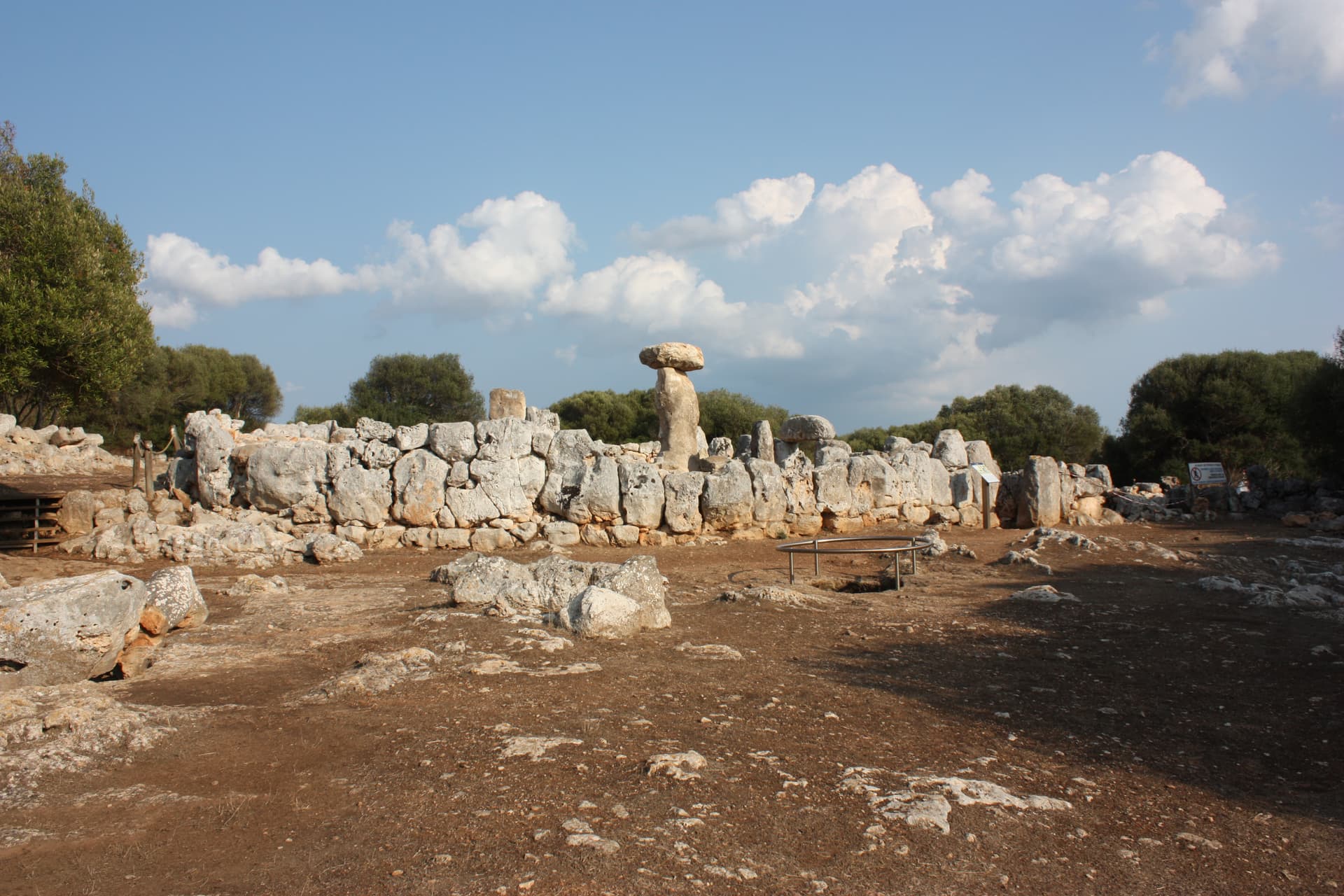
Six upright slabs form a rectangular burial chamber on a low rise south of Alaior, close enough to the great Talayotic settlement of Torre d'en Galmés that both clearly belonged to the same community. Ses Roques Llises was raised sometime between roughly 2100 and 1600 BCE, at the boundary between the island's Copper and early Bronze Ages, as a shared resting place rather than a monument to one person.
A narrow corridor through a slab pierced with a circular opening led into the chamber. An earthen tumulus once covered the structure, and its base remains traceable on the western side. When archaeologists Guillem Rosselló Bordoy and Lluís Plantalamor Massanet opened it in 1974, they found the overgrown chamber structurally sound but its skeletal contents dissolved by damp and root growth.
A stone wrist-guard, copper point or blade, bone button, and a handful of ceramic fragments survived, speaking of a working, mortal community: they were set beside the dead rather than displayed for them.
Why this place is sacred
Nothing in the surviving structure or grave goods points to ritual beyond burial itself. Ses Roques Llises belongs to a class of Talayotic dolmens understood as collective tombs, reused across generations for a single kin group rather than reserved for individuals of special status. Its meaning today rests less on any origin myth than on what it demonstrates plainly: how a Bronze Age community on Menorca built, and returned to, a fixed place for its own dead.
Collective funerary chamber for a Talayotic clan or community.
From active tomb (c. 2100-1600 BCE) to buried, overgrown ruin, to excavated and BIC-protected monument (1966), to a constituent site of the 'Talayotic Menorca' UNESCO World Heritage inscription (2023).
Experience and orientation
Approached on foot along an unpaved track from Torre d'en Galmés, the dolmen sits low in the landscape, its remaining roof slabs fallen inward, the chamber open to the sky where a mound once closed it. There is little to read on-site beyond an interpretive panel; the structure itself, and the silence around it, are the main things offered.
Context and lineage
Part of the Talayotic mortuary landscape surrounding Torre d'en Galmés, one of Menorca's principal Talayotic settlements.
Guillem Rosselló Bordoy
Co-director of the 1974 excavation
Lluís Plantalamor Massanet
Co-director of the 1974 excavation
Traditions and practice
Collective interment of community members over an unknown span of time, with personal items such as a bracer, a copper blade, and pottery placed among the dead.
Walk the chamber's perimeter slowly before entering its footprint. Notice the six slabs that still stand upright and the three fallen roof stones resting where they landed inside. Look for the base of the earthen mound on the western side, the only visible trace of what once fully enclosed the tomb, and consider the scale of the labor it took to move and set these stones without machinery.
Talayotic Culture
HistoricalSes Roques Llises is a funerary monument of the Talayotic culture, the Bronze Age-Iron Age society of Menorca and Mallorca, and formed part of the mortuary landscape linked to the nearby Torre d'en Galmés settlement.
Collective burial of community members over time, with grave goods including a bracer, a copper point or blade, a bone button, and ceramic fragments.
Archaeological Research and Heritage Conservation
ActiveThe dolmen has been under active heritage protection since its 1966 declaration as a Bien de Interés Cultural, and since 2023 forms part of the 'Talayotic Menorca' UNESCO World Heritage Site.
Formal excavation (1974), heritage listing, and inclusion in a managed UNESCO property with visitor interpretation.
Perspectives and open questions
Interpretation of Ses Roques Llises rests almost entirely on archaeological analysis; no traditional, indigenous, or esoteric readings were found in research.
Scholarly perspective
Archaeologists date the tomb to the transition between the Copper and early Bronze Ages, roughly 2100-1600 BCE, and classify it as a collective Talayotic funerary dolmen. The 1974 excavation by Rosselló Bordoy and Plantalamor Massanet found the chamber structurally intact but the human remains too degraded by moisture and root damage for detailed study, leaving open questions about how many individuals were interred and over what period.
Open questions
How many people were buried here, across how many generations, and what specific practices accompanied interment remain undetermined from the surviving evidence.
Plan your visit
Access and arrival
On foot from the Torre d'en Galmés Talayotic settlement, off the Alaior-Son Bou road, along an unpaved track. Sources vary on the distance from Torre d'en Galmés, giving figures of roughly 400 meters or, via the Torre Nova trail, about 1 kilometer. No mobile phone signal information was available at time of writing; check with the Consell Insular de Menorca or Menorca Talaiòtica for current access and signal conditions.
Respectful visit
No restrictions were found in research; photography appears unrestricted at this open, unstaffed site.
None; no tradition of offerings is associated with this site.
The site is not accessible to visitors with reduced mobility; it is reached only via an unpaved track.
Location
Map loads as you approach this section.
Pilgrim reflections
A portrait of encounter, not a score
Pilgrims describe what they felt, how present they could become, and whether the place would shape a journey. There are no stars and no ranking of traditions.
No reviewed reflections yet
The first pilgrims can help describe the character of being here.
Share a reflection
Available after an account-backed “Been there.” Every reflection is reviewed before publication.
Nearby sacred places
Explore other sacred places in the region. Proximity does not establish access or travel time; check each place’s guidance.


References
Sources consulted for this page. Source categories describe the publication, not a guarantee that every claim is verified. Traditional accounts and outside interpretations may differ.
- 01Dolmen of Ses Roques Llises — Menorca Talaiòtica (heritage information portal for the Talayotic Menorca UNESCO site)officialVisitor access details, opening hours, route from Torre d'en Galmés, excavation and UNESCO context.
- 02Ses Roques Llises (Q21077396) — Wikidata contributorsSource contextStructured data source for precise coordinates and BIC identifier.
- 03Dolmen de Ses Roques Llises — Wikipedia contributors (Catalan)encyclopediaCites excavation directors, BIC declaration date/code, and structural description.
- 04Ses Roques Llises — Wikipedia contributors (Spanish)encyclopediaMost detailed of the encyclopedia entries; corroborates dating, structure, excavation, grave goods.
- 05Dolmen de Ses Roques Llises — Baleares AntiguaguideArchaeology-focused heritage/travel publication; adds interpretive social/demographic detail treated as informed but not independently sourced within the page.
- 06Sepulcro Dolmen Megalítico Ses Roques Llises — Canal MenorcanewsLocal tourism/heritage news coverage.
Share a photo
Help visitors recognize Ses Roques Llises Dolmen. Every submission is reviewed before publication.