So na Caçana
Where Talayotic sun-worship met a taula sanctuary at solstice
Understand sacred places, explore living traditions, and learn how to engage respectfully with Pilgrim Map.
Access has not been verified. Check current local guidance before planning a visit.
Alaior, Balearic Islands, Spain
Read the sources
Visit essentials
A quick read before you go
- Access
- Located beside the road connecting Alaior and Cala en Porter, approximately six kilometers from…
- Etiquette
- Standard heritage-site conduct applies: stay on the marked path across private land, and treat…
Overview
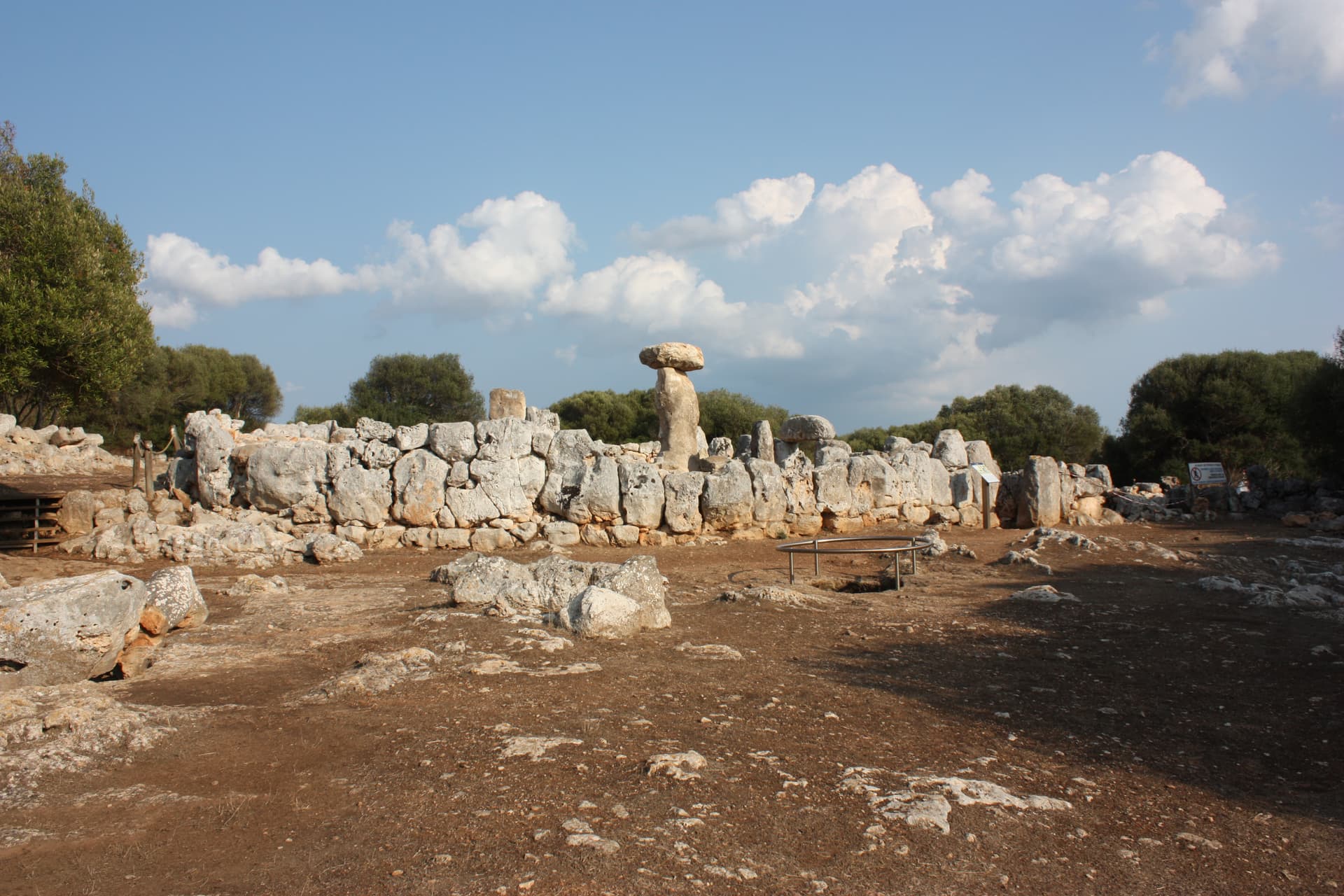
So na Caçana lies beside the Alaior–Cala en Porter road, about six kilometers from Alaior on Menorca. While most Talayotic settlements had one ritual taula enclosure, this site has three, plus a square talayot with an unusual concave, apsed facade, probable dwellings, and a burial ground of two natural caves and three underground hypogea.
Excavations from 1982 to 1987 led by Lluís Plantalamor of the Museo de Menorca concluded that the site was less an ordinary village than a shared sanctuary drawing worshippers from surrounding communities. Occupation ran from a pretalayotic hypogeum cut around 1500 BCE through the main Talayotic period, roughly 1000–700 BCE, to Roman habitation; one central monument's entrance was formally sealed in the 1st century BCE.
In 2023, researchers writing in peer-reviewed SPAL documented a deliberate solar hierophany previously unknown at Talayotic monuments: winter-solstice light entering the western taula enclosure illuminates the precise floor space once occupied by religious representations.
Why this place is sacred
What sets So na Caçana apart from the roughly two hundred taula enclosures known across Menorca is concentration and precision. Most Talayotic settlements built a single taula sanctuary to serve their own population; So na Caçana's builders raised three within one site, a redundancy that researchers read as evidence the location served multiple communities rather than one village alone.
The square talayot's concave, apsed facade departs from the usual conical talayot form found elsewhere on the island, suggesting the builders were working outside the standard architectural template even for their secondary structures.
The more striking claim, established only in 2023, concerns intention rather than scale: the western taula enclosure has a small window cut into its facade positioned so that, at the winter solstice, a shaft of sunlight crosses the interior at midday and lands on the floor area where cult representations stood.
This is not an incidental alignment discovered after the fact — the research team's photogrammetric and archaeoastronomical documentation argues it was built into the structure's design, meaning the community timed a key moment of the year to a specific architectural event inside their sanctuary.
A multi-enclosure religious and ceremonial center serving Talayotic communities beyond a single settlement, incorporating a hypogeum burial chamber, a necropolis of caves and underground tombs, and at least one taula enclosure built to register the winter solstice.
Religious use of the sanctuary enclosures appears to have ended by around 200 BCE. The site did not fall silent afterward — it was reused for ordinary habitation into the Roman period, with one monument's entrance deliberately sealed in the 1st century BCE, evidence of at least attention paid to the older structures even as their original function faded. Occupation is attested as late as the 4th century CE.
Experience and orientation
The approach is unassuming: a parking area beside a country road, a marked path leading onto private agricultural land where the monuments have stood among the fields for three thousand years. There is no visitor center, no signage beyond basic orientation — the site rewards those willing to read stone directly rather than through interpretive panels.
Walking the roughly ten surviving structures, the difference between the square talayot's blunt mass and the taula enclosures' more deliberate, enclosed geometry becomes physically apparent; the enclosures were built to hold and focus attention inward, in a way the talayot's bulk was not. The western taula enclosure rewards the most patience: its walls are lower and its facade window unremarkable outside the few midday minutes around December 21, when the sanctuary briefly does what it was built to do.
Visiting outside that window means encountering the mechanism, if not the moment — the window is there to be found even when the sun is elsewhere.
Come on foot from the roadside parking area; the site has no formal entrance sequence, so orient first toward the cluster of ten structures, then toward the western taula enclosure specifically if the solstice alignment is of interest.
Context and lineage
No founding narrative survives from the Talayotic community itself — they left no written record. What is known comes entirely from excavation: a pretalayotic hypogeum cut around 1500 BCE marks the earliest activity, predating the main Talayotic sanctuary phase by centuries, and radiocarbon dating of charcoal from the site points to activity as early as the 9th century BCE.
So na Caçana belongs to the broader Talayotic building tradition shared across Menorca — the same tradition responsible for the nearby Torralba d'en Salord settlement and the roughly 280 archaeological sites recognized in the 2023 'Talayotic Menorca' UNESCO inscription — but distinguishes itself within that tradition by its unusual concentration of three taula enclosures at a single location.
Traditions and practice
Excavation recovered material evidence of ritual activity inside the taula enclosures, though the sources consulted do not itemize specific artifacts. The 2023 solstice study argues that cult representations — figures or objects of veneration — were positioned on the enclosure floor at the exact spot the solstice sunlight strikes, implying the ritual calendar of the sanctuary was built around that yearly event rather than incidental to it.
Since December 2023, the Agència Menorca Talayótica and the archaeological group Nurarq have organized guided public visits timed to the winter solstice (December 21–23), allowing limited groups selected by lottery to witness the light entering the western enclosure. Outside those dates, the site functions as an open heritage monument with no organized ceremony.
Stand at the western taula enclosure and trace the line from its facade window to the floor space the 2023 study identifies as the illuminated spot — even without the solstice light present, the geometry itself is legible and worth tracing by eye. Walk the full cluster of ten structures slowly enough to register how the talayot's closed bulk differs in character from the enclosures' more deliberately shaped interior space.
Talayotic Culture
HistoricalSo na Caçana functioned as a multi-enclosure religious and ceremonial center for Bronze Age to Iron Age Talayotic communities on Menorca, its three taula enclosures marking it as unusually significant among the island's roughly two hundred taula sites.
Ritual activity centered on the taula enclosures, including — per the 2023 solar hierophany study — a winter solstice ceremony timed to sunlight entering the western enclosure and illuminating the location of cult representations.
Archaeoastronomy / Archaeological Research
ActiveActive scholarly investigation continues to reshape understanding of the site, most recently through the 2023 discovery of the winter solstice solar hierophany, which reframed So na Caçana from a settlement of archaeological interest into a documented example of astronomically aligned sacred architecture.
Ongoing archaeoastronomical and photogrammetric documentation, published in peer-reviewed venues such as SPAL — Revista de Prehistoria y Arqueología, alongside heritage-management stewardship by the Agència Menorca Talayótica.
Perspectives and open questions
So na Caçana is read almost entirely through archaeology and archaeoastronomy — the Talayotic community left no texts, so every interpretive claim about the site's meaning rests on excavated structure, dated material, and, since 2023, measured light.
Scholarly perspective
Lluís Plantalamor's excavation-era interpretation held that the concentration of three taula enclosures marked the site as a shared religious center serving multiple communities rather than a single settlement's own sanctuary.
The 2023 SPAL study by Riudavets González and colleagues extends that reading with archaeoastronomical evidence: the western enclosure's facade window and interior floor space form a deliberate solar hierophany at the winter solstice, the first such phenomenon documented at any Talayotic monument, which the authors argue reflects a solar element within Talayotic religious practice and establishes a concrete calendrical date for the community's ritual year.
Living and traditional perspectives
No continuous indigenous tradition survives from the Talayotic period; the culture's own cosmology and self-understanding are not preserved in any oral or written form, so there is no traditional-indigenous perspective distinct from the scholarly reconstruction above.
Open questions
Why the taula enclosures took their distinctive T-shaped form, and what specific deities or cosmological concepts they encoded beyond a solar element, remains unresolved. The relationship between the sanctuary function and the adjacent necropolis of two caves and three hypogea — whether burial and solstice ritual were part of one integrated religious system or served separate purposes at different points in the site's long occupation — is not fully explained in sources consulted.
Plan your visit
Access and arrival
Located beside the road connecting Alaior and Cala en Porter, approximately six kilometers from Alaior, just past the Torralba d'en Salord settlement. A marked path leaves the roadside parking area for the site, which sits on private land. No public transport details, opening hours, or admission fee information were found in sources consulted; check the Consell Insular de Menorca heritage listing for current details.
Mobile phone signal was not addressed in any source, but the site's proximity to a paved inter-town road and its location within a few kilometers of Alaior town make total isolation unlikely; travelers should not assume this and should verify signal locally if visiting at off-hours.
Respectful visit
No specific dress code was found in sources consulted; standard outdoor footwear suited to uneven ground and open, unshaded terrain is advisable.
No restriction on photography was found in sources consulted; the 2023 research project itself relied on photographic and photogrammetric documentation of the western taula enclosure.
No tradition of offerings is documented at this site.
The site sits on private land accessed via a public path; visitors should not leave the path, enter the necropolis caves or hypogea, or climb on the standing structures. No information on formal opening hours or ticketing was available in sources consulted — check the Consell Insular de Menorca heritage listing or the Agència Menorca Talayótica for current access details before visiting during the solstice period, when guided visits have required advance lottery registration.
The site is on private agricultural land; visitors should keep to the marked path and avoid entering fields or approaching structures beyond what the path permits.
Location
Map loads as you approach this section.
Pilgrim reflections
A portrait of encounter, not a score
Pilgrims describe what they felt, how present they could become, and whether the place would shape a journey. There are no stars and no ranking of traditions.
No reviewed reflections yet
The first pilgrims can help describe the character of being here.
Share a reflection
Available after an account-backed “Been there.” Every reflection is reviewed before publication.
Nearby sacred places
Explore other sacred places in the region. Proximity does not establish access or travel time; check each place’s guidance.



References
Sources consulted for this page. Source categories describe the publication, not a guarantee that every claim is verified. Traditional accounts and outside interpretations may differ.
- 01So na Caçana — Consell Insular de Menorca (menorca.es) — Consell Insular de MenorcaofficialOfficial island government heritage listing: municipality, access road, three taula enclosures, central monument sealed entryway (1st century BCE), western taula pilaster, necropolis of two natural caves and three hypogea.
- 02Una hierofanía solar en el recinto de taula oeste de So na Caçana (Menorca) — Riudavets González, I.; Ferrer Rotger, A.; Barceló Forteza, S.; Remolins Zamora, G.; Cladera Barceló, A.; Bravo Asensio, C.academicPeer-reviewed 2023 paper in SPAL — Revista de Prehistoria y Arqueología (Universidad de Sevilla), DOI 10.12795/spal.2023.i32.01. First documented solar hierophany at a Talayotic monument: winter solstice sunlight enters a window in the western taula enclosure facade and illuminates the spot where cult representations stood.
- 03Talayotic Menorca — UNESCO World Heritage Centre — UNESCOofficialConfirms 'Menorca Talayotic. An Island Cyclopean Odyssey' inscribed on the World Heritage List 18 September 2023 (Spain's 50th inscription); nine territorial components covering 280 of over 1,500 inventoried archaeological sites; period spans Bronze Age (~1600 BCE) to Late Iron Age (123 BCE).
- 04So na Caçana — Wikipedia, la enciclopedia libre — Wikipedia contributorsSource contextCoordinates (39°53′7.74″N 4°9′38.37″E), excavation dates (1982-1987, directed by Lluís Plantalamor), BIC heritage code RI-51-0003208, dating of hypogeum and sanctuary use phases.
- 05Celebración del solsticio de invierno talayótico: la hierofanía solar de "So na Caçana" — Menorca — COPE Illes BalearsSource contextNews coverage of the solstice guided-visit event (Dec 21-23, 2023) organized by Agència Menorca Talayótica and Nurarq, confirms research team names and describes the sunlight phenomenon in accessible terms.
- 06Archaeological heritage of Alaior in Talayotic Menorca — Ajuntament d'Alaior / visitalaior.comofficialMunicipal tourism office listing describing So na Caçana within Alaior's Talayotic heritage, dating the settlement 1000-700 BCE with occupation continuing into the Roman period.
Share a photo
Help visitors recognize So na Caçana. Every submission is reviewed before publication.