Tombeau de Merlin
Two stones where the greatest enchanter sleeps, and pilgrims still leave wishes for him to grant
Paimpont, Morbihan, France
Visit essentials
Before you go
- Access
- From the junction of the D71 and D59 near La Ville Moisan and Etang de la Marette, follow the…
- Address
- 35380 Paimpont, France
- Duration
- Thirty minutes to an hour allows time for meditation and wish-leaving.
- Etiquette
- Merlin's Tomb is an active site of pilgrimage and spiritual practice.
Overview
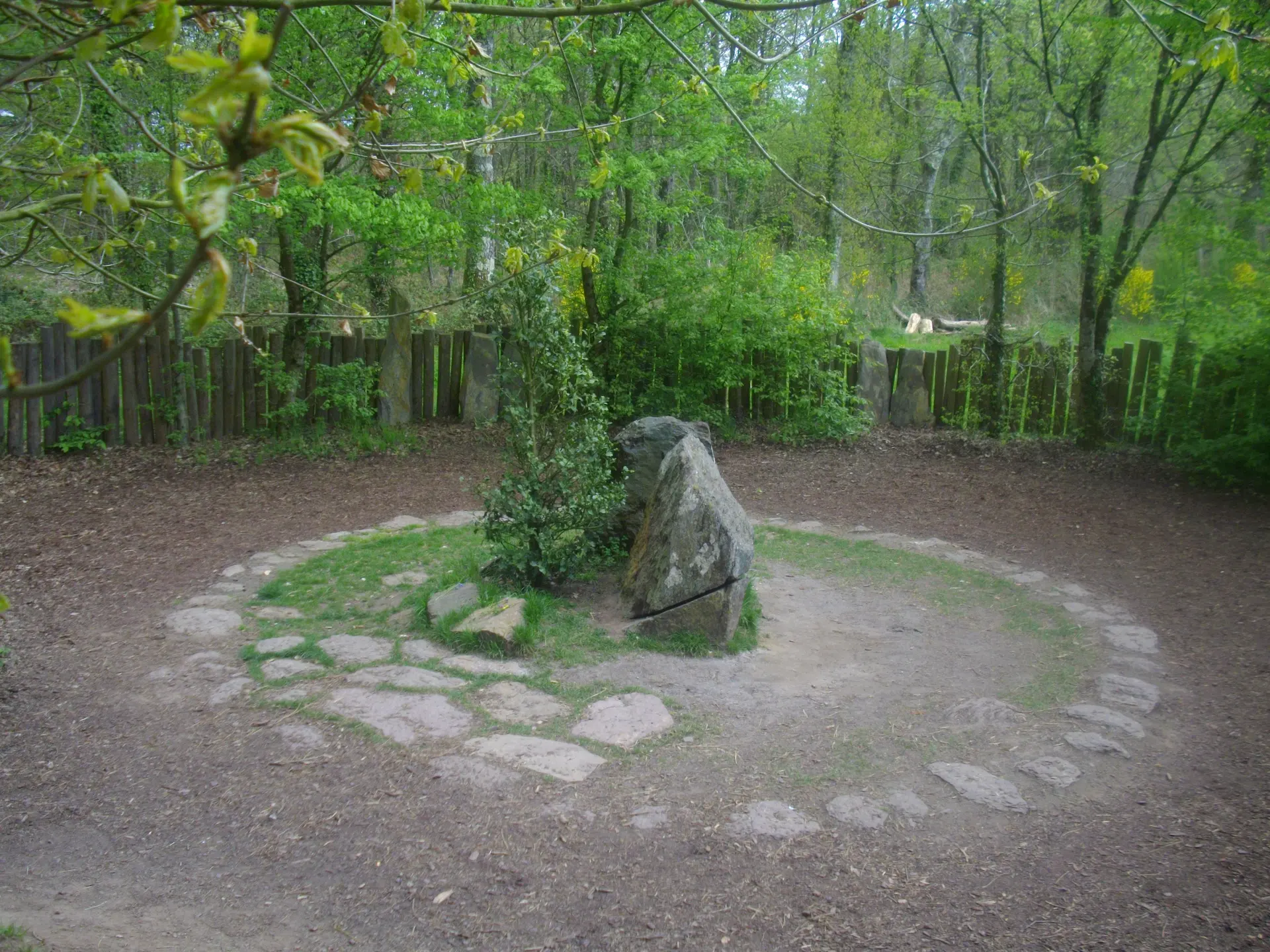
Two red-schist stones rise from the forest floor, remnants of a twelve-meter gallery grave destroyed by treasure hunters in 1892. What accumulates now is not wealth but thousands of wishes, folded into the cracks by visitors who may half-believe or not believe at all.
Legend says Viviane sealed Merlin here with spells he had taught her, moved by both love and fear of his power. In this "tomb of air," he is neither dead nor free; tradition holds that his spirit wanders Broceliande's ancient groves, and visitors continue to report sensing a presence.
Long before Arthurian poets named the place, Neolithic people buried their dead here more than four thousand years ago, marking a threshold already recognized before writing. Neo-Druidic practitioners have gathered for ceremony since 1951, while solitary seekers arrive in every season and at all hours. The site requires no particular belief: sitting, writing a wish, and placing it between the stones may reveal something through articulation itself.
Whether Merlin reads it remains unknowable; for participants, the act can already feel like magic.
Why this place is sacred
The site's power derives from convergence across time. Begin with the stones themselves, remnants of a Neolithic gallery grave constructed around 2500 BCE. The original builders chose this spot for burial—to place their dead at a threshold between the living world and what lies beyond. Whatever qualities made the location suitable for that purpose four thousand years ago, they did not disappear when the builders did.
Medieval legend added another layer. The poets who set Arthurian tales in Broceliande identified this particular spot as Merlin's prison. Why here? We cannot know, but their choice suggests recognition—something in this place that confirmed the story. The tomb of air, sealed by Viviane with Merlin's own spells, became one of the forest's most visited legendary sites.
Contemporary practice adds still more. Since 1951, neo-Druidic gatherings have used the tomb for ceremony. Since at least the nineteenth century, individual pilgrims have come to commune with Merlin's spirit. The wish-leaving tradition, now producing thousands of folded papers annually, represents ongoing ritual engagement. Each wish adds to the accumulated intention.
The destruction in 1892 paradoxically intensified the site's power. Where once stood a substantial monument, now two modest stones remain—remnants against which imagination projects freely. The absence of grand structure makes space for inner experience. Visitors often report that the disparity between expectation and physical reality produces a shift: the mind, unable to process the legend literally, opens to something subtler.
The original Neolithic purpose was collective burial. Gallery graves of this type served communities across Atlantic Europe as thresholds for the dead, places where the boundary between living and ancestors could be crossed through ritual. The site's specific significance for its builders is irrecoverable, but the category of significance—liminal, commemorative, sacred—establishes the continuity with later tradition.
The site's history unfolds in layers. Neolithic construction established it as sacred ground. At some point, likely in the medieval period, local tradition identified it with the imprisoned Merlin. This identification drew pilgrims and storytellers, who elaborated the legend and visited the tomb.
In 1889, archaeologist Felix Bellamy excavated the site and determined its Neolithic origin—the gallery grave predated Merlin's legend by millennia. Three years later, treasure hunters, apparently convinced Merlin had left gold, destroyed most of the monument, leaving only the two stones visible today.
The twentieth century brought revival. Neo-Druidic ceremonies began in 1951. Tourist infrastructure developed around Broceliande. The wish-leaving practice, which may be older, became established as the signature engagement with the site. Today, Merlin's Tomb functions as active pilgrimage destination despite—or because of—its physical modesty.
Experience and orientation
First encounters with the tomb often produce surprise. Two stones. That is all. Where is the grandeur the legends seemed to promise? This surprise itself becomes the opening. The mind, prepared for something external and impressive, turns inward instead.
Sitting with the stones, visitors often describe a quality of attention that differs from ordinary awareness. The forest sounds seem to recede or sharpen unpredictably. Time becomes uncertain—half an hour feels like ten minutes, or ten minutes like an hour. Some report sensing what they describe as presence, though they struggle to specify whose or what.
The wish-leaving practice produces its own category of experience. The act of writing requires articulation: what do you actually want? Many visitors discover that the question is harder than expected. The wish you thought you came with may not be the wish that emerges when pen meets paper. This clarification, independent of any belief in Merlin's intercession, has its own value.
Placing the folded wish in the stones' cracks participates you in a tradition centuries old. You are doing what pilgrims have done, in this place, for longer than anyone alive can remember. This participation produces what some call connection to lineage, others call honoring tradition, others simply call feeling less alone.
The most powerful experiences often come on return visits. First visit clears the expectation. Second visit allows the site to work without resistance. Those who return report subtler effects: unusual clarity about personal situations, dreams that feel significant, insights that arise unbidden in the days following.
Approach the tomb as you might approach a conversation with someone wiser than you who speaks only in silences. Bring genuine questions. Sit with the stones before engaging in any practice. Let the forest sounds become background rather than distraction.
When you write your wish, do not rush. The act of articulation matters as much as the final words. Notice what you first thought to write, and what actually emerges. Notice if the writing itself produces emotion.
After placing your wish, remain. Do not immediately photograph, check your phone, or move to the next site. Give the tomb time to respond, even if response takes a form you do not expect or recognize.
If the site seems quiet, empty, merely two stones in a forest clearing, accept that too. Not every encounter produces revelation. Sometimes the site speaks through absence, later, in dreams or shifts of perspective.
Context and lineage
The legend of Merlin's imprisonment exists in multiple versions. In the tradition most closely associated with Broceliande, Viviane—the Lady of the Lake—fell in love with Merlin and wished to keep him forever. She seduced him into teaching her his magical arts. When she had learned what she desired, she turned his own spells against him.
Some versions say she sealed him in a cave. Others describe a tower of air, invisible but impenetrable. The Broceliande tradition speaks of a tomb of air, closed by two massive stones. Merlin did not die—he cannot die—but neither can he escape. His spirit wanders the ancient groves, present to those who know how to attend.
Viviane's motivation varies across tellings. In some, she acts from fear of his power. In others, from jealousy, to keep him from other women. In still others, from a strange kind of love that preferred imprisonment to absence. The ambiguity enriches rather than obscures: the tomb becomes a monument to the complexity of desire.
The lineage at Merlin's Tomb stretches from Neolithic builders through medieval poets to contemporary pilgrims. The Neolithic community that constructed the gallery grave left no names. The medieval writers who identified the site with Merlin—building on earlier traditions from Wales and Brittany—created the legend that draws visitors today.
In 1889, Felix Bellamy's excavation documented the Neolithic origin, establishing that the site's sacredness predates its legendary association. The 1892 destruction by treasure hunters reduced the monument but did not end the pilgrimage. Since 1951, neo-Druidic practitioners have used the site for ceremony, adding a new layer to its accumulated meaning.
Each visitor who leaves a wish continues the lineage. The papers weather, fade, and eventually disintegrate, but new wishes replace them. The practice perpetuates itself, independent of any institution, carried forward by individuals who heard of it and chose to participate.
Merlin
legendary
The enchanter of Arthurian legend, understood as the last heir of Druidic wisdom, mediator between mortal and divine realms. His imprisonment in Broceliande preserved rather than ended his presence; visitors continue to seek his intercession.
Viviane
legendary
The enchantress who loved Merlin and imprisoned him. Her act is variously interpreted as betrayal, protection, or a form of love that transcended ordinary categories. She raised Lancelot and gave Arthur the sword Excalibur.
Traditions and practice
The practice of seeking Merlin's intercession through prayer or petition likely dates to the medieval period, when pilgrimage to the tomb became established. Specific forms of these early practices are not documented, but the concept of addressing the imprisoned enchanter—asking for his aid, his wisdom, or simply his attention—appears in the literary tradition.
Neo-Druidic practice, formalized at the site since 1951, treats Merlin as representative of Druidic wisdom carried through the Christian era. Ceremonies may include invocation of Merlin, offerings, and group meditation. These practices draw on modern Druidic traditions rather than documented medieval ritual.
The wish-leaving practice defines contemporary engagement with the tomb. Visitors write wishes on paper—typically concerning matters of love, health, career, or spiritual development—fold the paper, and place it in cracks between the stones. The practice requires no belief in Merlin's literal intercession; many participate as a form of intention-setting or ritual engagement with tradition.
Silent meditation at the tomb is common. Visitors sit with the stones, attend to the forest, and allow whatever arises to arise. Some report mental dialogue with Merlin; others experience stillness without specific content. Both are valid forms of engagement.
Neo-Druidic gatherings continue, typically at seasonal festivals. These are organized through Druidic networks rather than publicly advertised. Sincere seekers may find their way to such gatherings through inquiry.
Bring paper and pen. Before writing, sit with the stones and allow your mind to settle. Let the wish you came with meet the wish that actually wants to emerge. They may differ.
Write with intention. The words matter, but so does the act of writing. Let the pen move without excessive editing. The wish need not be perfect; it needs to be true.
Place the folded paper in the crack between the stones. Notice what you feel as you do so. Some report release; others anticipation; others a kind of quiet recognition.
After leaving your wish, remain at the site. Do not rush away. Give Merlin—or whatever name you prefer for what you have addressed—time to respond through silence.
If you seek deeper engagement, return another day. Many visitors find that return visits, after the initial encounter has settled, produce subtler and more significant experiences.
Arthurian Legend
ActiveArmorican (Breton) tradition places Merlin's tomb in Broceliande forest. According to legend, Viviane sealed him in a tomb of air using spells he had taught her, and his spirit still wanders the ancient groves. The tomb is one of the most significant legendary sites in the forest, drawing visitors who seek contact with the greatest enchanter of Western tradition.
Pilgrimage to the tomb; leaving written wishes in the cracks between the stones hoping Merlin will intercede; meditation and communion with Merlin's spirit; participation in guided Arthurian walks from the Centre de l'Imaginaire Arthurien.
Neo-Druidism
ActiveSince 1951, neo-Druidic practitioners have gathered at Merlin's Tomb for organized ceremony. Merlin functions within this tradition as the inheritor of Druidic wisdom, bridging pre-Christian and medieval worlds. The tomb serves as focal point for connecting with Celtic heritage and ancestral knowledge.
Organized ceremonies at seasonal festivals; reverence for Merlin as representative of Druidic wisdom; offerings and meditation; integration of the tomb into larger ritual cycles that include other forest sites.
Neolithic Burial Practice
HistoricalArchaeological excavation revealed the site as a Neolithic gallery grave constructed approximately 2500 BCE. This predates Arthurian legend by over three millennia and establishes the location as sacred ground from deep prehistory. The builders recognized something here that later traditions would name differently but respond to similarly.
Original practices are unknown but likely involved collective burial and ancestor veneration. The gallery grave served as threshold between living and dead, a place where the boundary could be ritually crossed.
Perspectives and open questions
Merlin's Tomb holds different meanings for different seekers. Scholars see a Neolithic monument overlaid with medieval legend. Neo-Druidic practitioners experience active sacred space. Visitors without strong commitments often report unexpected experiences that resist easy categorization. The tomb accommodates all of these readings.
Scholarly perspective
Archaeological excavation by Felix Bellamy in 1889 established the site as a Neolithic gallery grave, approximately 4,500 years old. Before destruction in 1892, the monument was a twelve-meter-long structure covered in red schist. The Arthurian association is medieval literary overlay, not historical fact.
Scholars note that the tomb functions as a 'lieu de memoire'—a site where collective memory materializes. The physical modesty of the surviving stones intensifies rather than diminishes this function; imagination projects freely where architecture no longer constrains.
The wish-leaving practice has been studied as contemporary folk religion, a form of ritual engagement that persists and adapts outside institutional frameworks.
Living and traditional perspectives
Medieval tradition understood Merlin as the last of the great Druids, carrying ancient wisdom through the Christian era. His imprisonment preserved rather than ended his accessibility; pilgrims could seek his intercession precisely because he remained in the forest, not dead but not free.
Neo-Druidic understanding builds on this foundation. Merlin represents Druidic wisdom available to those who approach correctly. The tomb is not merely legendary but actively powerful—a place where the connection between human and Druidic lineage can be renewed.
Alternative interpretations
Some practitioners believe Merlin was a historical figure, a real Druid whose memory was preserved through legend. In this view, the tomb marks an actual burial or imprisonment, and contact with Merlin's spirit is literal rather than metaphorical.
Others understand Merlin as an egregore—a thought-form created and sustained by centuries of human attention. Whether or not a historical Merlin existed, the accumulated belief has generated a presence that responds to those who address it.
Still others view the tomb as an energetic portal, a node on planetary energy lines where ordinary and extraordinary realities intersect.
Open questions
Genuine mysteries remain. Whether a historical figure inspired the Merlin legends cannot be determined from available evidence. The original form of the Neolithic monument before its 1892 destruction is only partially reconstructed. The nature of Merlin's 'imprisonment'—literal, metaphorical, or something between—remains a matter of interpretation rather than fact.
Why visitors consistently report experiences at this site that they do not report at comparable locations is also unexplained. The scholarly categories available may not be adequate to the phenomenon.
Plan your visit
Access and arrival
From the junction of the D71 and D59 near La Ville Moisan and Etang de la Marette, follow the country lane (D2) to a small parking area. A short forest walk leads to the tomb. Signage is adequate. The site is near the hamlet of Landelles in the commune of Paimpont.
Hotels and guesthouses are available in Paimpont village, approximately 10 kilometers from the tomb. No accommodation exists at the site itself.
Respectful visit
Forest walking attire with sturdy shoes is appropriate. The tomb is reached by forest path; mud is common. No formal requirements apply.
Permitted. Be mindful of others at the site. Do not photograph others' wishes or others in prayer or meditation without permission.
The established offering is a written wish on paper. Other offerings (flowers, crystals, food) are not traditional but not prohibited. If you leave something, ensure it is biodegradable. Do not leave items that will need eventual removal.
Do not touch or disturb the stones. Do not remove others' wishes. Do not climb on the monument. These restrictions protect both the site and the practices that have developed around it.
Do not remove wishes left by others. This violates the practice and the implicit trust of those who came before you. The wishes are not curiosities for your examination.
Do not disturb the stones. They are the only surviving fragments of a four-thousand-year-old monument. Climbing on them, attempting to move them, or chipping pieces as souvenirs harms an irreplaceable site.
Be skeptical of claims that specific rituals guarantee specific results. The tomb is not a vending machine. It responds to sincerity, not to procedure.
Current practical details
Address
35380 Paimpont, France
Hours
Hours, fees, and access can change — verify on the official source before you travel. Practical details last checked Jun 2026.
Location
Map loads as you approach this section.
Pilgrim reflections
A portrait of encounter, not a score
Pilgrims describe what they felt, how present they could become, and whether the place would shape a journey. There are no stars and no ranking of traditions.
No reviewed reflections yet
The first pilgrims can help describe the character of being here.
Share a reflection
Available after an account-backed “Been there.” Every reflection is reviewed before publication.
Nearby sacred places
Explore other sacred places in the region. Proximity does not establish access or travel time; check each place’s guidance.


References
Sources consulted for this page. Source categories describe the publication, not a guarantee that every claim is verified. Traditional accounts and outside interpretations may differ.
- 01Merlin's Tomb - Destination Brocéliande — Destination BrocéliandeofficialOfficial regional tourism information
- 02Tombeau de Merlin - Wikipedia — Wikipedia contributorsencyclopediaOverview with archaeological and legendary details
- 03Merlin's Tomb - Atlas Obscura — Atlas ObscuraguidePopular cultural context
- 04Tombeau de Merlin - Travel France Online — Travel France OnlineguideVisitor information and directions
- 05The Tomb of Merlin - Pagan Places — Pagan PlacesspiritualNeo-pagan perspective
Share a photo
Help visitors recognize Tombeau de Merlin. Every submission is reviewed before publication.