Tomb of Eagles
Where the Neolithic dead and the sea eagles shared a clifftop chamber for a thousand years
Understand sacred places, explore living traditions, and learn how to engage respectfully with Pilgrim Map.
Access has not been verified. Check current local guidance before planning a visit.
South Ronaldsay, Scotland, United Kingdom
Read the sources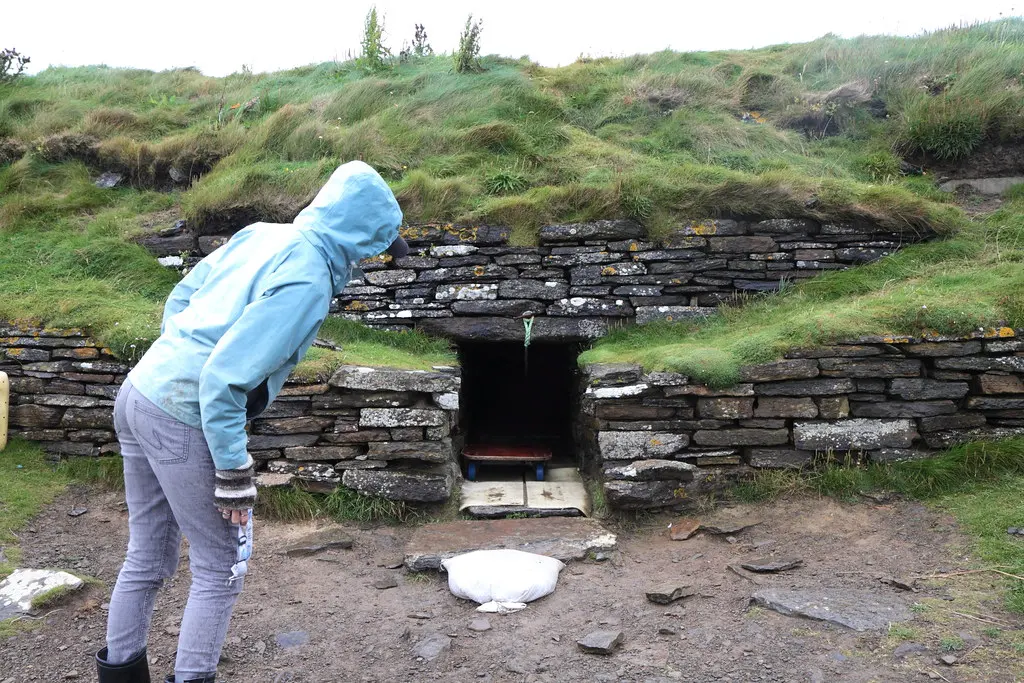
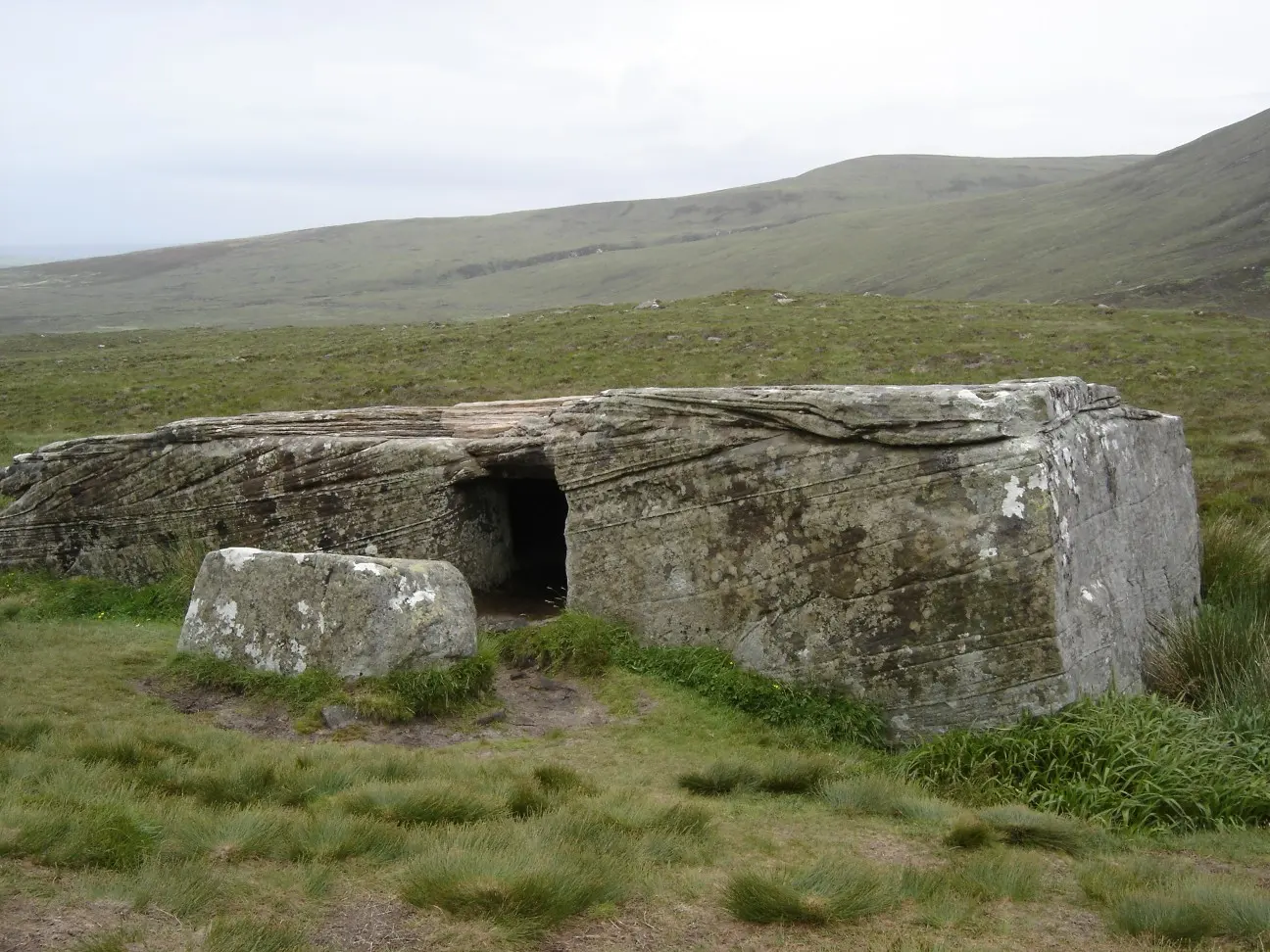
Image of Tomb of Eagles. Image source
Visit essentials
A quick read before you go
- Duration
- 2-3 hours for the full experience
- Etiquette
- This is a burial place.
Overview
A twenty-minute clifftop walk from the visitor centre crosses treeless, wind-exposed farmland above a restless grey-green sea. The Neolithic builders deliberately placed their house of the dead where earth gives way to water, a threshold between the known world and what lay beyond.
Visitors lie on a wheeled trolley and pull through a low passage into a five-thousand-year-old chamber. It is 8.2 metres long, with five compartments divided by paired upright slabs and three side cells. At least three hundred and forty people were deposited here over centuries. Skulls lined the walls and long bones were grouped and stacked after excarnation. This was care, not neglect: the community repeatedly returned, adding new dead and rearranging ancestors' bones.
Between approximately 2450 and 2050 BC, about a thousand years after the tomb's construction, whole white-tailed sea-eagle carcasses were placed among the human remains—eight to twenty, depending on the analysis, with talons and bones mingling with the dead. No other Orkney tomb shares this feature. The eagles gave the tomb its name and an unresolved mystery: totems, offerings, or something else expressing an intimate human relationship with the wild that followed both into death.
Why this place is sacred
The thinness of this place operates through physicality. You do not observe this tomb from a distance or read about it on a panel. You lie down, pass through a narrow opening, and enter the chamber where the dead were kept. The act of entering is itself a threshold crossing, a bodily negotiation between the outer world and an inner space shaped by intentions five thousand years old. The builders designed this experience. The entrance is deliberately low, deliberately narrow.
You must make yourself small to enter. Whatever rituals accompanied the deposition of bones, they began with this act of physical submission to the architecture of death.
The clifftop location intensifies the threshold quality. The tomb sits between land and sea, between the habitable world and the open Atlantic. Orkney weather ensures that this boundary is felt rather than merely seen. Wind, spray, the sound of waves against rock below, the unobstructed sky above. The walk to the tomb is itself a processional movement from the domestic world of the visitor centre to the liminal world of the cliff edge.
The sustained use of the tomb across a thousand years adds a temporal dimension to the thinness. This was not a place visited once and sealed. Generations returned. New bones joined old. The eagles arrived centuries after the first human deposits. The chamber was a living archive of the dead, continually updated, continually tended. The relationship between the living community and this place endured longer than most civilisations.
The tomb was constructed around 3000 BC as a communal burial chamber. The dead were excarnated elsewhere and their bones deposited in the chamber, with skulls arranged along the walls and long bones grouped in compartments. The tomb remained in active use for over a thousand years, with eagle carcasses added in the later period (c. 2450-2050 BC).
Discovered in 1958 by local farmer Ronald Simison, who found human skulls while digging flagstones. Simison conducted his own excavations from 1976, recovering what archaeologist John Hedges later described as the largest and best-preserved assemblage of Neolithic human bone in the British Isles. Hedges published the definitive account in his book Tomb of the Eagles (1984). The Simison family operated the site as a private visitor attraction for decades, offering an extraordinarily personal experience that included handling 5,000-year-old artefacts.
The site closed in 2020 and reopened in September 2025 under the South Ronaldsay and Burray Development Trust following a community fundraising campaign.
Experience and orientation
Begin at the visitor centre, where the Tomb of the Eagles experience has always been distinguished by intimacy. The Simison family, who discovered and excavated the site, established a tradition of allowing visitors to handle genuine Neolithic artefacts: stone tools, pottery, and bone implements that are five thousand years old. This is tactile archaeology. The weight and texture of these objects in your hands creates a connection that glass cases cannot replicate.
From the visitor centre, the walk to the tomb follows the clifftop southward. The path crosses open farmland with the sea on your left and the Orkney sky overhead. This is not a gentle landscape. The wind is constant, the terrain exposed, the cliffs nearby. Take your time. The Neolithic mourners who carried bones to this tomb walked a path not unlike this one, moving from the habitable interior of the island toward its edge.
You may also visit the Liddle Burnt Mound along the way, a Bronze Age structure comprising a mound of fire-cracked stone and the remains of a stone building with a hearth, beds, water reservoir, and channels. This site speaks to the domestic life that existed alongside the ritual world of the tomb.
At the tomb itself, you lie on a wheeled trolley and pull yourself through the low entrance passage into the chamber. The passage is approximately one metre high. The act is deliberate and slightly uncomfortable, which is part of the point. The builders did not make entry easy. Once inside, the chamber opens around you: five compartments divided by stone slabs, three side cells in the walls. The stones are as they were placed five thousand years ago.
The dead are gone, removed by the excavators, but the space they occupied remains, shaped by the same hands that shaped their journey from life to death.
Emerge from the tomb and stand on the cliff edge. The sea stretches away. The wind returns. The transition from the enclosed darkness of the chamber to the open light of the sky is itself a kind of resurrection, experienced in the body before it is understood by the mind.
The Tomb of the Eagles is located near the southeastern tip of South Ronaldsay, the southernmost of the Orkney islands connected by road. The visitor centre is approximately a 20-30 minute walk from the tomb along the clifftop. The nearest village is Burwick, and the nearest town is St Margaret's Hope, approximately 5 miles north.
Context and lineage
On a summer evening in 1958, Orkney farmer Ronnie Simison was digging flagstones near the cliffs at Isbister when he noticed a section of horizontal stones exposed in the earth. He dug down and found a cache of polished stone artefacts: a mace head, three axe heads, a black button, and a small chert knife. Returning a few days later, he uncovered a small stone chamber containing about thirty human skulls.
What he had thought might be a dwelling was a tomb, five thousand years old.
Simison waited nearly twenty years before excavating further. After observing professional archaeologists at work on a Bronze Age site nearby, he began his own careful excavation of the tomb in 1976. Between 1976 and 1982, he recovered approximately sixteen thousand human bones representing at least three hundred and forty individuals. The skulls had been arranged along the chamber walls. The bones had been grouped and stacked.
No intact skeletons remained; the dead had been excarnated before deposition, their flesh removed as part of the funeral process.
Among the human bones were the remains of white-tailed sea eagles. Talons and bones from eight to twenty birds, some deposited as whole carcasses in the central part of the chamber. Radiocarbon dating revealed that the eagles died between approximately 2450 and 2050 BC, up to a thousand years after the tomb was first built. The community that used this tomb maintained their relationship with it, and with the eagles, far longer than anyone had imagined.
Archaeologist John Hedges became friends with the Simison family and mounted a full academic study. His 1984 book, Tomb of the Eagles: Death and Life in a Stone Age Tribe, established the site's significance in the scholarly literature and gave it the name by which it is now known worldwide.
No continuous tradition survives from the Neolithic communities who built and used the tomb. The site's significance was lost until Simison's discovery in 1958. The Simison family's personal stewardship created a unique model of community-based heritage management, now continued by the South Ronaldsay and Burray Development Trust.
Ronald (Ronnie) Simison
Discoverer and excavator
John W. Hedges
Archaeologist
Traditions and practice
The Neolithic communities who used the tomb practiced excarnation, removing the flesh from the dead before depositing their bones in the chamber. Skulls were arranged along the walls, and long bones were grouped in compartments. This was communal burial: the individual identity of the dead dissolved into a collective ancestry of bone. The deposition of eagle carcasses, beginning a thousand years after the tomb was built, represents a later ritual practice whose meaning has not been recovered.
Visitors experience the tomb through the distinctive combination of artefact handling, clifftop walking, and chamber entry that the Simison family established. The visitor centre allows tactile engagement with genuine Neolithic objects. The walk to the tomb creates anticipation and connects visitors to the landscape. Entering the chamber on a trolley provides an embodied threshold experience that is unlike any other heritage site visit.
Handle the artefacts at the visitor centre with attention. Feel their weight and texture. Walk the clifftop slowly and notice the transition from farmland to cliff edge. When you enter the tomb, let the darkness settle around you. The chamber is small enough to feel intimate, old enough to feel vast. When you emerge, stand at the cliff edge and look at the sea.
Consider the people who chose this place for their dead and returned to it for a thousand years.
Neolithic Communal Burial and Ancestor Veneration
HistoricalThe tomb functioned as a communal house of the dead for over a thousand years, receiving the excarnated bones of successive generations. The arrangement of skulls and grouping of bones indicate sustained ritual engagement with the ancestral remains. The communal nature of the deposits suggests that individual identity was subsumed into collective ancestry upon death.
Excarnation of the dead before bone deposition. Arrangement of skulls along chamber walls. Grouping and stacking of long bones in compartments. Multi-generational deposition across centuries. Placement of tools and artefacts alongside remains.
Eagle Ritual Association
HistoricalThe unique deposition of white-tailed sea eagle carcasses alongside human remains, beginning approximately a thousand years after the tomb's construction, suggests a ritual or totemic relationship between this community and the eagle. This is the only tomb in Orkney with such a density of eagle bones.
Interment of whole white-tailed eagle carcasses in the central chamber. Continued deposition over centuries (c. 2450-2050 BC). Possible totemic identification of the burial community with the eagle.
Perspectives and open questions
The Tomb of the Eagles invites interpretation through archaeology, through the body, and through the question it poses about the relationship between the human dead and the wild creatures that shared their resting place.
Scholarly perspective
Archaeologists classify the Isbister cairn as a hybrid type combining features of Orkney-Cromarty stalled cairns with Maeshowe-type side cells. The approximately 16,000 human bones constitute the largest and best-preserved Neolithic bone assemblage in the British Isles. Evidence of excarnation, skull arrangement, and multi-generational deposition indicates complex and sustained funerary practices. The eagle bones, dating to a period up to 1,000 years after construction, have overturned assumptions about the duration of tomb use in Orkney.
Analysis of 85 skulls showed that 16 bore evidence of weapon trauma, suggesting that life in Neolithic Orkney was not without violence. John Hedges' publication remains the standard reference.
Living and traditional perspectives
No continuous oral tradition survives from the communities who built and used the tomb. The site's significance was entirely forgotten until Ronnie Simison's discovery in 1958. Orkney's broader Norse and Scottish traditions do not specifically address the tomb, though awareness of ancient burial cairns as places to be respected has persisted in island culture.
Alternative interpretations
The co-deposition of eagle bones has generated considerable interest among those exploring totemic relationships in Neolithic societies. Some scholars and writers have proposed that each Neolithic community in Orkney may have identified with a particular animal, with the eagle serving as the totem of the Isbister community. The clifftop location between land and sea has been interpreted through the lens of liminal sacred geography, placing the tomb at a threshold between worlds.
Open questions
The central mystery of the Tomb of the Eagles remains the eagles themselves. Why were whole eagle carcasses placed among the human dead? Why did this practice begin a thousand years after the tomb was built? Was the eagle a totemic animal for this community, or did the association develop later? What ceremonies accompanied the deposition of bones, both human and avian? How were the dead excarnated, and where?
These questions may never be answered, but they hold the site open to wonder.
Plan your visit
Access and arrival
Limited accommodation on South Ronaldsay; St Margaret's Hope has several options. Kirkwall (15 miles) offers the widest range. Book in advance during summer months.
Respectful visit
Dress for Orkney weather at all times. Waterproofs and warm layers essential, even in summer. Sturdy footwear for the clifftop walk. Wear clothing you are comfortable lying down in, as entering the tomb requires using a trolley.
Permitted throughout, including inside the tomb chamber. Low light inside the chamber may require a torch or flash.
Do not leave offerings, coins, or objects at the tomb. The site is managed as a heritage attraction and any additions compromise its integrity.
Physical fitness required for tomb entry via trolley. Children must be supervised. Do not remove any material from the site. Do not climb on or disturb the cairn structure.
The tomb entrance is low and narrow, requiring visitors to lie on a trolley. Those with claustrophobia, limited mobility, or back problems may not be able to enter. The clifftop walk is exposed to weather and wind. Check seasonal opening hours before visiting.
Current practical details
Address
Liddle, St Margaret's Hope, Orkney KW17 2RW, UK
Phone
Hours
Hours, fees, and access can change — verify on the official source before you travel. Practical details last checked Jun 2026.
Location
Map loads as you approach this section.
Pilgrim reflections
A portrait of encounter, not a score
Pilgrims describe what they felt, how present they could become, and whether the place would shape a journey. There are no stars and no ranking of traditions.
No reviewed reflections yet
The first pilgrims can help describe the character of being here.
Share a reflection
Available after an account-backed “Been there.” Every reflection is reviewed before publication.
Nearby sacred places
Explore other sacred places in the region. Proximity does not establish access or travel time; check each place’s guidance.
References
Sources consulted for this page. Source categories describe the publication, not a guarantee that every claim is verified. Traditional accounts and outside interpretations may differ.
- 01Tomb of the Eagles Official Website — Tomb of the EaglesofficialPrimary visitor information and site history
- 02The Isbister stalled cairn - South Ronaldsay Tomb of the Eagles — Ness of Brodgar / University of the Highlands and Islands Archaeology InstituteacademicDetailed archaeological analysis with radiocarbon dating discussion
- 03Tomb of the Eagles: Death and Life in a Stone Age Tribe — John W. HedgesacademicDefinitive published account by the excavating archaeologist (1984)
- 04Crowdfunder to reopen the Tomb of the Eagles gets under way — Archaeology OrkneynewsCurrent status and community reopening efforts
- 05Tomb of the Eagles - Isbister Chambered Cairn — Britain ExpressguideVisitor guide with historical context
- 06Isbister, Tomb of the Eagles — Odyssey AdventuresSource contextDetailed architectural and archaeological description
- 07Tomb of the Eagles - Wikipedia — Wikipedia contributorsSource contextGood overview with archaeological details and references
- 08Tomb of the Eagles in Orkney — Atlas ObscuraguideCultural travel perspective
- 09Tomb of the Eagles (Isbister Chambered Cairn) — The Brain ChamberSource contextDetailed archaeological and spiritual analysis
Share a photo
Help visitors recognize Tomb of Eagles. Every submission is reviewed before publication.