Cuween Hill Chambered Cairn
A Neolithic hilltop tomb where twenty-four dog skulls suggest bonds between humans and canines that endured beyond death
Understand sacred places, explore living traditions, and learn how to engage respectfully with Pilgrim Map.
Access has not been verified. Check current local guidance before planning a visit.
Kirkwall, Scotland, United Kingdom
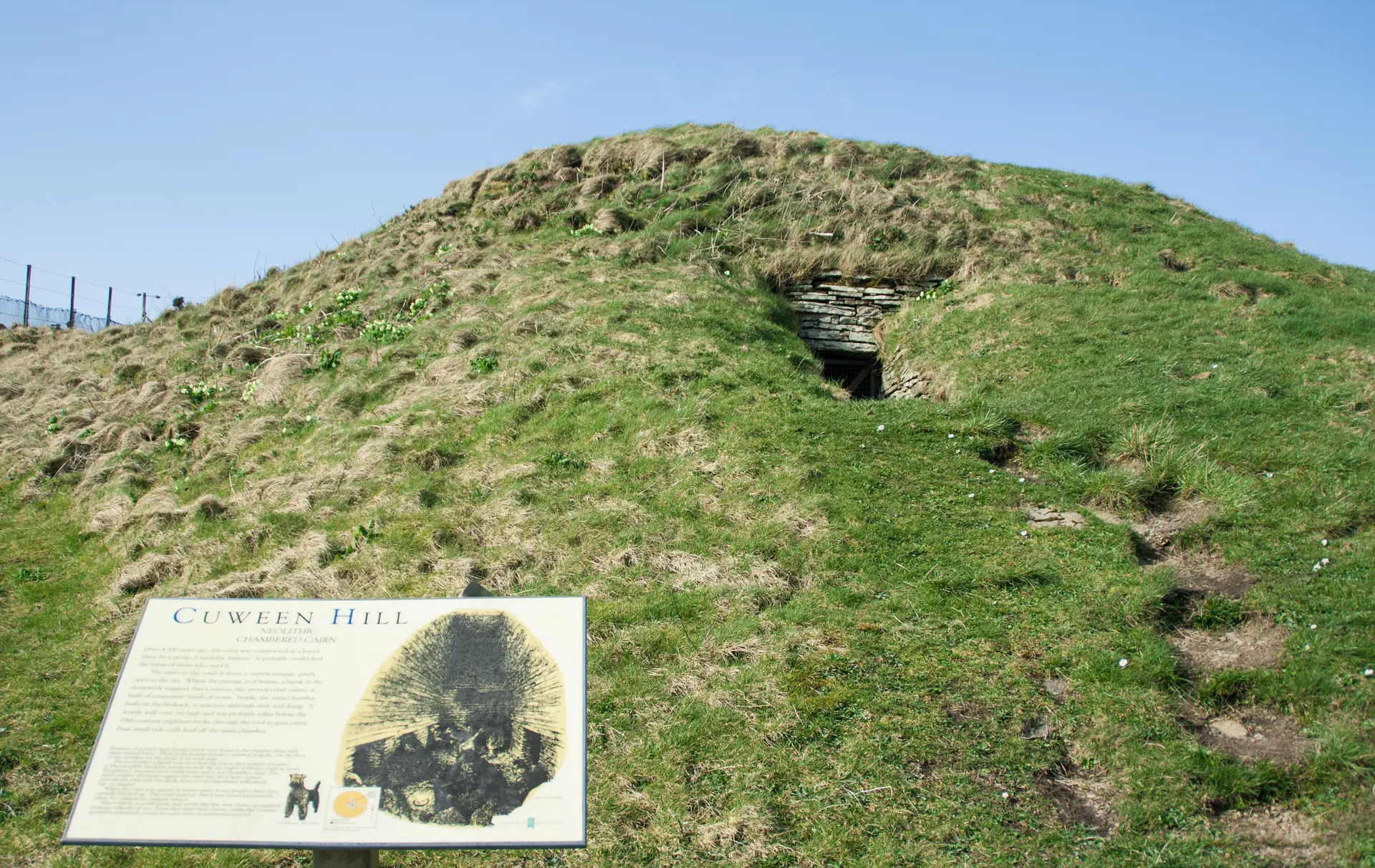
Image of Cuween Hill Chambered Cairn. Image source · CC-BY-SA-3.0
Visit essentials
A quick read before you go
- Duration
- One to one and a half hours for a relaxed visit with time to appreciate the hilltop views.
- Access
- Located off the A965, approximately four miles west of Kirkwall.
Overview
A brief, steep farm walk reaches Cuween Hill's summit, overlooking Kirkwall to the east, Mainland hills, and the sea. Neolithic builders deliberately placed their dead where the living landscape could be surveyed from the ancestors' threshold.
The Maeshowe-type cairn has a rectangular central chamber and four side cells. Its east-facing passage runs about 5.5 metres but is only seventy centimetres wide and eighty high, requiring a crawl or crouch—a physical humility the builders may have intended. Inside, the chamber opens upward after that constriction. In 1901 explorers found five human skulls on its floor, one at the entrance, and two in side cells; fragmentary remains indicate extended use with bones moved and rearranged.
Cuween is distinguished from every other Orkney cairn by twenty-four dog skulls deliberately placed beside the human dead, outnumbering the human skulls found. Four date to about 2500 BCE, centuries after the cairn's initial construction, showing that dog deposition continued. Elsewhere, Knowe of Yarso on Rousay held thirty-six red-deer skulls and Isbister on South Ronaldsay chiefly sea-eagle bones, suggesting each community's significant animal accompanied the dead; Cuween's was the dog.
In 2019 Historic Environment Scotland commissioned a forensic reconstruction from one skull. Experts advised a European-grey-wolf-like coat, revealing substantial, wolf-like working partners in Neolithic subsistence rather than small pets.
Why this place is sacred
The thinness at Cuween operates through a sequence of transitions. First, the climb: leaving the road and ascending through farmland, the body working, the perspective expanding. Then the arrival at the hilltop, where the panoramic views create a sense of elevation above the ordinary world. Finally, the passage: dropping to hands and knees and crawling through 5.5 metres of stone-lined tunnel into the dark interior.
This sequence, ascent followed by descent, openness followed by enclosure, mirrors the structure of many initiatory experiences. Whether the Neolithic builders designed it with this awareness cannot be known, but the effect on contemporary visitors is consistent and well-documented. The transition from hilltop light to chamber darkness is visceral. The stone presses close in the passage. The ceiling opens in the chamber. The side cells branch into shadow.
Knowing about the dog skulls transforms the experience of being inside. This was not merely a house for human dead. It was a shared space, humans and dogs together in death as they were, presumably, in life. Whatever the specific beliefs were, the practice of placing dog skulls in the tomb over centuries indicates an enduring conviction that the bond between these species continued beyond the grave.
The parallel with Yarso's deer and Isbister's eagles expands the contemplation. Each Orkney community, it seems, understood its identity partly through relationship with a particular animal. This is not a worldview that modern Western culture easily grasps. To sit in Cuween's chamber and consider that the people buried here thought of themselves as, in some sense, belonging with their dogs, is to encounter an understanding of human-animal relationship that predates and challenges our own.
The hilltop location adds a final dimension. Emerging from the passage back into daylight, the Orkney landscape unfolds in every direction. The contrast between the enclosed world of the dead and the open world of the living is immediate and powerful.
Cuween served as a communal burial monument for Neolithic farming communities, dating to approximately 3000 to 2400 BCE. The inclusion of dog remains alongside human burials indicates that the tomb functioned within a belief system that recognised bonds between humans and dogs as spiritually significant.
The cairn was constructed approximately 3000 BCE and used for burial over several centuries. Dog skulls were deposited as late as approximately 2500 BCE, indicating sustained use. Explored in 1901, the cairn was subsequently placed under the care of what is now Historic Environment Scotland. In the 1990s, excavations at the foot of Cuween Hill revealed the remains of a Neolithic settlement at Stonehall, providing context for the community that used the tomb.
Experience and orientation
The approach begins from a small car park off the A965, a few miles west of Kirkwall. A path leads uphill through farmland, climbing steeply to the summit of Cuween Hill. The ascent takes fifteen to twenty minutes and rewards with increasingly expansive views. On clear days, the Wide Firth and the hills of Mainland Orkney stretch in panorama.
The cairn presents as a low mound at the hilltop. The entrance faces east, a dark aperture in the grass-covered cairn. To enter requires dropping to hands and knees, or in some cases crawling flat, for the 5.5-metre passage. A torch is essential; there is no light inside. The passage is lined with stone slabs, tight but not crushing, requiring steady movement through darkness.
The chamber opens with welcome height. Standing upright again, you find yourself in a central space with four cells branching off, each a small enclosed space within the earth of the hill. The construction is precise: corbelled stonework narrowing upward, the roof now reinforced but still conveying the original sense of a space carved from stone.
The knowledge of what was found here charges the experience. Eight human skulls. Twenty-four dog skulls. Bones of both species, together in the dark, for five thousand years. The chamber feels inhabited in a way that goes beyond ordinary archaeological interest.
Emerging from the passage back into daylight is its own experience: the hillside, the views, the wind, all intensified by the contrast with the enclosed darkness below. Many visitors describe this moment of re-emergence as one of the most striking aspects of the visit.
The Neolithic settlement at Stonehall, at the foot of Cuween Hill, was excavated in the 1990s. While not visually impressive as a site to visit, its existence contextualises the cairn. The people who were buried in Cuween lived below the hill, and they climbed to its summit to bury their dead alongside their dogs.
Cuween Hill is located off the A965, approximately four miles west of Kirkwall on Mainland Orkney. A small car park provides access. The hilltop climb takes fifteen to twenty minutes. A torch is essential for entering the cairn. The site can be combined with visits to Maeshowe, the Ring of Brodgar, and other Mainland Orkney sites.
Context and lineage
No origin narrative survives. The cairn was constructed approximately 3000 BCE by Neolithic farming communities on Mainland Orkney. The choice of a hilltop location with panoramic views suggests the position held symbolic significance, perhaps placing the dead at a point of oversight over the living landscape. The inclusion of dog remains speaks to a relationship between humans and dogs that the builders considered worthy of preservation beyond death.
No continuous tradition connects the present to the Neolithic builders. The site has been under the care of Historic Environment Scotland. The 2019 forensic reconstruction of one of the dog skulls represented a modern attempt to bridge the temporal gap and understand the animals that shared this space with the human dead.
1901 Explorers
Traditions and practice
Neolithic burial practices at Cuween involved placing human remains in the central chamber and side cells. Bodies were deposited over time, with bones being moved and rearranged as space was needed. Dog skulls were placed alongside human remains over a period extending from the cairn's construction around 3000 BCE to at least 2500 BCE. The practice of depositing animal remains parallels findings at Yarso (deer) and Isbister (sea eagle).
No organised spiritual practices are maintained at the site. Cuween attracts visitors interested in archaeology, Neolithic Orkney, and the human-animal bond. The site is a popular alternative to the more famous but less accessible Maeshowe.
Enter the cairn with a torch and allow your eyes to adjust. Sit in the central chamber and consider the people and dogs who were placed here together. Emerging into daylight, appreciate the hilltop views that the builders chose as the setting for their dead. The climb and the crawl are themselves contemplative experiences.
Neolithic Orkney Passage Grave Tradition
HistoricalCuween exemplifies the Maeshowe-type passage grave tradition, with its central chamber, side cells, and low entrance passage. Its unique feature, the twenty-four dog skulls, suggests a variant of the tradition in which canine-human bonds were central to funerary practice and community identity.
Communal burial in chambered spaces. Placement of both inhumed and fragmentary remains over an extended period. Deposition of dog skulls alongside human remains, continuing for centuries after the cairn's construction. The passage entrance design required physical transition from the outside world into the burial chamber.
Perspectives and open questions
Cuween Hill's twenty-four dog skulls pose one of the most intriguing questions in Orkney archaeology: what was the nature of the bond between Neolithic communities and their dogs, and why was it considered significant enough to continue beyond death?
Scholarly perspective
Archaeologists classify Cuween as a Maeshowe-type chambered cairn, featuring a central rectangular chamber with four side cells accessed through a low passage. The 1901 exploration found remains of at least eight humans and twenty-four dogs. Radiocarbon dating of four dog skulls placed them at approximately 2500 BCE, several centuries after the cairn's initial construction around 3000 BCE, indicating prolonged use.
The dog remains parallel the deer skulls at Yarso and sea eagle bones at Isbister, forming a broader pattern in which different Orkney communities maintained distinct animal associations. Some scholars interpret these as totemic relationships. Others suggest the animals served as guardians or psychopomps, guides for the dead. The Neolithic settlement at Stonehall, excavated at the foot of Cuween Hill in the 1990s, provides valuable context for the community that used the tomb.
Living and traditional perspectives
No oral tradition survives from the Neolithic builders. The beliefs that motivated the placement of dog skulls alongside human remains must be inferred from archaeological evidence.
Alternative interpretations
Some writers on sacred landscapes interpret the dog deposits as evidence of shamanic practices in which dogs served as spirit guides accompanying the dead to the otherworld. The hilltop location and the passage from light to darkness have attracted interest from those who perceive the cairn as designed for initiatory experiences. The forensic reconstruction of one of the dog skulls in 2019 attracted attention from those interested in the deep history of human-canine relationships.
These interpretations extend beyond what the archaeological evidence can confirm.
Open questions
The meaning of the dog skull deposits is the central mystery. Were the dogs totemic animals, sacrificial offerings, companions for the afterlife, or something else entirely? Why dogs rather than other animals? Whether the dogs were wild, domesticated, or somewhere in between is not fully established. The criteria by which certain humans and certain dogs were selected for burial in the cairn are unknown.
Plan your visit
Access and arrival
Located off the A965, approximately four miles west of Kirkwall. Small car park at the base of the hill. A fifteen to twenty minute steep climb through farmland. No public transport directly to the site, but buses between Kirkwall and Stromness pass nearby. Bring a torch. Not wheelchair accessible due to the climb and crawl entrance.
Kirkwall offers a full range of accommodation. The site is easily accessible as a day trip from any Mainland Orkney base.
Respectful visit
Waterproof clothing recommended as the passage may be damp. Trousers that can withstand crawling on stone. Sturdy footwear for the hillside climb.
Photography permitted. Interior photography requires a torch or camera flash. The chamber is small and dark; wide-angle lenses are helpful.
Not appropriate at a heritage monument.
Do not touch, damage, or remove stonework. Do not leave objects in the cairn. Be considerate of other visitors in the confined space.
The passage is narrow and low; those with claustrophobia or mobility limitations may find entry difficult. A torch is essential. The hilltop is exposed to weather. The climb is steep but short.
Current practical details
Address
Old Finstown Rd, Orkney KW17 2EJ, UK
Phone
Hours
Hours, fees, and access can change — verify on the official source before you travel. Practical details last checked Jun 2026.
Location
Map loads as you approach this section.
Pilgrim reflections
A portrait of encounter, not a score
Pilgrims describe what they felt, how present they could become, and whether the place would shape a journey. There are no stars and no ranking of traditions.
No reviewed reflections yet
The first pilgrims can help describe the character of being here.
Share a reflection
Available after an account-backed “Been there.” Every reflection is reviewed before publication.
Nearby sacred places
Explore other sacred places in the region. Proximity does not establish access or travel time; check each place’s guidance.

Share a photo
Help visitors recognize Cuween Hill Chambered Cairn. Every submission is reviewed before publication.