Banks Chambered Tomb
A 5,000-year-old tomb where human and otter bones rest together in undisturbed darkness
Understand sacred places, explore living traditions, and learn how to engage respectfully with Pilgrim Map.
Access has not been verified. Check current local guidance before planning a visit.
South Ronaldsay, Scotland, United Kingdom
Read the sources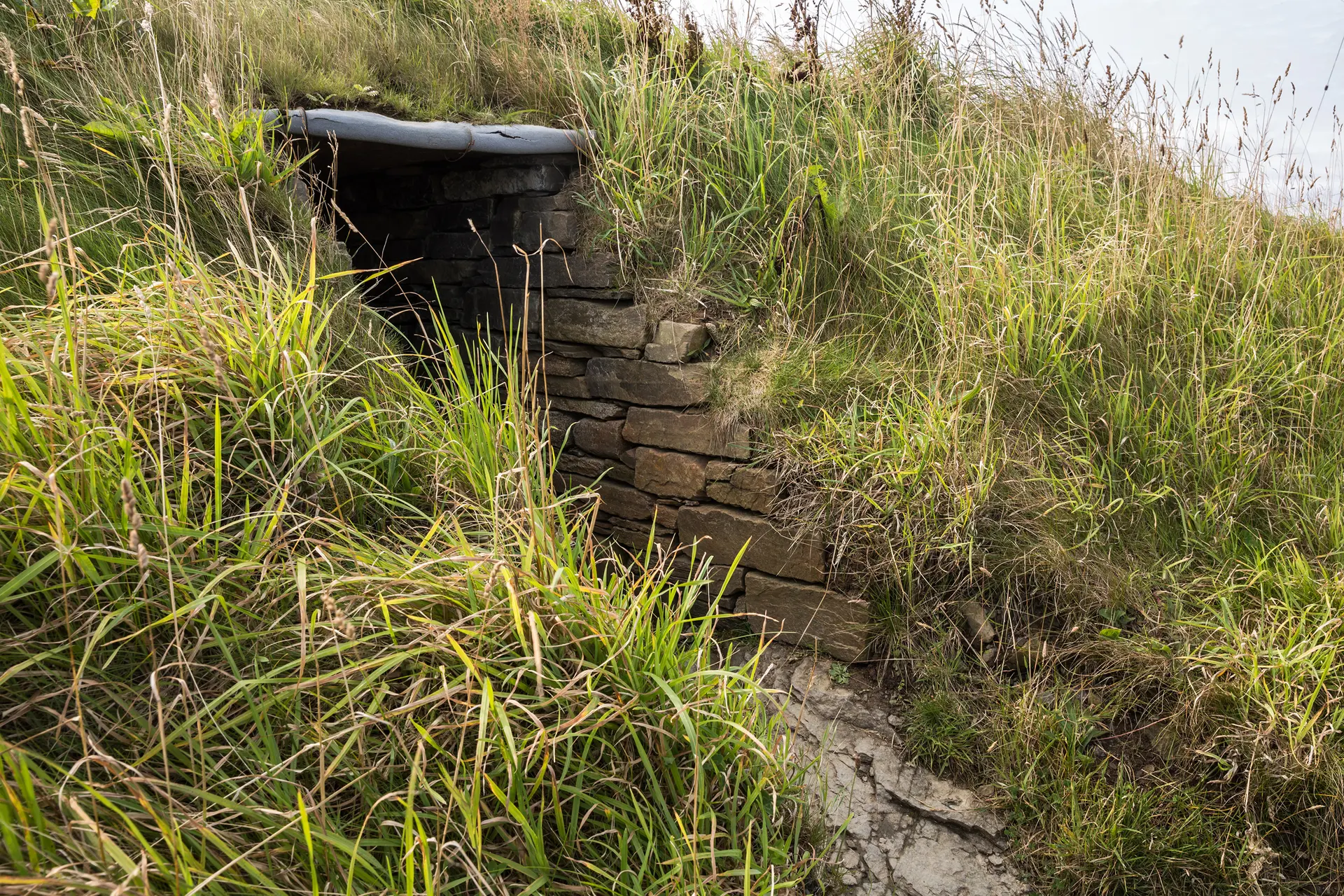
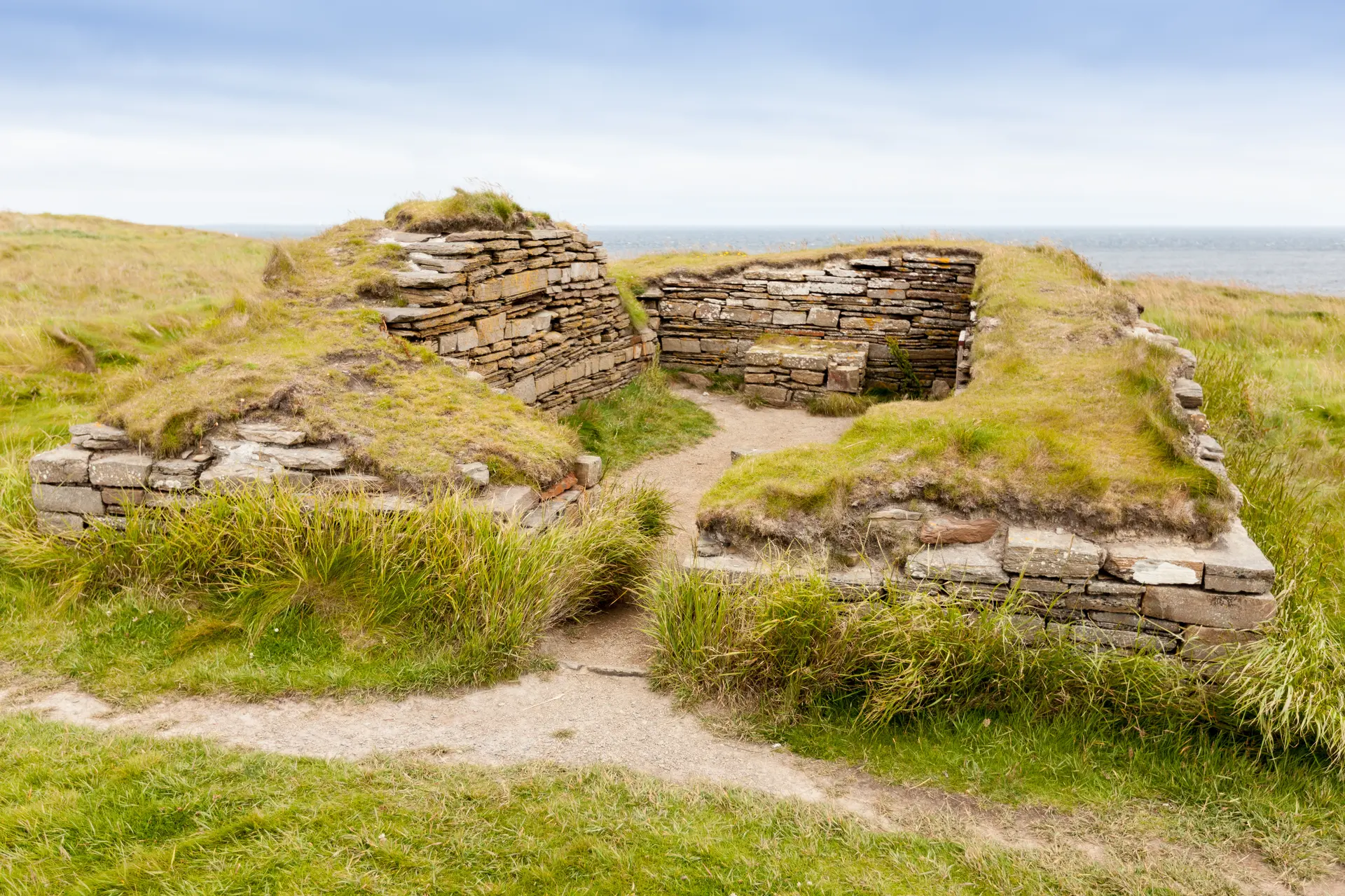
Image of Banks Chambered Tomb. Image source · CC-BY-4.0
Visit essentials
A quick read before you go
- Duration
- 2 hours including time to explore the surrounding coastline
- Etiquette
- A scheduled ancient monument on private land.
Overview
For five thousand years Banks lay sealed and undisturbed beneath a grassy mound on South Ronaldsay's clifftop farmland. In September 2010, Hamish Mowatt uncovered a stone chamber while levelling ground near his farmhouse; an underwater camera in the flooded space showed apparent human skulls where Neolithic hands had placed them. Scotland's first excavation of an undisturbed Neolithic burial in thirty years followed.
The Orkney Research Centre for Archaeology found an east-west passage about four metres long and seventy-five centimetres wide with five burial cells. Quarried from solid bedrock, a method unique in Orkney's normally above-ground, gathered-stone chambered cairns, the tomb suggests this place merited extraordinary labour. Layers of human bone separated by silt and thin slabs record adults, children, infants, and elders buried across three centuries, approximately 3344–3021 BC.
Otter bones and spraint occur in every layer: the animals entered between burials while the tomb stood open, giving the site its Tomb of the Otters name. Beside a young girl's bones lay a stone perhaps shaped as an otter head; whether keepsake or intentional symbol remains unknown after five thousand years.
Why this place is sacred
Most Neolithic tombs in Britain have been opened, emptied, robbed, reused, or collapsed before any modern hand reached them. Banks is different. When the chamber was breached in 2010, the bones still lay in the positions chosen by those who buried them. The layered deposits had not been shuffled by later disturbance. The silt between burial episodes had not been broken. The otter spraint still marked the boundary between one generation's dead and the next.
This preservation creates a quality of encounter that excavated and restored sites cannot replicate. To enter the tomb is to stand in a space that has been continuously sealed since the Neolithic people closed it for the last time. The air has not changed. The darkness has not been interrupted. The bones rest where intention placed them. There is also the matter of the otters.
In most interpretations, the otter remains are incidental, evidence that the tomb was left open between burial episodes and that coastal mammals wandered in. But the otters appear in every layer, across the full three centuries of the tomb's use. They were a constant presence alongside the human dead. Whether the builders tolerated the otters, welcomed them, or found meaning in their presence is unknowable.
But the result is a tomb where two species rest together, their bones interleaved through time. The otter-head stone found with the young girl adds complexity. It may be nothing more than a naturally shaped rock. It may be something deliberately placed. The ambiguity is itself significant. In a culture that left no written records, every object becomes a potential carrier of meaning, and every interpretation remains provisional. The clifftop location contributes its own quality.
South Ronaldsay's southern tip looks across the Pentland Firth toward the Scottish mainland, a threshold between the Orkney archipelago and the wider world. The nearby Tomb of the Eagles, just 574 metres to the southeast, held a similar concentration of human remains alongside bird bones. Two communities, or perhaps one community with two burial sites, chose this exposed coastal edge as the place to commit their dead to stone and earth.
The land falls away to the sea on three sides. The wind rarely ceases. The dead were placed where the elements are most present.
Communal burial tomb for a Neolithic farming community, used across approximately three centuries for the repeated interment of community members of all ages.
Constructed c. 3344 BC by quarrying into solid bedrock. Used for communal burial until c. 3021 BC, when the tomb was sealed. Remained undisturbed for approximately 5,000 years. Discovered accidentally on 16 September 2010 by Hamish Mowatt. Evaluation excavation by ORCA in November 2010. Partial excavation of one chamber and central passage revealed layered human and otter remains. DNA analysis by University of Copenhagen identified Middle Eastern genetic ancestry and Hepatitis B virus in two individuals.
Operated as a visitor attraction with guided tours from approximately 2014. Currently closed to the public.
Experience and orientation
The approach is unassuming. From the car park at Banks, a short path crosses farmland to a low mound that gives little indication of what lies beneath. South Ronaldsay is quiet country, sparsely populated, its fields running to cliff edges where the Pentland Firth churns below. The wind is the dominant presence, steady and salt-laden, carrying the sound of seabirds.
When the site operated as a visitor attraction, tours began in a small visitor centre where the story of the accidental discovery was told and artefacts displayed. The tour then moved outside to the tomb entrance, a low opening in the mound leading into the bedrock passage. Entering requires ducking low, stepping from daylight into stone-walled darkness. The passage is narrow, approximately seventy-five centimetres wide, and runs east to west for four metres.
The burial cells branch from this central corridor, small chambers where the dead once lay in their layered arrangement. The scale is intimate rather than monumental. This is not a grand cathedral of the dead but a close, dark space where a community placed its members one by one, generation after generation, for three hundred years. The contrast with the open Orkney sky outside is stark.
Above ground, the landscape extends in every direction: sea to the south and east, farmland to the north and west, the distant shapes of other islands on the horizon. Below ground, the world contracts to an arm's width of cut stone. The tomb holds both the expansiveness of the Orkney landscape and the intimacy of a space built to contain the dead.
Visitors who knew the site before its closure often describe the guided tour as deeply moving, particularly the moment of learning that bones still rest in their original positions in the unexcavated chambers. Five of the six cells have never been opened. What they contain, estimated at thousands of additional bones, remains as the Neolithic builders left it.
The tomb is located at Banks, Cleat, on the southern tip of South Ronaldsay. The entrance faces north. The central passage runs east to west. The Tomb of the Eagles (Isbister Chambered Cairn) lies 574 metres to the southeast. The Pentland Firth and the Scottish mainland are visible to the south.
Context and lineage
On 16 September 2010, Hamish Mowatt began levelling a mound of earth near his farmhouse and holiday cottages at Banks on South Ronaldsay. What he uncovered was the edge of a stone chamber. Looking inside the flooded space with an underwater camera, he saw what appeared to be human skulls. He contacted the authorities, and in November 2010, the Orkney Research Centre for Archaeology conducted evaluation excavations that confirmed the site as a Neolithic chambered tomb.
The discovery was remarkable for what had not happened: the tomb had not been disturbed since its Neolithic builders sealed it. The central passage, approximately four metres long by seventy-five centimetres wide, was aligned east to west, with five burial cells opening from it and one featuring an upper shelf. The chamber had been quarried from solid bedrock, a construction method with no parallel among the dozens of other chambered cairns in Orkney.
Excavation of one chamber and the central passage revealed human bones in multiple layers separated by silt and thin stone slabs. Radiocarbon dating placed the burials between 3344 and 3021 BC, indicating approximately three centuries of use. All age groups were represented, from very young infants to adults. In every layer, otter bones and otter spraint appeared alongside the human remains. The otters had entered the tomb during the intervals when the entrance stood open between burial episodes.
A deer antler and pottery fragments with four distinct incised patterns were also recovered. Among the most evocative finds was a natural stone resembling an otter's head, discovered beneath the bones of a young girl. Scratched symbols on interior stones, sealed since the tomb's closure, represent datable examples of Neolithic mark-making whose meaning remains undeciphered.
Banks Chambered Tomb belongs to the Orkney-Cromarty group of chambered cairns, a distinctly northern Scottish tradition of Neolithic mortuary architecture. Its closest neighbour is the Isbister Chambered Cairn (Tomb of the Eagles), 574 metres to the southeast, which held extensive human remains alongside white-tailed eagle bones and talons. Together they form a concentration of Neolithic burial monuments on the southeastern tip of South Ronaldsay.
The broader Orkney landscape contains dozens of chambered cairns including Maeshowe, Cuween Hill, Wideford Hill, and Unstan, all representing different expressions of the same cultural imperative to house the communal dead within permanent stone architecture.
Hamish Mowatt
ORCA (Orkney Research Centre for Archaeology)
University of Copenhagen
Traditions and practice
The Neolithic community at Banks practised communal burial over approximately three centuries. The dead were placed in layered deposits within the tomb's chambers, separated by silt and thin stone slabs marking successive episodes of interment. Pottery vessels with incised decoration and at least one possible symbolic stone were placed with the dead. The tomb was periodically opened and resealed, indicating ongoing engagement with the ancestral space. The final sealing of the tomb around 3021 BC ended its active use.
When the site operated as a visitor attraction, guided tours led visitors through the visitor centre and into the tomb itself. The experience of entering a 5,000-year-old burial space that had remained undisturbed became the primary form of contemporary engagement. The tour included interpretation of the discovery, the excavation, and the relationship between human and otter remains. Since the site's closure, the tomb is inaccessible to visitors.
If the site reopens, allow the confined darkness of the tomb to slow your attention. The passage is narrow and the chambers small; this intimacy is the point. Above ground, walk to the cliff edge and look south across the Pentland Firth. Consider visiting the nearby Tomb of the Eagles for a comparative experience of another South Ronaldsay chambered tomb. The two sites together present a concentrated encounter with Neolithic mortuary practice in a single landscape.
Orcadian Neolithic communal burial tradition
HistoricalBanks Chambered Tomb belongs to the Orkney-Cromarty group of chambered cairns, a Neolithic tradition of communal burial architecture found across northern Scotland. The tradition involved constructing permanent stone chambers for the repeated interment of community members over multiple generations. In Orkney, this tradition produced dozens of known chambered cairns, each representing a community's sustained engagement with its dead across centuries.
Communal burial of all community members. Layered deposition with natural separations between burial episodes. Periodic opening and resealing of the tomb. Placement of pottery and possible symbolic objects with the dead.
Orkney archaeological heritage
ActiveOrkney possesses one of the densest concentrations of Neolithic and Bronze Age monuments in Europe. The ongoing discovery and study of sites like Banks contributes to a living tradition of archaeological engagement with the deep past. The Heart of Neolithic Orkney World Heritage Site recognises the global significance of this landscape.
Archaeological excavation and analysis. DNA and pathogen analysis of ancient remains. Public engagement through visitor centres and guided tours. Community stewardship of archaeological sites by local landowners.
Perspectives and open questions
Banks Chambered Tomb sits at the intersection of accident and intention, a site whose significance emerges from both the deliberate choices of Neolithic builders and the chance preservation of five undisturbed millennia.
Scholarly perspective
Archaeologists classify Banks as an Orkney-Cromarty type chambered cairn, radiocarbon dated to approximately 3344-3021 BC. The site's primary scholarly significance lies in its undisturbed state, which allowed the study of burial layers as the Neolithic community arranged them. DNA analysis by the University of Copenhagen revealed Middle Eastern genetic ancestry consistent with the Neolithic farmer migration to Britain, and identified Hepatitis B virus in two adult individuals, representing some of the earliest British evidence of the disease.
The unique bedrock-quarried construction distinguishes Banks from other Orkney chambered cairns, all of which were built above ground from gathered stone. ORCA's evaluation excavation established the tomb's significance, but the majority of the site remains unexcavated, with five of six chambers still sealed.
Living and traditional perspectives
No surviving oral or written traditions relate specifically to Banks Chambered Tomb, which was unknown until its accidental discovery in 2010. The broader Orcadian landscape carries rich Norse and later Scottish traditions relating to ancient mounds and burial sites, including beliefs about the trows (supernatural beings) who were thought to inhabit prehistoric cairns.
Alternative interpretations
The co-presence of human and otter remains across all burial layers has generated speculation about totemic or symbolic relationships between Neolithic communities and specific animals. The nearby Tomb of the Eagles contained bird remains in a similar pattern, leading some researchers and commentators to propose that different South Ronaldsay communities may have identified with different animals. The otter-head stone found with the young girl adds weight to this possibility, though the evidence remains ambiguous.
Some visitors and writers have noted the concentration of Neolithic burial sites on this exposed coastal edge as suggesting the location itself held spiritual significance related to the threshold between land and sea.
Open questions
Why was this tomb quarried from bedrock when every other Orkney chambered cairn was built above ground? What do the scratched Neolithic symbols on interior stones signify? Were the otters tolerated visitors, welcomed guests, or symbolic presences? What relationship existed between the Banks community and those who used the Tomb of the Eagles 574 metres away? What lies in the five unexcavated chambers, and why was the tomb sealed around 3021 BC?
The otter-head stone invites but does not answer the question of whether it was placed with the girl by design or by chance.
Plan your visit
Access and arrival
St Margaret's Hope offers B&Bs and small hotels. Kirkwall (35 minutes by car) provides a wider range of accommodation. South Ronaldsay has limited but characterful options including the Skerries Bistro run by the Mowatt family.
Respectful visit
Warm, windproof clothing essential for the exposed Orkney coastline. Sturdy footwear for the walk to the tomb and the uneven ground. The tomb interior may be damp.
Permitted during guided tours, both inside and outside the tomb.
Not appropriate. This is a scheduled archaeological monument where any disturbance is illegal.
Guided tours only. Do not touch or remove stones, bones, or artefacts. Do not enter the tomb without a guide. The site is on private land.
The tomb chambers are very small and require crawling through a narrow passage. Those uncomfortable in confined spaces should be aware of this before entering. The clifftop location is exposed to strong winds year-round.
Current practical details
Address
B9041, St Margaret's Hope, Orkney KW17 2RW, UK
Hours, fees, and access can change — verify on the official source before you travel. Practical details last checked Jun 2026.
Location
Map loads as you approach this section.
Pilgrim reflections
A portrait of encounter, not a score
Pilgrims describe what they felt, how present they could become, and whether the place would shape a journey. There are no stars and no ranking of traditions.
No reviewed reflections yet
The first pilgrims can help describe the character of being here.
Share a reflection
Available after an account-backed “Been there.” Every reflection is reviewed before publication.
Nearby sacred places
Explore other sacred places in the region. Proximity does not establish access or travel time; check each place’s guidance.
References
Sources consulted for this page. Source categories describe the publication, not a guarantee that every claim is verified. Traditional accounts and outside interpretations may differ.
- 01Banks Chambered Tomb - VisitScotland — VisitScotlandofficialOfficial Scottish tourism body with basic site information
- 02Tomb of the Otters - Official Site — Tomb of the Otters / Hamish MowattofficialOfficial site run by the landowner with excavation details
- 03Tomb of the Otters Filled With Stone Age Human Bones - National Geographic — National GeographicSource contextNational Geographic coverage of the discovery with expert quotes
- 04Neolithic and medieval virus genomes reveal complex evolution of hepatitis B - eLife — Muhlemann et al.academicPeer-reviewed study referencing ancient DNA from Banks tomb individuals showing Hepatitis B virus
- 05Banks, chambered cairn 25m SW of, South Ronaldsay (SM13374) — Historic Environment ScotlandofficialScheduled monument designation record
- 06Banks Chambered Tomb [Tomb of the Otters] - The Megalithic Portal — The Megalithic PortalacademicDetailed archaeological database entry with coordinates, excavation history, DNA analysis results, and visitor information
- 07Banks tomb - Wikidata — WikidataSource contextStructured data entry with identifiers
- 08Banks (Chambered Tomb) - The Modern Antiquarian — The Modern AntiquarianacademicSpecialist antiquarian site with community contributions
- 09Tomb of the Otters, Orkney - symbols and sculpture? — Sarsen.orgacademicAnalysis of scratched Neolithic symbols and the otter-head stone
- 10Banks Chambered Tomb - Lonely Planet — Lonely PlanetguideTravel guide with visitor-oriented details
- 11Tomb of the Otters - Scotland Off the Beaten Track — Scotland Off the Beaten TrackguideDetailed visitor account and practical information
Share a photo
Help visitors recognize Banks Chambered Tomb. Every submission is reviewed before publication.