Rocio, Basilica of Nuestra Señora del Rocio
Where a million pilgrims cross marshland to carry their Virgin through the night
Understand sacred places, explore living traditions, and learn how to engage respectfully with Pilgrim Map.
Access has not been verified. Check current local guidance before planning a visit.
Almonte, Huelva, Spain
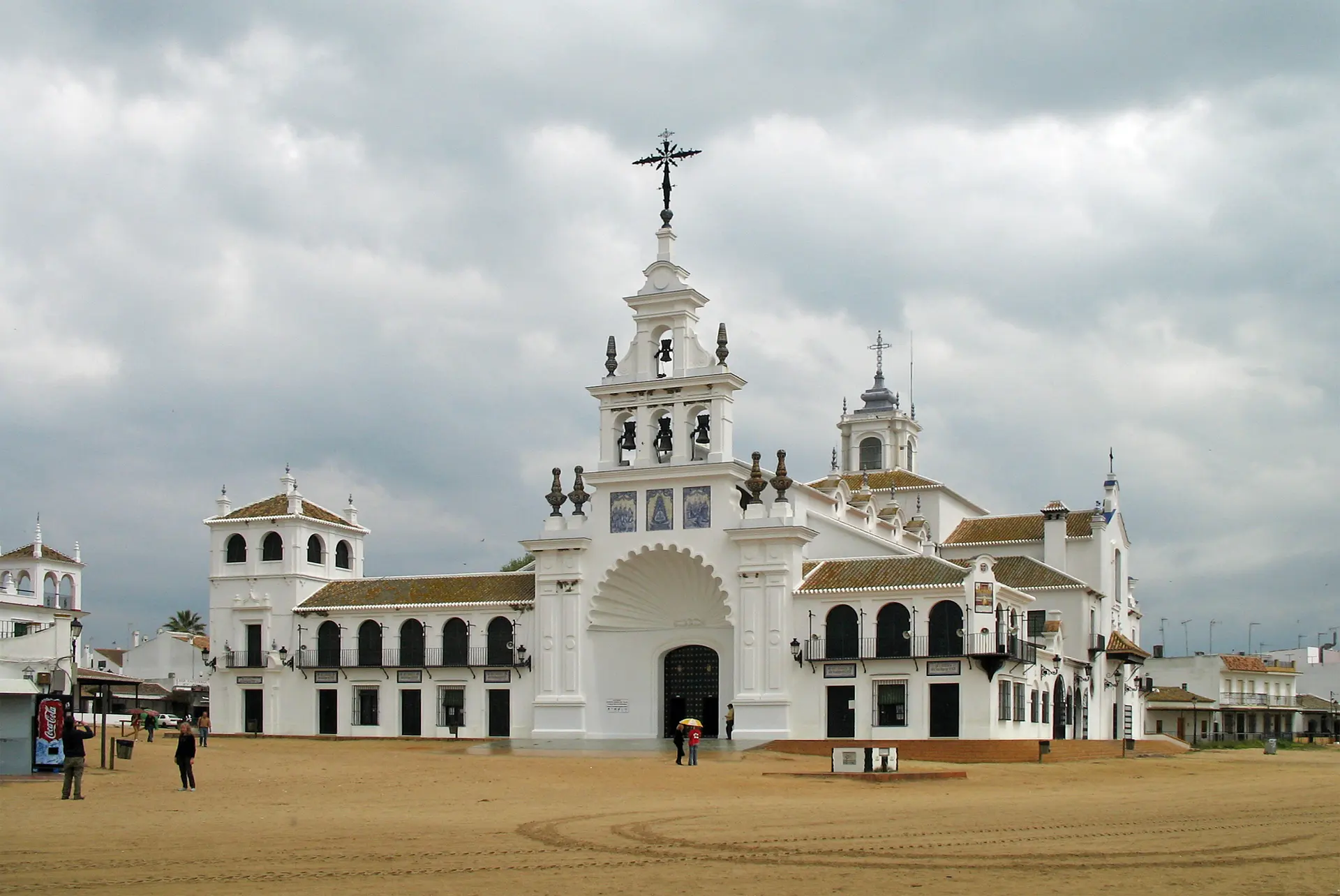
Image of Rocio, Basilica of Nuestra Señora del Rocio. Image source · CC-BY-SA-4.0
Visit essentials
A quick read before you go
- Duration
- Half-day for the sanctuary and village.
- Access
- El Rocío is approximately 80 km southwest of Seville, reached via the A-49 motorway and A-483…
Overview
El Rocío is an Andalusian village of unpaved sand streets, more horses than cars, and air scented by marshwater and rosemary beside one of Europe's last great wetlands. For most of the year its few hundred residents live quietly; at Pentecost, approximately one million pilgrims arrive on foot through Doñana, on horseback, and in decorated ox-carts crossing rivers and sand. More than 120 brotherhoods bring their banners, songs, and inherited traditions for the Virgen del Rocío.
Legend says a hunter found the Virgin's statue in an ancient tree and, after trying to take it away, woke to find it returned there. A hermitage marked her chosen threshold between settlement and wilderness. In 1653, a downpour after Almonte petitioned her during drought gave her the name Nuestra Señora del Rocío, Our Lady of the Dew.
The 1969 Andalusian-regionalist sanctuary houses the small medieval statue in elaborate vestments, but devotion fills the multi-day journey, sevillanas rocieras around campfires, brotherhood-banner presentation, and the salto de la reja, when men of the Hermandad de Almonte vault the iron fence and carry the Virgin into the streets. Devotees call this embodied intensity prayer with muscles.
Why this place is sacred
The thinness of El Rocío begins not at the sanctuary but on the road. The pilgrimage routes cross rivers, marshlands, and scrubland, requiring days of walking, riding, or traveling by ox-cart. The physical labor is the point. Sleep deprivation, shared meals cooked over campfires, devotional songs echoing across the wetlands at night: these communal experiences gradually dissolve the boundaries between individual pilgrims and between the ordinary world and the sacred.
The village itself deepens this threshold quality. El Rocío has no paved roads. Horses and riders move through sandy streets that belong to another century. The low white buildings with their open porches face the marshlands where flamingos and herons wade. Visitors describe a disorienting temporal dislocation, as if the modern world has been left behind at some unmarked border.
The sanctuary sits at the precise edge of human settlement, where the village ends and the Doñana wetlands begin. This is the geography of the original legend: the Virgin chose to remain not in a town but in the wild, in the hollow of a tree at the boundary between civilization and wilderness. The pilgrimage reenacts the crossing of that boundary.
The thinning reaches its climax on Monday night. By this point, pilgrims have walked for days, slept little, sung until their voices are raw. In the early hours of Pentecost Monday, men from the Hermandad de Almonte scale the iron fence surrounding the altar and carry the small, ornately dressed statue into the streets. The crowd surges. The air fills with cries of devotion.
The experience combines extreme physical intensity with emotional catharsis in a collective moment that participants struggle to articulate afterward. Even self-described atheists report being moved by the force of collective devotion.
The Pentecost timing adds a theological layer: the feast of the Holy Spirit descending, of barriers between languages dissolving, of ordinary people receiving extraordinary gifts. The marshlands at this season teem with migrating birds, wildflowers, and extending daylight. The natural world echoes the liturgical themes of renewal.
The original hermitage was built to honor a miraculous statue discovered in the marshlands. The devotion began as a local veneration maintained by the people of Almonte, centered on protecting their community and its agricultural prosperity. The 1653 rain miracle cemented the Virgin's role as intercessor against drought.
From a local hermitage devotion, El Rocío grew into a regional and then national pilgrimage. The brotherhood system expanded from the founding Hermandad de Almonte to over 120 affiliated brotherhoods across Spain. The current sanctuary replaced earlier structures in 1969. The Romería has been celebrated at Pentecost since 1758. Television broadcasts since the late 20th century brought the pilgrimage to national consciousness, though the heart of the devotion remains the physical journey and the brotherhood community.
Experience and orientation
If you visit outside the Romería, approach El Rocío from the north along the A-483. The landscape shifts from agricultural Andalusia to something wilder: umbrella pines, matorral scrubland, and then the flat expanse of the marshlands opening to the south. The village appears suddenly, its low white buildings lining sandy streets that have never been paved.
Walk the Paseo Marismeño, the wide sandy avenue that separates the village from the marshlands. In spring, flamingos may be visible in the shallow waters beyond. The sanctuary stands at the avenue's western end, its white façade and twin towers facing the wetlands.
Inside, the space is surprisingly luminous. The Virgen del Rocío, known affectionately as La Blanca Paloma, sits behind an iron fence in her ornate vestments, a small medieval figure almost lost in her elaborate robes. In the quiet of a non-festival visit, you can observe devotees approaching the reja to pray, light candles, and speak to her in the intimate Andalusian manner that treats her as a living presence rather than an artifact.
During the Romería, the experience transforms entirely. The village fills with hundreds of thousands of people. Decorated ox-carts line the streets. The sounds of sevillanas rocieras, flamenco-inflected devotional songs, fill the air from every direction. The formal presentation of brotherhood banners before the sanctuary takes approximately 36 hours. Riders in traditional traje corto and women in flamenco dresses move through the sand in processions that blend solemnity with festive exuberance.
The climax arrives in the early hours of Monday. After days of journeying, singing, and praying, the Hermandad de Almonte exercises its ancient privilege. Men scale the iron fence, and the Virgin is lifted from her altar and carried into the streets. The crowd presses in. The experience is visceral, overwhelming, and profoundly communal. There is nothing quite like it in European religious life.
The sanctuary is the focal point, but the village itself and the surrounding marshlands are integral to the experience. The Paseo Marismeño offers the best vantage for both the marshlands and the sanctuary. The Centro de Información Las Rocinas, approximately 1 km south, provides context on the Doñana ecosystem. For the Romería, arrive before the weekend and secure accommodation well in advance.
Context and lineage
The founding legend tells of a hunter who discovered a carved image of the Virgin Mary hidden in the hollow of an ancient tree in the marshlands of La Rocina. When he tried to carry her to his town, he fell asleep and woke to find she had returned to the tree. Interpreting this as the Virgin's desire to remain in that wild place, the local community built a hermitage at the site.
The legend was first committed to writing in the mid-18th century, roughly four centuries after the events it describes, making the historical kernel uncertain.
In 1653, severe drought threatened the crops and livelihood of Almonte. The townspeople carried the statue to a shaded spot and implored the Virgin for rain. When a sudden downpour followed, the community named her Nuestra Señora del Rocío, Our Lady of the Dew, and declared her patron saint of Almonte on June 29 of that year.
The devotion belongs to the broader tradition of Andalusian popular Catholicism, which integrates official Church liturgy with deeply personal and communal expressions of faith. The brotherhood system, through which more than 120 hermandades organize the pilgrimage, represents a distinctive lay-controlled structure that gives the devotion its vitality. The Hermandad Matriz de Almonte, founded in the 14th century, holds primacy and the exclusive privilege of carrying the Virgin during the Monday procession.
Unknown Neolithic-era statue creator
Original sculptor
Alfonso X (Alfonso the Wise)
Likely patron of original hermitage during the Reconquista
Antonio Delgado y Roig and Alberto Balbontín de Orta
Architects of the current sanctuary
Juan Talavera y Heredia
Architect whose 'white regionalism' inspired the sanctuary's style
Traditions and practice
The Romería follows a pattern refined over centuries. Each brotherhood departs from its home city days before Pentecost, traveling by traditional routes through the Doñana marshlands on foot, horseback, or in decorated ox-carts called carretas. The journey itself is devotional practice: shared meals, campfire singing of sevillanas rocieras, and the daily rhythm of walking create communal bonds that participants describe as transformative.
On arrival, each brotherhood formally presents its simpecado, an ornate banner depicting the Virgin, before the sanctuary in a procession that takes approximately 36 hours. The Solemn Pontifical Mass, celebrated by the Bishop of Huelva on Pentecost Sunday morning, draws tens of thousands to the Paseo Marismeño.
The culmination is the salto de la reja. In the early hours of Pentecost Monday, men from the Hermandad Matriz de Almonte vault over the 1.2-meter iron fence surrounding the altar. They lift the Virgin's statue and carry it in procession through the village streets. This tradition, established around 1975 in its current form, channels the devotion's emotional climax into a single collective act.
Every seven years, the Traslado transfers the statue to the parish church in Almonte, 15 kilometers away, where it remains for several months before returning. This periodic displacement and return reinforces the bond between the Virgin and her original community.
Daily Mass and Rosary are celebrated at the sanctuary year-round. Visitors may light candles, pray before the Virgin, and attend services without formal affiliation. Brotherhood communities maintain year-round activities including charitable works, cultural events, and pilgrimage preparation. The musical tradition of sevillanas rocieras remains vibrant, with new compositions appearing alongside centuries-old songs.
For a contemplative encounter, visit outside the Romería period and spend time before the Virgin in the quiet sanctuary. Walk the Paseo Marismeño at dawn when the marshlands are most alive with birdlife. If attending the Romería, consider joining a brotherhood's caravan with permission, which allows participation in the communal journey rather than merely observing the destination.
Roman Catholic Marian Devotion
ActiveEl Rocío represents one of the most passionate expressions of Marian devotion in the Catholic world. The Virgin of El Rocío, known as La Blanca Paloma, is the patron of Almonte and one of Spain's most venerated Marian images. The devotion combines official Church liturgy with deeply personal, embodied expressions of faith. The Virgin received Canonical Coronation in 1919.
Daily Mass and Rosary at the sanctuary; annual Romería pilgrimage at Pentecost drawing approximately one million devotees; presentation of simpecados before the Virgin; the salto de la reja; periodic traslados every seven years; Solemn Pontifical Mass celebrated by the Bishop of Huelva on Pentecost Sunday.
Andalusian Brotherhood (Hermandad) Tradition
ActiveThe devotion is inseparable from the hermandad system. Over 120 brotherhoods organize the pilgrimage, each with its own identity, banner, songs, dress, and traditions. The Hermandad Matriz de Almonte, founded in the 14th century, holds primacy. The brotherhoods serve as year-round communities of faith, mutual aid, and cultural preservation.
Each brotherhood makes the multi-day pilgrimage on foot, horseback, or in decorated ox-carts, camping along traditional routes. Shared meals and flamenco-inflected devotional singing mark the journey. Formal presentation of each brotherhood's simpecado before the Virgin follows at the sanctuary. The Hermandad de Almonte alone holds the privilege of carrying the Virgin during the Monday procession.
Perspectives and open questions
El Rocío sits at the intersection of multiple interpretive frameworks: Catholic Mariology, Andalusian cultural identity, anthropological studies of pilgrimage, and ecological consciousness tied to the Doñana wetlands. These perspectives illuminate different facets of a devotion that resists simple categorization.
Scholarly perspective
Scholars regard El Rocío as one of the most significant examples of popular Catholic devotion in Europe, notable for its lay-controlled brotherhood structure, the integration of Andalusian cultural identity with religious practice, and its continued growth despite broader secularization trends in Spain. The founding legend follows a common medieval pattern of miraculous image discovery that legitimized Reconquista-era devotions. Art historians date the statue to 1280-1335 with French stylistic origins.
The current expression of the mass pilgrimage dates primarily to the 18th-19th centuries, with the brotherhood system providing organizational continuity.
Living and traditional perspectives
Within Andalusian Catholic tradition, the Virgin of El Rocío is understood as a living presence who chose her location in the marshlands and continues to intercede for her devotees. The 1653 rain miracle is foundational. Devotees describe a deeply personal relationship: one is reported saying, 'When I saw her in the street and speak with her and to see that she is looking at me.' The physical ordeal of the pilgrimage is understood as prayer offered with the body.
The brotherhoods preserve communal structures of mutual aid and collective identity that predate modern individualism.
Alternative interpretations
The Doñana marshlands were known in antiquity as the possible location of Tartessos and carry pre-Christian associations with water, fertility, and liminal landscapes. The convergence of water, wilderness, and Marian devotion at El Rocío echoes broader patterns of Marian shrines at springs, caves, and wild places across Catholic Europe. The ecstatic, embodied character of the devotion, with its singing, dancing, sleep deprivation, and physical exertion, has parallels with non-Christian pilgrimage traditions worldwide.
Open questions
The precise origins of the devotion remain uncertain. The founding legend was first written down approximately 400 years after the events it describes. The identity of the statue's maker and the circumstances of its placement in the marshlands are unknown. Why this particular location, at the edge of a vast wetland, became one of Europe's most powerful pilgrimage destinations rather than any number of similar marshland shrines remains a question that historical evidence alone cannot fully answer.
Plan your visit
Access and arrival
El Rocío is approximately 80 km southwest of Seville, reached via the A-49 motorway and A-483 road. The nearest significant town is Almonte, 15 km north. No public transport runs directly to El Rocío outside the Romería period. During the Romería, special bus services operate from Seville and Huelva. The village streets are unpaved sand, requiring sturdy footwear. Wheelchair access to the sanctuary exists but the sandy streets present challenges.
Accommodation in El Rocío is limited and books far in advance for the Romería. Almonte and Matalascañas offer additional options. Year-round, several small hotels and guesthouses operate in the village. Camping is integral to the Romería experience for brotherhood members.
Respectful visit
No strict dress code for the sanctuary; modest attire covering shoulders and knees is appropriate. During the Romería, traditional Andalusian dress is the cultural norm. Comfortable footwear is essential at all times, as the village streets are unpaved sand. Sun protection is critical in the Andalusian climate.
Photography is generally permitted both inside the sanctuary and during the Romería processions. During the salto de la reja and Monday procession, the crowd density makes photography challenging and visitors should prioritize personal safety.
Candles and flowers are traditional offerings at the sanctuary. Many pilgrims carry personal petitions or ex-votos. Monetary donations support the brotherhoods and sanctuary maintenance.
The statue of the Virgin is behind an iron fence and cannot be touched except during the Monday procession by designated carriers from the Hermandad de Almonte. Visitors should give way to brotherhood processions.
The Romería involves extreme crowding, with approximately one million people in a small village. Accommodation must be booked months in advance. The Monday night procession involves intense crowd pressure; maintain awareness of exits and protect children. Summer heat in this part of Andalusia regularly exceeds 40 degrees Celsius. Carry ample water.
Current practical details
Address
C. Ermita, s/n, 21750 El Rocío, Huelva, Spain
Phone
Hours
Hours, fees, and access can change — verify on the official source before you travel. Practical details last checked Jun 2026.
Location
Map loads as you approach this section.
Pilgrim reflections
A portrait of encounter, not a score
Pilgrims describe what they felt, how present they could become, and whether the place would shape a journey. There are no stars and no ranking of traditions.
No reviewed reflections yet
The first pilgrims can help describe the character of being here.
Share a reflection
Available after an account-backed “Been there.” Every reflection is reviewed before publication.
Nearby sacred places
Explore other sacred places in the region. Proximity does not establish access or travel time; check each place’s guidance.


Share a photo
Help visitors recognize Rocio, Basilica of Nuestra Señora del Rocio. Every submission is reviewed before publication.