The Giants' Tomb of Osono
From burial ground to tomb-sanctuary, Osono witnessed transformation in how the Nuragic people honored their dead
Understand sacred places, explore living traditions, and learn how to engage respectfully with Pilgrim Map.
Access has not been verified. Check current local guidance before planning a visit.
Triei, Nuoro, Italy
Read the sources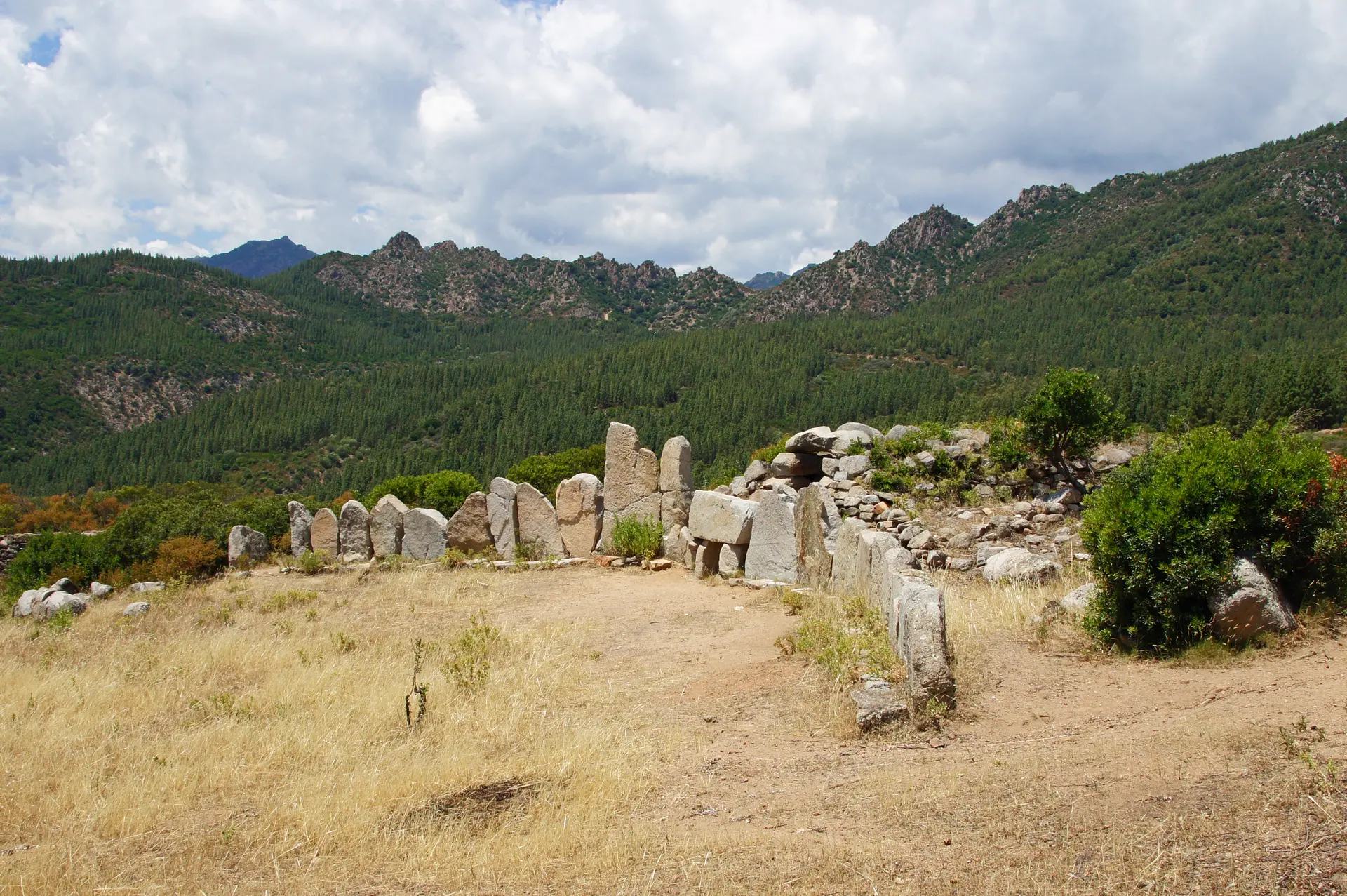
Image of The Giants' Tomb of Osono. Image source · CC-BY-SA-2.5
Visit essentials
A quick read before you go
- Duration
- 30 minutes to 1 hour; longer if combining with nearby Bau Nuraxi.
- Etiquette
- Respect the restored tomb through careful movement and contemplative behavior.
Overview
Local tradition calls the Giants' Tomb of Osono 's'ischisorgeddu' — the hiding place of the treasure. Archaeologists found not gold but evidence of how the Nuragic relationship with death evolved over millennia.
During the Early Bronze Age, the community used the tomb for collective interment, building the exedra and extending the corridor. In a second phase, it became a tomb-sanctuary where funerary rites continued after its primary burial function ended. The living maintained connection across death through ritual at a permanent point of contact with ancestors resting elsewhere.
Mario Sanges's 1989-1990 excavation documented this transformation and enabled the 1993 restoration that makes Osono accessible today. Evidence of use into the third century AD shows more than two thousand years of sacred continuity.
Green fields in the Osono valley frame the tomb, with views toward the Supramonte of Baunei. The landscape remains essentially as the Nuragic builders chose it; the site's treasure is the accumulated devotion of two millennia.
Why this place is sacred
The thinness at Osono crystallizes in the transformation from tomb to tomb-sanctuary. At some point during the Bronze Age, the Nuragic community stopped bringing bodies to this place but continued coming themselves. The dead had been interred; the living kept returning.
This shift indicates sophisticated understanding of sacred geography. A site can accumulate power through use, becoming thin not because of what it physically contains but because of what has happened there. The ancestors buried in the first phase had made Osono sacred; the rituals of the second phase maintained that sacredness even as burial practice ceased.
The evidence of third-century AD activity extends this pattern remarkably. For over two thousand years, people continued to recognize something special about this valley location. The Nuragic religion ended, Roman rule came and went, but Osono retained significance that transcended specific religious frameworks.
The local name 's'ischisorgeddu'—hiding place of treasure—preserves folk awareness that something valuable lies concealed here. The treasure-hunting legend may misunderstand what the site holds, but it correctly identifies Osono as a place where something worth seeking can be found.
The 1989-1990 excavation and 1993 restoration transformed understanding without diminishing mystery. We know now that the tomb evolved through two phases, that use continued for millennia, that the Nuragic people developed their practices over time. What we cannot know is precisely what happened in the sanctuary phase—what rituals were performed, what the living sought from their connection with the dead.
The valley setting adds to the thin quality. The green plain with its views of the Supramonte creates contained space that feels set apart. To enter Osono is to enter a landscape that has supported sacred activity for four thousand years.
First phase (Early Bronze Age): burial site for collective interment. Second phase (Middle/Recent/Final Bronze Age): tomb-sanctuary where funerary rites continued after primary burial use ended.
Used from Early Bronze Age through third century AD—over two thousand years of sacred activity. Excavated by Mario Sanges 1989-1990. Restored with repositioning of exedra and orthostats in 1993.
Experience and orientation
The approach to Osono leads through the Ogliastra landscape—eastern Sardinia where mountains meet sea and valleys hold secrets in their folds. From Triei, follow SP 55 toward Lotzorai; the signposted turnoff leads to the site through green fields framed by hills.
The tomb emerges from the landscape with the authority of restoration that respects original form. The 1993 work repositioned exedra and orthostats based on careful archaeological documentation, making visible what millennia had partially obscured. You see now what Nuragic mourners saw, albeit filtered through modern conservation practice.
The exedra curves in the characteristic bull's-horn shape, creating forecourt space where funerary ceremonies took place. During the first phase, bodies were processed here before interment in the corridor tomb. During the sanctuary phase, the rituals continued without bodies—the living coming to honor ancestors buried elsewhere or in earlier times.
Spend time considering this transformation. What would it mean for a burial site to become something else—not abandoned, but evolved? The community that built Osono understood something about sacred places that contemporary culture often misses: that a location can accumulate power through use, becoming a permanent resource for connection with transcendent realms.
The valley's peaceful setting supports contemplation. Views toward the Supramonte of Baunei create dramatic backdrop; the green fields that surround the tomb have been worked for millennia. Nearby, the nuraghe of Bau Nuraxi (approximately 2 km) suggests the settlement that may have used this tomb.
Local tradition's name 's'ischisorgeddu' invites treasure-seeking imagination. The treasure you find at Osono is not gold but understanding—of how the Nuragic people developed their relationship with death across generations.
From Triei, take SP 55 toward Lotzorai. After 1 km, turn right at intersection for sports field, then after 100m turn right again following signs. Free access to outdoor site. Allow 30 minutes to 1 hour; longer if combining with nearby Bau Nuraxi nuraghe.
Context and lineage
The Giants' Tomb of Osono was built during the Early Bronze Age as a collective burial site for the Nuragic community of the Ogliastra region. Like other Giants' Tombs, it featured the curved exedra and corridor tomb that characterized Nuragic funerary architecture.
At some point, transformation occurred. The site evolved from burial ground to tomb-sanctuary—a sacred location where funerary rites continued to be practiced even after bodies were no longer interred. This second phase demonstrates sophisticated Nuragic understanding of how sacred places function.
Archaeologist Mario Sanges's 1989-1990 excavation documented this two-phase history. Evidence showed use extending from the Bronze Age through the third century AD—remarkable continuity that transcended the end of Nuragic civilization and continued into the Roman Imperial period.
The 1993 restoration repositioned the exedra and orthostats, making the tomb one of the most comprehensible Giants' Tombs to visit. The work respected archaeological documentation while enabling contemporary visitors to understand the original architecture.
Local tradition preserved awareness of the site's significance through the name 's'ischisorgeddu'—hiding place of treasure. While no material treasure was found, the name correctly identified Osono as a place where something valuable lay concealed.
Built by Nuragic civilization (Early Bronze Age), transformed to tomb-sanctuary (Middle/Recent/Final Bronze Age), continued use into Roman Imperial period (3rd century AD). Excavated 1989-1990, restored 1993.
Mario Sanges
Archaeologist
Traditions and practice
First phase: collective burial with funerary rites. Second phase: tomb-sanctuary rituals maintaining connection with ancestors without active burial. The transformation indicates evolving Nuragic understanding of sacred space.
Archaeological appreciation and cultural tourism. The site's comprehensible restoration makes it valuable for understanding Nuragic funerary traditions.
Approach with awareness of the site's transformation from burial to sanctuary. Contemplate what it would mean for a community to continue rituals at a tomb where burial had ceased. Visit nearby Bau Nuraxi nuraghe to understand the settlement context.
Nuragic Burial and Sanctuary Practices
HistoricalOsono demonstrates the evolution of Nuragic funerary traditions from burial to tomb-sanctuary. This transformation indicates sophisticated understanding of how sacred places function—accumulating power through use that transcends original purpose.
First phase: collective burial with funerary rites. Second phase: sanctuary practices maintaining ancestral connection. The continuation into the third century AD shows remarkable cultural continuity.
Perspectives and open questions
Osono can be understood as evidence of evolving Nuragic burial practices, as a tomb-sanctuary demonstrating sophisticated understanding of sacred space, or as testimony to continuity of sacred use across two millennia.
Scholarly perspective
Archaeologist Mario Sanges's excavation established the site's significance for understanding how Nuragic practices evolved. The transformation from burial to tomb-sanctuary demonstrates that Giants' Tombs could serve multiple functions across time.
Living and traditional perspectives
The local name 's'ischisorgeddu' (hiding place of treasure) preserves folk awareness of the site's significance even when original meaning was forgotten.
Alternative interpretations
The site's long history of sacred use and dramatic natural setting attract visitors interested in contemplation and connection with ancient spirituality.
Open questions
The specific rituals performed during the tomb-sanctuary phase remain undocumented. The nature of third-century AD activity at the site invites further research. What 'treasure' the folk tradition refers to remains mysterious.
Plan your visit
Access and arrival
Accommodation available in Triei and nearby coastal towns.
Respectful visit
No specific requirements. Sturdy shoes recommended for rural terrain.
Photography permitted.
Not appropriate at archaeological sites.
Respect the restored structures. Stay on paths and designated areas.
Rural terrain; may present challenges for mobility-impaired visitors.
Current practical details
Address
Tomba dei Giganti Ósono, 08040 Triei OG, Italy
Phone
Hours
Hours, fees, and access can change — verify on the official source before you travel. Practical details last checked Jun 2026.
Location
Map loads as you approach this section.
Pilgrim reflections
A portrait of encounter, not a score
Pilgrims describe what they felt, how present they could become, and whether the place would shape a journey. There are no stars and no ranking of traditions.
No reviewed reflections yet
The first pilgrims can help describe the character of being here.
Share a reflection
Available after an account-backed “Been there.” Every reflection is reviewed before publication.
Nearby sacred places
Explore other sacred places in the region. Proximity does not establish access or travel time; check each place’s guidance.

References
Sources consulted for this page. Source categories describe the publication, not a guarantee that every claim is verified. Traditional accounts and outside interpretations may differ.
- 01The giant's grave of Osono - La Sardegna verso l'Unesco — La Sardegna verso l'UnescoSource contextUNESCO candidacy documentation
- 02Triei, Tomb of the Giants of Osono - Sardegna Cultura — Sardegna CulturaofficialOfficial regional cultural site
- 03Tomba di Giganti di Osono - Sardegna Turismo — Sardegna TurismoofficialOfficial tourism information
- 04Tomba dei giganti di Osono - AroundUs — AroundUsSource contextLocation details and coordinates
- 05Giants' grave - Wikipedia — Wikipedia contributorsencyclopediaGeneral reference
Share a photo
Help visitors recognize The Giants' Tomb of Osono. Every submission is reviewed before publication.