The Archaeological Park of Alto de las Piedras
Where the Double Self stands guard over a thousand years of transformation between human and divine
Understand sacred places, explore living traditions, and learn how to engage respectfully with Pilgrim Map.
Access has not been verified. Check current local guidance before planning a visit.
Huila, Huila, Colombia

Visit essentials
A quick read before you go
- Duration
- One to two hours for the park itself.
- Access
- Located in the Las Delicias hamlet, seven kilometers from Isnos, Huila Department, Colombia.
Overview
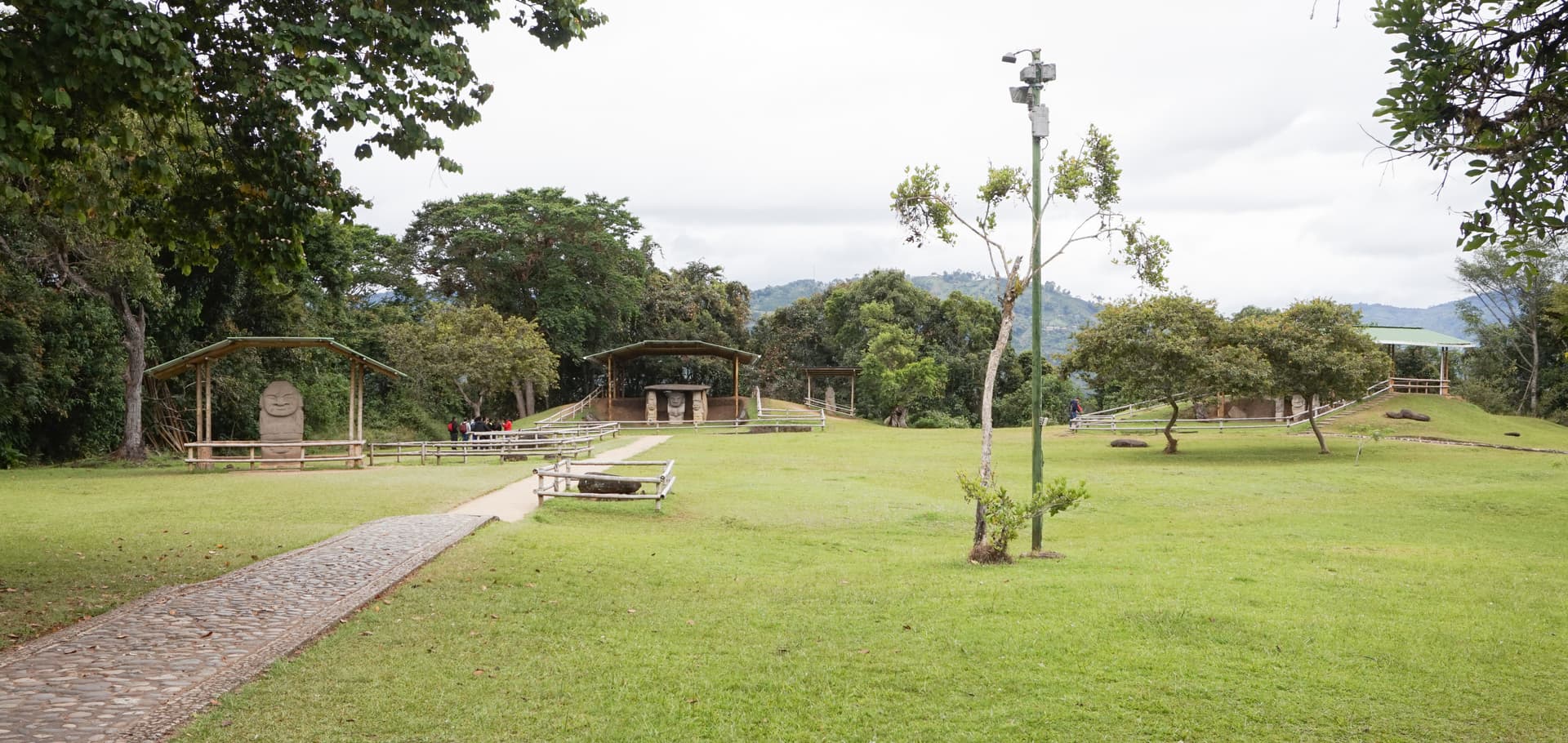
For approximately a thousand years, people no longer lived at Alto de las Piedras; they came only to bury their dead. The San Agustin people reserved this hilltop near Isnos, roughly 1,840 meters high in the Colombian highlands, for nine centuries after abandoning it as a settlement.
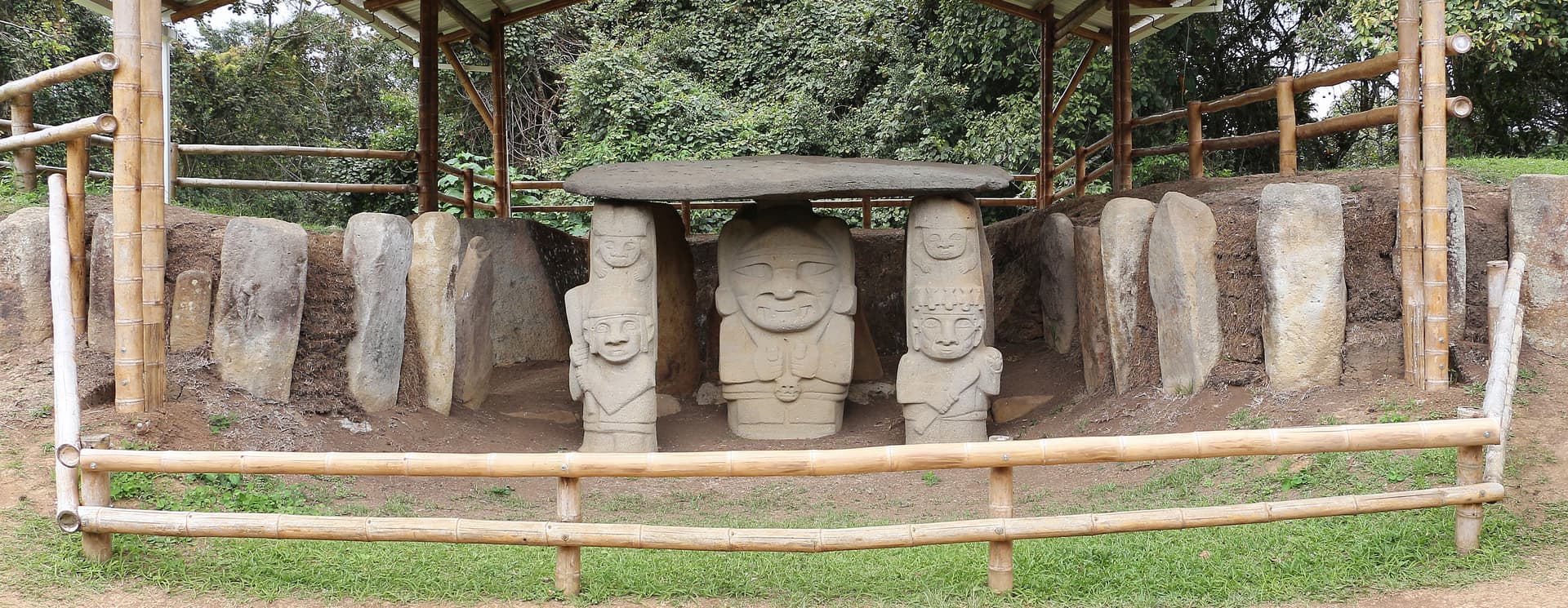
Eleven monumental statues remain. El Doble Yo—the 1.94-meter Double Self—carves four figures as one in volcanic stone: a human-feline being merging with a bestial alter ego above while a crocodile-like creature rides its back, linking the human realm to the underworld. More cosmic diagram than portrait, it expresses human identity as a meeting place of forces.
Painted burial chambers preserve centuries-old colors whose meanings remain enigmatic. Deep graves hold monolithic sarcophagi cut from single stone blocks, evidence of care beyond practical necessity. Alto de las Piedras belongs to the San Agustin Archaeological Park UNESCO World Heritage Site, inscribed in 1995. Quieter and less visited than the main park, it leaves space to contemplate death and transformation.
Why this place is sacred
The decision to maintain a site solely for burial after ceasing to live there is not trivial. It implies that the place itself held a quality that domestic use would compromise. The San Agustin people who continued to return to Alto de las Piedras for nine hundred years to bury their dead were making a statement about the nature of this ground: it belonged to the dead, and the dead required a place of their own.
El Doble Yo makes the theoretical framework visible. The four figures carved as one, human and jaguar and alter ego and underworld creature, are not four beings but four aspects of a single reality. In the San Agustin understanding, the boundary between human and animal, between the living and the dead, between the surface world and the underworld, was not a wall but a membrane.
Shamanic transformation, the ability to become jaguar or eagle or serpent, was not metaphor but technology: the means by which certain individuals could cross the boundaries that ordinary people could not.
The burial chambers reinforce this reading. The dead were not simply placed in the ground. They were placed in deep graves, in monolithic sarcophagi carved from single blocks of stone, accompanied by guardian statues, surrounded in some cases by painted walls. The effort invested in each burial far exceeded what was practically required, suggesting that the process of burial was itself ceremonial, each step a ritual enactment of the transformation the dead were understood to undergo.
The painted chambers are particularly evocative. Colors that have survived centuries underground, applied by hands that understood something about death that their language has not transmitted to us. The paintings remain, their meanings inaccessible, their presence sufficient to confirm that the dead were sent off with beauty.
Alto de las Piedras served first as a residential settlement and burial ground from approximately 1000 BCE. Around the first century CE, residential use ceased, and the site was maintained exclusively as a funerary and ceremonial ground for the next nine hundred years. The monumental statues served as guardians of the dead, and the deep graves with sarcophagi housed elite individuals who were understood to undergo transformation in death.
The shift from residential to exclusively funerary use around the first century CE marks the most significant transition in the site's history, elevating it from a place where people lived and died to a place reserved entirely for death and the ceremonies that accompanied it. The continued carving and placement of statues through the ninth century indicates that the site's sacred significance intensified rather than diminished over time.
After the decline of the San Agustin sculptural tradition, the site passed out of active use. Konrad Theodor Preuss documented it in 1914, initiating the modern archaeological engagement. UNESCO inscription in 1995 brought international recognition and conservation standards.
Experience and orientation
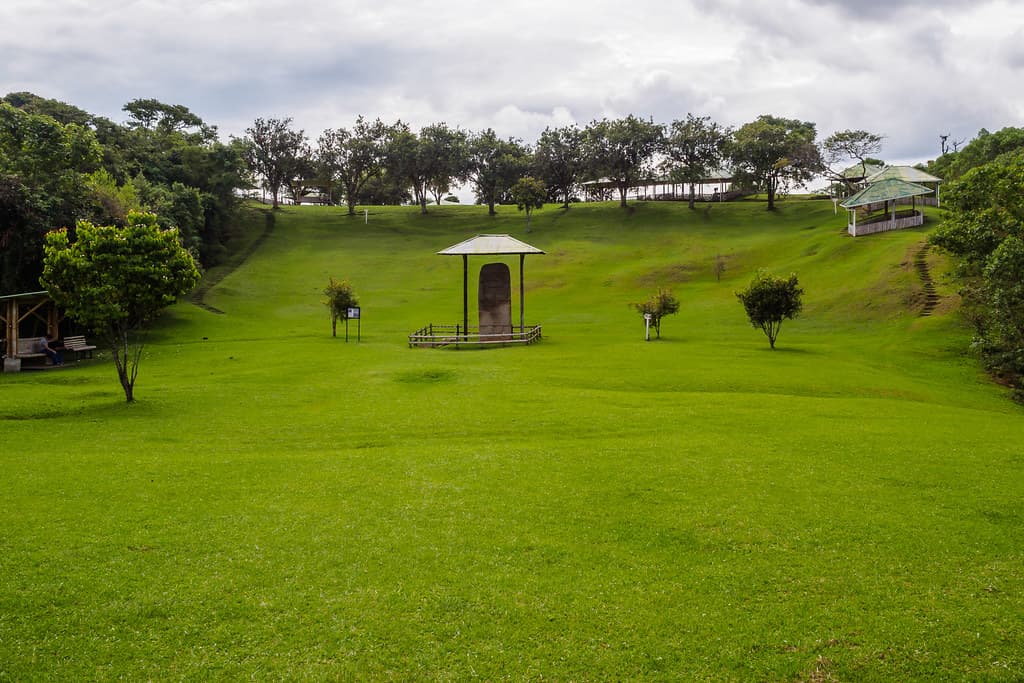
The approach crosses the Colombian highlands' agricultural landscape from Isnos, seven kilometers away. On the hilltop at approximately 1,840 meters, elevation brings cool, clear air; compared with the busy main San Agustin park, Alto de las Piedras is often quiet.
Nearly two meters tall and carved from volcanic stone, El Doble Yo commands prolonged attention. Its human-feline face, bestial figure above, and crocodile on the back communicate urgency across millennia. Circling reveals shifting relationships among the four figures; realizing that all are carved as one, from a single block, changes the image from scene to statement.
Only eleven statues stand here, rather than the main park's hundreds, allowing individual attention. Supernatural beings with exposed teeth and solemn guardians vary within a shared San Agustin vocabulary, suggesting individual responses to individual deaths. Descending toward painted burial chambers crosses from light and air to the builders' significant world beneath. Reds, blacks, and whites from mineral pigments survive on underground walls: their meaning is lost, their beauty is not.
Begin with El Doble Yo, the site's centerpiece, and spend time observing it from multiple angles before moving to the other statues. The burial chambers with painted walls should be visited after the statues, as the shift from above-ground monuments to underground chambers mirrors the San Agustin understanding of the journey from life to death.
If combining this visit with Alto de los Idolos and the main San Agustin park, consider visiting Alto de las Piedras last: its smaller scale and quieter atmosphere serve as a contemplative conclusion to the broader archaeological circuit.
Context and lineage
The San Agustin culture occupied the Upper Magdalena region of Colombia for at least two thousand years, developing a complex cosmology expressed through monumental stone sculpture. At Alto de las Piedras, the community initially lived and buried their dead on the same hilltop. Around the first century CE, they abandoned the settlement but continued returning to bury their dead, maintaining the site exclusively for funerary purposes for the next nine hundred years.
The statues they carved, particularly El Doble Yo, encoded their understanding of death as transformation: the human being becoming something more, crossing the boundary between worlds through the merging of human, animal, and supernatural forms.
The lineage at Alto de las Piedras is one of sustained sacred dedication followed by silence. For roughly two thousand years, from initial settlement through the ninth century CE, the site received continuous human attention: first as a place for both living and dying, then as a place reserved entirely for the dead. After the decline of the San Agustin sculptural tradition, the site entered a long period of quiet.
No descendant community has maintained continuous tradition from the original builders. The modern lineage is archaeological and conservational: Preuss's 1914 documentation, ICANH management, and the 1995 UNESCO inscription form a chain of custodianship that honors the site's significance even as its original meanings remain beyond recovery.
Konrad Theodor Preuss
archaeologist
German archaeologist who conducted the first systematic documentation of Alto de las Piedras in 1914, establishing the archaeological foundation for understanding the site within the broader San Agustin complex.
San Agustin culture sculptors
original builders
The unnamed artists who carved El Doble Yo and the other statues over a period spanning approximately a thousand years. Their cultural identity and language are entirely unknown; what survives is the stone record of their cosmological vision.
ICANH (Colombian Institute of Anthropology and History)
conservation steward
The Colombian government institution responsible for managing and preserving the archaeological park, ensuring that the statues and burial chambers survive for future generations.
Traditions and practice
The San Agustin people practiced elaborate funerary ceremonies in which important individuals were buried in deep graves with monolithic sarcophagi, accompanied by carved guardian statues representing supernatural protectors. Offerings were placed with the dead. Some burial chambers were painted with ritual imagery. The transformation imagery of the statues, particularly El Doble Yo, suggests shamanic practices in which the boundaries between human and animal, living and dead, were understood as permeable.
The continued use of the site exclusively for burial for nine hundred years after residential abandonment indicates that the ceremonies of death were the most important activities performed here.
The site is maintained as an archaeological park with guided and self-guided visits. Educational programs explain the San Agustin culture and its cosmological vision. Archaeological research continues under ICANH oversight. Guided tours are available and can illuminate the iconographic significance of the statues.
Before photographing El Doble Yo, observe its four-in-one form from several angles and consider the human, animal, alter-ego, and underworld aspects as one reality. Give the other statues the same patience. At the painted chambers, notice how descent from open air into enclosed space changes attention and echoes the dead's understood transition. The thin air, sharper light, and hilltop silence at 1,840 meters frame contemplation of the boundary between living and dead.
San Agustin Funerary Culture
HistoricalAlto de las Piedras preserves the San Agustin culture's most concentrated expression of death as transformation. El Doble Yo, the site's masterwork, encodes the cosmological understanding that human identity is fluid, connecting the human realm to the animal, the divine, and the underworld. Nine centuries of exclusive funerary use testify to the site's sustained sacred significance.
Elaborate funerary ceremonies with deep graves, monolithic sarcophagi, guardian statues, and painted burial chambers. The transformation imagery suggests shamanic practices in which boundaries between realms were crossed.
Archaeological Research and Conservation
ActiveSince Preuss's 1914 documentation through UNESCO inscription in 1995 and ongoing ICANH management, the archaeological and conservation tradition has served as custodian of the San Agustin legacy, preserving the statues and burial chambers for study and contemplation.
Systematic documentation, conservation, and interpretation of the archaeological features. Guided tours and educational programs for visitors. Ongoing research into the chronology, iconography, and cultural context of the San Agustin tradition.
Perspectives and open questions
Alto de las Piedras invites interpretation through archaeological, spiritual, and philosophical lenses. The transformation imagery of El Doble Yo and the nine centuries of exclusive funerary use raise questions about the nature of death, identity, and the relationship between the human and the more-than-human.
Scholarly perspective
Archaeologists recognize Alto de las Piedras as one of the three principal components of the San Agustin Archaeological Park UNESCO World Heritage Site. El Doble Yo is widely studied as a masterwork of San Agustin sculptural art, encoding the culture's understanding of shamanic transformation and cosmological duality. The two-thousand-year occupational sequence from residential settlement to exclusive funerary use provides key evidence for the development of the San Agustin monumental tradition.
Preuss's 1914 documentation remains foundational, though subsequent research has expanded understanding of the site's chronology and iconographic program.
Living and traditional perspectives
While no direct descendant community maintains continuous tradition from the San Agustin culture, local indigenous and mestizo communities in the Huila region regard the sites with respect as the work of ancestors. The transformation imagery of the statues resonates with shamanic traditions still practiced by some indigenous communities in Colombia and the broader Amazon-Andes region. The jaguar, in particular, retains deep symbolic significance across indigenous South American cosmologies.
Alternative interpretations
The transformation symbolism of El Doble Yo, the human becoming jaguar, the merger of multiple realms in a single form, has attracted interest from researchers studying shamanic consciousness and altered states. The site's exclusive use as a burial ground for nine hundred years has been interpreted as evidence of a sophisticated understanding of death as a portal rather than an ending.
The painted burial chambers, with their surviving colors, have been compared to other traditions of adorning the passage to the afterlife.
Open questions
Fundamental questions remain unanswered. Who were the San Agustin people? Their own name for themselves is lost, along with their language and the specific details of their beliefs. What ceremonies accompanied the burials? What do the paintings inside the burial chambers depict, and what was their ritual function? Why was the site maintained exclusively for burial for nine centuries after residential abandonment? These questions may never be answered. The stone keeps what the people did not write down.
Plan your visit
Access and arrival
Located in the Las Delicias hamlet, seven kilometers from Isnos, Huila Department, Colombia. Approximately thirty kilometers from San Agustin town. Accessible by taxi or hired vehicle from Isnos or San Agustin. Some tour operators include Alto de las Piedras in multi-site San Agustin tours. The road from Isnos is paved. Combined ticket with San Agustin Archaeological Park and Alto de los Idolos, valid for forty-eight hours. Verify current prices locally.
Mobile phone signal may be intermittent in the rural highland setting; confirm signal availability with local contacts before relying on it for navigation.
San Agustin town, approximately thirty kilometers southwest, offers the widest range of accommodation. Isnos, seven kilometers away, has basic options. Visitors exploring all three parks typically base themselves in San Agustin and visit Alto de las Piedras and Alto de los Idolos as a combined day trip.
Respectful visit
Comfortable walking shoes appropriate for the hilly terrain. Weather-appropriate clothing for the highland setting. Sun protection advisable for open areas.
Photography is permitted throughout the park and is a non-destructive way to engage with the statues and their details.
Not customary. The funerary nature of the site calls for respect rather than material offerings.
Stay on marked paths. Do not touch, climb on, or sit on statues or burial mounds. Do not enter burial chambers beyond designated areas. Do not remove any material from the site. These are Scheduled Ancient Monuments within a UNESCO World Heritage Site.
The site contains funerary monuments and burial chambers. Treat them with the same respect you would give any burial ground. Do not touch, climb on, or sit on the statues. Do not enter burial mounds or chambers beyond designated viewing areas. The highland weather can change quickly; carry a light layer even on warm days.
Current practical details
Address
Isnos, Huila, Colombia
Hours
Hours, fees, and access can change — verify on the official source before you travel. Practical details last checked Jun 2026.
Location
Map loads as you approach this section.
Pilgrim reflections
A portrait of encounter, not a score
Pilgrims describe what they felt, how present they could become, and whether the place would shape a journey. There are no stars and no ranking of traditions.
No reviewed reflections yet
The first pilgrims can help describe the character of being here.
Share a reflection
Available after an account-backed “Been there.” Every reflection is reviewed before publication.
Nearby sacred places
Explore other sacred places in the region. Proximity does not establish access or travel time; check each place’s guidance.

Share a photo
Help visitors recognize The Archaeological Park of Alto de las Piedras. Every submission is reviewed before publication.