San Agustín Archaeological Park
The Americas' greatest necropolis, where three hundred stone guardians still watch over the dead they were carved to protect
Understand sacred places, explore living traditions, and learn how to engage respectfully with Pilgrim Map.
Access has not been verified. Check current local guidance before planning a visit.
Huila, Huila, Colombia
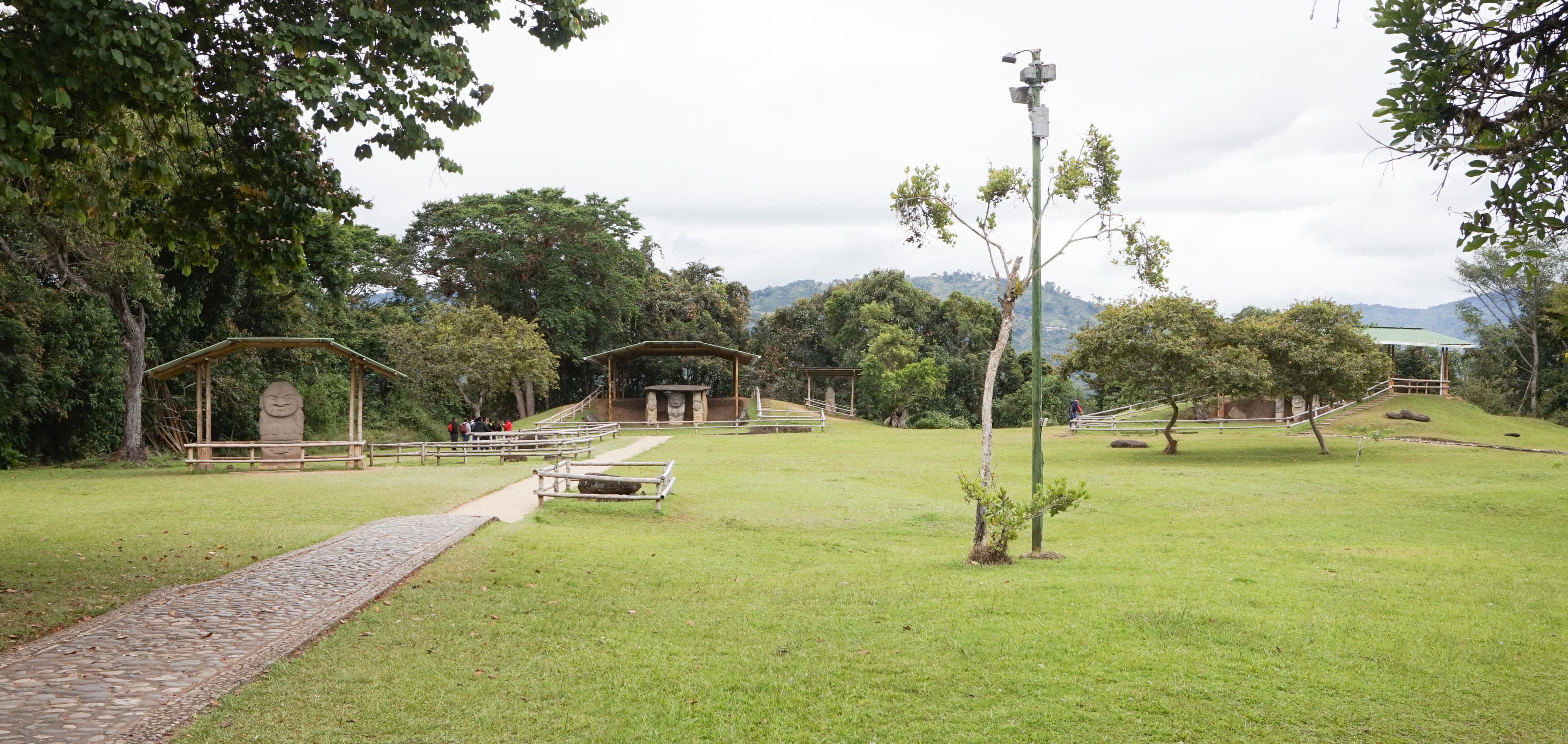
Image of San Agustín Archaeological Park. Image source · CC-BY-SA-4.0
Visit essentials
A quick read before you go
- Duration
- Three to five hours for the main park.
- Access
- Located approximately three kilometers from San Agustin town, Huila Department, southwestern…
Overview
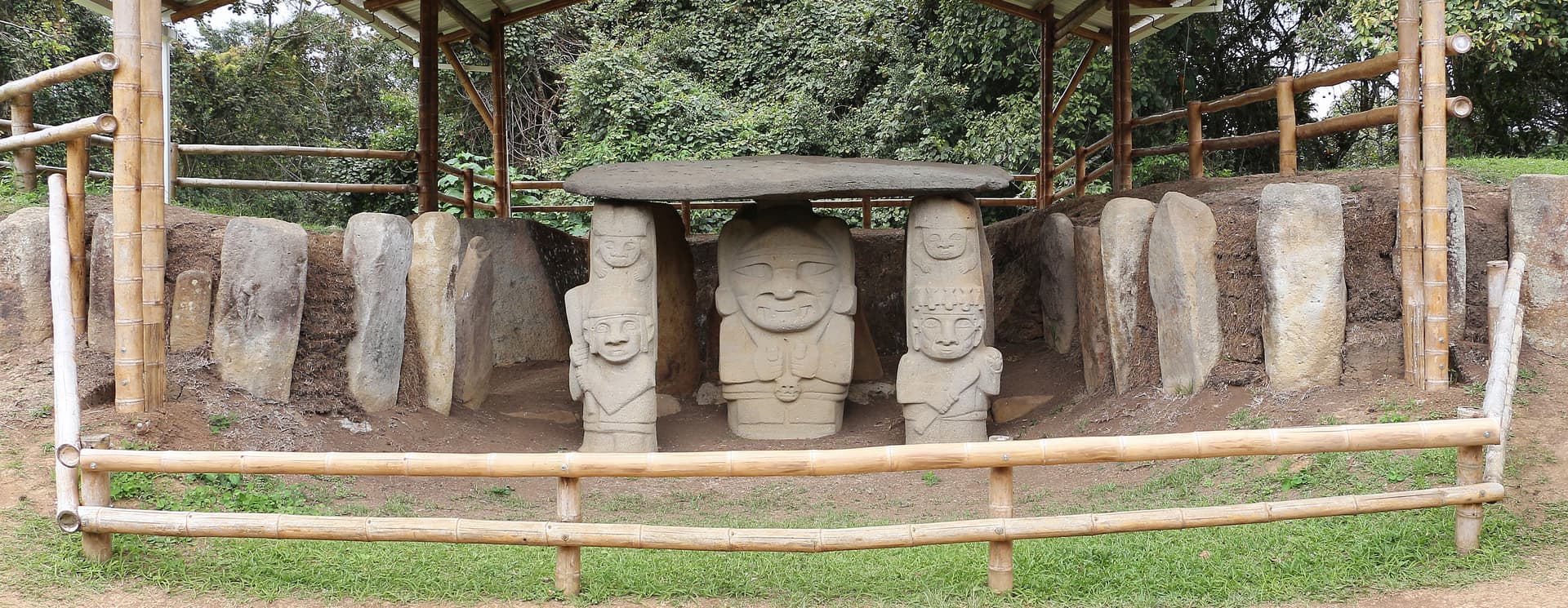
They left no writing or name for themselves, but they left stone. Approximately three hundred monumental statues in San Agustin Archaeological Park were carved from volcanic rock over more than a thousand years and placed as guardians at important graves. Eagles represent the upper world, jaguars the earth, and serpents and frogs the realm below. Shaman figures transform between human and animal, the living and something else.
This is not a museum: the guardians remain at the graves they were carved to protect. Across forested hills at the Magdalena River's headwaters, visitors trace a landscape cosmology—the four Mesitas and their burial mounds; Fuente de Lavapatas, carved into a stream bed with serpents, lizards, and human figures; and Alto de Lavapatas, overlooking mountains where the Andes begin to diverge.
The creators occupied the Colombian Massif for at least two millennia. People traveled from across the region to bury important dead here, making San Agustin an inter-community pilgrimage place. Sculpture peaked between the fifth century BCE and ninth century CE, then ceased for unknown reasons although people remained in the region.
UNESCO inscribed San Agustin in 1995 as South America's largest group of religious monuments and megalithic sculptures. The park covers one hundred and sixteen hectares across three properties. The culture's name and its name for this place are lost; stone, the dead beneath it, and their guardians remain.
Places within this site
Why this place is sacred
What draws a civilization to concentrate its dead in one landscape for over a thousand years? Not convenience. The terrain is mountainous, the location remote. The people who brought their dead to San Agustin from distant communities in the Upper Magdalena region did so because they believed this place held a quality that their own settlements did not.
The statues make the belief explicit. These are not memorials in the Western sense, not tributes to the achievements of the dead. They are guardians: active figures stationed at the threshold between the world of the living and whatever lay beyond. The eagles represent the upper realm. The jaguars represent the earth. The serpents and frogs represent the underworld.
The shamans depicted in transformation, their faces shifting between human and animal, represent the beings who could cross between realms and who would guide the dead on the passage.
The Fuente de Lavapatas adds another dimension. Carved into the bed of a living stream, its images of serpents, lizards, and human figures interact with flowing water, creating a ceremonial feature that combines two elements: the permanence of stone and the movement of water. Whatever rituals were performed here, they took place at the intersection of what endures and what flows.
The park sits at the geographical heart of Colombia, where the Andes split into three cordilleras and the Magdalena, the country's greatest river, begins its journey north. This convergence of geological forces, the point where mountain ranges diverge and a great river originates, may have contributed to the San Agustin people's understanding of this landscape as a place of origin and transformation.
The complete loss of the culture's name and language adds a quality of encounter that named traditions do not provide. Standing before a San Agustin statue, one faces an entirely alien cosmology expressed with absolute confidence and skill. There is no text to mediate the encounter. The stone speaks, but in a language that has no dictionary.
San Agustin was a ceremonial and funerary landscape where communities from across the Upper Magdalena region brought their important dead for burial, accompanied by carved stone guardians. The Fuente de Lavapatas served as a water-based ceremonial feature. The entire landscape functioned as the Americas' greatest necropolis, a sacred space dedicated to death, transformation, and the relationship between the living and the dead.
The earliest occupation traces in the region date to approximately 3000 BCE. The monumental sculptural tradition developed from approximately 300 BCE, reaching full expression between the fifth century BCE and the ninth century CE. After the ninth century, the tradition of carving monumental statues ceased for reasons that remain unknown. The Spanish colonial period brought the name San Agustin, a colonial imposition that replaced whatever the people called this place.
Friar Juan de Santa Gertrudis described the statues in 1758, and Konrad Theodor Preuss conducted the first systematic archaeological study in 1914. The site was declared a national archaeological park in 1935 and inscribed as a UNESCO World Heritage Site in 1995.
Experience and orientation
San Agustin does not yield itself quickly. The park covers seventy-eight hectares of mountainous terrain, and the sites are dispersed across forested hillsides connected by walking trails. This dispersal is not a logistical inconvenience but an essential part of the experience. The culture did not concentrate its monuments in a single location because the entire landscape was the monument.
Begin at the Mesitas, the broad terraces containing the principal burial mounds. Mesita A, one of the oldest sites, preserves caryatid warriors supporting tomb ceilings, their special tiaras and weapons marking them as spiritual guardians. A feline-faced deity watches over all of them. Mesita B, the most elaborate, contains sixty-three statues across three burial mounds, including the famous eagle clasping a snake, the upper and lower realms connected in a single sculptural gesture.
Mesita C offers a different register: smaller, finer statues with individual artistic personality, suggesting personal rather than programmatic expression.
The Fuente de Lavapatas is the park's most singular feature. A ceremonial space carved into the bed of a stream, its rock-cut images of serpents, lizards, and human figures interact with the water that flows over and around them. Standing at the Fuente, watching water move across carved stone, the visitor encounters a conjunction of elements: the permanent and the flowing, the shaped and the natural, the ceremonial and the geological.
Whatever happened here, it happened at the boundary between the human ability to shape the world and the world's own movements.
The Bosque de las Estatuas, the Forest of Statues, contains thirty-nine statues relocated here for display along a forest trail. While the statues are not in their original positions, the forest setting provides an intimate encounter with individual works and the full range of the sculptural tradition.
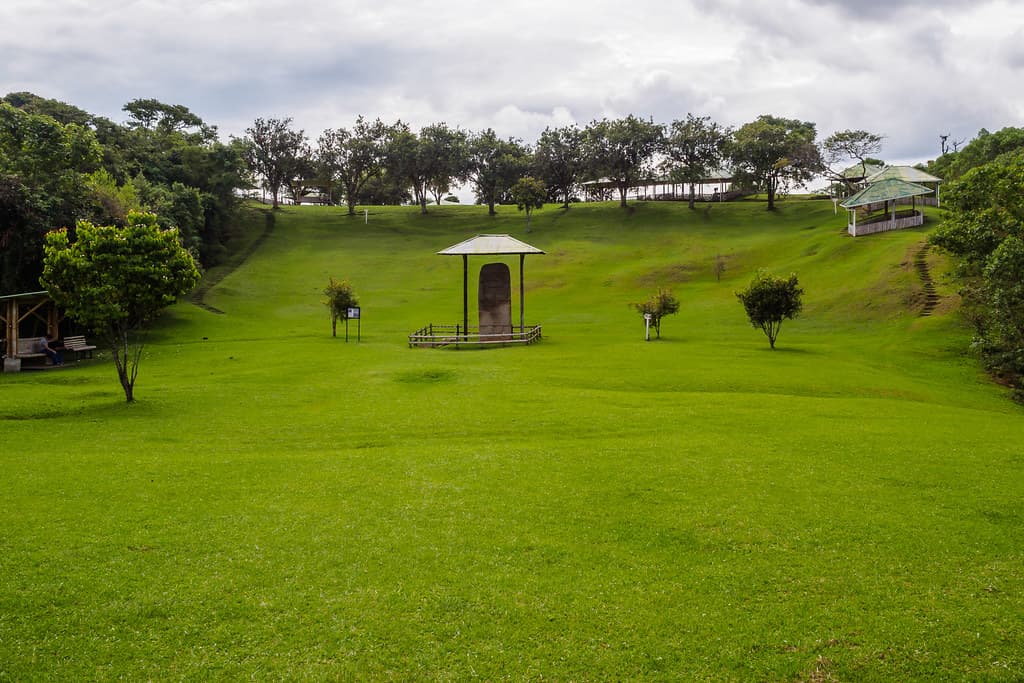
Alto de Lavapatas, the park's highest point, offers panoramic views of the mountains where the Andes begin to diverge. From this vantage, the landscape's scale becomes apparent: the valleys, the ridgelines, the river far below. The San Agustin people chose this location at the geographical heart of their world.
Arrive at the park's opening time of eight in the morning to allow sufficient time for the full circuit. Begin with the Mesitas, moving from A through B and C to understand the development and diversity of the sculptural tradition. The Fuente de Lavapatas should be visited in the middle of the day, when light penetrates the stream bed. The Bosque de las Estatuas provides a concentrated introduction or conclusion.
Alto de Lavapatas rewards the climb with views that place the entire archaeological landscape in its geographical context. Budget three to five hours for the main park. The combined ticket, valid for forty-eight hours, allows visits to Alto de los Idolos and Alto de las Piedras as well.
Context and lineage
The San Agustin culture developed in the Colombian Massif, the mountainous knot where the Andes divide into three cordilleras and where the Magdalena River begins. In this place of geographical convergence, they created a civilization centered on the relationship between the living and the dead. Over more than a millennium, they carved hundreds of monumental statues to guard their dead, built mortuary temples to honor their ancestors, and carved ceremonial features into the living rock of stream beds.
The culture's own name is lost. San Agustin is a colonial designation, applied by the Spanish after the modern town. Their language is unknown. What survives is the stone record of their cosmology: a world divided into three realms, sky and earth and underworld, connected by the transformative power of beings who could cross between them.
People from across the Upper Magdalena region traveled to San Agustin to bury their important dead, making it a pilgrimage destination in the most literal sense: a place to which the dead were carried across distances, because this ground was understood as the proper threshold between worlds.
The lineage runs from unknown origins through approximately two millennia of active sculptural and funerary practice, then through silence, then through colonial encounter, then through modern archaeology. The culture itself left no written lineage, no succession of named leaders or artists. The lineage that exists is in the stone: early, simpler carvings giving way to increasingly complex iconographic programs, suggesting a tradition that developed, refined, and eventually ceased.
The modern lineage of custodianship, from Preuss's documentation through the 1935 national park designation through UNESCO inscription, ensures that the culture's stone legacy persists even as its human context remains irrecoverable.
San Agustin culture sculptors
original builders
The unnamed artists and communities who created the largest body of megalithic funerary sculpture in the Americas over a period exceeding a thousand years. Their language, their name for themselves, and the specific details of their rituals are entirely lost; what survives is the cosmological vision they encoded in stone.
Friar Juan de Santa Gertrudis
first European documenter
Spanish friar who described the statues in 1758, providing the first written European account of the site. His report initiated the outside world's awareness of what the San Agustin people had created.
Konrad Theodor Preuss
archaeologist
German archaeologist who conducted the first systematic archaeological study of San Agustin in 1914. His documentation of the Mesitas and their statues remains foundational to the field.
ICANH
conservation steward
The Colombian government institution responsible for managing the park, overseeing archaeological research, and ensuring the preservation of the statues and burial mounds.
Traditions and practice
The San Agustin people practiced elaborate funerary rituals in which the dead were placed in mortuary temples with carved stone guardians. The statues depicted shamanic transformations, guardian spirits, and supernatural beings positioned to protect and guide the deceased. The Fuente de Lavapatas, carved into a stream bed with images of serpents, lizards, and human figures, was used for water-based ceremonies whose specific nature is unknown but whose setting suggests purification or transformation rituals.
People from across the Upper Magdalena region traveled to San Agustin to bury their dead, making the site a pilgrimage destination. The carving of guardian statues itself likely involved ceremonial practices, given the cosmological significance of the images produced.
The park is managed as a UNESCO World Heritage Site with marked trails, interpretation panels, and guide services. Archaeological research continues under ICANH oversight. The Bosque de las Estatuas provides a concentrated introduction to the sculptural tradition. Educational programs serve both visitors and local communities.
Walk the trails at a pace that allows the landscape to register. San Agustin was not designed as a museum; the burial mounds were placed in relationship to the terrain, and that relationship can only be felt at walking speed. At the Mesitas, observe the guardian statues not as objects in a collection but as sentinels still in position at the graves they were carved to protect.
At the Fuente de Lavapatas, spend time watching the water move across the carved surfaces. The stream is still flowing, the carvings are still there, and the interaction between the two elements, water and stone, that the San Agustin people found meaningful enough to formalize in carved rock continues every moment of every day.
At Alto de Lavapatas, look out at the landscape and consider that this is where Colombia begins, geographically: where the Andes split and the Magdalena River originates. The San Agustin people built their greatest necropolis at the place of origin.
San Agustin Funerary Culture
HistoricalThe San Agustin culture created the largest body of megalithic funerary sculpture in the Americas, encoding a cosmological system that understood death as transformation. Approximately three hundred statues within the main park, and six hundred across the wider region, testify to a sustained commitment to honoring the dead that exceeds anything comparable in the continent.
Elaborate funerary rituals with mortuary temples, carved stone guardians, and the Fuente de Lavapatas water ceremonies. Inter-community pilgrimage to bury the dead at the Americas' greatest necropolis.
Archaeological Research and Conservation
ActiveFrom Preuss's 1914 expedition through UNESCO inscription in 1995 and ongoing ICANH management, the modern tradition of research and conservation serves as custodian of the San Agustin legacy.
Systematic archaeological investigation, conservation of statues and burial mounds, guided interpretation for visitors, and educational programs for local communities.
Perspectives and open questions
San Agustin invites engagement from multiple directions: as an archaeological wonder, as a cosmological text written in stone, as a meditation on death and transformation, and as a reminder of how much a civilization can say without words and how much can be lost despite stone's permanence.
Scholarly perspective
UNESCO recognizes San Agustin as containing the largest group of religious monuments and megalithic sculptures in South America and describes the area as of outstanding value in illustrating the creative genius of the prehistoric peoples of northern South America. Archaeologists emphasize the sophistication of the culture's cosmological system, expressed through a consistent iconographic program: the three-realm cosmology of sky, earth, and underworld, connected by shamanic transformation. The Fuente de Lavapatas is recognized as a singular achievement.
Fundamental questions persist: the culture's own name, their language, and the reasons for the decline of monumental sculpture after the ninth century remain unknown.
Living and traditional perspectives
While no direct descendant community has been identified with certainty, indigenous peoples of the Huila and wider Colombian highlands regard the San Agustin sites as the work of ancestors. The transformation imagery resonates with shamanic traditions still practiced by some indigenous communities in Colombia and the broader Amazon-Andes region. Local communities serve as custodians and guides, maintaining a relationship with the site that, if not a continuous tradition, is a living engagement with the ancestral landscape.
Alternative interpretations
The concentration of funerary monuments at the geographical point where the Andes split and the Magdalena River begins has drawn attention from those who see connections between geological energy and sacred site placement. The shamanic transformation imagery has been studied in the context of entheogenic plant use and altered states of consciousness, a line of inquiry supported by the rich tradition of plant-based shamanism in the Amazon-Andes region.
The three-realm cosmology parallels similar systems found in cultures worldwide, suggesting either independent development or deep-time cultural connections.
Open questions
What was the San Agustin culture's name for themselves? Their language is entirely unknown. Why did the monumental sculpture tradition decline after the ninth century, while the people apparently continued to live in the region? What specific rituals were performed at the Fuente de Lavapatas? How were the statues transported and erected in mountainous terrain without draft animals or the wheel? What is the full extent of the San Agustin site network?
The answers to these questions may never be recovered. The people who could have answered them chose stone over writing, and stone preserves form but not voice.
Plan your visit
Access and arrival
Located approximately three kilometers from San Agustin town, Huila Department, southwestern Colombia, approximately 520 kilometers southwest of Bogota. Accessible by bus from Bogota (approximately ten hours), Popayan (five hours), or Neiva (five hours). The town of San Agustin has accommodation and services. Local transport (taxis, mototaxis) connects the town to the park. Combined ticket for all three parks valid forty-eight hours; verify current prices locally. Guided tours available for an additional fee.
Mobile phone signal is generally available in the town but may be intermittent within the park. No specific accessibility information was available at time of writing; the terrain is hilly with unpaved trails.
San Agustin town offers a range of accommodation from hostels and guesthouses to comfortable hotels, concentrated within easy reach of the park. The town has restaurants, shops, and basic services. Tour operators offer multi-site packages covering all three parks.
Respectful visit
Comfortable walking shoes essential for the hilly terrain. Rain gear advisable. Sun protection for open areas. Layers for variable weather at 1,800 meters elevation.
Photography is permitted throughout the park. The statues and landscape reward careful composition. Early morning and late afternoon light are most effective.
Not customary. The funerary nature of the site calls for contemplative respect rather than material offerings.
Stay on marked paths. Do not touch, climb on, or sit on statues. Do not enter burial mounds or restricted areas. Do not remove any material from the site.
The terrain is hilly and trails can be muddy, particularly in the rainy season. Comfortable walking shoes are essential. The altitude, approximately 1,800 meters, may affect visitors not acclimatized to elevation. Rain gear is advisable, as the region receives significant rainfall. Allow sufficient time; rushing through San Agustin defeats the purpose of a site designed for contemplative encounter with the dead.
Current practical details
Address
San Agustín, Huila, Colombia
Phone
Hours
Hours, fees, and access can change — verify on the official source before you travel. Practical details last checked Jun 2026.
Location
Map loads as you approach this section.
Pilgrim reflections
A portrait of encounter, not a score
Pilgrims describe what they felt, how present they could become, and whether the place would shape a journey. There are no stars and no ranking of traditions.
No reviewed reflections yet
The first pilgrims can help describe the character of being here.
Share a reflection
Available after an account-backed “Been there.” Every reflection is reviewed before publication.
Nearby sacred places
Explore other sacred places in the region. Proximity does not establish access or travel time; check each place’s guidance.


Share a photo
Help visitors recognize San Agustín Archaeological Park. Every submission is reviewed before publication.