Templo del Sol y la Luna
An Inca sun temple carrying a colonial church on its shoulders, where two faiths share the same stone
Understand sacred places, explore living traditions, and learn how to engage respectfully with Pilgrim Map.
Access has not been verified. Check current local guidance before planning a visit.
Vilcashuaman, Ayacucho, Peru
Read the sources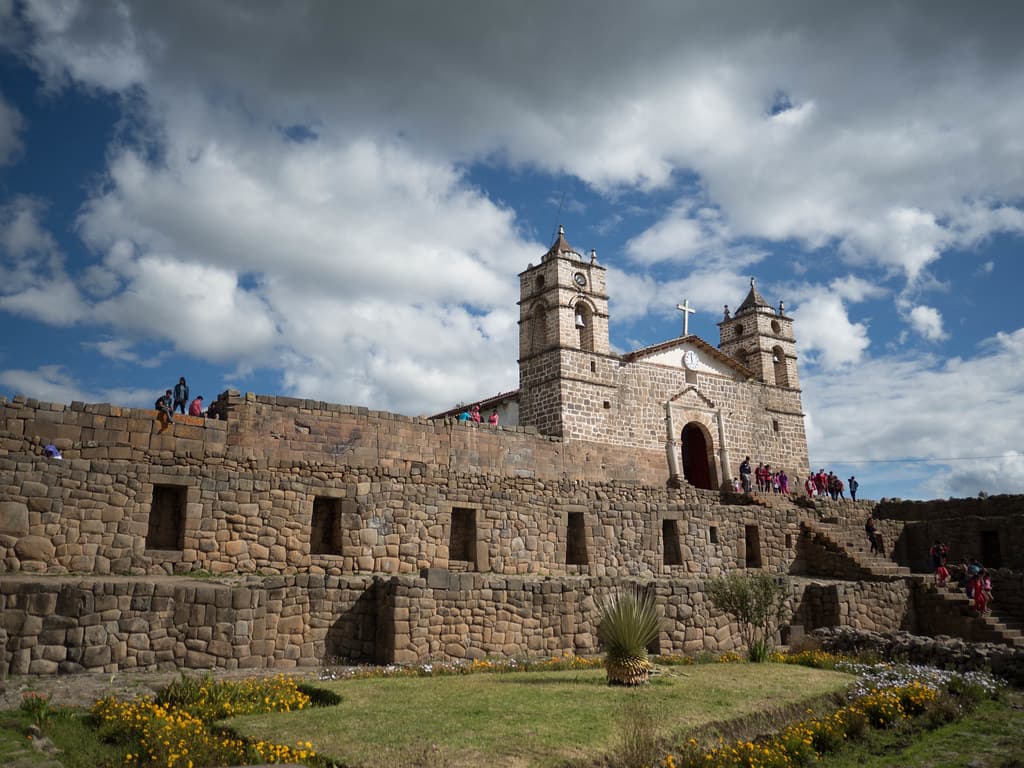
Image of Templo del Sol y la Luna. Image source
Visit essentials
A quick read before you go
- Duration
- 45 minutes to 1 hour; combine with El Ushnu and the broader complex
- Access
- Within the Vilcashuamán complex, 107 km south of Ayacucho (3-5 hours by road).
Overview
Pachacutec built twin temples at Vilcashuamán: one for Inti, the Sun, and one for Mama Killa, the Moon. At what was considered the geographic centre of the Tawantinsuyu, they flanked a great plaza where thousands gathered for state ceremonies. The polished-walled Sun temple ranked among the most important outside Cusco.
Spanish forces recognised the site's strategic and symbolic value. In a pattern repeated across the Andes, they built the Catholic church of San Juan Bautista directly on the Sun temple's foundations. Inca walls became church walls, and Mass replaced solar ceremonies in the same space. The less structurally useful Temple of the Moon was more thoroughly dismantled.
The traditions now coexist vertically. Inca stonework beneath and around the active colonial church remains load-bearing rather than archaeological fragments. Services continue inside walls cut to honour another deity; neither tradition has entirely displaced the other, an enduring truth of this Andean site.
Why this place is sacred
Most sacred sites carry their history in stories. The Templo del Sol y la Luna carries it in stone. The Inca walls, with their characteristic precision — blocks fitted without mortar, edges softly rounded — support colonial masonry of a different character: rougher, mortared, adapted to a different God. The transition is not hidden. It is the building.
This is not unique in the Andes. Churches were built on temples from Cusco to Quito. But Vilcashuamán's relative remoteness has preserved the layering with unusual clarity. The Inca work is not merely a foundation buried underground but a visible presence, walls you can touch that were shaped by hands working five centuries before the church was imagined.
The Temple of the Moon, by contrast, was more thoroughly destroyed — its stones reused or scattered. What remains is fragmentary. The asymmetry is itself meaningful: the Sun temple survived because it was useful to the conquerors; the Moon temple, associated with Mama Killa and the feminine, was not repurposed but erased. The duality that the Inca encoded in their twin temples — Sun and Moon, masculine and feminine, complementary halves — was broken by the colonial intervention.
What stands now is half of a pair.
The twin temples served the Inca state religion: the Sun temple for ceremonies honouring Inti and the highest state rituals, the Moon temple for rites associated with Mama Killa, fertility, and agricultural cycles. Together they embodied the complementary duality (yanantin) central to Andean cosmology.
Spanish colonisation converted the Sun temple into the Church of San Juan Bautista, while the Moon temple was largely dismantled. The church continues to function as a place of Catholic worship, while the Inca stonework beneath it persists as both archaeological evidence and structural support.
Experience and orientation
Approach the complex from the trapezoidal plaza, shared with the adjacent ushnu. The Church of San Juan Bautista presents itself as a modest colonial structure, unremarkable from a distance. Move closer and the reading changes. The lower courses of the walls shift from colonial masonry to Inca stonework — the blocks larger, tighter, more carefully shaped. The transition is not a restoration or a display but a structural fact: the church stands on the temple.
Enter if the church is open. The interior carries the quiet of a small Andean parish church: candles, worn pews, the particular scent of old plaster and devotion. The knowledge that these walls once enclosed solar ceremonies adds a dimension that the interior alone does not announce. It must be brought by the visitor.
Outside, seek the remains of the Temple of the Moon. They are less dramatic — lower walls, scattered foundations, the suggestion of a plan rather than a standing structure. The contrast with the preserved Sun temple is instructive. What the colonisers found useful, they kept. What they did not, they took apart. The Moon temple's absence speaks as clearly as the Sun temple's persistence.
Begin at the ushnu to understand the complex's original scale and purpose, then approach the church. Examine the exterior walls at close range to identify the transition from Inca to colonial stonework. If the church is open, enter and sit briefly. Then walk to the Moon temple remains and let the contrast register.
Context and lineage
Vilcashuamán was constructed on the defeated Chanca capital after Pachacutec's military victory. The twin temples to Inti and Mama Killa replicated the sacred duality of Cusco's Coricancha in a provincial setting, declaring that the cosmic order centred on the Inca had been extended to this conquered territory.
Chanca sacred ground, Inca imperial temple complex, colonial Catholic church — three layers in one structure. The lineage is not sequential but simultaneous: all three persist in the same stones.
Inca Pachacutec
Builder of the Vilcashuamán complex including the twin temples
Traditions and practice
Inca ceremonies at the Sun temple included solar observations, chicha libations, and state rituals timed to astronomical events. The Moon temple hosted rites associated with Mama Killa, fertility, and the agricultural calendar. Both temples would have been active during major Inca festivals, operating in complementary relation to each other and to the adjacent ushnu.
Catholic services continue in the Church of San Juan Bautista. The church functions as a parish for the local community. No formal Inca ceremonial practices have been revived at this site.
Visit the church during a quiet hour and sit in the nave. The experience of being inside a Catholic space that is physically supported by Inca temple walls does not require explanation — it is felt in the architecture itself. Then walk outside and place your hand on the Inca stonework at the base of the church wall.
Inca solar and lunar worship
HistoricalThe twin temples embodied the cosmological duality of Inti and Mama Killa at one of the empire's most important provincial centres
Solar observations, libations, state ceremonies, agricultural rites tied to the lunar calendar
Roman Catholicism
ActiveThe Church of San Juan Bautista, built atop the Sun temple, continues as an active parish serving the Vilcashuamán community
Regular Mass and parish services within the colonial church
Perspectives and open questions
The layered architecture of the Templo del Sol y la Luna resists simple interpretation. It is simultaneously evidence of conquest and evidence of persistence.
Scholarly perspective
Scholars recognise the Vilcashuamán temples as significant examples of Inca provincial religious architecture. The colonial church overlay is studied as a paradigmatic example of religious superimposition — the deliberate placement of Catholic worship atop indigenous sacred space. The relative destruction of the Moon temple compared to the Sun temple has received attention as evidence of gendered colonial priorities.
Living and traditional perspectives
In Andean cosmology, the Sun and Moon temples represented complementary cosmic forces — Inti and Mama Killa — whose balance sustained the world. The colonial intervention broke this duality by preserving one temple (for reuse) and dismantling the other. For communities that hold this cosmological framework, the site is not merely a ruin but evidence of an imbalance that was imposed and has not been fully repaired.
Alternative interpretations
Some visitors perceive energetic tension at the site — a sense that the two religious traditions layered in the same stone remain unresolved. Whether this reflects objective conditions or the visitor's awareness of the site's history is not a question that can be settled from outside.
Open questions
The original interior features of both temples — wall coverings, ritual objects, spatial arrangements — are largely unrecoverable. The full extent of the Moon temple's plan remains incompletely mapped. Whether any continuity of Andean ceremonial practice persisted within the colonial church, disguised in syncretic forms, is a question that historical records do not fully answer.
Plan your visit
Access and arrival
Within the Vilcashuamán complex, 107 km south of Ayacucho (3-5 hours by road). Same transport options as El Ushnu. No separate entry fee. Church access may be limited Sundays.
Basic lodging in Vilcashuamán town; most visitors use Ayacucho as a base.
Respectful visit
Modest clothing for the church interior; practical wear for the archaeological areas
Ask before photographing inside the church. The exterior and archaeological areas are open for photography.
Candle lighting may be available in the church. No formal offering protocol for the archaeological areas.
Maintain silence during church services | Do not touch or lean against church murals or artwork | Do not remove stones from the archaeological areas | Respect the church as an active place of worship
Church access may be limited during Sunday services. The Moon temple remains are exposed and unprotected — watch footing.
Current practical details
Address
82WW+CGX, Vilcashuamán 05326, Peru
Hours, fees, and access can change — verify on the official source before you travel. Practical details last checked Jun 2026.
Location
Map loads as you approach this section.
Pilgrim reflections
A portrait of encounter, not a score
Pilgrims describe what they felt, how present they could become, and whether the place would shape a journey. There are no stars and no ranking of traditions.
No reviewed reflections yet
The first pilgrims can help describe the character of being here.
Share a reflection
Available after an account-backed “Been there.” Every reflection is reviewed before publication.
Nearby sacred places
Explore other sacred places in the region. Proximity does not establish access or travel time; check each place’s guidance.
References
Sources consulted for this page. Source categories describe the publication, not a guarantee that every claim is verified. Traditional accounts and outside interpretations may differ.
- 01Vilcashuamán: the great Inca complex of Ayacucho — Salkantay Trek MachuguideDescribes the Temple of the Sun with colonial church overlay and the Moon temple
- 02Vilcashuamán: the great Inca complex of Ayacucho — Inca Trail MachuguideOverview of the complex including both temples
- 03Vilcashuamán Ruins Guide — Lost Ruins of the AmericasguideDetailed visitor guide with historical context
- 04Vilcashuamán, Peru: Where Incan Ruins, Spanish Colonization, and Modern Peru Collide — Blue Sky LimitguideDescribes the colonial-Inca architectural fusion
- 05Vilcashuamán: Ayacucho Inca complex — Peru SIMguideGeneral overview and visitor information
- 06Ayacucho tourist attractions — El BúhoSource contextSpanish-language article mentioning the temples as underdiscovered
Share a photo
Help visitors recognize Templo del Sol y la Luna. Every submission is reviewed before publication.