Ayacucho Cathedral
The spiritual heart of Peru's 'City of Churches,' where colonial gold meets Andean devotion
Understand sacred places, explore living traditions, and learn how to engage respectfully with Pilgrim Map.
Access has not been verified. Check current local guidance before planning a visit.
Ayacucho, Ayacucho, Peru
Read the sources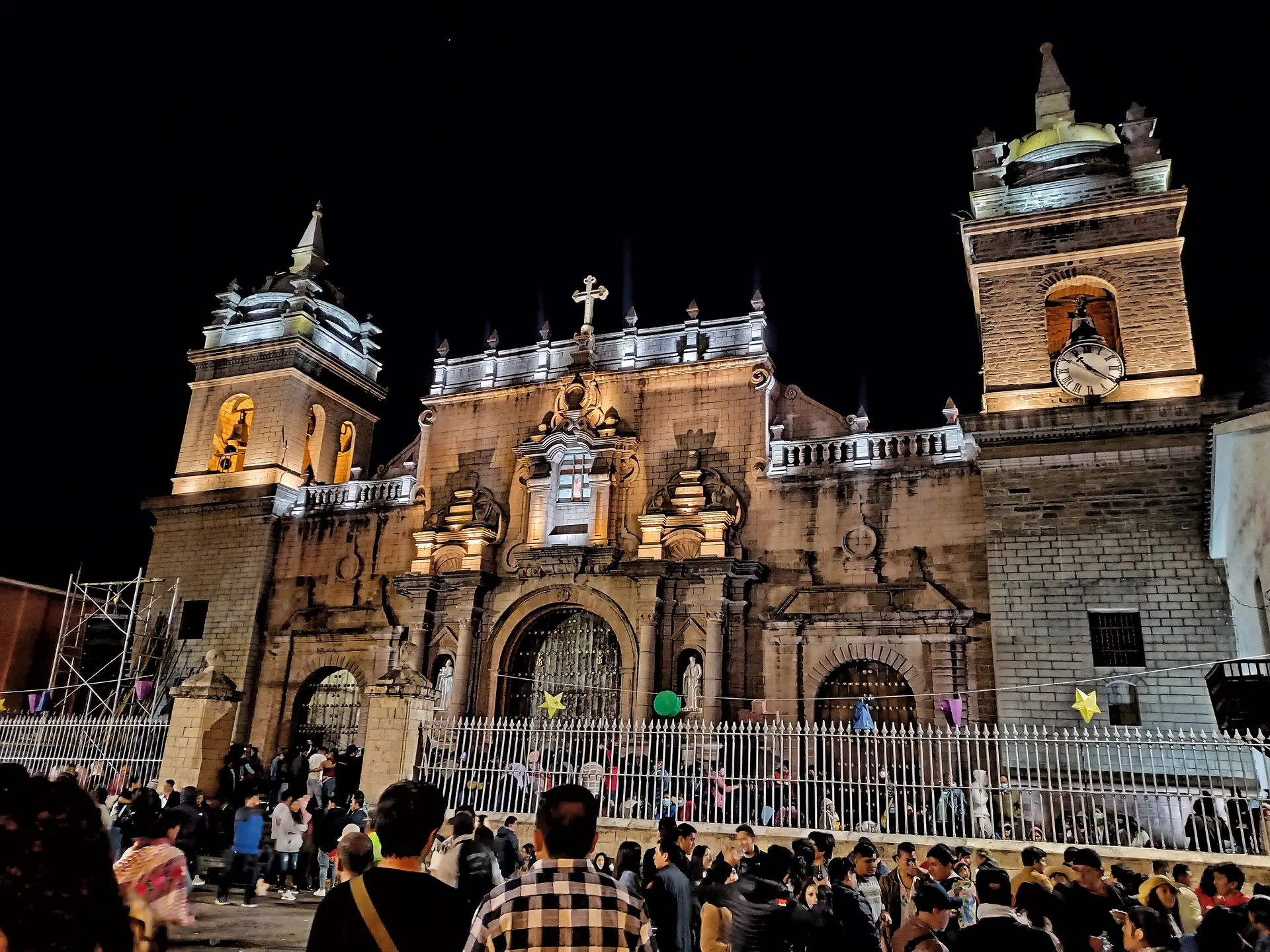
Image of Ayacucho Cathedral. Image source · CC-BY-SA-4.0
Visit essentials
A quick read before you go
- Duration
- One to two hours for the cathedral; days or weeks for the full Semana Santa experience.
- Etiquette
- As an active cathedral and the center of Peru's most elaborate Holy Week celebrations, approach…
Overview
Ayacucho, also known by its colonial name Huamanga, occupies a fertile valley on the eastern Andean Cordillera Occidental at 2,746 metres. The Spanish called it the `City of Churches`; locals count 33, one for each year of Christ's earthly life, centred on the Basilica Cathedral of Santa Maria.
Built exclusively of stone from 1632 through forty years to completion in 1672, it has stood nearly 350 years: pink stone at the centre, grey flanking towers, semicircular arched doors, double Corinthian columns beside the entrance, and Saints Peter and Paul above. Inside, ten gold-leaf altars fill three naves. The baroque High Altar spans three sections and five streets, with the Virgin of the Snows between Saint John the Baptist and the Magdalene.
Other altarpieces honour San Pedro, the Lord of the Resurrection, the Virgin of Carmen, the Lord of Burgos, and the Holy Trinity. Its bells celebrated independence at the nearby Battle of Ayacucho. Colonial gold came from the Andean wealth that fuelled an empire; today Semana Santa processions follow flower-carpeted streets around this spiritual axis of Ayacucho's devotional life.
Why this place is sacred
Some thin places achieve their quality through antiquity, through events that tear the boundary between worlds. Ayacucho Cathedral achieves its thinness through accumulation—the patient accrual of devotion across generations, the yearly intensification of Holy Week when the entire city becomes a prayer.
The gold-leaf altars hold that accumulated devotion in visible form. Colonial craftsmen worked precious metal into surfaces that have absorbed the candlelight of nearly 350 years of Masses. The Virgin of the Snows has gazed from the High Altar since the seventeenth century, receiving the supplications of indigenous converts and mestizo faithful, of independence fighters and modern pilgrims.
The cathedral witnessed history that shaped a continent. Spanish and patriot troops passed through before the Battle of Ayacucho in 1824—the battle that effectively ended Spanish rule in South America. Its bells announced that liberation. The building that had risen from colonial power became a symbol of independence.
But it is Semana Santa that most intensifies the cathedral's thin quality. For two weeks each year, Ayacucho transforms into a living passion play. Processions emerge from the cathedral's doors, wind through streets carpeted with flowers and colored sawdust, and return to the baroque interior. The boundary between the Gospel's Jerusalem and Andean Ayacucho dissolves. For those who participate, the Passion is not remembered but re-enacted, not past but present.
In this annual intensification, the cathedral becomes a threshold between ordinary time and sacred time, between the valley of Huamanga and the Jerusalem of salvation.
Built between 1632-1672 as the principal church of Huamanga (Ayacucho), seat of Spanish colonial religious authority in the region.
From colonial religious center to symbol of independence (bells rang for the 1824 victory) to national heritage site (declared Historical Cultural Heritage in 1972) to continuing focus of South America's most elaborate Holy Week celebrations.
Experience and orientation
Approach from the Plaza de Armas—Peru's only plaza with stone columns and arches on all four sides. The cathedral's facade rises with calculated restraint: pink stone center, gray stone towers, the sober announcement of something waiting within.
Pass through the semicircular arched doors into transformation. Ten gold-leaf altars catch whatever light penetrates the baroque interior. Give your eyes time to adjust; give your heart time to receive what centuries of devotion have placed here.
The High Altar draws the gaze inexorably. Distributed across three sections and five streets—the baroque architecture of salvation—it holds the Virgin of the Snows at its center. Christ crucified appears in canvas above her. Saint John the Baptist and the Magdalene attend. Let the gold overwhelm you as it was meant to: this was colonial Peru's vocabulary of divine glory.
Move through the other altars: San Pedro, the Lord of the Resurrection, the Virgin of Carmen, the Lord of Burgos, the Holy Trinity. Each carries its particular devotional freight. The liturgical objects of gold and silver, the artistic works from the colonial era—let them speak of a time when Andean silver became European devotion.
If you can time your visit for Semana Santa, you will experience the cathedral as its builders intended: as the sacred center from which processions emerge and to which they return. The streets become extensions of the nave; the flower-carpeted paths become the Way of the Cross; and for those weeks, the boundary between sanctuary and city dissolves completely.
The cathedral faces the Plaza de Armas from its eastern edge, on the Municipal Portal at the extension of Jirón 2 de Mayo. Enter from the plaza through the central doors.
Context and lineage
Construction began in 1632, forty years after the city's founding. The Spanish colonial authorities intended a cathedral worthy of a city they called Huamanga—a place where the displacement of Tahuantinsuyo (the Inca Empire) and the implantation of Catholic faith were to be made permanent in stone.
For forty years, workers raised the structure using stone exclusively, a choice that would give the building its remarkable durability. Pink stone formed the center, gray stone the towers. By 1672, the cathedral stood complete—a baroque monument to colonial ambition and colonial faith.
The interior received its golden glory gradually, as wealth from Andean mines was transmuted into devotional art. Ten gold-leaf altars eventually filled the three-nave space. The High Altar, a masterwork of baroque design, positioned the Virgin of the Snows at the center of civic and religious life.
The cathedral witnessed the approach of history. Before the Battle of Ayacucho in December 1824—the final major battle of Spanish colonial rule in South America—both Spanish and patriot forces moved through the city. When the patriots prevailed, the cathedral's bells announced a continent's liberation.
In 1972, the cathedral received designation as Historical Cultural Heritage of Peru, official recognition of what devotees had always known: this was sacred space of national significance.
Roman Catholic, under the Diocese of Ayacucho. Continuous use as the city's principal church since 1672.
Virgin of the Snows (Virgen de las Nieves)
Patronal dedication
Traditions and practice
Colonial-era devotions to the Virgin of the Snows and the saints represented in the ten altars. Veneration of the liturgical objects and religious art.
Daily masses, religious services throughout the year, Semana Santa celebrations considered among the best in Peru and South America. The cathedral serves as a religious art museum as well as an active church.
Attend Mass to experience the liturgical use of the baroque interior. Take time with each of the ten altars. If possible, time your visit for Semana Santa to witness the full expression of Ayacucho's devotional culture.
Roman Catholicism / Baroque Devotion
ActiveThe cathedral represents the fullest expression of colonial baroque Catholicism in Peru's highlands, with ten gold-leaf altars creating an immersive devotional environment.
Daily masses, Semana Santa processions and celebrations, veneration of the Virgin of the Snows and cathedral saints.
Perspectives and open questions
The cathedral can be understood as a monument of colonial power, as a treasury of baroque religious art, as the center of South America's greatest Holy Week celebration, or as a symbol of independence after the 1824 battle.
Scholarly perspective
The cathedral represents a prime example of colonial baroque architecture adapted to Andean materials and conditions. Its construction history illustrates the investment of colonial resources in religious infrastructure.
Living and traditional perspectives
Within Catholic tradition, the cathedral embodies the Counter-Reformation ideal of sacred space—baroque splendor designed to evoke the glory of heaven and inspire devotion.
Alternative interpretations
The gold-leaf altars can be read as transformations of Andean wealth extracted through colonial exploitation, raising questions about the relationship between beauty and justice.
Open questions
The full extent of pre-existing indigenous sacred associations with the cathedral site remains undocumented.
Plan your visit
Access and arrival
Full range of accommodations in Ayacucho; book far in advance for Semana Santa.
Respectful visit
Modest dress appropriate for a Catholic cathedral. Shoulders and knees covered.
Photography may be permitted outside of services; check current guidelines. Never photograph during Mass or devotions.
Entrance fee of approximately S/10 soles supports maintenance. Candles and donations welcome.
Observe silence during services. Respect areas reserved for prayer and clergy.
Semana Santa draws enormous crowds; plan accommodations and transportation well in advance. Respect the active devotional life of the space year-round.
Current practical details
Address
RQQF+PWV, 2 De Mayo, Ayacucho 05003, Peru
Phone
Hours
Hours, fees, and access can change — verify on the official source before you travel. Practical details last checked Jun 2026.
Location
Map loads as you approach this section.
Pilgrim reflections
A portrait of encounter, not a score
Pilgrims describe what they felt, how present they could become, and whether the place would shape a journey. There are no stars and no ranking of traditions.
No reviewed reflections yet
The first pilgrims can help describe the character of being here.
Share a reflection
Available after an account-backed “Been there.” Every reflection is reviewed before publication.
Nearby sacred places
Explore other sacred places in the region. Proximity does not establish access or travel time; check each place’s guidance.

References
Sources consulted for this page. Source categories describe the publication, not a guarantee that every claim is verified. Traditional accounts and outside interpretations may differ.
- 01Ayacucho Cathedral BasilicaSource context
- 02Cathedral Basilica of St. Mary, Ayacucho - WikipediaSource context
- 03Ayacucho - City of ChurchesSource context
- 04Ayacucho - BritannicaSource context
- 05The 8 most beautiful churches in PeruSource context
- 06Exploring Peru's Most Impressive CathedralsSource context
Photo gallery
3 curated photos
Share a photo
Help visitors recognize Ayacucho Cathedral. Every submission is reviewed before publication.