Church of Saint John the Baptist of Huaytara
Where the Catholic church rises on Inca walls that were built to amplify sacred sound
Understand sacred places, explore living traditions, and learn how to engage respectfully with Pilgrim Map.
Access has not been verified. Check current local guidance before planning a visit.
Huaytará, Huancavelica, Peru
Read the sources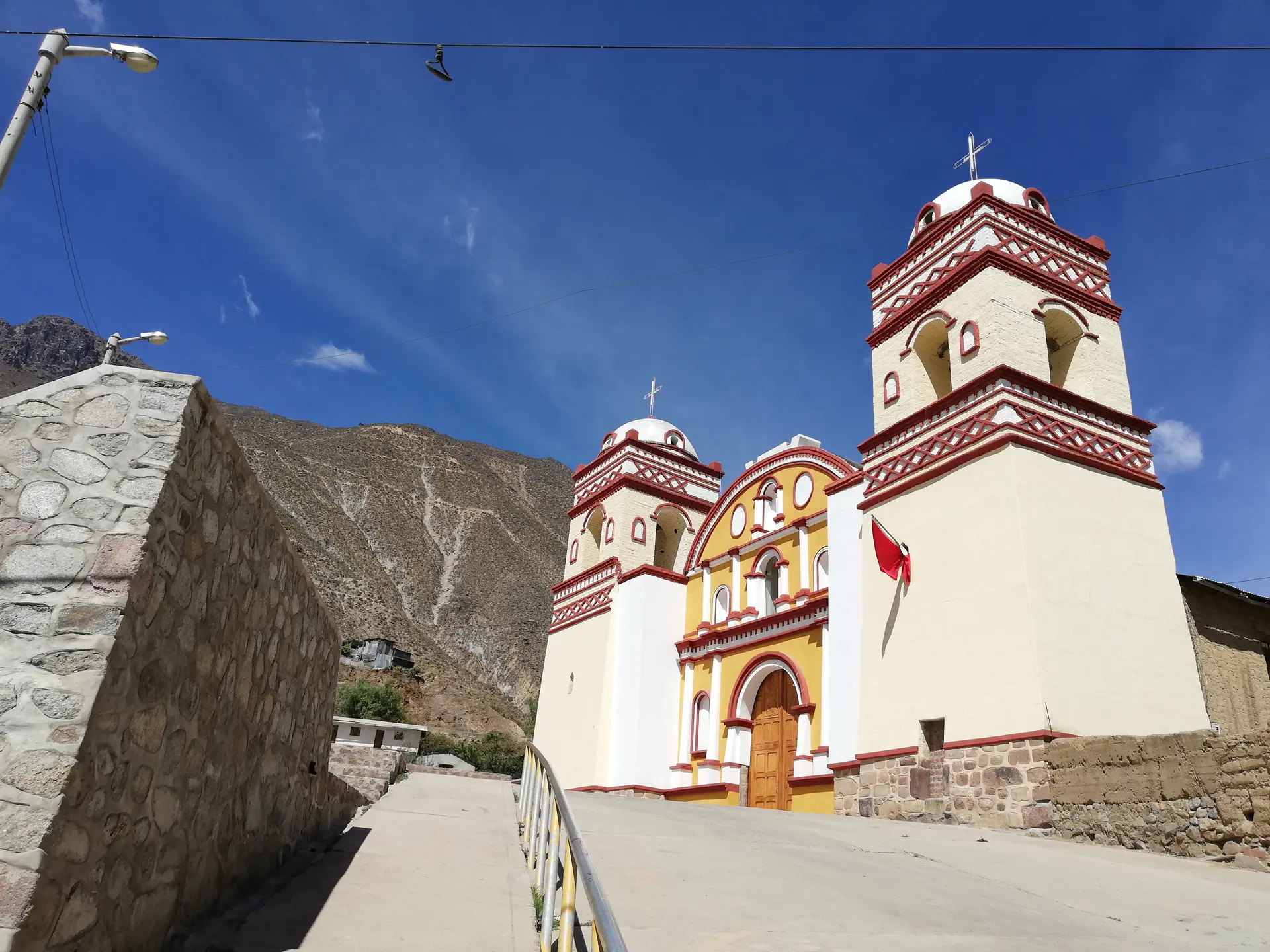
Image of Church of Saint John the Baptist of Huaytara. Image source · CC-BY-SA-4.0
Visit essentials
A quick read before you go
- Duration
- One to two hours for the church; additional time for exploring Huaytara.
- Etiquette
- Approach as both an active Catholic church and a site of preserved Inca heritage.
Overview
Huaytara's claim to be Huancavelica's archaeological capital rests on a building containing two sacred traditions. The Church of San Juan Bautista rises from the century-older Temple of Huaytara, built by Pachacutec during the early-fifteenth-century Inca conquest of the Chincha.
The original carpa uasi, or 'tent house,' is unique in Inca architecture. Departing from usual enclosed rectangular plans, it has a trapezoidal floor, walls 1.65 meters thick and 3.70 meters high, and features suggesting special purpose. Scholars identify it as a Temple of the Sun; others argue for a palace.
During the Spanish 'extirpation of idolatries,' colonizers converted rather than destroyed it — perhaps recognizing sacred power in the location. Colonial upper walls and interior now rise above preserved Inca stonework. Research published in 2025 found the earlier structure engineered to amplify and project sound, implying sophisticated ceremonial acoustics; if priests chanted here, the walls strengthened their voices.
Visitors still see Inca niches and doorways beneath Catholic architecture. Mass is celebrated where sun worship may once have occurred, its sound perhaps still shaped by Inca engineering.
Why this place is sacred
At Huaytara, the thin place is visible in the walls themselves. Look down and see Inca stonework: trapezoidal niches, massive blocks fitted without mortar, the architecture of Pachacutec's empire. Look up and see colonial construction: the church that Spanish authorities built to claim this sacred space for Christianity. The transition occurs within a single building, a visible stratigraphy of sacred power.
The deliberate choice to build the church on the temple—rather than demolishing and rebuilding—suggests that colonial authorities recognized something about the location. Sacred sites resist erasure; power tends to accumulate rather than transfer. By building on rather than replacing, the Spanish may have inadvertently preserved what they intended to suppress.
The acoustic engineering adds another dimension. Recent research reveals that the Inca structure was built to amplify and project sound. Whatever ceremonies occurred here—sun worship, perhaps—were enhanced by architecture that made voices carry with unusual power. The colonial church inherited this acoustic space. Mass celebrated within these walls resonates through engineering designed for a different worship.
The carpa uasi structure itself was unique. This was the only known example of this building type, breaking with Inca architectural conventions in ways that suggest special sacred function. Whatever required this departure from standard practice concentrated unusual significance at this location.
Huaytara's thinness thus operates through layers: the persistence of Inca sacred architecture, the colonial attempt at conversion, the acoustic enhancement that serves whatever worship occurs, and the unique architectural form that suggests powers the records do not fully explain.
Inca temple, possibly dedicated to sun worship (Temple of the Sun), built by Pachacutec during the conquest of the Chincha. The unique carpa uasi structure was engineered to amplify sound.
From Inca temple to colonial church through the 'extirpation of idolatries' campaign. Both layers preserved in a single structure. Recent research has revealed the acoustic engineering of the original building.
Experience and orientation
Huaytara sits in central Peru, capital of Huaytara Province in the Huancavelica Region. The elevation varies by source (2,706-3,599 meters), but the altitude is significant enough to require attention. The town itself is small, the church its primary attraction.
Approach the church from the main plaza, as visitors have approached it for centuries. The exterior announces colonial Catholic architecture, but the lower walls already hint at what lies beneath—the massive Inca stonework visible from outside.
Enter and allow your eyes to adjust. The interior reveals the extraordinary layering that makes this church unique. The lower portions of the walls are unmistakably Inca: the characteristic trapezoidal niches, the recesses and doorways, the stonework 1.65 meters thick and 3.70 meters high. These are the walls of Pachacutec's temple, preserved within the colonial church.
Above this Inca foundation, the colonial structure rises: the upper walls, the ceiling, the altar, the Christian imagery. The transition between eras occurs within the building itself, visible to any observer who takes time to see.
Consider the acoustics. Recent research has established that the Inca structure was engineered to amplify and project sound. When you hear voices in this space—whether priest or visitor—you're hearing them shaped by architecture designed for Inca ceremony. The colonial church inherited a sonic environment created for a different worship.
If Mass is being celebrated, listen with awareness of this layering. The liturgy sounds through walls that were built for sun worship, in a space designed to make ritual voices carry with power.
Reflect on the 'extirpation of idolatries'—the colonial campaign to destroy indigenous religion. The decision to build on the temple rather than demolish it created unintended preservation. Two sacred traditions coexist in one structure, neither fully dominant.
The church faces the main plaza of Huaytara, the capital of Huaytara Province in the Huancavelica Region of central Peru.
Context and lineage
When Pachacutec expanded the Inca Empire into Chincha territory in the early 15th century, he ordered the construction of ceremonial sites to mark Inca presence. At Huaytara, his builders created a unique structure—a carpa uasi or 'tent house' that broke with standard Inca architectural conventions.
The structure's purpose remains debated. Most scholars believe it was a Temple of the Sun, dedicated to Inti worship as the empire's primary religious expression. Others suggest it may have been a palace. The unique carpa uasi form—the only known example of this building type—argues for special sacred function.
Recent research (2025) has added another dimension: the structure was engineered to amplify and project sound. The walls' thickness and composition created acoustic properties that would have enhanced ritual chanting or speech. Whatever ceremonies occurred here, they resonated through space designed to make them powerful.
When Spanish colonizers arrived in the 16th century, they initiated the 'extirpation of idolatries'—a systematic campaign to destroy indigenous religious practice and replace it with Catholicism. At Huaytara, they faced a choice. The temple could be demolished, its stones scattered or repurposed. Or it could be converted—the church built on the temple, claiming the sacred space for Christianity.
They chose conversion. The Church of San Juan Bautista rose on Inca foundations. The lower walls were preserved—perhaps because demolishing them would have been difficult, perhaps because something about the location seemed too powerful to abandon. Colonial walls and ceiling were added above. The result was a unique building containing two sacred traditions in visible layers.
Inca imperial construction under Pachacutec, transformed by Spanish colonial 'extirpation of idolatries' into the Catholic Church of San Juan Bautista. Both traditions preserved in one structure.
Pachacutec (Inca Yupanqui)
Builder of original temple
Traditions and practice
Inca sun worship (if the structure was a Temple of the Sun). Ceremonies enhanced by sophisticated acoustic engineering. Practices associated with the unique carpa uasi architecture.
Catholic masses and services dedicated to Saint John the Baptist. Preservation of dual heritage as archaeological and spiritual site. Research into acoustic properties of the original structure.
Attend Mass if possible to experience the liturgy in the acoustically engineered space. Examine the transition between Inca and colonial architecture in the walls. Consider what it means for two traditions to coexist in one structure.
Roman Catholicism
ActiveThe Church of San Juan Bautista serves as the parish church of Huaytara, celebrating Mass and sacraments within walls that began as an Inca temple.
Catholic masses and services, veneration of Saint John the Baptist, feast day celebrations.
Inca Religious Practice
HistoricalThe original temple, possibly dedicated to sun worship, represents Pachacutec's expansion of Inca religion into Chincha territory. The unique carpa uasi architecture suggests special sacred function.
Sun worship ceremonies (inferred), rituals enhanced by acoustic engineering.
Perspectives and open questions
The church can be understood as a site of colonial religious conquest, as an example of accidental preservation through conversion, as a demonstration of Inca acoustic engineering, or as a unique synthesis where two sacred traditions coexist in one structure.
Scholarly perspective
Recent research has focused on the acoustic properties of the Inca structure, revealing sophisticated sound engineering for ceremonial purposes. The carpa uasi architectural form remains unique and not fully understood.
Living and traditional perspectives
Within Catholic tradition, the church represents the triumph of Christianity over indigenous religion. Within Andean perspective, the survival of the Inca structure represents the persistence of sacred place despite attempts at erasure.
Alternative interpretations
The layering of traditions invites reflection on how sacred sites resist replacement—how power accumulates in locations regardless of which religion claims them.
Open questions
The specific ceremonies conducted in the original Inca structure. The full significance of the unique carpa uasi architecture. Whether the acoustic properties were intentionally preserved or accidentally maintained in the colonial construction.
Plan your visit
Access and arrival
Basic accommodations available in Huaytara and surrounding area.
Respectful visit
Modest dress appropriate for a Catholic church. Comfortable shoes for exploring Huaytara.
Check current guidelines; photography may be restricted during services.
Donations support the church's maintenance.
Respect areas reserved for worship. Do not touch or damage Inca stonework.
The church is an active place of worship; approach with appropriate reverence. Check locally for Mass times and accessibility.
Location
Map loads as you approach this section.
Pilgrim reflections
A portrait of encounter, not a score
Pilgrims describe what they felt, how present they could become, and whether the place would shape a journey. There are no stars and no ranking of traditions.
No reviewed reflections yet
The first pilgrims can help describe the character of being here.
Share a reflection
Available after an account-backed “Been there.” Every reflection is reviewed before publication.
Nearby sacred places
Explore other sacred places in the region. Proximity does not establish access or travel time; check each place’s guidance.


References
Sources consulted for this page. Source categories describe the publication, not a guarantee that every claim is verified. Traditional accounts and outside interpretations may differ.
- 01Huaytara Archaeological ComplexSource context
- 02Huaytara the archaeological capital of HuancavelicaSource context
- 03Researchers Investigate Why a 15th-Century Inca Structure Was Built to Amplify and Project SoundSource context
- 04Temple of Huaytará - Megalithic BuildersSource context
- 05Researchers Explore Possible Use of an Inca Structure in Central Peru - Archaeology MagazineSource context
- 06Introduction to religious art and architecture in early colonial PeruSource context
Share a photo
Help visitors recognize Church of Saint John the Baptist of Huaytara. Every submission is reviewed before publication.