Kolmiköytisienvuori Rock Painting
A Stone Age figure still facing the water it was painted to be seen from
Understand sacred places, explore living traditions, and learn how to engage respectfully with Pilgrim Map.
Access has not been verified. Check current local guidance before planning a visit.
Ruokolahti, South Karelia, Finland
Read the sources
Visit essentials
A quick read before you go
- Duration
- 20-40 minutes, covering the walk from the parking area along the marked path to the shore and…
- Access
- A parking area is located at Kirjamoinniementie 31, 56140 Ruokolahti, from which a marked path…
Overview
Kolmiköytisienvuori is one of the rock paintings around Lake Saimaa. Its single panel stands 3.5 to 4.5 meters above the current water level on a granite face in Ruokolahti, South Karelia. Timo Miettinen found and first inventoried it in 1977, then re-documented it in 1994; Minna Kähtävä-Marttinen recorded it more fully in 1996, followed by photography in 2004, a field check in 2012, and GPS resurvey in 2021.
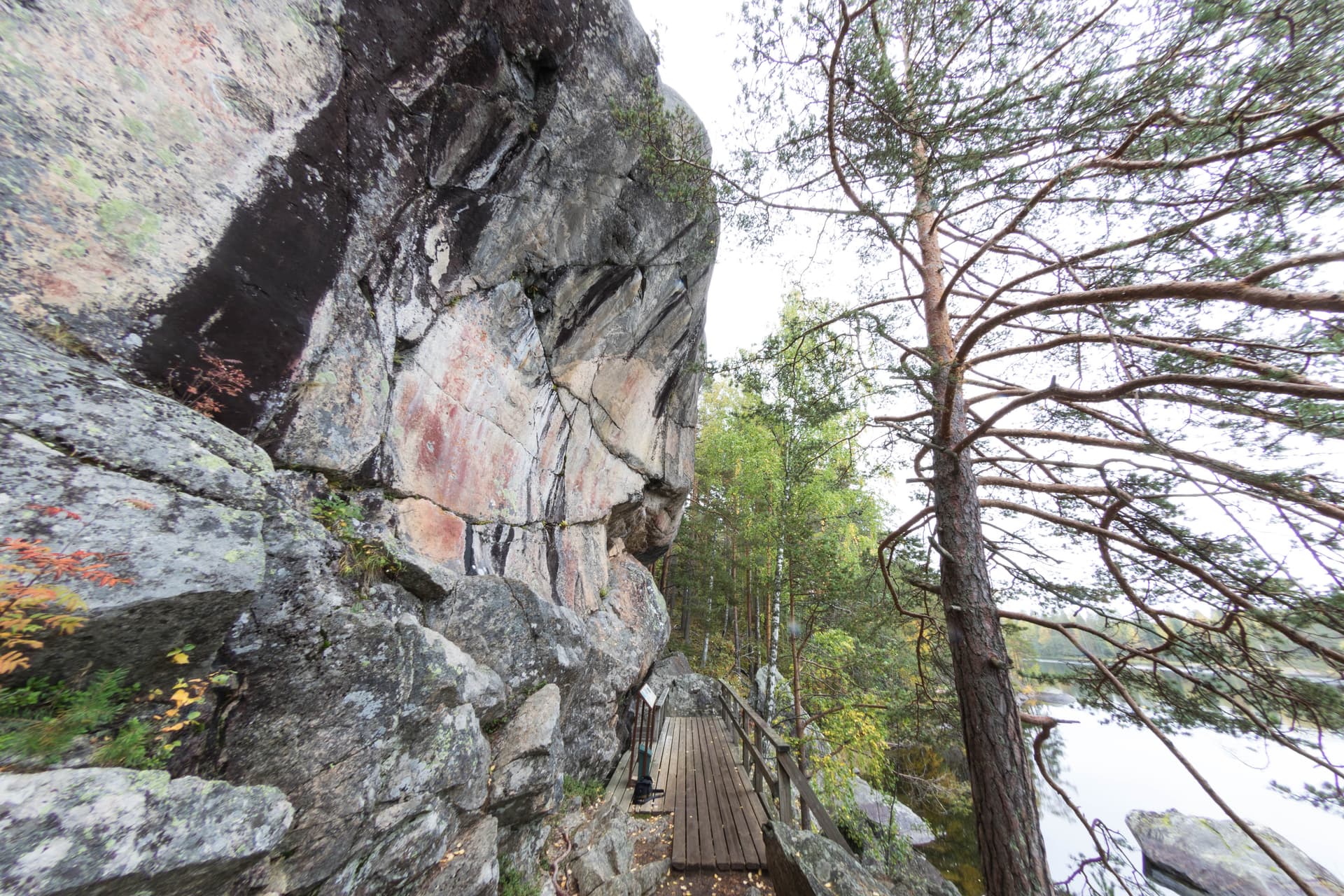
Two large human figures raise their arms in the posture Finnish sources call 'adorant'; beside them, a smaller figure's lower body resembles a serpent. Finland's official ancient-monument register cautions that parts are damaged and difficult to identify. A marked path leads from parking to Saimaa Geopark signage explaining the panel.
Why this place is sacred
The painting's most distinctive quality is where it sits: not tucked into a hidden crevice, but on a rock face positioned 3.5 to 4.5 meters above the water at the time it was made — a height Finnish archaeologists use, via Saimaa's well-documented history of shore displacement, to date the panel to roughly 3000 BCE, or 4,700 to 3,700 years ago in the calibrated range the Saimaa Geopark cites.
Whoever painted it chose a surface visible from the lake rather than from land, which suggests an intended audience moving across the water rather than approaching on foot. The imagery itself is modest in scale — a painted area of about 1.35 by 2.45 meters, according to the site's own description — and its state is imperfect: the official heritage register describes the figures as 'partially difficult to identify and damaged,' which tempers any claim of pristine preservation.
Within that damaged, red-ochre surface, two human figures stand with arms raised, and a third, smaller figure appears beside them with a lower body resembling a serpent. Finnish rock-art commentary reads this hybrid figure as a depiction of shamanic transformation — a person changing into serpent form, potentially understood as a passage toward another realm — though this is an interpretation built from the imagery and comparative frameworks, not from any surviving account of what the original makers intended.
Not documented with certainty. The prevailing interpretation among the sources reviewed is that the panel relates to shamanic belief — a figure in transformation — but no textual or oral record from the culture that made it survives to confirm this.
Painted by Stone Age communities of the Saimaa basin around 3000 BCE, when the lake stood higher against this rock face; left unrecorded until 1977, when Timo Miettinen found and inventoried it; re-documented by Miettinen in 1994 and by Minna Kähtävä-Marttinen in 1996; photographed again in 2004 by Ismo Luukkonen; checked in the field in 2012 by Helena Ranta; and GPS-resurveyed in 2021 by Teemu Mökkönen.
It is now a legally protected ancient monument within the Saimaa UNESCO Global Geopark's visitor network.
Experience and orientation
A parking area off Kirjamoinniementie in Ruokolahti now marks the start of the visit, with a path leading down to the shore where the painting is set into the rock face. Saimaa Geopark signage stands both at the parking area and near the painting itself, orienting visitors before they reach the panel.
What there is to see is a small, weathered field of red-ochre marks on grey granite — not a restored or enhanced image, but the same damaged, partial composition the official register describes. The figures are easiest to make out with patience rather than a quick glance: the two raised-arm forms are the most legible, and the smaller serpent-bodied figure beside them takes longer to resolve.
No specific first-person visitor accounts were found in the sources used for this profile, so this description stays close to what the site's own official and geopark documentation confirms rather than reaching for an atmosphere no source attests to.
Follow the marked path from the Kirjamoinniementie parking area to the shore; read the Geopark signage at both the parking area and the shoreline before approaching the panel itself.
Context and lineage
The painting was made by Stone Age communities living around Lake Saimaa at a time when the water stood several meters higher against this rock face than it does now. Its height above the current shoreline is the primary evidence used to date it, drawing on the well-studied pattern of Saimaa's gradual post-glacial shore displacement, which places the panel at roughly 3000 BCE, or within a calibrated window of 4,700 to 3,700 years ago.
Stone Age communities of the Saimaa basin (creation, c. 3000 BCE) → undocumented for millennia → formal discovery and inventory (1977) → sequence of re-documentation and verification (1994, 1996, 2004, 2012, 2021) → legal protection as a nationally significant ancient monument → incorporation into the Saimaa UNESCO Global Geopark's visitor network
Traditions and practice
The painting itself is the only surviving evidence of practice: red ochre applied to a vertical rock face positioned to be seen from the water. No account of song, gesture, or accompanying ceremony has survived. What is inferred — a shamanic figure in transformation — comes from the imagery and from comparison with other rock art discussed in Finnish sources, not from any direct record.
None in the ritual sense. The site's current activity is stewardship and interpretation: heritage registration, periodic re-survey by researchers, and geopark signage for visitors.
Take the marked path at an unhurried pace and read both sets of Geopark signage before looking at the panel directly. Once at the shore, give the two raised-arm figures time to separate from the surrounding rock discoloration, and look for the smaller, serpent-bodied figure beside them — it is described in sources as harder to make out than the two larger forms. Resist the urge to touch or trace the pigment to see it more clearly.
Stone Age Saimaa Rock Painting Tradition
HistoricalPart of the wider corpus of red ochre rock paintings around Lake Saimaa, attributed to Stone Age hunter-fisher-gatherer communities. The raised-arm figures and the serpent-bodied form are read in Finnish sources as imagery associated with shamanic transformation.
Red ochre pigment applied to a vertical rock face positioned to be visible from open water, 3.5 to 4.5 meters above the water level at the time of painting.
Finnish Heritage Agency Rock Art Stewardship
ActiveA documented, decades-long tradition of inventory, re-documentation, and verification (1977 through 2021) that keeps the site under active scholarly attention, now paired with the Saimaa UNESCO Global Geopark's public interpretive program.
Site inventory, photographic documentation, field verification visits, GPS/boundary resurvey, and geopark trail and signage installation.
Perspectives and open questions
Kolmiköytisienvuori sits at the intersection of a well-documented modern research history and a genuine gap in what can be known about the painting's original meaning.
Scholarly perspective
Finland's official ancient monument register and the site's Wikipedia summary together establish a clear, multi-decade research record: discovery and inventory in 1977, re-documentation in 1994 and 1996, photography in 2004, field verification in 2012, and GPS resurvey in 2021. The shore-height dating method places the painting at roughly 3000 BCE. The register itself, however, describes the figures as partially difficult to identify and damaged — a caution against treating any single reading of the imagery as settled fact.
Living and traditional perspectives
No living community traces direct cultural descent from the painting's creators; it is held as shared Finnish national prehistoric heritage rather than an actively practiced tradition.
Alternative interpretations
Some popular accounts frame raised-arm figures in rock art generally as universal markers of 'ancient spirituality' without engaging the specific, more cautious shamanic-transformation reading offered in the sources reviewed here; that broader framing is not adopted in this profile.
Open questions
Whether the site was painted and used once or returned to repeatedly is not established in the sources reviewed. The precise identity suggested by the serpent-bodied figure — ancestor, spirit-guide, or a shaman depicted mid-transformation — cannot be recovered from the image alone, and no source claims otherwise.
Plan your visit
Access and arrival
A parking area is located at Kirjamoinniementie 31, 56140 Ruokolahti, from which a marked path leads to the shore and the painting. Saimaa UNESCO Global Geopark signage is posted at the parking area and again near the painting itself. No mobile phone signal information was available in the sources used for this profile; check with Ruokolahti municipality or the Saimaa UNESCO Global Geopark for current details.
No specific seasonal closure dates were documented, but ice cover affects the surrounding lake in winter.
Not documented in the sources reviewed; Ruokolahti and the nearby South Karelia region offer general lodging, but no specific accommodation was verified for this profile.
Respectful visit
No specific requirement; practical outdoor clothing suited to a shoreline path.
Permitted; the site is documented in Museovirasto's own official photographic archive.
None are appropriate; leaving objects or markings at the site risks violating its protected status.
Touching or scraping the pigment is prohibited under the Ancient Monuments Act (295/1963). Stay on the marked path where one exists; the panel is already noted by the official register as partially difficult to identify and damaged.
Do not touch, scrape, or apply anything to the pigment; it is a legally protected ancient monument under Finland's Ancient Monuments Act (295/1963), and the surface is already officially recorded as partially damaged.
Location
Map loads as you approach this section.
Pilgrim reflections
A portrait of encounter, not a score
Pilgrims describe what they felt, how present they could become, and whether the place would shape a journey. There are no stars and no ranking of traditions.
No reviewed reflections yet
The first pilgrims can help describe the character of being here.
Share a reflection
Available after an account-backed “Been there.” Every reflection is reviewed before publication.
Nearby sacred places
Explore other sacred places in the region. Proximity does not establish access or travel time; check each place’s guidance.

References
Sources consulted for this page. Source categories describe the publication, not a guarantee that every claim is verified. Traditional accounts and outside interpretations may differ.
- 01Kulttuuriympäristön palveluikkuna – Kolmiköytisienvuori ancient monument register entry (KOHDE_ID 700010016) — Museovirasto (Finnish Heritage Agency)officialOfficial government heritage register. Independently corroborates 1977 initial inventory by Timo Miettinen and 1996 documentation by Minna Kähtävä-Marttinen. Adds further verified documentation events: photographic documentation in 2004 (Ismo Luukkonen), a verification visit on 24 May 2012 (Helena Ranta), and a GPS/boundary re-survey on 28 July 2021 (Teemu Mökkönen, ±6 m accuracy). Confirms legal protection under the Ancient Monuments Act (295/1963) and designation as a nationally significant archaeological site (muinaisjäännösrekisteri / VARK). Notes two undated stone cairns south of the painting and describes the figures as 'partially difficult to identify and damaged.'
- 02Kolmiköytinen Rock Painting – Saimaa UNESCO Global Geopark — Saimaa UNESCO Global GeoparkofficialOfficial geopark visitor page. Confirms a marked parking area (Kirjamoinniementie 31, 56140 Ruokolahti; coordinates 61.271127, 28.627373), a path leading from parking to the shore and painting, and geopark interpretive signage both at the parking area and at the shore near the painting. Confirms panel position 3.5-4.5 m above water level, age of 4,700-3,700 years following the post-Suursaimaa lake phase, and underlying granodiorite bedrock (~1,880 million years old, cut by younger pegmatite dikes).
- 03Ruokolahden Kolmiköytisienvuoren kalliomaalaus (osa) – Museovirasto / Finna.fi — Museovirasto (Finnish Heritage Agency)officialOfficial heritage agency photographic archive record confirming site identity and imagery.
- 04Kolmiköytisienvuoren kalliomaalaus – Wikipedia — Wikipedia contributorsacademicDirectly quoted for: painted-area dimensions (1.35 x 2.45 m), discovery ('Maalauksen löysi vuonna 1977 Timo Miettinen, joka on myös merkitty maalauksen inventoijaksi'), 1994 re-documentation by Miettinen, 1996 documentation by Minna Kähtävä-Marttinen, figure description, shore-height dating to ~3000 BCE.
- 05Ruokolahden Kolmiköytisien vuoren kalliomaalaus – Retkipaikka — RetkipaikkaSource contextVisitor-oriented Finnish outdoor-recreation site; used for supplementary visitor-experience framing only, not for any date or name claims.
- 06Metsästä Venäjän rajalla löytyi erikoinen kalliomaalaus – näetkö sinä tässä saman kuvion kuin tutkija? – Yle — Yle Etelä-KarjalaSource contextNews article about a different, newly discovered rock painting (Salosaari) in Ruokolahti; mentions Kolmiköytisienvuori only in passing as 'the other rock painting' in the municipality.
Share a photo
Help visitors recognize Kolmiköytisienvuori Rock Painting. Every submission is reviewed before publication.