Styrdalen Valla Dolmen
A five-thousand-year-old stone chamber where Neolithic hands carved meaning into rock
Understand sacred places, explore living traditions, and learn how to engage respectfully with Pilgrim Map.
Access has not been verified. Check current local guidance before planning a visit.
Kållekärr, Västra Götaland, Sweden

Visit essentials
A quick read before you go
- Duration
- Fifteen to thirty minutes for the dolmen itself.
- Access
- Located beside Hjaltebyvägen road between Valla kyrka and Furasater on the island of Tjorn,…
Overview
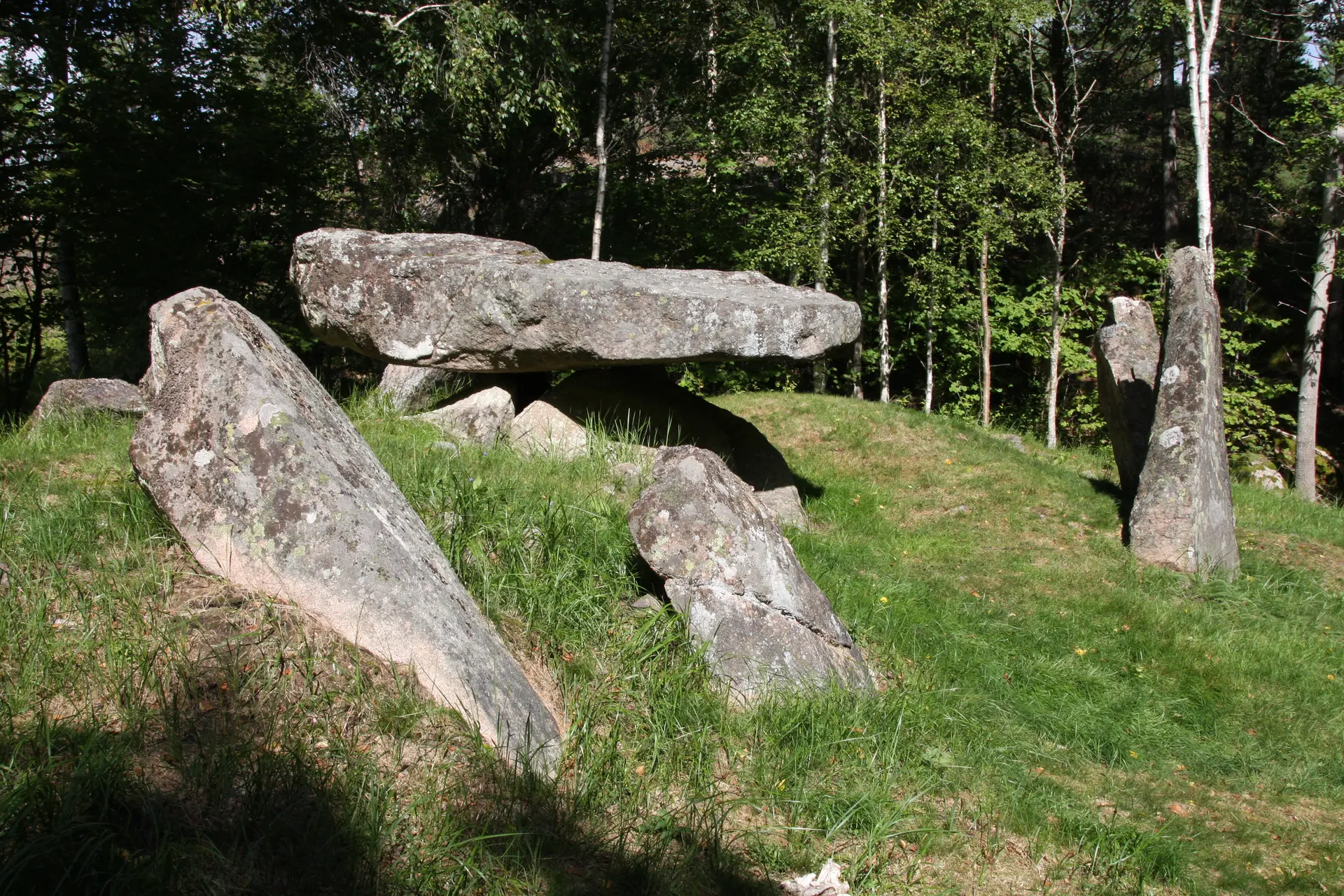
The Valla Dos has waited on its Tjorn hilltop for approximately five thousand years. A capstone roughly two meters across rests on supporting stones, forming a mushroom-shaped chamber barely large enough to kneel inside. Time and weather have smoothed cup marks carved into the capstone and one supporting stone.
Its Funnel Beaker Culture builders brought megalithic burial traditions to Scandinavia in the early Neolithic. They deliberately placed the tomb near the former shoreline, threading the dead between land and sea; Richard Bradley's research on Tjorn's tombs confirms the importance of this monument-water relationship.
The dolmen's original contents were cleared long before the 1915 excavation, leaving its burial deposits unknown. Architecture and cup marks survive. Later generations called the hollows alvkvarnar, elven mills, believing supernatural beings ground flour in them at night; people offered grease and seeds there well into historical times.
Kneeling beneath the capstone hides the sky and contracts the world to stone and breath, making five thousand years intimate rather than abstract.
Why this place is sacred
The Funnel Beaker Culture people who built this dolmen did not simply need a place to put their dead. They needed a place where the dead could be held in relationship to the living world, and they chose with care.
Richard Bradley's study of megalithic tombs on Tjorn demonstrated that the island's dolmens were sited in relation to the Neolithic shoreline, not the landscape as we see it today. Five thousand years ago, sea levels were higher and the coastline closer. The builders positioned their dead at the threshold between cultivated land and the waters beyond, a liminal placement that speaks to a cosmology in which death was understood as a crossing.
The chamber itself creates a threshold of a different kind. The mushroom shape, with its capstone resting on supporting stones, forms an enclosed space just large enough for a body. Kneeling inside, the visitor experiences a radical contraction of awareness. The open Bohuslan landscape, with its wind and sky, gives way to stone pressing close. The shift is physical before it is conceptual.
The cup marks extend the site's sacred life far beyond its original construction. These small hollowed depressions, carved into the capstone and one supporting stone, connect the dolmen to a pan-Scandinavian tradition of ritual marking that scholars associate with fertility rites, ancestor veneration, and seasonal ceremonies. The marks may have been carved centuries or millennia after the dolmen was built, indicating that subsequent communities recognized this place as significant and continued to engage with it ritually.
In later Swedish folk tradition, cup marks became alvkvarnar, elven mills. People left offerings of grease, seeds, grains, and coins in the hollows, maintaining a relationship with the site that had by then passed beyond archaeological memory into the realm of folklore. The tradition of leaving offerings persisted into modern times, suggesting an unbroken thread of attention spanning from the Neolithic to the present.
Archaeological evidence and typological comparison indicate the dolmen served as a burial chamber for Funnel Beaker Culture farming communities around 3500-3300 BCE. The communal stone construction implies collective effort and shared beliefs about the treatment of the dead. The placement near the Neolithic shoreline suggests that the relationship between the burial and the sea held cosmological significance for the builders.
The dolmen's original burial deposits were removed at an unknown date before the 1915 archaeological excavation, severing the link between the monument and its specific dead. The cup marks represent a second phase of sacred engagement, possibly during the Bronze Age, when the existing monument was incorporated into new ritual practices. Folk traditions around the alvkvarnar constitute a third phase, translating the stone's significance into a supernatural framework.
Today, the dolmen functions as an archaeological monument, but visitors who kneel beside it enter a space that has drawn human attention for five millennia.
Experience and orientation
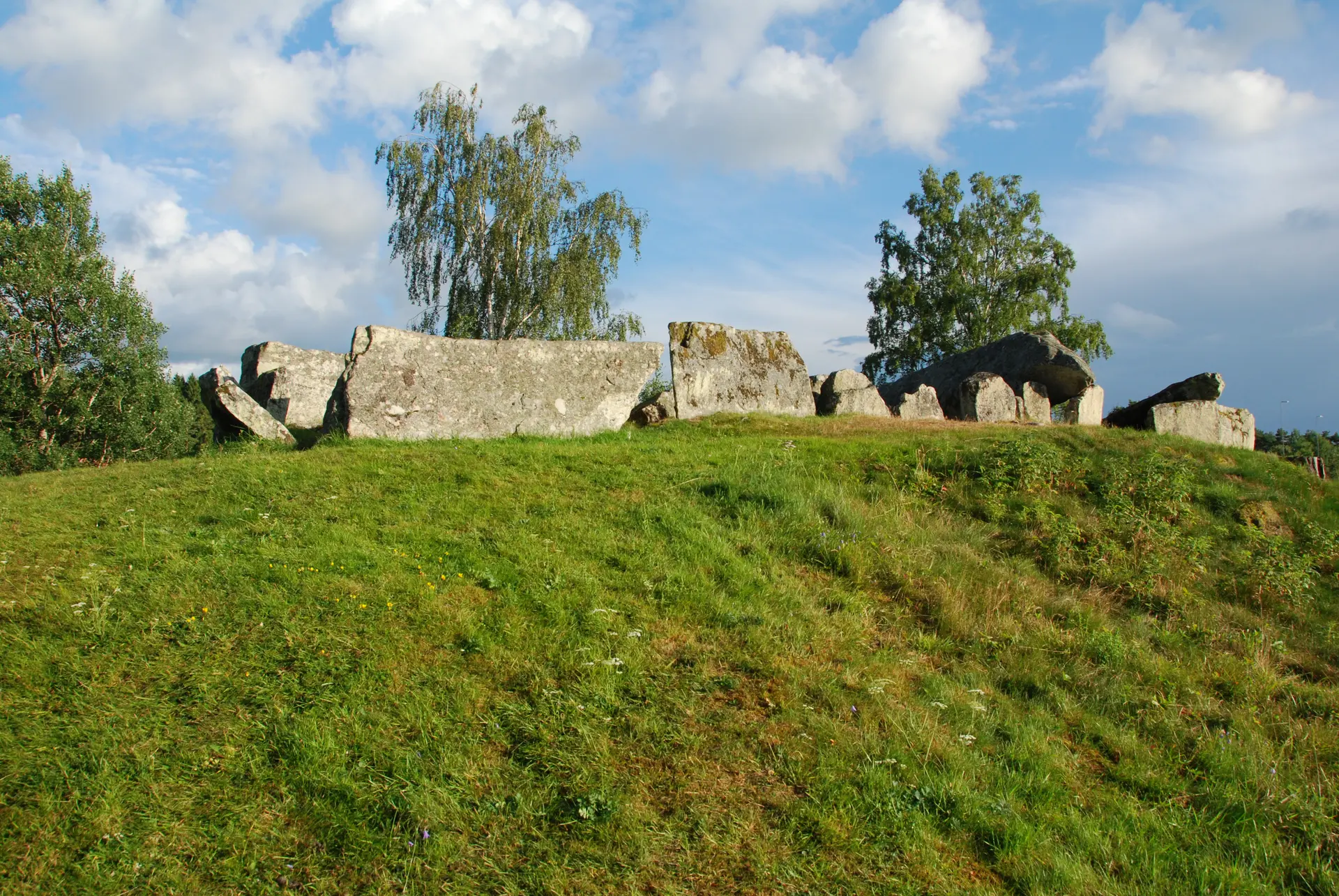
The Valla Dos does not announce itself. Positioned beside the road between Valla kyrka and Furasater, it could be mistaken for a natural rock formation by a driver passing too quickly. The dolmen asks visitors to slow down, to stop, to approach on foot across the low hill.
Up close, the mushroom shape becomes legible. The capstone, roughly two meters across, sits on its supporting stones at a height that invites kneeling rather than standing. The proportions are human, not monumental. Where the great passage graves of Falbygden impress through scale, this dolmen impresses through intimacy.
The cup marks reward patience. They are not immediately obvious, especially in flat light. But as your eyes adjust and your fingers trace the stone, the small hollowed depressions emerge, each one a deliberate act of carving by hands that held tools fashioned from flint or harder stone. Some scholars connect these marks to celestial maps, others to fertility symbols, others to ritual offerings.
The uncertainty is itself part of the experience: you are looking at something meaningful whose meaning has been lost.
Visitors who combine the dolmen with the nearby Pilane sculpture park and Iron Age burial ground discover a landscape where human meaning-making spans from the Neolithic to the present day. Contemporary sculptures stand among ancient stone circles and burial mounds, creating an unexpected dialogue across millennia.
The wind on Tjorn rarely stops. It wraps around the dolmen as it has for five thousand years, carrying the smell of salt from the nearby coast. In this wind, beside these stones, the distance between then and now feels less like a gulf and more like a breath.
Approach slowly. The dolmen sits on a low hill beside the road, and the temptation is to photograph it from a distance and move on. Instead, walk up to it. Kneel beside the chamber and look underneath the capstone. Notice how the space contracts, how the sky disappears.
Look for the cup marks on the capstone's surface. They are subtle, especially in overcast light, but once you see one, the others become visible. Run your eyes over the stone rather than your fingers, as the monument is protected.
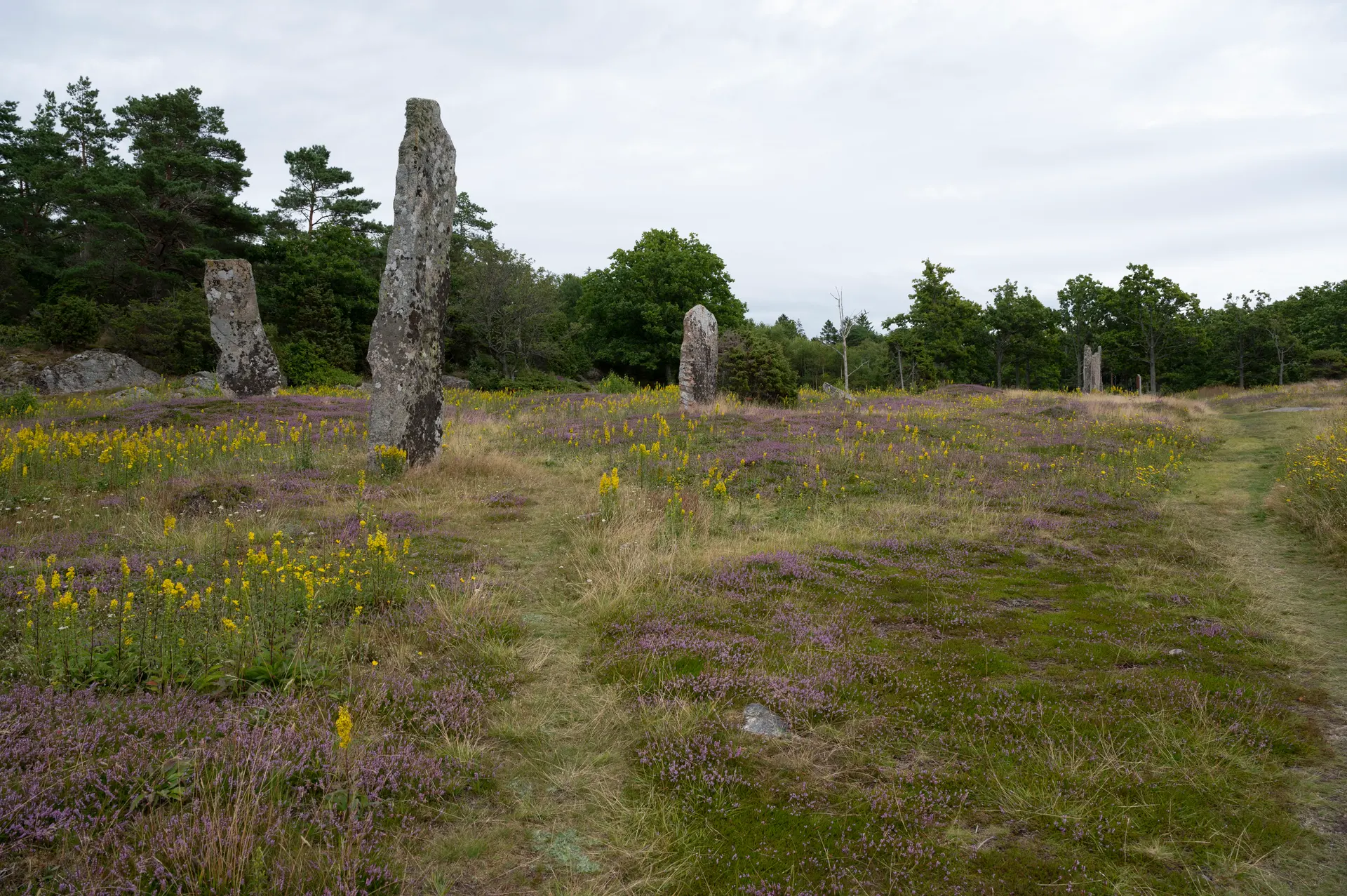
If time allows, walk west to the Pilane burial ground with its Iron Age stone circles and standing stones, then return to the dolmen. The two sites, separated by thousands of years, share this hilltop landscape and illuminate each other. The dolmen marks the beginning of a tradition of placing the dead in prominent positions within the landscape; Pilane shows how that tradition evolved.
Context and lineage
The Funnel Beaker Culture, known in Swedish as Trattbagarkultur, brought both agriculture and megalithic building traditions to Scandinavia during the early Neolithic. These communities, transitioning from hunting and gathering to farming, constructed permanent stone tombs that represented a fundamental shift in how the dead were honored. The dolmen at Valla was built during this transformative period, positioned on a hilltop that then overlooked the nearby shoreline.
The monument was first formally documented in archaeological records and excavated in 1915, though by that time its burial deposits had already been removed. The excavation confirmed the dolmen's Neolithic origin through typological comparison with other megalithic tombs in the region, but the specific individuals who were laid to rest here remain unknown.
The Funnel Beaker Culture's megalithic building tradition reached Scandinavia from northern Germany and Denmark, part of a broader European phenomenon that also produced the dolmens of Brittany, the passage graves of Ireland, and the megalithic tombs of the Iberian Peninsula. On Tjorn, this tradition produced multiple dolmens and passage graves positioned along the ancient coastline.
The cup marks on the Valla Dos link it to a second tradition of ritual engagement with stone that persisted across Scandinavia from the Bronze Age through the historical period. In later centuries, these marks were absorbed into folk belief as alvkvarnar, places where supernatural beings worked and where offerings could be left.
The 1915 excavation brought the site into the modern archaeological record, and its registration under Swedish heritage law ensures its preservation. Today, visitors encounter the dolmen within a landscape that also includes the Pilane Iron Age burial ground and contemporary sculpture park, creating an unusually layered site where five thousand years of human meaning-making are visible within walking distance.
Funnel Beaker Culture Builders
Original constructors of the dolmen, farming communities who brought megalithic traditions to Scandinavia
Richard Bradley
Archaeologist whose research on Tjorn's megalithic tombs demonstrated their deliberate siting near Neolithic shorelines
Riksantikvarieambetet (Swedish National Heritage Board)
Heritage authority responsible for the site's protection and registration as RAA Valla 15:1
Traditions and practice
Neolithic communities interred their dead within the stone chamber, likely accompanied by grave goods such as pottery and tools, though the original deposits were removed before the 1915 excavation. The communal effort required to transport and raise the capstone indicates that burial here was a significant communal event.
The cup marks carved into the capstone and supporting stone represent a later phase of ritual activity, possibly dating to the Bronze Age. Across Scandinavia, cup marks are associated with fertility rites, seasonal celebrations at Midsummer and spring, and funerary rituals honoring ancestors. Historical accounts record people smearing grease into the marks and leaving offerings of seeds, grains, and coins well into modern times.
Some modern visitors with connections to neo-pagan or earth-based spiritual practices visit megalithic sites in Sweden for personal meditation and reflection. The Valla Dos, with its roadside accessibility and intimate scale, occasionally draws such visitors, though no organized gatherings take place.
Kneel beside the chamber and look into the space beneath the capstone. Allow your eyes to adjust to the shadows. Notice how the air changes within the enclosure, how sound softens. The chamber was designed to hold a human body; your presence activates its proportions in a way that standing beside it cannot.
Examine the capstone surface for the cup marks. They are easiest to see in raking light, early morning or late afternoon. Consider that these marks may have been carved a thousand years after the dolmen was built, by people who found meaning in a monument they did not construct. The continuity of attention is itself worth contemplating.
If visiting in summer, extend your walk to the Pilane sculpture park and burial ground to the west. The Iron Age stone circles and contemporary sculptures create a conversation with the dolmen that enriches both sites.
Funnel Beaker Culture (TRB) Burial Tradition
HistoricalThe dolmen belongs to the Funnel Beaker Culture (Trattbagarkultur, c. 4300-2800 BCE), which introduced megalithic burial practices to Scandinavia. These communal stone tombs represented a fundamental shift in how early farming communities honored their dead, implying beliefs in an afterlife and the enduring significance of ancestors within the landscape of the living.
Communal burial in stone chambers, placement of grave goods including pottery and tools, possible reuse of tombs across generations. The construction required significant collective labor, indicating the burial was a community event of considerable social importance.
Scandinavian Cup Mark Tradition
HistoricalCup marks carved into the capstone and one supporting stone connect the dolmen to a widespread Scandinavian tradition of ritual marking. These small hollowed depressions appear on rock surfaces and megalithic monuments across the region, and in later folklore were known as alvkvarnar (elven mills), associated with supernatural beings and folk offerings.
Historical accounts record people smearing grease into cup marks and leaving offerings of seeds, grains, and coins. Cup marks were associated with fertility rites, kindling of ritual fires during Midsummer and spring celebrations, and funerary rites honoring ancestors. The practice of leaving offerings in cup marks persisted into the modern period in parts of rural Sweden.
Archaeological Heritage Stewardship
ActiveThe Valla Dos is registered as RAA Valla 15:1 by the Riksantikvarieambetet (Swedish National Heritage Board) and protected under Swedish heritage law. This modern tradition of archaeological documentation, protection, and public interpretation ensures the monument's survival and accessibility for future generations.
Heritage registration, legal protection under the Kulturmiljolagen, archaeological survey and documentation, and public access management. The 1915 excavation and subsequent studies form part of the ongoing scholarly engagement with the site.
Perspectives and open questions
The Valla Dos invites interpretation at multiple levels: as archaeological artifact, as evidence of Neolithic cosmology, as a node in folk tradition, and as a place where contemporary visitors encounter the weight of deep time. Each perspective illuminates something the others miss.
Scholarly perspective
Archaeological consensus places the dolmen within the Funnel Beaker Culture tradition (c. 3500-3300 BCE) that introduced megalithic burial practices to Scandinavia. Richard Bradley's peer-reviewed analysis of megalithic tombs on Tjorn demonstrated that these monuments were deliberately sited near the Neolithic shoreline, suggesting the builders understood the relationship between land and sea as cosmologically significant. The cup marks indicate ritual engagement that continued beyond the original construction period, though their precise meaning remains debated among scholars.
The dolmen had been cleared of its burial deposits before the 1915 excavation, so dating relies on typological comparison rather than direct evidence from this specific monument.
Living and traditional perspectives
In Swedish folk tradition, the cup marks on the dolmen were known as alvkvarnar, elven mills. According to this tradition, supernatural beings used the hollows to grind flour at night. People maintained relationships with these beings through offerings left in the cup marks, a practice that persisted into the historical period. This folk tradition, while not the original meaning of the cup marks, represents a genuine form of engagement with the monument that kept it within living cultural memory.
Alternative interpretations
Some modern visitors and neo-pagan practitioners approach dolmens as nodes of earth energy or points along ley lines. The mushroom-shaped chamber is sometimes interpreted as a symbolic gateway between the world of the living and the world of the ancestors, a portal through which communication with the dead might be facilitated. While these interpretations lack archaeological support, they often emerge from genuine experiences visitors have at the site.
Open questions
The dolmen's original burial contents were removed before the 1915 excavation, so the identity of those interred and the nature of their grave goods remain permanently unknown. The precise purpose and meaning of the cup marks continue to be debated, with interpretations ranging from celestial maps to fertility symbols to ritual offering points.
Why this particular hilltop was chosen, and how the Neolithic builders transported and raised the capstone with the technology available to them, invite speculation about engineering capabilities and landscape perception that cannot be definitively resolved.
Plan your visit
Access and arrival
Located beside Hjaltebyvägen road between Valla kyrka and Furasater on the island of Tjorn, Bohuslan. Tjorn is connected to the mainland by the Tjorn Bridge (Tjornbron). The dolmen sits on a low hill directly beside the road, making it easily accessible on foot. No mobile phone signal information was available at time of writing; check coverage maps for the Tjorn area before visiting. The nearest settlement is the village of Valla.
Tjorn offers a range of accommodations from guesthouses to camping. The island is a popular summer destination with facilities concentrated around Skarhamn and Klädesholmen. The mainland town of Stenungsund provides additional options.
Respectful visit
No specific requirements. Outdoor walking attire suitable for the terrain and weather is recommended. The site is exposed to wind from the coast.
Photography is permitted and encouraged at this open-air monument. The cup marks photograph best in low-angle light.
Do not leave modern objects at the site. While historical folk traditions involved leaving offerings in the cup marks, the monument is now protected and such practices would constitute interference with an archaeological site.
Do not climb on the stones or disturb the monument in any way. The site is legally protected under Swedish heritage law (Kulturmiljolagen). The dolmen is registered as RAA Valla 15:1 by the Riksantikvarieambetet.
Do not climb on the stones or attempt to enter the chamber. The dolmen is a legally protected archaeological monument under Swedish law. Avoid touching the cup marks, as oils from skin contribute to erosion over time. Do not leave offerings or objects at the site.
Current practical details
Address
Dösevägen 72, 471 72 Hjälteby, Sweden
Hours
Hours, fees, and access can change — verify on the official source before you travel. Practical details last checked Jun 2026.
Location
Map loads as you approach this section.
Pilgrim reflections
A portrait of encounter, not a score
Pilgrims describe what they felt, how present they could become, and whether the place would shape a journey. There are no stars and no ranking of traditions.
No reviewed reflections yet
The first pilgrims can help describe the character of being here.
Share a reflection
Available after an account-backed “Been there.” Every reflection is reviewed before publication.
Nearby sacred places
Explore other sacred places in the region. Proximity does not establish access or travel time; check each place’s guidance.

Share a photo
Help visitors recognize Styrdalen Valla Dolmen. Every submission is reviewed before publication.