Jättakullen Hällkista Dolmen
The largest stone cist in the Nordic region, a fourteen-meter house for the dead on a hilltop
Understand sacred places, explore living traditions, and learn how to engage respectfully with Pilgrim Map.
Access has not been verified. Check current local guidance before planning a visit.
Vårgårda kommun, Västra Götaland, Sweden
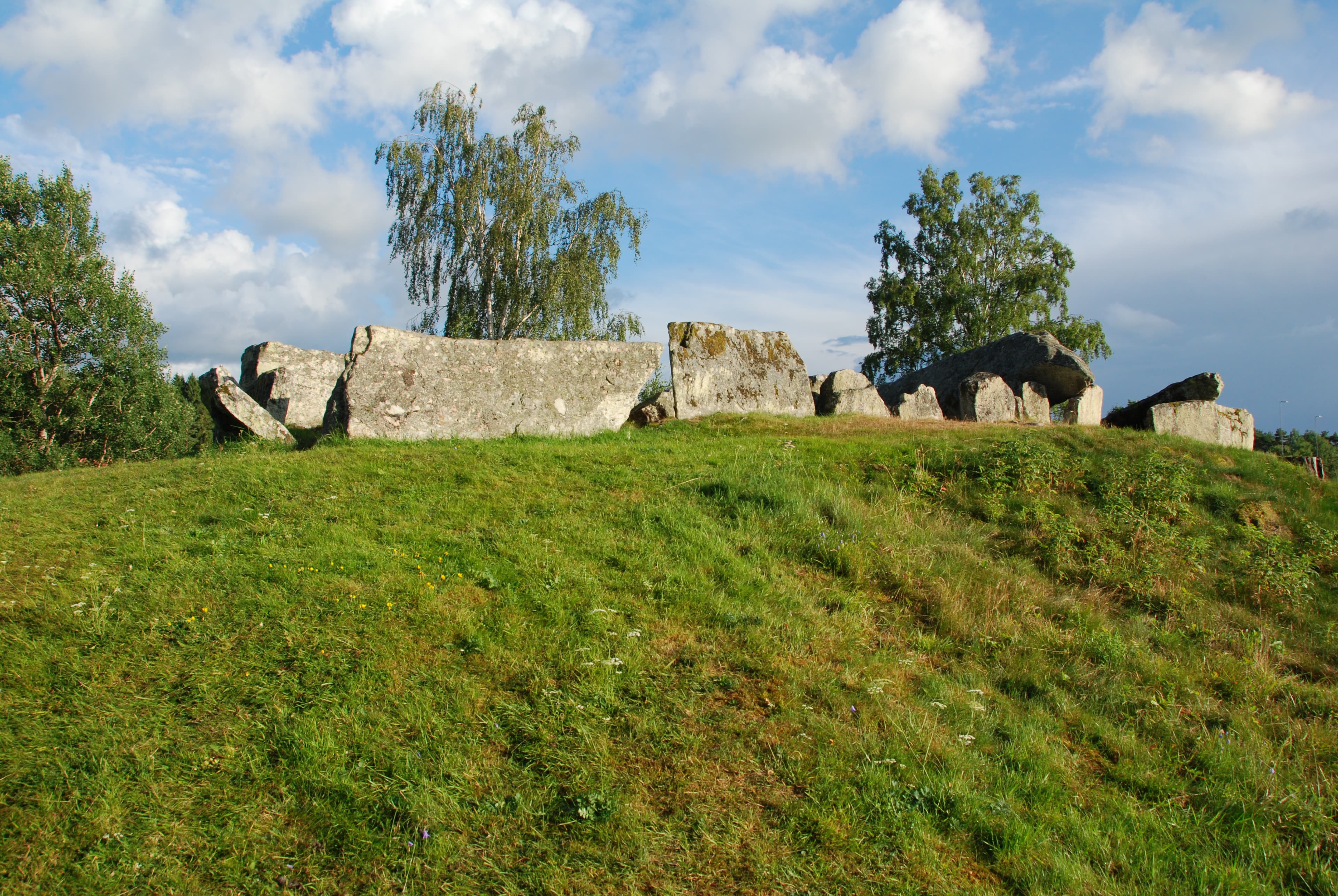
Image of Jättakullen Hällkista Dolmen. Image source · CC-BY-SA-3.0
Visit essentials
A quick read before you go
- Duration
- Twenty to forty minutes for the monument itself.
- Access
- Located on a hilltop between the Nossan river and the E20 highway, outside Vargarda, in Sodra…
Overview
Jattakullen means Giant's Mound, preserving a folk explanation for a stone cist fourteen metres long and four metres wide—the Nordic region's largest hallkista. Late Neolithic farmers in Vastergotland built it about four thousand years ago as gallery graves replaced passage graves.
Transverse slabs divide three chambers whose family, hierarchical, chronological, or other organization remains unknown because the site has never been formally excavated. Surface finds include flintstone tools, shale implements, and bones. Its hilltop commands the surrounding landscape, while an observed alignment with Sodra Harene Church may indicate continuity of sacred use or coincidence. The monument still asks why its builders needed a house for the dead on this scale.
Why this place is sacred
A fourteen-metre cist required slabs weighing hundreds of kilograms to be quarried, carried uphill, and placed with further precision around three chambers. Choosing difficulty made the dead visible rather than hidden, announced by the hill itself.
Later people named the monument Jattakullen because they could not imagine human hands building it. The giants attribution acknowledges its deliberate excess: four thousand years later, the overwhelming response still works.
The gallery grave was constructed approximately 2200-1500 BCE as a communal burial space for successive generations. The three-chambered structure and hilltop placement indicate a monument designed to serve an important community over an extended period.
The site has never been formally excavated, preserving its archaeological integrity but limiting knowledge of its contents and use history. The alignment with Sodra Harene Church suggests possible continuity of sacred landscape use from the Late Neolithic through the Christian period. Today, the monument stands on private property but remains accessible and protected under Swedish heritage law.
Experience and orientation
A low hilltop mound resolves into stone as you approach between the Nossan river and E20 highway. Four thousand years ago, the river itself was a route through this strategic landscape. Up close, the fourteen-metre cist and three chambers appear through gaps between massive slabs weathered across four millennia. Some stones bear carvings not yet thoroughly documented.
Without excavation, possible family, sequential, or hierarchical uses remain open. From the hill, Vastergotland's farmland, farmsteads, and distant monument-bearing profiles unfold within Falbygden, one of Sweden's densest megalithic landscapes with over three hundred graves.
The site is on private property, so approach with respect. Park in designated areas and walk to the hilltop.
Walk the full length of the cist, fourteen meters, to appreciate the scale. Most gallery graves are a fraction of this size. The builders did something here that no one in the Nordic region attempted at this scale.
Look for the divisions between the three chambers. The transverse slabs that separate them indicate organized burial practice rather than simple accumulation.
Before leaving, turn from the monument and look at the landscape. The hilltop was chosen for visibility. Consider who was meant to see this monument and what its presence announced to them.
Context and lineage
The gallery grave tradition emerged during the Late Neolithic as passage graves fell out of use. Gallery graves, with their long rectangular chambers accessed from the short end rather than through a side passage, represented a shift in burial architecture that may have reflected changing social structures and beliefs about death. Jattakullen, at fourteen meters, pushed this architectural form to its extreme.
The name Jattakullen (Giant's Mound) reflects the folk tradition of attributing impressive prehistoric monuments to the work of jattar, the giants of Norse mythology. This naming pattern appears across Scandinavia and represents a form of cultural memory that acknowledged the monuments' significance while replacing the original builders' identity with supernatural agency.
Gallery graves succeed passage graves in the Scandinavian megalithic sequence, representing a shift from communal chambers accessed through side passages to elongated rectangular cists accessed from one end. Jattakullen sits within the broader Falbygden megalithic landscape that also contains some 253 passage graves, representing a region where monumental burial practices spanned millennia. The nearby Lundskullen, with its well-preserved hallkista and standing stones, provides a comparative site.
Late Neolithic Farming Communities
Builders of the largest gallery grave in the Nordic region
Lansstyrelsen Vastra Gotaland
County administrative board responsible for heritage protection of the site
Traditions and practice
The gallery grave received successive burials over multiple generations, each new interment adding to the community of the dead within the three-chambered structure. Grave goods found at the surface include flintstone tools, shale implements, and bones, suggesting the dead were accompanied by personal objects or ritual offerings.
The site draws visitors interested in megalithic culture and Neolithic archaeology. No organized tours or events are regularly held at the monument itself. Falbygdens Museum in Falkoping and the Platabergens Geopark provide broader context for the region's megalithic heritage.
Walk the full fourteen-meter length of the cist slowly. At each chamber division, pause and consider the organization. The transverse slabs are deliberate internal architecture, not accident. Someone decided where the divisions should fall.
Stand at the highest point of the hilltop and survey the landscape in every direction. The builders chose this position for its visibility. The monument was meant to be seen, to assert the presence of the dead to every community within sight.
If visiting Jattakullen, consider continuing to Lundskullen, a few kilometers south, where another well-preserved hallkista and standing stones offer a companion experience. The two sites together begin to sketch the outline of a Late Neolithic sacred landscape.
Late Neolithic/Early Bronze Age Gallery Grave Burial Tradition
HistoricalJattakullen is the largest hallkista in the Nordic region, measuring fourteen meters long and four meters wide. The three-chambered structure indicates organized approaches to communal burial that may have reflected family, social, or temporal divisions among the dead.
Multi-generational communal burial within stone-slab chambers. Grave goods including flintstone tools, shale implements, and bones were placed with the dead. The gallery grave was reopened repeatedly to accept new burials over time.
Heritage Protection and Conservation
ActiveThe monument is protected under Swedish heritage law and overseen by Lansstyrelsen Vastra Gotaland. Its unexcavated status preserves archaeological deposits for future research using techniques not yet developed.
Legal protection under the Kulturmiljolagen, heritage registration and monitoring, and management of public access on private property.
Perspectives and open questions
Jattakullen's unexcavated status means it holds more questions than answers. The largest gallery grave in the Nordic region invites speculation about scale, ambition, and the social forces that produced a monument without parallel.
Scholarly perspective
Jattakullen is classified as a hallkista (gallery grave) belonging to the Late Neolithic/Early Bronze Age tradition (c. 2200-1500 BCE). Scholarly research on gallery graves in southwestern Sweden has established that these monuments served as communal burial spaces used over multiple generations. The site has not been formally excavated, so its full archaeological potential remains untapped.
Its extraordinary size, the largest in the Nordic region, has no clear parallel and raises questions about the social organization and resources of the community that built it.
Living and traditional perspectives
The name Jattakullen (Giant's Mound) reflects the Swedish folk tradition of attributing large prehistoric monuments to the work of jattar (giants). This naming pattern is found across Scandinavia and represents a cultural memory of the monuments that long outlasted knowledge of their actual builders.
Alternative interpretations
Some modern visitors and spiritual practitioners view hallkistor as portals to the underworld or places where the boundary between the living and the dead is particularly thin. The three-chambered structure is sometimes interpreted symbolically as representing different stages of death or transition.
Open questions
Since the site has never been formally excavated, fundamental questions remain unanswered. How many individuals were buried here? Over what time period? What was the social relationship between the people buried in the three different chambers? The carvings inside the cist have not been thoroughly documented. Why this particular hilltop was chosen for the largest gallery grave in the Nordic region, and what significance the alignment with Sodra Harene Church may hold, remain open questions.
Plan your visit
Access and arrival
Located on a hilltop between the Nossan river and the E20 highway, outside Vargarda, in Sodra Harene parish, Vastra Gotaland. The exposed hilltop makes the monument visible and relatively easy to find. The site is on private property; park in designated areas. No mobile phone signal information was available at time of writing; the proximity to the E20 highway and Vargarda suggests standard network coverage.
Vargarda provides basic accommodation. Falkoping and Skovde offer broader options for visitors exploring the Vastergotland megalithic landscape.
Respectful visit
Sturdy outdoor footwear for the hilltop terrain. No specific dress code.
Photography is permitted. The monument photographs well from both close range and from a distance showing the hilltop context.
Do not leave objects at the site.
Located on private property; be respectful of the landowner. Do not climb on or disturb the stones. The monument is legally protected under Swedish heritage law.
The site is on private property. Park in designated areas, be respectful of the landowner, and do not litter. Do not climb on or disturb the stones. The monument has not been formally excavated, and its archaeological integrity must be preserved.
Current practical details
Address
E20, 447 91 Vårgårda, Sweden
Hours
Hours, fees, and access can change — verify on the official source before you travel. Practical details last checked Jun 2026.
Location
Map loads as you approach this section.
Pilgrim reflections
A portrait of encounter, not a score
Pilgrims describe what they felt, how present they could become, and whether the place would shape a journey. There are no stars and no ranking of traditions.
No reviewed reflections yet
The first pilgrims can help describe the character of being here.
Share a reflection
Available after an account-backed “Been there.” Every reflection is reviewed before publication.
Nearby sacred places
Explore other sacred places in the region. Proximity does not establish access or travel time; check each place’s guidance.


Share a photo
Help visitors recognize Jättakullen Hällkista Dolmen. Every submission is reviewed before publication.