Spanish Peaks, Colorado
Twin peaks where rain gods dwell and ancient trade routes converge beneath volcanic dikes radiating like rays from the sacred
Walsenburg, Colorado, United States
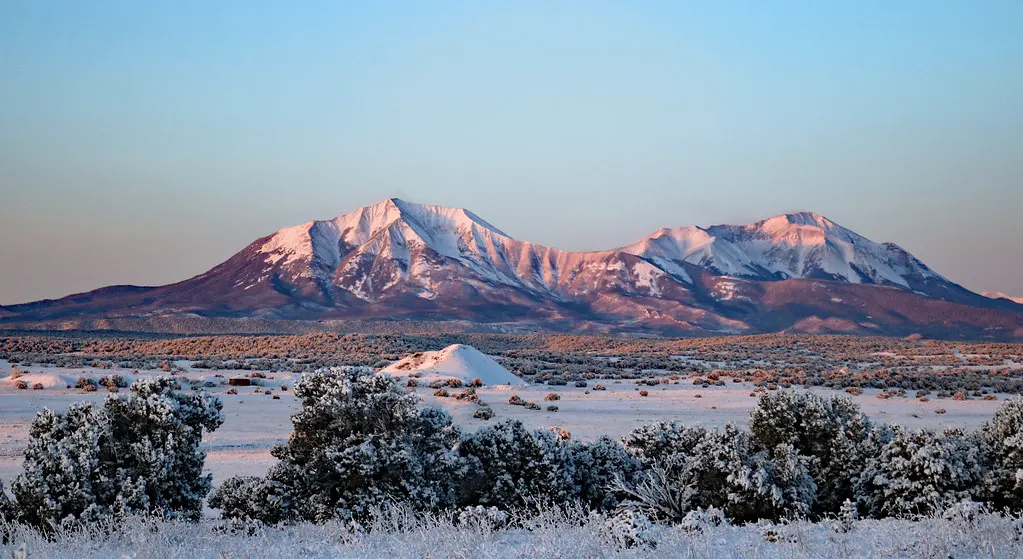
Image of Spanish Peaks, Colorado. Image source
Visit essentials
Before you go
- Address
- Spanish Peaks, Colorado 81020, USA
- Duration
- Day hike to West Spanish Peak summit: 6-8 hours.
- Etiquette
- The Spanish Peaks are publicly accessible as a Wilderness Area, but their sacred significance…
Overview
The Spanish Peaks announce themselves long before you reach them. Driving north on the Highway of Legends, they rise abruptly from the plains, two massive forms that seem to belong to a different order of existence than the grasslands below. West Spanish Peak reaches 13,626 feet; East Spanish Peak stands at 12,683 feet.
Between them, around them, radiating outward for miles, volcanic dikes cut across the landscape like ancient walls, some rising forty feet high, remnants of molten rock that cooled in the fractures of the earth twenty-five million years ago.
Comanche Huajatolla, often translated 'Double Mountain' or 'Breasts of the Earth', Ute 'Breasts of the World', and Apache sacred-landmark recognition preserve distinct relationships to the peaks. Multiple peoples understood them as divine dwellings, with summit thunderstorms signaling the Rain God's presence.
This was a convergence point. Trade routes from across the Southern Plains and Rocky Mountain region met in the shadow of the Spanish Peaks. The Ute tell of acquiring horses near here around 1600, a transformative moment in their history. Petroglyphs and pictographs throughout the region attest to centuries of indigenous presence. Recent archaeological excavations at La Veta have uncovered hearths dating to the colonial period, adding material evidence to oral traditions.
Today the Spanish Peaks are protected as a National Natural Landmark and Wilderness Area. The geological story is extraordinary in its own right, but for those who come seeking something beyond the scientific, the peaks offer what they have always offered: an encounter with mountains that multiple peoples, across centuries, recognized as sacred.
Why this place is sacred
Something shifts when the Spanish Peaks come into view. You have been driving through grassland, through ordinary terrain, and then, without warning, two immense forms rise from the earth with a verticality that seems impossible. Seven thousand feet of elevation gain in a matter of miles. The plains end. The sacred begins.
Indigenous peoples recognized this threshold. The Comanche, the Ute, the Apache all understood these peaks as dwelling places of powers greater than human. When thunderstorms gathered at the summits, clustering around the peaks while the lowlands remained dry, this was not meteorology but theology. The Rain God lived there. The mountains held divine treasure. To approach was to approach the numinous.
The volcanic dikes that radiate from the peaks add to this sense of sacred geometry. Over five hundred dikes extend outward, some running twenty-five miles from the central peaks, stone walls rising from the earth like spokes from a wheel. Geologists explain this as the result of magma intruding into fractures millions of years ago, but the visual effect is of energy emanating from a center, rays proceeding from a source.
Whatever the origin, the landscape reads as organized around these peaks, pointing toward them, leading to them.
The trade routes did the same. Indigenous peoples from across the region converged here, following paths that led to the mountains and to each other. The Spanish Peaks were both destination and crossroads, a place where different peoples met, traded, and recognized common sacred ground. This convergence adds another layer to the thinness, the sense that this location is a meeting point not only between earth and sky but between worlds, between peoples, between human time and geological time.
For contemporary visitors, the thinness may arrive during the ascent, when the altitude begins to affect breathing and the view opens to a hundred miles in every direction. It may come when a thunderstorm builds at the summit while you stand in sunlight below. It may come in the presence of the dikes, walking alongside stone walls that were ancient before humans existed. The peaks themselves create the conditions for encounter.
The original sacred significance of the Spanish Peaks predates all written records. No single tradition claims to have first recognized them as sacred; like many sacred mountains, they seem to have been understood as numinous from the beginning of human presence in the region. Archaeological evidence from the La Veta area documents indigenous occupation during the colonial period, with a hearth dated between 1721 and 1814, but the sacred significance extends far earlier.
The peaks functioned as navigation landmarks for trade routes connecting indigenous groups across the Southern Plains and Rocky Mountains. They served as sites for vision quests and spiritual practices, though specific ceremonial details remain private to the traditions that hold them. The belief that rain gods dwelled at the summits connected the peaks to agricultural and survival concerns, and the association with the origin of life in some traditions gave them cosmological significance.
The Spanish Peaks have passed through multiple phases of cultural recognition while retaining their sacred character. Indigenous peoples revered them for millennia before European contact. Spanish explorers first documented the peaks in 1706, giving them a colonial name that stuck even as indigenous names remained in use. The nineteenth century brought traders and settlers, with Colonel Francisco establishing a trading post at the foot of the peaks in 1862.
In 1976, the peaks received designation as a National Natural Landmark, recognizing their geological significance. In 2000, Congress established the Spanish Peaks Wilderness Area, protecting nearly 20,000 acres from development. The Highway of Legends, the scenic byway that passes through the region, received National Scenic and Historic Byway designation in 2021, acknowledging the layered cultural and natural history.
Throughout these transitions, the peaks have retained their sacred character. The Francisco Fort Museum in La Veta houses significant indigenous artifact collections, including petroglyphs and an extensive arrowhead collection, preserving material evidence of the spiritual relationship between indigenous peoples and this landscape.
Experience and orientation
The approach matters. From the south, the Highway of Legends (Colorado Highway 12) winds through the Cuchara Valley, revealing the peaks in stages. First a glimpse through the gap, then a fuller view, then the full emergence of both summits against the sky. The drive itself is a form of pilgrimage, a gradual leaving behind of the ordinary world.
The volcanic dikes begin to appear as you near the peaks. Some run parallel to the road, stone walls rising from the grasslands. Others cut across ridges, visible for miles. The effect is of entering a landscape organized around the peaks, everything pointing toward them, leading to them. Geologists call this the most extensive and best-exposed radial dike system in the world.
For those who seek the summits, trails lead into the Wilderness Area. The West Spanish Peak Trail climbs 2,585 feet over 3.6 miles to a summit at 13,626 feet, the highest point in the region. This is not a casual hike. The altitude demands respect; the weather can shift from sunshine to thunderstorm in an hour.
But the reward is the view the Comanche and Ute saw when they came here to fast and pray, the horizon extending in every direction, the plains below, the mountains beyond.
The summit experience has its own character. You stand where the rain gods were believed to dwell. If a thunderstorm builds around you, as they often do in summer afternoons, you understand why indigenous peoples recognized this as a place of power. The clouds gather at your elevation. Lightning strikes nearby peaks. You are not watching the storm; you are in it.
For those who prefer a less demanding approach, the Highway of Legends offers multiple viewpoints, the Francisco Fort Museum provides cultural context, and the region's trails include moderate options like the Apishipa Trail. The peaks themselves remain visible throughout, watching over the landscape as they have for millennia.
Plan for a full day to experience the region. The Highway of Legends drive takes 2-4 hours depending on stops. The West Spanish Peak summit hike takes 6-8 hours. Bring layers, rain gear, and sun protection; weather is highly variable above 9,000 feet. The Cordova Pass Road, which provides the primary access to trailheads, is typically open late May through mid-October. Check conditions before traveling. Afternoon thunderstorms are common in summer, so plan summit attempts for early morning starts.
Context and lineage
The Spanish Peaks hold origin stories in multiple traditions. A Ute legend recounts that the acquisition of horses by the Ute people around 1600 occurred in the vicinity of the peaks, marking a transformative moment in tribal history. The peaks thus witnessed and sanctified this pivotal change in Ute life and mobility.
For the Comanche and Ute, the peaks were the home of the Rain God. Summer thunderstorms clustering about the summits were evidence of divine presence.
Some sources cite a Tarahumare belief that all life on earth originated from the area surrounding the Spanish Peaks, though the Tarahumare homeland is in northern Mexico, making this attribution uncertain.
The legend of El Gran-do-te, chronicled by local historian Sporleder from oral accounts in the late 1800s, tells of a people who came from far south of Mexico and lived peacefully in the valleys of the Spanish Peaks, encountering a talking black panther and eventually meeting a tragic fate at the hands of Spanish colonizers.
The Spanish Peaks belong to multiple indigenous lineages. The Comanche gave them the name Huajatolla, recognizing them as sacred landmarks and dwelling places of divine powers. The Ute called them the Breasts of the World and connected them to pivotal moments in tribal history. The Apache recognized them as sacred territory. Trade routes connecting peoples across the Southern Plains and Rocky Mountains converged here, making the peaks a meeting point for multiple traditions.
Today, this multi-tribal significance continues, with the peaks recognized as part of the shared sacred geography of the region.
The Rain God
Divine being believed by the Comanche and Ute to dwell at the summits of the Spanish Peaks. Summer thunderstorms were evidence of this presence.
Juan de Ulibarri
Leader of the 1706 Spanish expedition that first documented the peaks from a European perspective, giving them the colonial name that persists.
Colonel John M. Francisco
Established a trading post at the foot of the Spanish Peaks in 1862, now preserved as the Francisco Fort Museum. His enterprise documented and preserved significant indigenous artifacts.
Sporleder
Local historian who chronicled the legend of El Gran-do-te from oral accounts in the late 1800s, preserving indigenous and regional mythology.
Traditions and practice
Indigenous peoples including the Comanche, Ute, and Apache regarded the Spanish Peaks as sacred sites associated with rain gods. The peaks served as navigation landmarks for trade and travel across the Southern Plains. Vision quests and spiritual practices were conducted in the region, though specific ceremonial details remain private to the traditions that hold them.
The presence of petroglyphs, pictographs, and ceremonial artifacts throughout the region indicates sustained ritual activity over centuries. Buffalo skulls and other offerings were likely made at significant locations. The timing of visits may have been connected to seasonal events, with solstices and the appearance of specific star patterns holding potential significance.
There is no publicly documented ongoing ceremonial use at the Spanish Peaks comparable to sites like the Bighorn Medicine Wheel. However, the peaks retain their sacred significance in indigenous worldviews. The Comanche, Ute, and Apache continue to recognize the cultural and spiritual importance of this landscape.
The Francisco Fort Museum in La Veta serves as a repository for indigenous artifacts and a resource for understanding the region's cultural history. Archaeological investigations continue, with excavations at La Veta in 2023 uncovering new evidence of indigenous and colonial presence.
Visitors to the Spanish Peaks can engage with the landscape's sacred significance through respectful presence. The ascent of the peaks themselves offers a form of mountain pilgrimage, with the physical exertion of climbing echoing traditional practices of fasting and vision seeking. Standing at the summit, exposed to the weather that indigenous peoples attributed to divine presence, creates opportunity for encounter.
Visiting the Francisco Fort Museum in La Veta provides context for understanding the indigenous relationship to this landscape. Walking alongside the volcanic dikes invites contemplation of deep time and the forces that shape the earth. Driving the Highway of Legends with awareness of its name and purpose transforms a scenic drive into something more intentional.
Comanche Tradition
HistoricalThe Comanche gave the peaks their indigenous name Huajatolla (Wahatoya), meaning Double Mountain. They regarded the peaks with deep spiritual reverence, viewing them as sacred sites where rain gods dwelled. Summer thunderstorms at the summits were evidence of divine presence. The peaks served as essential navigation points across the Southern Colorado landscape.
Spiritual reverence for the peaks as dwelling place of rain gods; use as landmarks for travel and trade; vision quests and fasting practices in the region.
Ute Tradition
HistoricalThe Ute called the peaks Breasts of the World and considered them mystical and sacred. Oral traditions connect the peaks to the Ute acquisition of horses around 1600, a transformative moment in tribal history. Trade routes established by the Ute converged near the peaks long before European arrival.
Trade route navigation; ceremonies connected to pivotal historical events; spiritual connection to the mountains as life-giving and nurturing forces.
Apache Tradition
HistoricalThe Apache recognized the Spanish Peaks as sacred landmarks within their territory. The peaks held spiritual importance as part of the Apache sacred geography, though specific Apache practices at the site are less documented than those of the Comanche and Ute.
Recognition of peaks as sacred landmarks; inclusion in Apache territorial and spiritual geography.
Pan-Indigenous Sacred Mountain
ActiveThe Spanish Peaks are recognized as a sacred site by multiple indigenous peoples of the Southern Plains and Rocky Mountain region. The peaks represented a convergence point where different cultures met on common ground. Today they retain this status as a shared sacred geography.
Recognition of the peaks as sacred landmarks; reverence for the spiritual power associated with thunderstorms and the high mountain environment; cultural preservation through museums and oral tradition.
Perspectives and open questions
The Spanish Peaks invite multiple interpretations: geological, archaeological, historical, and spiritual. What makes the site distinctive is the convergence of these perspectives around two mountains that have drawn reverence from multiple peoples across millennia.
Scholarly perspective
Geologists recognize the Spanish Peaks as containing one of the most extensive and best-exposed radial dike systems in the world, justifying their 1976 designation as a National Natural Landmark. The peaks formed through volcanic activity 24-27 million years ago during the Late Oligocene epoch. Over 500 dikes radiate from the peaks, some extending up to 25 miles, ranging in height from a few feet to over 100 feet.
Archaeological investigations document indigenous presence in the region spanning centuries. A 2023 excavation at La Veta uncovered a hearth dated between 1721 and 1814, along with indigenous and colonial artifacts. Petroglyphs and pictographs throughout the region attest to sustained cultural engagement with the landscape.
Linguistic analysis indicates that the name Huajatolla/Wahatoya is Comanche rather than Ute, meaning Double Mountain, though it is commonly translated poetically as Breasts of the Earth. The attribution of certain traditions to the Tarahumare is questioned, as their homeland is in northern Mexico.
Living and traditional perspectives
For the Comanche, Ute, and Apache, the Spanish Peaks are sacred mountains where rain gods dwell. The peaks were not simply landmarks but dwelling places of divine powers. Summer thunderstorms clustering at the summits were evidence of the Rain God's presence. The mountains were thought to hold the treasure of the gods.
The peaks stood at the convergence of trade routes connecting indigenous peoples across the Southern Plains and Rocky Mountains. The Ute connect the peaks to a pivotal moment in their history, the acquisition of horses around 1600. Petroglyphs and ceremonial artifacts indicate sustained spiritual engagement over centuries.
This is not archaeology to indigenous peoples but living relationship. The peaks retain their sacred significance regardless of what geological or historical research reveals. The names Huajatolla and Breasts of the World carry meaning that transcends translation.
Alternative interpretations
The Spanish Peaks attract interest from those drawn to sacred mountains, earth energy, and the intersection of geology and spirituality. The radiating volcanic dikes invite interpretations involving energy lines or ley lines. The Breasts of the Earth name connects to goddess traditions and earth-as-mother symbolism. The peaks' role in indigenous cosmology as dwelling places of rain gods resonates with those who understand mountains as places where worlds meet.
However, these interpretive frameworks should be approached with respect for primary indigenous traditions. The peaks' power is not dependent on external validation. What makes them thin places is the sustained recognition across cultures that they are thin places.
Open questions
The full extent of ceremonial practice at the Spanish Peaks remains unknown and largely private to indigenous communities. The specific meanings of petroglyphs and pictographs in the region have not been fully interpreted. The nature of the treasure believed by indigenous peoples to be deposited at the peaks remains mysterious. Whether the Tarahumare origin-of-life tradition represents actual cultural presence or later attribution is uncertain. The complete archaeological record of indigenous occupation has not been excavated.
The El Gran-do-te legend and related oral traditions await fuller documentation and interpretation.
Plan your visit
Access and arrival
La Veta offers lodging, dining, and the Francisco Fort Museum with its indigenous artifact collections. Walsenburg provides additional services. Primitive camping is available in the Wilderness Area with permit. Cordova Pass has a small campground.
Respectful visit
Dress for high-altitude mountain conditions. Layers are essential; temperatures can vary forty degrees between morning and afternoon. Sturdy hiking boots for trail travel. Sun protection including hat, sunglasses, and sunscreen. Rain gear. At elevations above 12,000 feet, cold-weather gear even in summer.
Photography is permitted throughout the Wilderness Area and along the Highway of Legends. The volcanic dikes, peak views, and alpine landscapes offer exceptional subjects. Be respectful if you encounter any evidence of indigenous cultural sites.
There is no documented tradition of visitor offerings at the Spanish Peaks. Practice Leave No Trace principles and do not leave objects in the wilderness.
{"No motorized vehicles or bicycles in the Wilderness Area","Camping permits required","Camp at least 100 feet from water sources and trails","Pack out all trash","Dogs must be leashed in designated areas","Only certified weed-free hay for pack animals","Respect seasonal road closures (typically October through May for Cordova Pass Road)","Do not disturb archaeological sites, petroglyphs, or artifacts"}
Respect the peaks' indigenous sacred significance even in the absence of posted restrictions. Do not disturb any artifacts, petroglyphs, or structures you may encounter. Practice Leave No Trace principles in the Wilderness Area. Be aware that specific ceremonial knowledge belongs to indigenous communities and is not available for appropriation.
Current practical details
Address
Spanish Peaks, Colorado 81020, USA
Hours, fees, and access can change — verify on the official source before you travel. Practical details last checked Jun 2026.
Location
Map loads as you approach this section.
Pilgrim reflections
A portrait of encounter, not a score
Pilgrims describe what they felt, how present they could become, and whether the place would shape a journey. There are no stars and no ranking of traditions.
No reviewed reflections yet
The first pilgrims can help describe the character of being here.
Share a reflection
Available after an account-backed “Been there.” Every reflection is reviewed before publication.
Nearby sacred places
Explore other sacred places in the region. Proximity does not establish access or travel time; check each place’s guidance.

References
Sources consulted for this page. Source categories describe the publication, not a guarantee that every claim is verified. Traditional accounts and outside interpretations may differ.
- 01Spanish Peaks Wilderness — USDA Forest Service, Pike-San Isabel National ForestsofficialOfficial Forest Service management page
- 02Colorful Colorado: Spanish Peaks country's mythical rocks — Denver PostacademicMajor newspaper coverage of the region's mythology
- 03Highway of Legends — Colorado.com (State Tourism)officialOfficial Colorado tourism page for Highway of Legends
- 04Work is now underway to piece together the story behind surprise archeological find in La Veta — Colorado Public Radioacademic2023 reporting on archaeological discoveries
- 05Best hikes and trails in Spanish Peaks Wilderness — AllTrailsguideTrail information and user reviews
- 06Spanish Peaks Wilderness Area — La Veta TrailsofficialLocal trails organization with access information
- 07Francisco Fort Museum — Museum Trail of Southern ColoradoofficialMuseum information with indigenous artifact collections
- 08Spanish Peaks Wilderness Regulations — Wilderness.netofficialOfficial wilderness regulations
- 09History | Spanish Peaks Country — Spanish Peaks Country TourismofficialRegional tourism authority with historical overview
- 10Spanish PeaksencyclopediaWikipedia article with geological and historical overview
- 11Spanish Peaks WildernessencyclopediaWikipedia article on wilderness area designation
- 12Spanish Peaks — GrokipediaencyclopediaComprehensive overview with etymology discussion
- 13The Spanish Peaks: Legends — The World JournalacademicArticle documenting local legends and folklore
- 14Spanish Peaks National Wilderness Area — Uncover ColoradoguideTravel guide with historical context
- 15The Great Dikes — Spanish Peaks CountryofficialExplanation of volcanic dike formations
Share a photo
Help visitors recognize Spanish Peaks, Colorado. Every submission is reviewed before publication.