Great Sand Dunes, Colorado
Sand used in healing rituals by 18 tribes for 11,000 years, beneath a Navajo sacred mountain
Understand sacred places, explore living traditions, and learn how to engage respectfully with Pilgrim Map.
Access has not been verified. Check current local guidance before planning a visit.
Mosca, Colorado, United States
Read the sources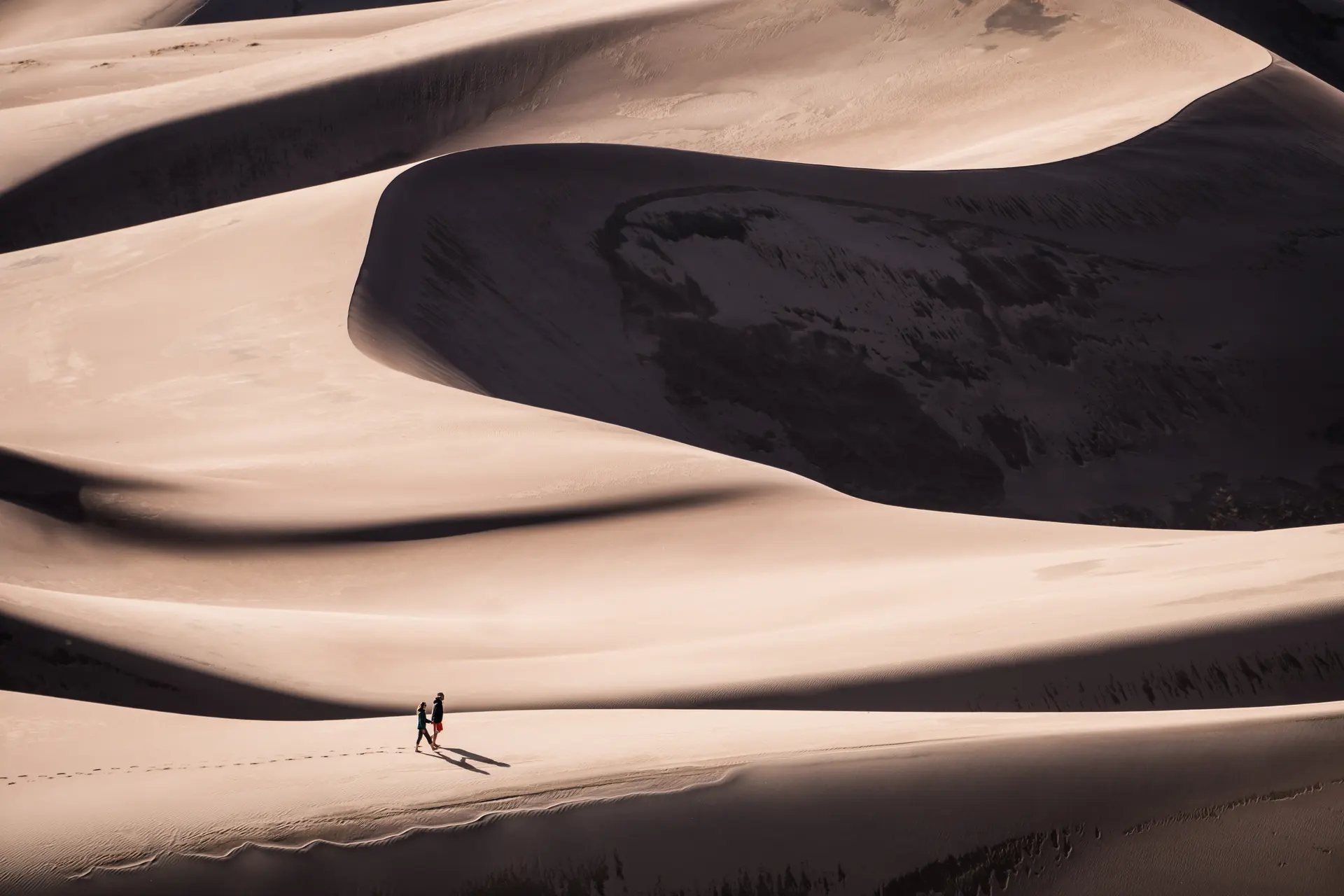
Visit essentials
A quick read before you go
- Duration
- Full day to explore dunes, creek, and visitor center
- Access
- The park is accessible via Highway 150 from Highway 17 in the San Luis Valley.
Overview
North America's tallest sand dunes rise 750 feet against the 14,000-foot backdrop of the Sangre de Cristo Range in south-central Colorado. To 18 Indigenous tribes, they are cultural property where sacred materials are gathered for living ceremonies. Evidence of human presence in the San Luis Valley extends back approximately 11,000 years.
According to Richard Begay, Navajo Nation Tribal Historic Preservation Officer, Navajo visitors make offerings and collect sand, plants, minerals, and water; their healing sand paintings are living beings that receive a person's imbalance or ailment. The Jicarilla Apache use the sand in five ceremonies, including the Bear Dance and Four Directions ceremony, and first ask Mother Earth for permission when gathering.
Bryan Vigil of the Jicarilla Apache Nation explains that wind brought the sand with great force or energy and made it fine for sacred use. Black magnetic sand is especially powerful because it contains the power of the Earth's poles. Southeast, Blanca Peak (Sisnaajini), one of the four Navajo sacred mountains, marks a boundary of the Navajo homeland.
The 18 affiliated tribes are the Southern Ute, Ute Mountain Ute, Ouray and Uinta Ute, Hopi, Zuni, 11 New Mexico Pueblo tribes, Jicarilla Apache, and Navajo. The Ute names include So-wop-a-wat ('where the sand is') and Saa waap maa nache ('sand that moves'); the Jicarilla Apache call it Seinanyédi ('it goes up and down'), and the Navajo Tsé-whíz-hosh ('sand comes back down on you').
Why this place is sacred
The Great Sand Dunes offer a thinness grounded in sacred material whose power travels beyond the place. In Navajo understanding, living sand paintings actively receive a person's imbalance or ailment, allowing the gathered sand's healing power to manifest wherever ceremony occurs.
Bryan Vigil's Jicarilla Apache account describes wind bringing the sand with great force or energy and making it fine for sacred use: dune formation becomes preparation by wind, Earth's breath. Black magnetic sand's power from the Earth's poles is presented not as metaphor but as Indigenous understanding.
Blanca Peak, one of the four Navajo sacred mountains, places the dunes within a sacred geography extending to the boundaries of Dinetah. The sand, mountain, approximately 11,000 years of human relationship, and recognition as cultural property by 18 tribes make this significance layered and not confined to one tradition.
The Great Sand Dunes have served as a gathering place for sand used in healing ceremonies for at least 11,000 years based on archaeological evidence. The Indian Grove shows over 200 culturally modified ponderosa pine trees, evidence of bark-peeling for food and medicine by Ute, Apache, and other peoples.
Traditional gathering practices continue. Tribal members visit to collect sand, plants, minerals, and water for ceremonial use. Field trips bring younger generations to pass on practices and history. National park designation has not ended traditional use but has formalized its protection.
Experience and orientation
Golden dunes rise 750 feet from the San Luis Valley against the dark, sometimes snow-capped Sangre de Cristo Range. Blanca Peak stands southeast as both a Colorado fourteener and one of the four Navajo sacred mountains.
Seasonal Medano Creek runs along the dune edge. In late spring and early summer, its surge flow sends pulsing waves across the sand. The dunes invite climbing, but summer sand can shift from cool mornings to 150 degrees Fahrenheit (65 Celsius) at midday before cooling toward evening; high dunes bring difficult sand terrain and broad views across the valley and eastern mountains.
Indian Grove offers quiet forest among over 200 culturally modified ponderosa pines. Bark-peeling scars record Ute, Apache, and other peoples' gathering of food and medicine over centuries. Knowledge of the 18 tribes' continuing ceremonies changes the landscape from scenery into living cultural property and the sand into sacred healing material.
Great Sand Dunes National Park lies in the San Luis Valley of south-central Colorado. Highway 150 provides access from Highway 17. The Visitor Center offers orientation and interpretation including Indigenous history.
Context and lineage
The tribes who consider the Great Sand Dunes sacred have not shared specific origin narratives for the dune formation itself. What has been shared is the significance of the sand for ceremonial purposes and the reasons for that significance.
Bryan Vigil of the Jicarilla Apache explained: 'It was brought with great force or energy, and that's why it's sacred. The wind took it there and made it real fine for us to use.' The geological process of dune formation, where sand from the valley floor is carried by wind and deposited against the mountains, becomes the preparation of sacred material.
Richard Begay of the Navajo Nation described the sand paintings made with this material as living beings that absorb illness from the sick, curing them through transfer. The sand's power lies in its capacity to receive and transform affliction.
Human presence in the San Luis Valley extends back approximately 11,000 years based on archaeological evidence. The 18 tribes who identify the dunes as cultural property represent ongoing relationships with this landscape that predate European contact by millennia. The continuation of sand gathering for ceremonies represents an unbroken practice.
Richard Begay
Navajo Nation Tribal Historic Preservation Officer who has explained the significance of the dunes to the Navajo and the use of sand in healing ceremonies.
Bryan Vigil
Jicarilla Apache Nation member who explained why the sand is sacred and how it is gathered with permission from Mother Earth.
Traditions and practice
Navajo practitioners gather sand for healing paintings understood as living beings that absorb a sick person's imbalance or ailment by transfer. The Jicarilla Apache use sand in five ceremonies, including the Bear Dance and Four Directions ceremony; gatherers first ask Mother Earth for permission, and black magnetic sand is especially powerful because it contains the power of the Earth's poles.
Tribal members also gather plants, minerals, and water. More than 200 culturally modified ponderosa pines in Indian Grove record bark-peeling by Ute, Apache, and other peoples for food and medicine. Vision quests and other ceremonies have also been held here; multiple traditions recognize the dunes, mountain backdrop, and Blanca Peak as conditions suited to sacred practice.
Tribal members continue to visit for offerings and to collect sand, plants, minerals, and water for ceremonial use. Field trips organized by tribes bring younger generations to learn traditional practices and hear their history.
The National Park Service recognizes the tribes' ongoing relationship with the land. Interpretation at the Visitor Center includes Indigenous significance. The 18 affiliated tribes have ongoing consultation relationships with park management.
Visit with awareness that 18 tribes gather this sand as sacred material for healing ceremonies, and learn about its Indigenous significance at the Visitor Center. When climbing, remember Bryan Vigil's Jicarilla Apache description of wind bringing the sand 'with great force or energy' and making it fine for sacred use. Look southeast to Blanca Peak, one of the four Navajo sacred mountains, understood as a deity dressed in white shell and fastened to earth with lightning.
Navajo (Diné)
ActiveThe Great Sand Dunes provide sand for healing sand paintings that absorb illness from the sick. The dunes lie within sight of Blanca Peak (Sisnaajini), one of the four sacred mountains marking the Navajo homeland.
Tribal members gather sand, plants, minerals, and water for ceremonial use. Sand paintings are viewed as living beings that cure through absorbing and transferring ailment.
Jicarilla Apache
ActiveThe sand is sacred because wind brought it 'with great force or energy,' making it fine for ceremonial use. The black magnetic sand contains the power of the Earth's poles.
Sand is used in five different ceremonies including the Bear Dance and Four Directions ceremony. When gathering sand, permission is first asked of Mother Earth.
Multi-tribal cultural property
Active18 tribes identify the Great Sand Dunes as traditional cultural property: Southern Ute, Ute Mountain Ute, Ouray and Uinta Ute, Hopi, Zuni, 11 New Mexico Pueblo tribes, Jicarilla Apache, and Navajo. Each has their own name and relationship with this place.
Various ceremonies and gathering practices continue. Field trips bring younger generations to learn traditional practices and history.
Perspectives and open questions
The Great Sand Dunes' significance to 18 Indigenous tribes is recognized by the National Park Service in official interpretation and ongoing tribal consultation. The site's use in healing ceremonies has been documented through tribal testimony.
Scholarly perspective
Archaeological evidence documents approximately 11,000 years of human presence in the San Luis Valley. The Indian Grove's 200+ culturally modified trees provide physical evidence of traditional uses extending back centuries.
The significance of the dunes to 18 tribes is documented in National Park Service materials and through tribal consultation processes. Ethnographic work has recorded the use of sand in healing ceremonies.
Living and traditional perspectives
Eighteen tribes maintain the Great Sand Dunes as cultural property. In Navajo understanding, living sand paintings absorb illness by transfer. In Jicarilla Apache teaching, wind brought the sand with great force and energy and made it fine for ceremony; gatherers first ask Mother Earth for permission, and black magnetic sand holds the power of the Earth's poles. Tribal visits, ceremonies, and teaching of younger generations continue an approximately 11,000-year human relationship with this landscape.
Alternative interpretations
The nearby town of Crestone has become known as a spiritual center, hosting meditation retreats and healing centers representing various traditions. This contemporary spiritual community exists alongside the much older Indigenous sacred geography.
Open questions
The full range of traditional practices associated with the dunes by all 18 affiliated tribes may not be comprehensively documented in public sources. What has been shared represents what tribal members have chosen to make known.
Plan your visit
Access and arrival
The park is accessible via Highway 150 from Highway 17 in the San Luis Valley. The Visitor Center provides orientation and interpretation.
Camping at Pinon Flats Campground within the park. Lodging in Alamosa, Crestone, and San Luis Valley communities.
Respectful visit
Appropriate outdoor attire. Sand can be extremely hot in summer; wear shoes. Sun protection is essential.
Permitted throughout the park. The dunes and mountain backdrop offer remarkable photography opportunities.
Not traditional for non-Indigenous visitors. Leave nothing on the dunes.
Do not gather sand, plants, or other materials. Standard national park regulations apply.
Do not gather sand, plants, or other materials. Traditional gathering by tribal members is permitted under tribal cultural rights, but this does not extend to other visitors.
The sand can reach dangerous temperatures in summer, up to 150 degrees Fahrenheit. Wear shoes and time your dune exploration for cooler hours.
The Indian Grove is a sensitive cultural area. Approach the modified trees with respect; do not touch or damage them.
Location
Map loads as you approach this section.
Pilgrim reflections
A portrait of encounter, not a score
Pilgrims describe what they felt, how present they could become, and whether the place would shape a journey. There are no stars and no ranking of traditions.
No reviewed reflections yet
The first pilgrims can help describe the character of being here.
Share a reflection
Available after an account-backed “Been there.” Every reflection is reviewed before publication.
Nearby sacred places
Explore other sacred places in the region. Proximity does not establish access or travel time; check each place’s guidance.

References
Sources consulted for this page. Source categories describe the publication, not a guarantee that every claim is verified. Traditional accounts and outside interpretations may differ.
- 01The sand that lives and breathes: The Great Sand Dunes is cultural property to 18 Native American tribes — The Crestone EaglenewsIn-depth cultural reporting
- 02Affiliated Tribes of Great Sand Dunes — National Park ServiceofficialOfficial NPS documentation
- 03The Indian Grove within Great Sand Dunes National Park — National Park ServiceofficialOfficial NPS article
- 04The Indigenous History of Great Sand Dunes National Park — RVsharespiritualCultural history
Share a photo
Help visitors recognize Great Sand Dunes, Colorado. Every submission is reviewed before publication.