Skiemonys Chapel, Skiemonys
A wooden church in a village of 38 people, where golden tears fell in clover fields under Soviet watch
Understand sacred places, explore living traditions, and learn how to engage respectfully with Pilgrim Map.
Access has not been verified. Check current local guidance before planning a visit.
Skiemonys, Anykščiai, Lithuania
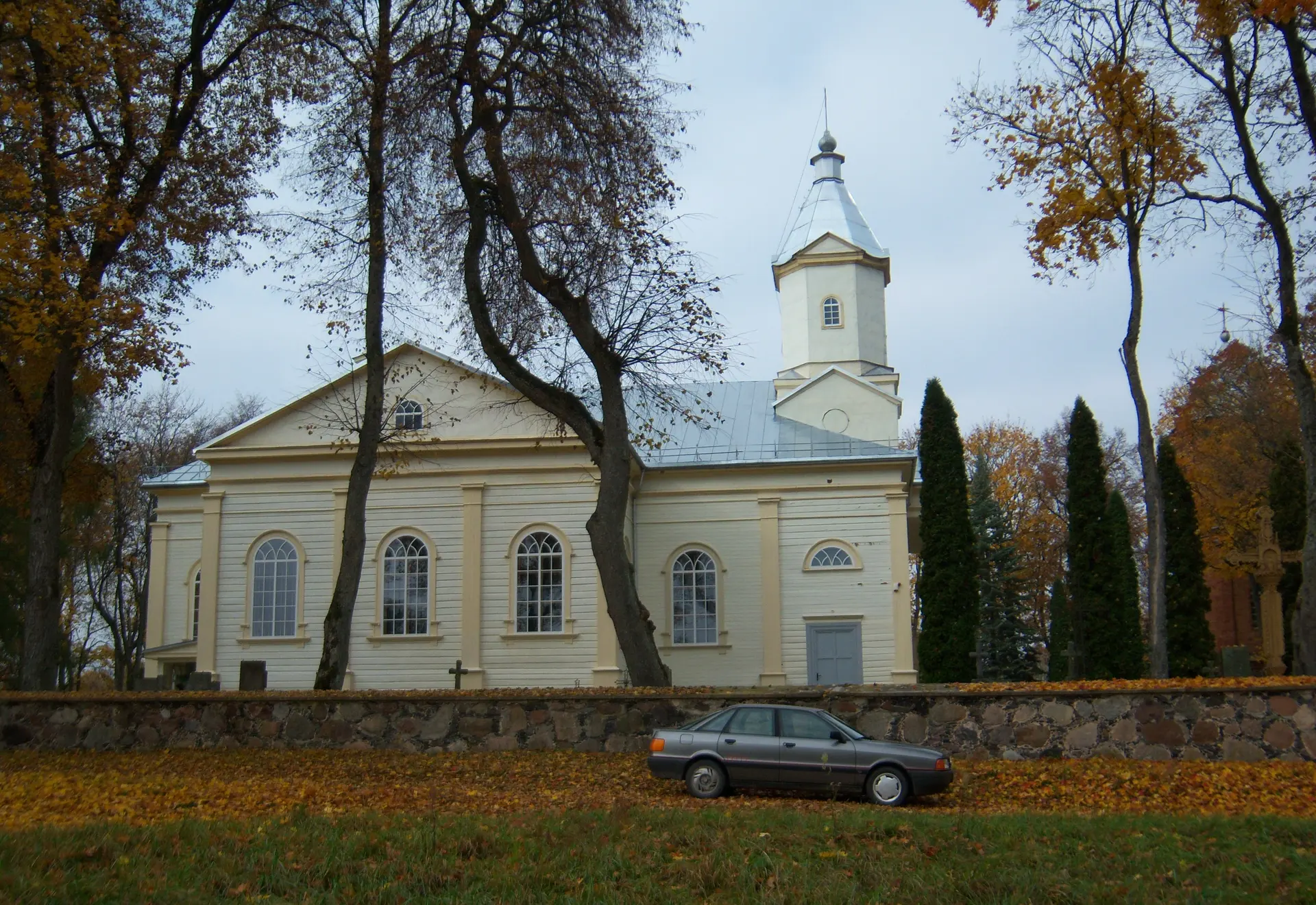
Image of Skiemonys Chapel, Skiemonys. Image source · CC-BY-SA-3.0
Visit essentials
A quick read before you go
- Duration
- A visit to the church and the Janonis Chapel takes approximately 30 to 60 minutes, including the…
- Access
- Located in Skiemonys, Anyksciai district, Utena County, northeast Lithuania.
Overview
Skiemonys has no highway exit, signpost chain, or infrastructure of welcome. A route through the Aukstaitija countryside between Moletai and Anyksciai crosses the Luknos River into a village smaller than most city-bus loads, where a modest nineteenth-century wooden church carries an expansive history.
The Church of the Visitation of the Blessed Virgin Mary has existed in some form since at least 1500. Canonical Canons Regular of Penance kept a monastery here from 1677 to 1832. The present wooden church dates to 1884 and its brick bell tower to 1903. Yet pilgrims come from across Lithuania for events in a nearby clover field.
On the night of July 13, 1962, eighteen-year-old Ramute Macvyte was walking at Janonis near the church when she reported seeing the Virgin Mary: white clothing with blue ribbons, hands positioned as if celebrating Mass, and golden tears falling like coins. The figure promised help if humanity turned to prayer and asked people not to eat meat on Fridays. The apparition reportedly recurred the next evening.
As crowds gathered, Soviet military personnel arrived on July 15, beating and chasing pilgrims away.
The Catholic Church has neither endorsed nor condemned the apparition. For Lithuanian Catholics formed under Soviet rule, its meaning exceeds official status: the Mother of God reportedly wept in a church field taken by a state seeking to erase God from public life. After independence, Janonis Chapel was built where Ramute saw what she saw, marking where claimed divine consolation and state brutality met.
Why this place is sacred
The scale of Skiemonys is itself a threshold factor. In a village this small, in a countryside this quiet, the usual barriers between ordinary awareness and something deeper thin of their own accord. There are no crowds, no commercial distractions, no competing claims on attention. The church and the field are all there is.
The apparition's location carries its own resonance. The field at Janonis had belonged to the church before the Soviet state confiscated religious property. That the Virgin chose to appear on land the state had taken from God's service is, for believers, not coincidence but communication. The ground remembered what it had been, even when the authorities tried to make it forget.
The five centuries of worship at Skiemonys provide a foundation beneath the apparition's intensity. A church has stood here since roughly 1500. Monks prayed here for 155 years. Generations of rural Lithuanians have been baptized, married, and mourned in this wooden structure. That accumulated devotion creates a ground from which the extraordinary event of 1962 grows naturally, as if the vision emerged from what was already there.
The church was established as a center of Catholic worship for the surrounding rural community, a function it has served continuously since at least 1500. The Janonis Chapel was built specifically to honor and preserve the memory of the 1962 apparition.
From a rural parish church with a monastic foundation, Skiemonys has evolved into a pilgrimage destination that holds two sacred loci in creative tension: the old church of regular worship and the new chapel of extraordinary vision. The Soviet attempt to suppress the apparition devotion paradoxically cemented its significance.
Experience and orientation
What strikes visitors first is the smallness. The wooden church is not grand. The village is not picturesque in any postcard sense. There is no visitor center, no cafe, no curated experience. You arrive, and you are simply present in a place where people have prayed for five hundred years and where a young woman saw something that cannot be explained.
The church interior carries the warmth of wood and the quiet of regular but unpretentious worship. This is not a Baroque showpiece but a parish church that has served its community faithfully through political changes that shattered far more impressive structures.
The Janonis Chapel, reached by a short walk through the countryside, occupies the field where the apparition occurred. Here the experience becomes more complex. Standing where Ramute Macvyte stood, looking across the same landscape, knowing that Soviet soldiers beat pilgrims who came to this spot: these layers of meaning press upon the visitor. The chapel provides a focal point for prayer, but the field itself is the true sacred space.
The emotional register at Skiemonys tends toward quiet intensity rather than dramatic revelation. Visitors describe feeling something settle: not a surge of emotion but a deepening of attention, a clearing of noise. The village's isolation helps. There is nowhere else to be, nothing else to do. You are here, and here asks nothing of you but presence.
Visit the church first, grounding yourself in the longer history of the site. Then walk to the Janonis Chapel. The transition from church to field, from institutional worship to apparition site, mirrors the transition from the ordinary to the extraordinary. If you can arrange your visit for the anniversary of the apparition in mid-July, the communal dimension adds depth. Otherwise, the solitary encounter with this quiet place has its own power.
Context and lineage
The church at Skiemonys dates to around 1500, though details of the earliest chapel are lost. In 1618, the area was granted to the Canonical Canons Regular of Penance from Vidukle, who established a monastery and built a wooden church in 1677. The monastery operated until the Russian suppression of 1832. The current church, the third or fourth on the site, was built in 1884 by Father K. Bernatavicius, and a brick bell tower was added in 1903.
The event that transformed Skiemonys from parish to pilgrimage site occurred on the night of July 13, 1962. Eighteen-year-old Ramute Macvyte was walking through clover fields at Janonis, near the church, when at 11 PM she saw the Virgin Mary dressed in white with blue ribbons, hands positioned as if celebrating Mass. The Virgin wept golden tears that fell like coins and spoke: 'I will help mankind if man turns to prayer.'
She asked people not to eat meat on Fridays. The apparition recurred the following evening. Within days, crowds gathered despite the prohibition of religious activity under Soviet law. On July 15, uniformed military personnel arrived, physically assaulting and dispersing pilgrims.
The religious lineage at Skiemonys passes from the unknown founders of the earliest chapel around 1500, through the Canonical Canons Regular of Penance who maintained the monastery for 155 years, to the secular parish priests who have served since the monastery's suppression, and finally to the apparition devotion that adds a Marian dimension to the parish's long history.
Ramute (Roma) Macvyte
historical
Eighteen-year-old visionary of the 1962 apparition at Janonis, near Skiemonys. Her account of the Virgin Mary weeping golden tears initiated the pilgrimage tradition.
Canonical Canons Regular of Penance
historical
Monastic order from Vidukle that maintained a monastery and church at Skiemonys from 1677 to 1832, establishing the site's institutional religious foundation.
Father K. Bernatavicius
historical
Built the current wooden church in 1884, creating the structure that continues to serve the parish today.
Traditions and practice
Catholic Mass and sacramental worship have been practiced at Skiemonys since at least 1500. The monastic community added the structure of regular liturgical offices during their 155-year presence. After the 1962 apparition, the traditional practice of pilgrimage to the Janonis field began, initially as an act of underground devotion during the Soviet era.
Regular parish services continue at the Church of the Visitation, which serves the small community and visiting pilgrims. The Janonis Chapel, built after Lithuanian independence, is open for prayer and pilgrimage visits. The anniversary of the apparition, around July 13 to 14, draws additional pilgrims for Marian devotions. The Feast of the Visitation, the parish's patronal feast, is celebrated on July 2 in the current Roman calendar.
Begin at the church, where five centuries of worship have established a foundation of sacred presence. Sit in a pew and let the wooden interior, weathered by generations of Lithuanian winters and prayers, speak its own language.
Then walk to the Janonis Chapel. The walk itself, through the countryside that Ramute Macvyte crossed on the night of her vision, is part of the practice. At the chapel, pray or sit in silence. If the detail of golden tears speaks to you, hold it: a mother weeping for her children in a country that forbade them to pray.
The return walk to the church completes the circuit: from institutional faith to apparitional encounter and back again, each enriching the other.
Roman Catholicism
ActiveThe Church of the Visitation has served as a center of Catholic worship since approximately 1500, with a monastic foundation from 1677. The parish, established in 1926, is part of the Diocese of Panevezys. The 1962 apparition added a Marian pilgrimage dimension to the parish's long history.
Regular parish Mass and worship services. Pilgrimage to the Janonis Chapel. Marian devotions. Celebration of the Feast of the Visitation as the parish's patronal feast.
Marian Apparition Devotion
ActiveThe 1962 apparition to Ramute Macvyte, though unapproved by the Catholic Church, has generated a lasting pilgrimage tradition. The apparition's occurrence during Soviet persecution, the Soviet military's violent response, and the subsequent construction of the Janonis Chapel after independence have given the devotion dimensions of both spiritual encounter and national resistance.
Pilgrimage to the Janonis Chapel at the apparition site. Prayer at the place where the Virgin reportedly appeared. Commemoration of the apparition anniversary around July 13 to 14.
Perspectives and open questions
Skiemonys holds together several threads of interpretation: the historical longevity of a parish church, the devotional power of an unapproved but enduring apparition, the political dimension of faith under Soviet persecution, and the architectural heritage of Lithuanian wooden churches.
Scholarly perspective
The 1962 apparition is catalogued among unapproved but not condemned Marian apparitions. Lithuanian historian-priest Robertas Gedvydas Skrinskas has documented more than 100 miraculous Marian images and 25 sites of Marian apparitions in Lithuania, placing Skiemonys within a broader devotional pattern. The apparition is understood by scholars in the context of Soviet-era religious suppression, where claimed supernatural events served both devotional and political resistance functions. The church itself is a representative example of nineteenth-century Lithuanian wooden church architecture.
Living and traditional perspectives
For Lithuanian Catholics, the Skiemonys apparition manifests the Virgin Mary's particular concern for Lithuania during its time of greatest spiritual suffering. The message urging prayer and Friday abstinence is understood as simple, maternal guidance. The golden tears are interpreted as Mary's sorrow over the suppression of faith. The construction of the Janonis Chapel after independence is viewed as vindication of the believers' faithfulness through decades of persecution.
Alternative interpretations
The apparition's occurrence in a field that formerly belonged to the church, on land whose religious character the Soviet state sought to erase, is sometimes interpreted as evidence of places retaining sacred imprints regardless of political attempts to desacralize them. The detail of golden tears falling like coins has been subject to various symbolic interpretations, connecting material imagery to spiritual value.
Open questions
The exact date of the apparition remains disputed between sources, with some citing June 13 and others July 13, 1962. The subsequent life of the visionary Ramute Macvyte, and whether she reported further experiences, is not well documented in English sources. Whether there were additional witnesses beyond the initial visionary is unclear. The Catholic Church has neither approved nor condemned the apparition, leaving its status formally open.
Plan your visit
Access and arrival
Located in Skiemonys, Anyksciai district, Utena County, northeast Lithuania. Approximately 81 kilometers north of Vilnius. Accessible by car via route 119 between Moletai and Anyksciai, on the left bank of the Luknos River. Very limited public transport makes a car essentially required. The village has a population of approximately 38 people, and amenities are nonexistent. Bring everything you need. Mobile phone signal may be unreliable in this area.
No specific emergency access information was available at time of writing; the nearest town with services is Anyksciai, approximately 20 kilometers north.
No accommodation exists in Skiemonys. Anyksciai, approximately 20 kilometers north, offers guesthouses and small hotels. Moletai, to the south, provides additional options.
Respectful visit
Modest dress appropriate for a Catholic church.
Photography is generally permitted outside. Exercise discretion inside the church, particularly during services.
Candles may be lit at the church. Donations are accepted for the parish and support the maintenance of both the church and the chapel.
Quiet and respectful behavior at all times. Respect the devotional atmosphere at both the church and the Janonis Chapel.
Skiemonys is a very small village with essentially no public amenities. Bring water and any supplies you need. The church may not be open at all times; if visiting outside of scheduled services, inquire locally about access. Mobile phone signal may be limited in this rural area.
Current practical details
Address
29223 Skiemonys, Lithuania
Phone
Hours, fees, and access can change — verify on the official source before you travel. Practical details last checked Jun 2026.
Location
Map loads as you approach this section.
Pilgrim reflections
A portrait of encounter, not a score
Pilgrims describe what they felt, how present they could become, and whether the place would shape a journey. There are no stars and no ranking of traditions.
No reviewed reflections yet
The first pilgrims can help describe the character of being here.
Share a reflection
Available after an account-backed “Been there.” Every reflection is reviewed before publication.
Nearby sacred places
Explore other sacred places in the region. Proximity does not establish access or travel time; check each place’s guidance.

Church of St Matthew the Evangelist, Rokiškis
Rokiškis, Rokiškis, Panevėžys County, Lithuania
64.0 km away
Place of the Apparition of St. Mary at Lake Ilgis
Sviriškės, Zarasai, Lithuania
66.6 km away
Church of the Virgin Mary Victorious, Kazokiskes
Kazokiškės, Elektrėnai, Lithuania
72.1 km away

Vilnius Calvary Way of the Cross
Vilnius, Vilnius, Vilnius County, Lithuania
75.1 km away
Share a photo
Help visitors recognize Skiemonys Chapel, Skiemonys. Every submission is reviewed before publication.