Place of the Apparition of St. Mary at Lake Ilgis
A lakeside apparition that defied Soviet suppression, now marked by hundreds of crosses and a mitre-shaped chapel
Understand sacred places, explore living traditions, and learn how to engage respectfully with Pilgrim Map.
Access has not been verified. Check current local guidance before planning a visit.
Sviriškės, Zarasai, Lithuania
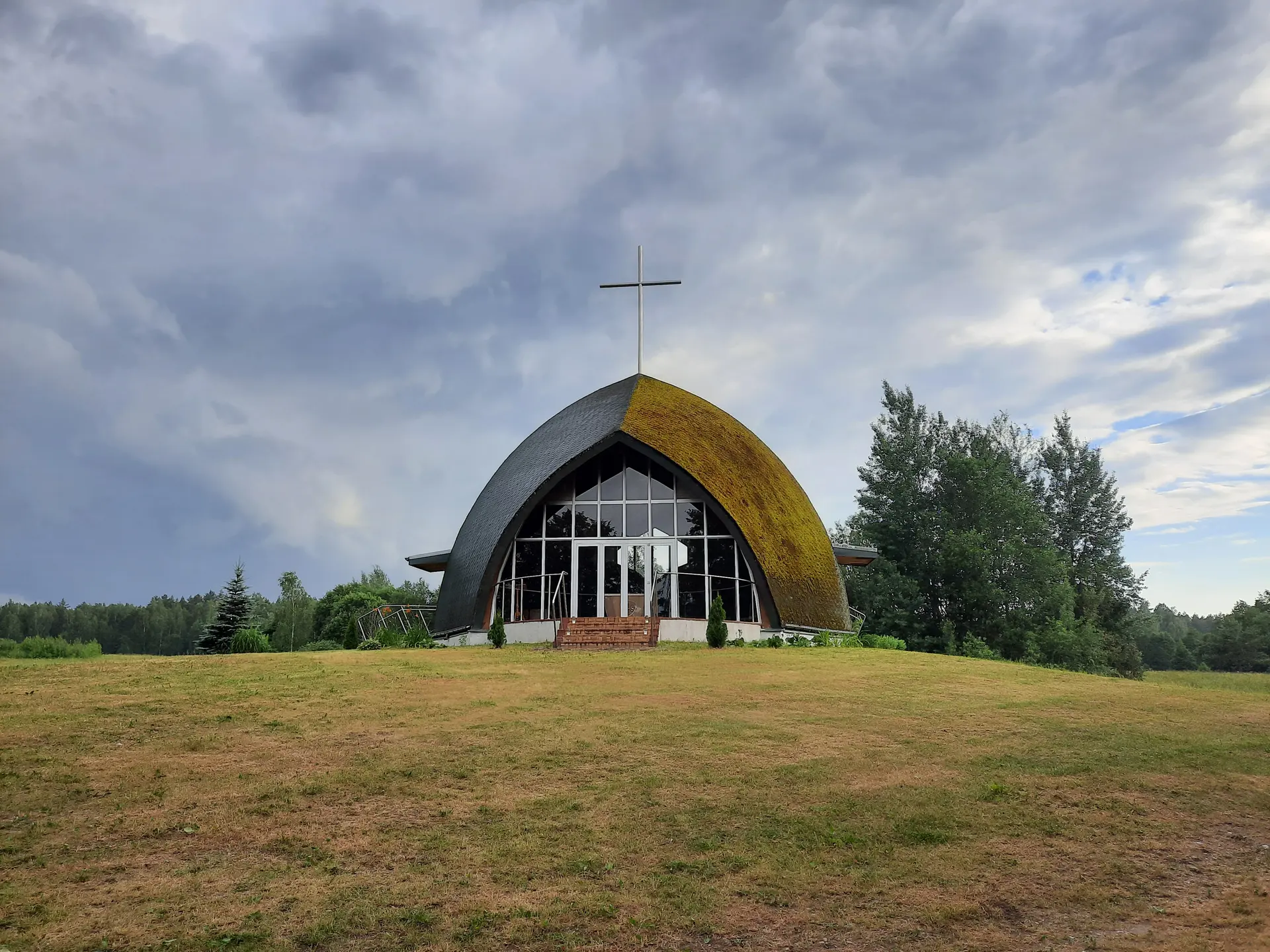
Image of Place of the Apparition of St. Mary at Lake Ilgis. Image source · CC-BY-SA-4.0
Visit essentials
A quick read before you go
- Duration
- A visit to the chapel, crosses, and lakeside takes 30 to 60 minutes.
- Access
- Located near the site of the vanished village of Kvintiskes, on the western shore of Lake Ilgis,…
Overview
On a summer evening in 1967, two teenagers rode beside a stream from Lake Ilgis when their motorcycle stopped without explanation. Looking toward the lake, they saw above the water a luminous young woman of extraordinary beauty, wearing a white dress and cape, with golden hair lit by no visible source.
They recognized the Virgin Mary. Local parish priest Father Jonas Jatulis confirmed their account. Word spread through nearby communities within days, and pilgrims came hoping that a boundary between worlds had opened.
The Soviet response was immediate and violent: militia destroyed pilgrims' crosses, barricaded roads, beat worshippers, and bused them away. Authorities understood a Marian apparition in Soviet Lithuania as a threat to state atheism, but persecution deepened rather than destroyed devotion. The faithful continued coming for more than two decades through the remaining Soviet years.
After Lithuanian independence in 1990, the site became freely accessible. In 2014, Bishop Emeritus Jonas Kauneckas consecrated a lakeside chapel designed by architect Kazys Tamosecius. Its papal-mitre form declares across the water that the ground belongs to something the state tried to erase.
Hundreds of pilgrim-planted crosses surround the chapel. Like the Hill of Crosses near Siauliai, where cross placement became spiritual and national resistance, Lake Ilgis joins faith to landscape: crosses stand among water and forest, reflected in the lake.
Why this place is sacred
The apparition occurred at the boundary between elements: a luminous figure standing in or above water. This detail carries weight beyond the specifics of the 1967 event. Water has served as a threshold between worlds in spiritual traditions far older than Christianity, and the Lithuanian landscape of lakes and forests has been understood as spiritually charged since pre-Christian times.
Whether the apparition tapped into something already present in this landscape or created something new is a question that admits no simple answer.
The Soviet suppression paradoxically deepened the site's sacred quality. Places where people suffered for their faith acquire a resonance that undisturbed places do not. The memory of militia destroying crosses, of pilgrims beaten for praying, of roads barricaded to prevent worship: these events added a dimension of sacrifice to the site's significance. The crosses that stand here now are planted not only in devotion but in defiance of what was done.
The remoteness itself contributes. Reaching Lake Ilgis requires deliberate travel through rural northeastern Lithuania, through countryside that the post-Soviet era has left sparsely populated. The journey is a form of pilgrimage before arrival, a gradual stripping away of urban distraction that prepares the visitor for encounter.
The site became sacred through the apparition event itself, transforming an ordinary lakeside into a place of claimed divine visitation. No prior sacred significance is documented, though the lake's setting in the Aukstaitija region, with its dense pre-Christian associations, may suggest older layers of landscape reverence.
From spontaneous apparition site to persecuted underground pilgrimage destination to officially recognized shrine with a consecrated chapel, the site's evolution mirrors Lithuania's own passage through Soviet occupation to independence. The construction of the 2014 chapel represents a formal ecclesiastical embrace of a devotion that spent decades in the underground.
Experience and orientation
The approach matters here as much as the arrival. The rural roads of the Zarasai district lead through quiet countryside, past scattered farmsteads and into the lake region that defines northeastern Lithuania. By the time you reach Lake Ilgis, the pace of urban life has fallen away.
At the site, the first impression is often the crosses. They cover the ground near the chapel in varying sizes, styles, and materials: wooden crosses rough-hewn by hand, metal crosses wrought with care, simple crosses made from branches found nearby. Each one represents a specific human intention: gratitude, petition, commemoration, or simply the desire to mark one's presence at a place where something happened. The cumulative effect is of entering a field of prayer.
The chapel itself, with its distinctive mitre form, provides a focal point for devotion. Its architecture is contemporary but its purpose is ancient: to shelter the act of prayer at a place of claimed divine encounter. Inside, the atmosphere is simple and direct, without the elaborate ornamentation of Lithuania's Baroque churches.
The lake completes the experience. Some pilgrims collect water from Lake Ilgis, believing it carries healing properties. Whether or not one shares this belief, the act of descending to the water's edge, of cupping lake water in one's hands at the place where a vision was seen, connects the visitor to a gesture as old as human encounter with the sacred.
Come with time to spare. The site rewards unhurried presence. Walk among the crosses before entering the chapel. After prayer or reflection inside, go to the lakeside. If the annual feast on June 30 is accessible to you, the communal pilgrimage experience adds a dimension that solitary visits cannot replicate. Bring your own cross if you wish to participate in the tradition of planting one.
Context and lineage
On the evening of June 30, 1967, Juozas Kriauklys, sixteen years old, and his cousin Albina Skvarcinskaite, seventeen, were riding a motorcycle along a stream flowing from Lake Ilgis. The motorcycle stopped without apparent cause. Looking toward the lake, they saw a young woman standing on a rotten pole in or above the water. She was dressed in white with a cape, her golden hair luminous. The teenagers recognized the figure as the Virgin Mary.
Father Jonas Jatulis, the parish priest of nearby Imbradas, confirmed to his parishioners that this was a genuine apparition. Word spread rapidly, and within days crowds were converging on the lake. The Soviet authorities responded with force: militia destroyed crosses erected by pilgrims, barricaded access roads, and physically beat and dispersed worshippers. Despite these measures, devotion continued in secret throughout the remaining decades of Soviet rule.
After Lithuania regained independence in 1990, the site became freely accessible. Pilgrims began openly placing crosses at the apparition location, creating a growing field of devotional markers. In 2014, architect Kazys Tamosecius designed a chapel with a distinctive form resembling a papal mitre, and Bishop Emeritus Jonas Kauneckas consecrated it on June 30, the anniversary of the apparition.
The devotion at Lake Ilgis has passed from the initial visionaries through the underground period of Soviet-era persecution to its current status as a recognized pilgrimage destination within the Diocese of Panevezys. The site belongs to the broader pattern of Lithuanian Marian apparitions documented by scholar-priest Robertas Gedvydas Skrinskas, who has catalogued 25 such sites across the country.
Juozas Kriauklys
historical
Sixteen-year-old witness of the 1967 apparition at Lake Ilgis. His account, corroborated by his cousin, initiated the pilgrimage tradition.
Albina Skvarcinskaite
historical
Seventeen-year-old cousin of Juozas, co-witness of the apparition.
Father Jonas Jatulis
historical
Parish priest of Imbradas who confirmed the apparition account to his parishioners, providing ecclesiastical validation that accelerated the pilgrimage.
Bishop Emeritus Jonas Kauneckas
historical
Consecrated the lakeside chapel on June 30, 2014, providing formal ecclesiastical recognition of the apparition site.
Traditions and practice
The core traditional practice is pilgrimage to the apparition site, undertaken as an act of Marian devotion. During the Soviet era, this pilgrimage carried real physical risk, and the act of coming to Lake Ilgis was itself a profession of faith. The tradition of placing crosses at the site echoes the Lithuanian practice of kryzdirbyte, cross-crafting, inscribed on UNESCO's Intangible Cultural Heritage list in 2001.
Collection of water from the lake, believed to possess healing properties, connects to broader Lithuanian folk traditions about sacred natural water sources.
The annual feast on June 30, the anniversary of the apparition, is the primary liturgical celebration, with Mass and Marian devotions. Year-round pilgrim visits are common, especially during the warmer months. The chapel serves as the focal point for prayer. Crosses continue to be placed at the site by visitors from Lithuania and abroad. The site is part of the Zarasai regional tourism route, bringing it to a wider audience.
Walk among the crosses first. Read their inscriptions where visible, notice the range of materials and craftsmanship, and consider what each one represents: a person who traveled here, knelt on this ground, and planted something vertical in the earth as a statement of faith.
In the chapel, let the simplicity of the space serve you. There is nothing here to distract from the central encounter: a place where something was seen, something was suffered for, and something endures.
At the lakeside, be present to the water. If the tradition of collecting lake water speaks to you, bring a container. If not, simply stand where the teenagers stood and look across the surface where a luminous figure was reported. What you see or do not see is between you and the lake.
Roman Catholic / Marian Apparition Devotion
ActiveLake Ilgis is one of approximately 25 recorded Marian apparition locations in Lithuania. The 1967 apparition, confirmed by the local parish priest, initiated a pilgrimage tradition that survived Soviet persecution and continues to grow. The consecration of the chapel in 2014 by Bishop Emeritus Kauneckas represents formal ecclesiastical support, though the apparition itself has not been formally approved or condemned by the Catholic Church.
Annual feast on June 30 with liturgical celebrations. Year-round pilgrimage visits. Placing of crosses at the apparition site. Collection of lake water believed to have healing properties. Prayer and Marian devotions at the chapel.
Lithuanian Cross-Crafting (Kryzdirbyte)
ActiveThe proliferation of crosses at Lake Ilgis connects the site to the UNESCO-recognized Lithuanian tradition of cross-crafting, inscribed on the Representative List of the Intangible Cultural Heritage of Humanity in 2001. The site has become a secondary expression of this tradition, alongside the Hill of Crosses near Siauliai.
Pilgrims bring and erect crosses of various sizes, materials, and styles as expressions of personal faith, gratitude, petition, or commemoration.
Perspectives and open questions
The Lake Ilgis apparition sits at the intersection of Marian devotion, Soviet-era resistance history, Lithuanian folk tradition, and questions about the nature of religious experience. Each lens offers genuine insight into why this remote lakeside continues to draw pilgrims.
Scholarly perspective
The apparition is situated within a broader pattern of Marian apparitions in Soviet-era Lithuania, where claimed supernatural events served as focal points for both religious devotion and cultural resistance against atheist state policy. Scholar-priest Robertas Gedvydas Skrinskas has documented 25 sites of Marian apparitions across Lithuania. The cross-crafting phenomenon at the site is recognized as an expression of kryzdirbyte, the Lithuanian cross-crafting tradition inscribed on UNESCO's Intangible Cultural Heritage list.
The 2014 chapel by architect Kazys Tamosecius represents a contemporary architectural response to vernacular sacred space.
Living and traditional perspectives
For Lithuanian Catholics, the Lake Ilgis apparition represents the Virgin Mary's protective presence during the darkest period of Soviet persecution. The Soviet authorities' violent response paradoxically confirmed the sacred authenticity of the site for believers. The healing water tradition connects to broader Lithuanian folk beliefs about the spiritual properties of natural water sources. The placing of crosses continues a centuries-old tradition of marking sacred places, a practice that has acquired dimensions of national and spiritual identity.
Alternative interpretations
The apparition's location, a luminous female figure above a lake's waters, resonates with widespread cross-cultural archetypes of water spirits and lake goddesses. Pre-Christian Baltic tradition included reverence for bodies of water as spiritually charged places, suggesting possible continuity between ancient water veneration and the modern Marian apparition. The belief in the lake water's healing properties may reflect syncretism between Christian devotion and older folk traditions.
Open questions
The exact date of the apparition remains uncertain, with sources conflicting between 1967 and 1968. Whether there were additional witnesses or subsequent apparitions is not well documented. The Catholic Church's formal position on the apparition, whether it has been investigated and with what conclusions, is unclear from available sources. The visionaries' subsequent lives and testimonies are not well documented. The history of the vanished village of Kvintiskes, why it disappeared, remains unexplained.
Plan your visit
Access and arrival
Located near the site of the vanished village of Kvintiskes, on the western shore of Lake Ilgis, in Imbradas Eldership, Zarasai District, Utena County, northeastern Lithuania. The site is approximately 30 kilometers from Zarasai town and 170 kilometers from Vilnius. A car is essential, as there is no regular public transport to the site. Roads are paved but rural. Mobile phone signal may be unreliable in this remote area. The nearest reliable signal and services are in Zarasai.
Part of the Zarasai regional tourism route.
No accommodation exists at the site itself. Zarasai, approximately 30 kilometers away, offers guesthouses and small hotels. The Zarasai lake district is a popular summer destination with additional seasonal accommodation options.
Respectful visit
Modest dress appropriate for a sacred site, particularly when entering the chapel.
Photography is generally permitted. Exercise discretion around pilgrims engaged in prayer or water collection.
Bringing and placing a cross is the traditional offering and the most meaningful way to participate in the site's devotional life. Donations for the chapel's upkeep are accepted.
Do not remove or disturb crosses. Respect the natural environment of the lake. Do not litter or leave non-devotional objects at the site.
The site is in a rural area with no formal amenities. Bring water and any supplies you need. The terrain around the lake can be uneven and muddy, particularly after rain. Mobile phone signal may be unreliable in this remote area; ensure someone knows your travel plans.
Location
Map loads as you approach this section.
Pilgrim reflections
A portrait of encounter, not a score
Pilgrims describe what they felt, how present they could become, and whether the place would shape a journey. There are no stars and no ranking of traditions.
No reviewed reflections yet
The first pilgrims can help describe the character of being here.
Share a reflection
Available after an account-backed “Been there.” Every reflection is reviewed before publication.
Nearby sacred places
Explore other sacred places in the region. Proximity does not establish access or travel time; check each place’s guidance.



Share a photo
Help visitors recognize Place of the Apparition of St. Mary at Lake Ilgis. Every submission is reviewed before publication.