Skellig Michael
A pyramidal rock in the Atlantic where monks built a monastery at the edge of the known world
Understand sacred places, explore living traditions, and learn how to engage respectfully with Pilgrim Map.
Access has not been verified. Check current local guidance before planning a visit.
County Kerry, Kerry, Ireland
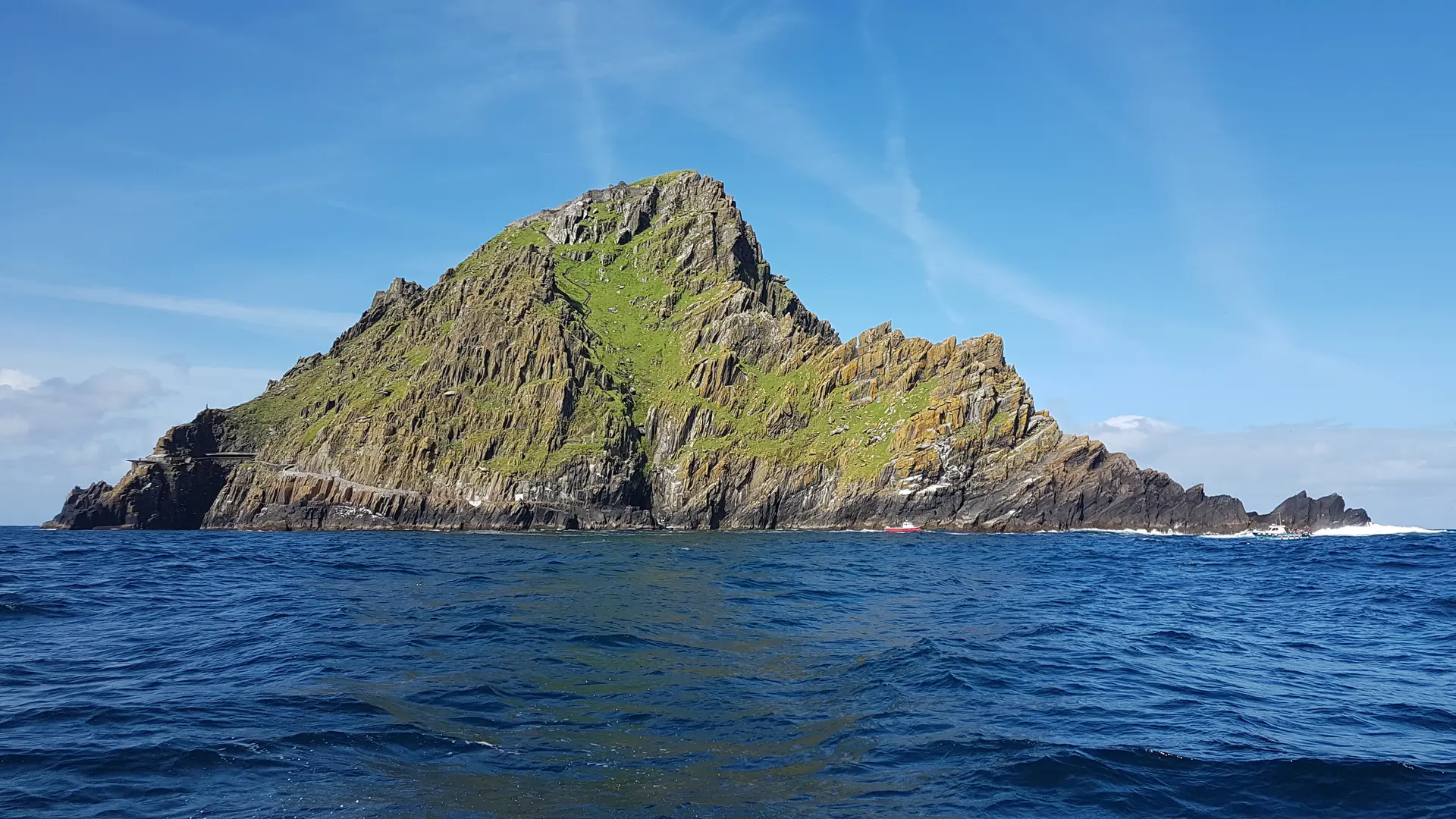
Image of Skellig Michael. Image source · CC-BY-SA-4.0
Visit essentials
A quick read before you go
- Duration
- 4.5 to 5 hours total from Portmagee
- Etiquette
- The island is a protected UNESCO World Heritage Site.
Overview
The Skellig appears on the horizon as a dark triangle, improbably steep, rising from open ocean with a finality that seems to end the world. As the boat closes the twelve-kilometre gap from Portmagee, the scale becomes real: sheer cliffs, wheeling gannets, the sound of the Atlantic breaking against rock that has resisted it for 350 million years. Landing is an act of commitment. The sea must cooperate.
The monks who chose this place understood that access would always be conditional, always earned. The 618 steps begin at the landing and climb to the monastery 218 metres above the water. They are the original steps, laid by the monks themselves, worn smooth by a millennium of feet. The climb is steep and exposed, with no handrails and no shelter from wind. Halfway up, the mainland disappears behind you.
By the time you reach the monastery, you have left the ordinary world behind in a way that is not metaphorical. The beehive cells are small, dark, and perfectly dry after twelve centuries. They were built without mortar, each stone corbelled inward until the walls close into a roof, a technique that has kept the rain out since the early medieval period.
The monks who lived here, no more than twelve and an abbot, endured Atlantic storms, Viking raids, and the simple daily challenge of survival on a rock. They did this willingly, seeking what they called peregrinatio pro Dei amore: pilgrimage for the love of God. The concept held that the further one travelled from comfort, the closer one came to the divine. Skellig Michael was their answer. The island does not argue for this theology.
It simply presents the evidence: that human beings chose the most inhospitable place they could find and built something that has lasted, and that the silence at the top, broken only by wind and seabirds, continues to offer what the monks came looking for.
Why this place is sacred
The thinness of Skellig Michael is inseparable from its geography. The island sits at the western extreme of the European landmass, the last habitable point before the Atlantic stretches unbroken to North America. For the monks who settled here, this was not incidental but essential. Their theology of peregrinatio held that spiritual proximity to God increased with physical distance from the comforts of the world. They went as far as they could go.
The physical experience of the island enforces this theology whether you share it or not. The boat crossing removes you from the mainland. The climb removes you from sea level. The silence at the monastery removes you from the noise of contemporary life. Each step strips something away. By the time you stand among the beehive cells, 218 metres above the ocean, the ordinary concerns that occupied your mind at Portmagee have become difficult to recall.
The preservation of the monastic buildings adds temporal depth to the spatial isolation. These cells, oratories, and crosses have stood here since the early medieval period, essentially unchanged. No restoration has been necessary because the original construction was so sound. Entering a beehive cell is entering a space that has not been altered since a monk last slept in it centuries ago. The continuity is not conceptual; it is physical.
The same stones, the same darkness, the same sound of wind through the doorway. The Atlantic itself functions as a threshold. The sea that surrounds the island is not a backdrop but an active presence, its moods determining whether you can land, how long you can stay, and whether you can leave. The monks lived with this uncertainty daily. For two and a half hours on the island, so do you.
The monastery was established between the sixth and eighth centuries by monks following the Irish tradition of island monasticism and the ideal of peregrinatio pro Dei amore. They sought radical isolation and asceticism as a path to intimacy with God.
The monastery was continuously occupied until the twelfth or thirteenth century, when the community relocated to Ballinskelligs Priory on the mainland. The island then became a lay pilgrimage destination, with increasingly dangerous rituals including kissing a cross on a rock ledge on the South Peak. Lord Dunraven conducted the first comprehensive survey in 1871. Conservation works began in 1986. UNESCO inscribed the site in 1996. The island's appearance in the Star Wars films added a contemporary mythological layer.
Experience and orientation
The day begins at Portmagee marina, where licensed boats depart between 8 and 10:30am. The crossing takes forty-five minutes to an hour, depending on conditions, and conditions matter. The Atlantic off the Kerry coast is not tame. Swells of two metres are common; cancellations due to weather are frequent. Seasickness medication is worth considering.
The approach reveals the island in stages: first a distant shape, then the staggering verticality of the cliffs, then the colony of gannets on Little Skellig, then the landing pier, small and exposed, where the sea must permit you to step ashore. The 618 steps begin immediately. They are narrow, uneven, and unfenced. The monks carved them from the rock, and they have served without modification for over a millennium.
The climb takes thirty to forty-five minutes, depending on pace and fitness. There is no shortcut. The view expands with each step: first the sea, then the mainland, then the smaller Skellig island with its gannet colony, then the open Atlantic stretching to the western horizon. Halfway up, a resting point at Christ's Saddle offers a chance to catch your breath and absorb the scale. The monastery occupies a terraced shelf near the summit.
Six beehive cells, two oratories, a graveyard with stone crosses, and garden terraces are arranged within a retaining wall. OPW guides stationed at the monastery provide interpretation, but the silence between their words is the real content. The cells are cool and dark inside; the sound of wind shifts as you enter, as if the threshold still separates two worlds. You have approximately 2.5 hours on the island. This is enforced and, in retrospect, feels right.
The intensity of the experience does not dilute with time; it concentrates. The descent is its own meditation, the mainland growing larger with each step, the return to the ordinary world approaching whether you are ready or not.
Skellig Michael lies 12 km off the Iveragh Peninsula in County Kerry. Boats depart from Portmagee marina. The 618 steps lead from the landing pier to the monastery at 218 metres above sea level. The South Peak hermitage, higher still, is not accessible to visitors. OPW guides are stationed at the monastery.
Context and lineage
Sometime between the sixth and eighth centuries, a small community of monks made a decision that still defies ordinary comprehension. They sailed twelve kilometres into the Atlantic, landed on a pyramidal rock with no fresh water, no soil, and no shelter, and began building. Using only dry stone, without mortar, they constructed beehive cells, oratories, retaining walls, and garden terraces. They carved 618 steps into the rock face to connect the landing pier to the monastery.
They created a self-sufficient community of no more than twelve monks and an abbot, sustained by rainwater, seabird eggs, fish, and whatever they could grow on tiny terraced plots. Tradition attributes the founding to St Fionan, though historians doubt this specific attribution. Between 950 and 1050, the monastery was dedicated to the Archangel Michael, connecting it to the European tradition of Michaeline sanctuaries at dramatic high places.
The community endured Viking raids, including an attack in 823 that saw the abbot Eitgal carried off. Yet the monks remained. They stayed for centuries, until the twelfth or thirteenth century brought a gradual withdrawal to the mainland monastery at Ballinskelligs Priory. The reasons remain debated: climate deterioration, Viking pressure, shifts in monastic reform movements. What they left behind was a monument so perfectly built that it has required no reconstruction in over a thousand years.
Skellig Michael belongs to the tradition of Irish island monasticism that also produced monastic settlements on the Aran Islands, Inishmurray, Scattery Island, and Church Island in Valencia Harbour. The Michaeline dedication connects it to a pan-European network including Mont Saint-Michel, Sacra di San Michele, and Monte Sant'Angelo. The monks who left Skellig founded Ballinskelligs Priory on the mainland, maintaining continuity with their Atlantic origins.
St Fionan
Eitgal
Lord Dunraven
The OPW (Office of Public Works)
Traditions and practice
The monks followed a daily liturgical cycle of prayer in their oratories, celebrated Mass at the altar stone, and maintained extreme penitential discipline. After the monastery's abandonment, the island became a lay pilgrimage destination. The most demanding tradition required climbing to the South Peak hermitage and kissing a cross on a narrow rock ledge, an act that risked death. In later centuries, the pilgrimage became associated with courtship, with young unmarried people traveling to the island to dance and socialize.
The site is managed as a heritage monument by the OPW. No regular religious services are held on the island. Visitors make a form of pilgrimage through the boat crossing and the 618-step climb, an experience that physically replicates the monastic pattern of sacrifice and ascent. Personal prayer and meditation at the monastic site are welcome. OPW guides provide interpretation. The 2.5-hour time limit creates an intentional, focused visit.
Treat the crossing as part of the practice, not merely transport. The uncertainty of the sea, the exposure to weather, the commitment required to board the boat, all of this belonged to the monks' experience and belongs to yours. Climb slowly. The steps are not an obstacle to be overcome but a path to be walked. At the monastery, enter a beehive cell. Stand still. Let the darkness and the silence do what they do.
Before descending, sit at the edge of the terrace and look west. There is nothing between you and America. The monks chose this view for a reason.
Celtic Christianity / Early Irish Monasticism
HistoricalSkellig Michael represents the most extreme expression of the monastic ideal of peregrinatio pro Dei amore. UNESCO describes it as illustrating 'the extremes of a Christian monasticism' as no other property can. A community of no more than twelve monks and an abbot maintained a self-sufficient existence on a pyramidal rock in the Atlantic.
Daily liturgical prayer in the oratories, cultivation of garden terraces, extreme ascetic discipline, study, and the dangerous pilgrimage to the South Peak hermitage.
Cult of St Michael the Archangel
ActiveThe monastery was dedicated to the Archangel Michael between 950 and 1050, placing it within the broader European Michaeline tradition of sanctuaries at dramatic high places. The dedication connects Skellig to Mont Saint-Michel, Sacra di San Michele, and Monte Sant'Angelo.
The feast of Michaelmas (September 29) historically held significance for the island. The Michaeline tradition of high, difficult-to-access sanctuaries finds its most extreme expression here.
Irish Catholic Pilgrimage
ActiveAfter the monks' departure, Skellig Michael became a major lay pilgrimage destination. The tradition of making the arduous crossing and climb continues in contemporary form, blending heritage tourism with spiritual seeking.
The boat crossing and 618-step climb replicate the original monastic experience of sacrifice and effort. Contemporary visitors, regardless of religious background, consistently report spiritual or emotional experiences at the monastery.
Heritage Conservation
ActiveAs a UNESCO World Heritage Site and National Monument, Skellig Michael is protected under the National Monuments Acts. The OPW manages conservation and access, balancing preservation with public engagement.
Ongoing conservation by the OPW, controlled visitor access through licensed boat operators, on-site interpretation by OPW guides, and monitoring of the monastic structures and natural environment.
Perspectives and open questions
Skellig Michael stands at the intersection of early Christian asceticism, archaeological preservation, Celtic mythology, and a contemporary search for meaning through encounter with the extreme.
Scholarly perspective
UNESCO's designation in 1996 under criteria iii and iv confirmed the site's 'exceptional universal value,' describing it as illustrating 'the extremes of a Christian monasticism characterizing much of North Africa, the Near East and Europe' as no other property can. Archaeological investigations since 1986 have revealed clear evolution in dry-stone construction techniques. The monastery was likely founded in the sixth to eighth century. The Viking raid of 823 is documented in Irish annals.
The Michaeline dedication between 950 and 1050 connected the site to broader European patterns of archangelic veneration.
Living and traditional perspectives
In Irish Catholic tradition, Skellig Michael represents the summit of early Irish monastic devotion, the willingness to endure radical hardship for the love of God. According to tradition, St Michael appeared on the island with the Heavenly Host to help St Patrick banish the serpents from Ireland. In older Irish mythology, Irr, son of Mil Espaine, was shipwrecked and buried here during the Milesian invasion, an event attributed to the supernatural Tuatha De Danann.
The Celtic concept of the Isles of the Blessed, otherworldly islands at the western edge of the world, may underlie the island's pre-Christian sanctity.
Alternative interpretations
The most prominent alternative interpretation places Skellig Michael on the St Michael-Apollo Axis, an alignment running from the island through Mont Saint-Michel, Sacra di San Michele, Monte Sant'Angelo, and onward to Mount Carmel. Astrophysicist Luca Amendola noted measurable linearity at 60.45 degrees, while emphasizing there is no evidence the alignment was intentionally planned. Some practitioners regard the island as a major energy vortex and the western anchor of a global spiritual grid.
Open questions
The exact founding date remains uncertain. Whether the island had pre-Christian sacred significance is unconfirmed; the mythological associations are suggestive but not archaeologically proven. The purpose of the isolated South Peak hermitage remains debated. The precise reason for the monastery's abandonment in the twelfth to thirteenth century is unclear. How the monks constructed the monastery on such a precipitous site, including transporting materials by boat and up the cliff, remains only partially understood.
Plan your visit
Access and arrival
Accommodation available in Portmagee, Cahirciveen, and Waterville. Book well in advance during summer months. The Ring of Kerry provides a range of options.
Respectful visit
Mandatory: warm outdoor clothing, sturdy walking boots with ankle support, waterproof jacket and trousers. This is not a suggestion but a requirement enforced by the OPW. The island is fully exposed to Atlantic weather, which can change within minutes.
Photography is permitted and the site is exceptionally photogenic. Do not climb on structures or approach cliff edges for photographs. Drone use is prohibited. Respect the wildlife; do not approach nesting seabirds.
No offering traditions at the site. Leave no trace. All items brought to the island must be taken back.
Do not climb on or touch monastic buildings. Stay on designated access routes. No picnicking within the monastic enclosure or on the steps; use designated areas at Christ's Saddle. No dogs or other animals. Children under twelve not permitted. No drone use. All litter must be taken back to the boat.
The island has no facilities: no toilets, no shops, no shelter. Bring food and water. The steps are steep, uneven, and unfenced; reasonable fitness is required. Children under twelve are not permitted on landing tours. Seasickness is common on the crossing. Weather cancellations are frequent; build flexibility into your plans.
Current practical details
Address
Great Skellig, Skellig Rock Great, Co. Kerry, Ireland
Hours, fees, and access can change — verify on the official source before you travel. Practical details last checked Jun 2026.
Location
Map loads as you approach this section.
Pilgrim reflections
A portrait of encounter, not a score
Pilgrims describe what they felt, how present they could become, and whether the place would shape a journey. There are no stars and no ranking of traditions.
No reviewed reflections yet
The first pilgrims can help describe the character of being here.
Share a reflection
Available after an account-backed “Been there.” Every reflection is reviewed before publication.
Nearby sacred places
Explore other sacred places in the region. Proximity does not establish access or travel time; check each place’s guidance.
Photo gallery
3 curated photos
Share a photo
Help visitors recognize Skellig Michael. Every submission is reviewed before publication.