Kenmare Stone Circle, Kenmare, Ireland
Southwest Ireland's largest stone circle, where Bronze Age astronomy still tracks the winter solstice
Understand sacred places, explore living traditions, and learn how to engage respectfully with Pilgrim Map.
Access has not been verified. Check current local guidance before planning a visit.
Kenmare, Kerry, Ireland
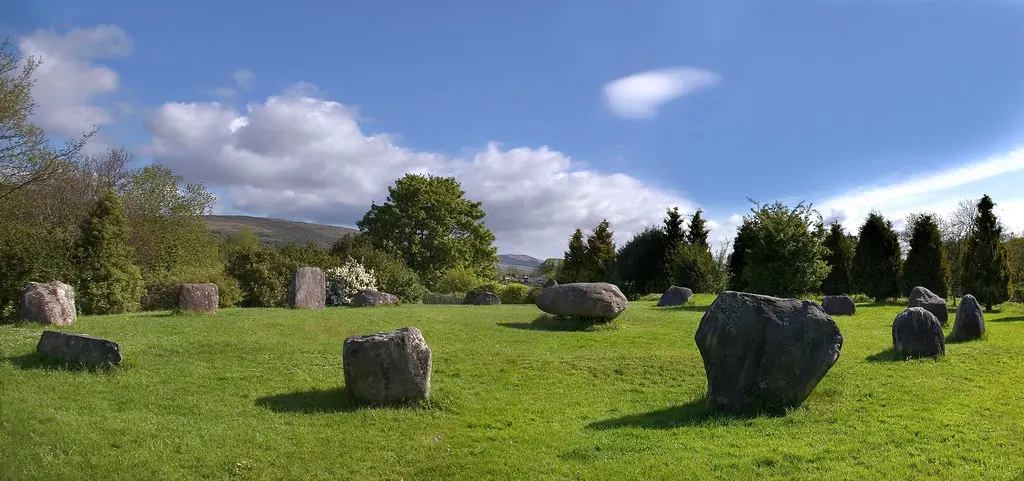
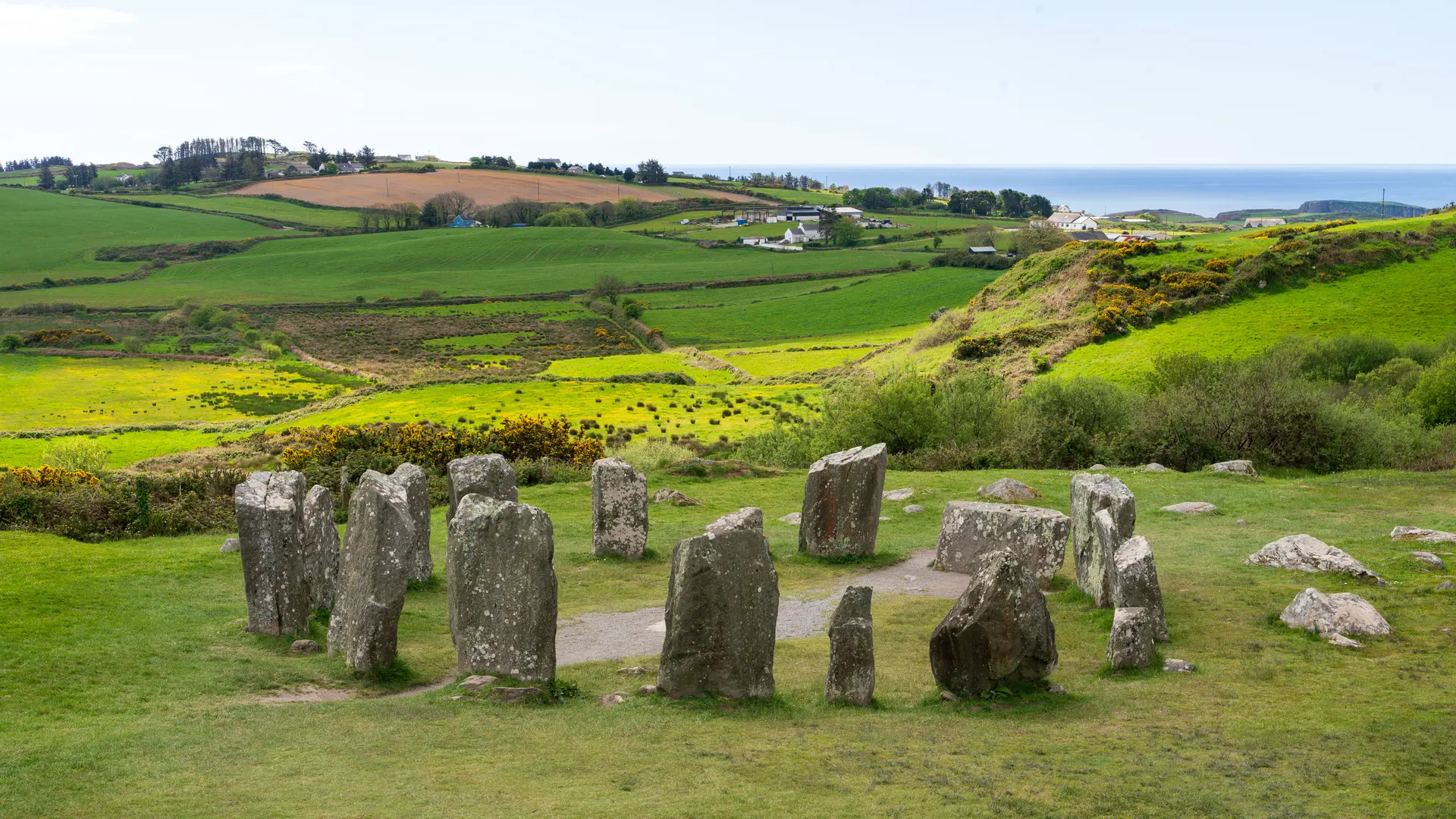
Image of Kenmare Stone Circle, Kenmare, Ireland. Image source
Visit essentials
A quick read before you go
- Duration
- Allow 20 to 45 minutes for a thorough visit including time within the circle, reading…
- Access
- Five-minute walk from the center of Kenmare town.
Overview
Five minutes from central Kenmare, fifteen stones form a sacred space marked by Bronze Age people roughly four thousand years ago. A residential street and gate, not a remote approach, make the encounter unexpectedly intimate.
This is southwest Ireland's largest stone circle and Munster's only egg-shaped example. Its central boulder-burial supports an approximately seven-ton capstone, requiring coordinated engineering. Whether its purpose was funerary, ceremonial, astronomical, or all three remains unanswered.
At winter-solstice sunrise, light passes between the entrance stones onto the boulder-burial, turning the circle into an instrument for the year's darkest turning and the return of light. Whatever else its builders intended, their arrangement encodes the cosmos.
A hawthorn fairy tree carries later Irish folk meaning. Visitors write wishes on provided cards and attach them to its branches, naming their hopes for the fairy folk. The stones themselves remain silent, waiting as they have for three thousand years.
Why this place is sacred
The egg-shaped ring feels organic—more body than diagram—and gathers a space where town and traffic recede. Its central boulder-burial draws attention inward and downward: a seven-ton capstone whose literal and experiential gravity still commands the center, whatever once lay beneath it, on it, or burned beside it.
At winter solstice, sunrise through the entrance stones illuminates the central burial, marking the year's turn toward returning light. This dynamic alignment joins the broader Irish tradition represented by Newgrange and other passage tombs and shows Bronze Age astronomical engagement with landscape.
Irish tradition holds hawthorns as homes of fairy folk, especially significant at Bealtaine, the May Day beginning of summer. Writing a wish at this tree makes participation, not observation, part of the visit. The circle's location within modern Kenmare heightens the threshold between coffee shops and parked cars and the ancient stones.
The circle's original purpose remains a matter of archaeological interpretation. The boulder-burial at the center suggests funerary use, though Professor William O'Brien's excavations of similar boulder-burial structures in the late 1980s found no evidence of actual burials, raising the possibility that the structures served primarily ceremonial rather than funerary functions. The winter solstice alignment indicates calendrical and possibly astronomical use. Traces of a fireplace found at the center suggest fire-based rituals.
The most likely interpretation is that the circle served multiple interconnected functions: marking death, marking the solar year, and providing a communal gathering place for seasonal ceremonies.
The circle's meaning has shifted across millennia. Built by Bronze Age communities whose beliefs and social structures are largely unknown, it passed into the folklore of later Celtic inhabitants who named it 'The Druid's Circle,' attributing it to spiritual figures from their own tradition. The legend of the stones as 'frozen dancing gods' echoes a widespread European folk motif, suggesting the circle retained its numinous quality even as its original context was forgotten.
In the modern era, the circle has been cared for by dedicated custodians since the 1990s, who maintain the site and provide access. The hawthorn fairy tree and its wish-making tradition connect the ancient monument to living Irish folk practice.
Experience and orientation
A residential street and gate lead directly into a monument older than the pyramids' final form; the ordinary approach sharpens the encounter. Inside, shoulder-height stones create a still enclosure disproportionate to their scale. Visitors report effortless calm or feeling held by the ring.
The central boulder-burial invites close attention to its massive capstone and unanswered questions about what its builders understood or placed here. At the hawthorn, writing and tying a provided wish card requires naming a hope without judgment.
Sunset and golden hour draw color and texture from the gray stone. Winter-solstice sunrise is the most archaeologically resonant moment, when the builders' alignment becomes visible.
Enter the circle through the gap between the two entrance stones at the southwest, the same approach the winter solstice sun uses. Stand at the center and face each direction in turn. Notice how the stones frame different aspects of the surrounding landscape. Spend at least a few minutes in silence before reading the interpretive information. If the fairy tree has wish cards available, write one.
The formality of the act is less important than the honesty of what you name.
Context and lineage
No foundation narrative survives from the Bronze Age builders. The circle emerged from communities who were clearing woodlands, developing agriculture, and building monuments that encoded their understanding of death, the seasons, and the relationship between earth and sky. The scale of the Kenmare circle, the precision of its solstice alignment, and the engineering required to position a seven-ton capstone all indicate a society with both technical knowledge and strong communal purpose.
In later folk tradition, the circle was attributed to druids fleeing persecution, and the stones themselves were said to be 'frozen dancing gods.' These narratives, while not reflecting the Bronze Age context, demonstrate that successive communities recognized the stones as carrying significance beyond the ordinary.
The circle's lineage runs from Bronze Age communities whose astronomical knowledge is encoded in the alignment, through Celtic peoples who renamed it and integrated it into their folklore, to the current custodians who maintain it as a heritage site. The hawthorn fairy tree represents a living thread of Irish folk spirituality that connects the ancient monument to contemporary practice, however informally.
Bronze Age Builders
historical
The anonymous communities who erected the circle and positioned its seven-ton capstone, demonstrating astronomical knowledge and communal organization whose details are lost to time.
Professor William O'Brien
historical
Archaeologist who excavated similar boulder-burial structures in southwest Ireland in the late 1980s, finding no evidence of burials and complicating the traditional interpretation of these monuments.
Site Custodians
historical
Private custodians who have maintained and provided access to the stone circle since the 1990s, ensuring its preservation and public accessibility.
Traditions and practice
The original Bronze Age rituals performed within the circle are unknown but likely involved seasonal ceremonies connected to solar events, particularly the winter solstice when the rising sun aligns through the entrance stones onto the central boulder-burial. The central capstone may have functioned as a focal point for offerings or ceremonial fires, as traces of a fireplace have been reported at the center.
The circle is associated with La Bealtaine (May 1), the Celtic festival marking summer's arrival, though this connection dates from a later period than the monument's construction.
Walk through the entrance gap at the southwest and stand at the center of the ring. Allow the enclosure to settle around you before moving or reading. The egg-shaped plan creates a space that feels gathered rather than geometric, and spending a few minutes in silence allows this quality to register.
Circle the interior slowly, pausing at each stone. Notice how they vary in size and shape, how some lean slightly, how the gaps between them frame different aspects of the surrounding landscape. The stones decrease in height from the entrance toward the back of the circle, a gradation that may have carried symbolic meaning.
At the central boulder-burial, observe the capstone closely. Seven tons of stone, placed here by human effort and intention over three thousand years ago, resting on supports that have not shifted. The engineering is worth contemplating in itself.
If wish cards are available at the hawthorn tree, take one and write something honest. The tradition asks only sincerity. Tie the card to a branch and step back.
The winter solstice (approximately December 21) offers the most archaeologically resonant experience. Arrive before sunrise (approximately 6:40am) and position yourself to observe the rising sun as it passes through the entrance stones and illuminates the central boulder-burial. The alignment connects you directly to the intention of the builders. La Bealtaine (May 1) has folk-traditional associations and marks the beginning of the light half of the Celtic year. Early morning and late afternoon light reveal the stones' textures most vividly.
Bronze Age Ritual and Ceremonial Traditions
HistoricalThe Kenmare Stone Circle was erected during the Bronze Age as a ritual monument of exceptional scale and precision. It is the largest stone circle in southwest Ireland, with an egg-shaped configuration that is the only example of its kind in Munster. The winter solstice alignment demonstrates that the builders encoded astronomical knowledge into the monument's design.
The circle likely served as a site for seasonal rituals connected to solar events. The central boulder-burial and traces of fire suggest ceremonies involving both ancestral commemoration and fire-based ritual. The precise nature of these ceremonies is unknown.
Irish Folk Tradition (Fairy Tree / Wish-Making)
ActiveA hawthorn tree at the site functions as a fairy tree in Irish folk tradition, connecting the ancient monument to living practices of folk spirituality. The hawthorn is sacred in Irish tradition, associated with the fairy folk (si) and the Bealtaine festival (May 1).
Visitors write wishes on provided cards and tie them to the hawthorn tree. The tradition holds that the fairy folk who inhabit the tree will attend to the wishes. The practice is simple, participatory, and requires no prior knowledge or belief.
Archaeological and Heritage Stewardship
ActiveThe stone circle has been maintained by dedicated private custodians since the 1990s, representing a model of community-based heritage stewardship. Their work ensures public access, site preservation, and interpretation for visitors from around the world.
Ongoing conservation, maintenance of wheelchair access, provision of interpretive materials, and management of visitor access through the honesty-box admission system. The custodians serve as the human connection between the ancient builders and contemporary visitors.
Perspectives and open questions
The Kenmare Stone Circle holds multiple interpretations in productive tension: archaeological analysis of its construction and function, folk traditions that gave it new meanings across millennia, and contemporary spiritual engagement that finds significance in its enduring presence.
Scholarly perspective
Archaeologists classify the Kenmare Stone Circle as a Bronze Age ritual monument, the largest in southwest Ireland and the only egg-shaped stone ring in Munster. The central boulder-burial is a distinctive feature of southwest Irish stone circles, though Professor William O'Brien's excavations of similar structures in the late 1980s found no evidence of burials, raising questions about whether these monuments served primarily ceremonial rather than funerary purposes.
The monument's alignment to the winter solstice sunrise is consistent with broader patterns in Irish and European megalithic astronomy. Dating of similar sites to the Middle Bronze Age (approximately 1500 to 1000 BC) provides the current best estimate for construction, though the broad range of 2200 to 500 BC appears in some sources.
Living and traditional perspectives
In Irish folk tradition, the circle is known as 'The Druid's Circle,' reflecting a widespread practice of attributing megalithic monuments to the druids even when they predate the historical druids by millennia. The legend of the stones as 'frozen dancing gods' echoes a folk motif found across Europe, expressing the persistent sense that stone circles are places where the ordinary order of things was once suspended.
The hawthorn fairy tree connects the site to the living tradition of Irish fairy belief, the sí, and to the Bealtaine festival. These folk traditions demonstrate continuous recognition of the stones' sacred character across cultures and centuries.
Alternative interpretations
The winter solstice alignment is emphasized by those who view the site as evidence of sophisticated astronomical knowledge among Bronze Age Irish communities, knowledge that mainstream archaeology has been slow to fully acknowledge. Some interpret the egg-shaped plan as symbolically representing fertility or cosmic creation. The site is sometimes included in discussions of earth energies and the spiritual properties of stone circles.
The fairy tree tradition is embraced by visitors with neo-pagan and New Age spiritual interests who find in it a living connection to pre-Christian Irish spirituality.
Open questions
The precise function of the central boulder-burial remains unclear. Whether the egg-shaped plan was intentional and what it symbolized to the builders cannot be determined from surviving evidence. The exact nature of the ceremonies performed within the circle is lost. Whether the site was used continuously from the Bronze Age through to the Celtic period, or was abandoned and later reinterpreted by new communities, is uncertain.
The identity and social organization of the builders, and why they chose this particular location, remain open questions.
Plan your visit
Access and arrival
Five-minute walk from the center of Kenmare town. From the town center, head east on Henry Street, turn left onto Station Road, and continue to Market Street (number 52). Free or low-cost parking available in Kenmare town. By public transport: Bus Eireann route 283 from Killarney to Kenmare. By car from Killarney: take the N71 for approximately 32 km. Wheelchair accessible. Small admission fee of two euros fifty via honesty box.
Mobile phone signal is available in the Kenmare town area. No specific seasonal closure information was available at time of writing; check locally for current opening arrangements.
Kenmare is a well-served tourist town with accommodation at all price points, from hostels to luxury hotels. Its position on the Ring of Kerry and the Beara Peninsula makes it an excellent base for exploring southwest Ireland's sacred landscape.
Respectful visit
No formal dress code. Comfortable shoes are recommended as the terrain within the circle is slightly uneven. Weather-appropriate clothing for Kerry's changeable climate is advisable, particularly if visiting for the winter solstice sunrise.
Photography is permitted and encouraged. The site is photogenic at all times of day but particularly at sunrise, during golden hour, and at the winter solstice. Photograph without touching or repositioning the stones.
Write wishes on provided cards and attach them to the hawthorn fairy tree. No other offerings should be left at the site. Do not leave litter, crystals, candles, or other objects on or near the stones.
Do not touch, lean on, or climb on the stones. A small admission fee of two euros fifty is collected via honesty box. The site is open during summer months; check for current hours with the custodians. Do not remove anything from the site. Respect the hawthorn fairy tree.
Do not touch, lean on, or climb on the stones. They are approximately three to four thousand years old and any physical contact contributes to erosion. Do not leave offerings other than wishes on the fairy tree. Do not remove anything from the site. The honesty box admission fee of two euros fifty supports the custodians who maintain the site.
Current practical details
Address
52 Market St, Kenmare, Co. Kerry, Ireland
Hours
Hours, fees, and access can change — verify on the official source before you travel. Practical details last checked Jun 2026.
Location
Map loads as you approach this section.
Pilgrim reflections
A portrait of encounter, not a score
Pilgrims describe what they felt, how present they could become, and whether the place would shape a journey. There are no stars and no ranking of traditions.
No reviewed reflections yet
The first pilgrims can help describe the character of being here.
Share a reflection
Available after an account-backed “Been there.” Every reflection is reviewed before publication.
Nearby sacred places
Explore other sacred places in the region. Proximity does not establish access or travel time; check each place’s guidance.
Share a photo
Help visitors recognize Kenmare Stone Circle, Kenmare, Ireland. Every submission is reviewed before publication.