St Gobnait's well (Ballyvourney)
Where a 6th-century saint found nine white deer and pilgrims still walk the rounds she established
Understand sacred places, explore living traditions, and learn how to engage respectfully with Pilgrim Map.
Access has not been verified. Check current local guidance before planning a visit.
Ballyvourney, County Cork, Ireland
Read the sources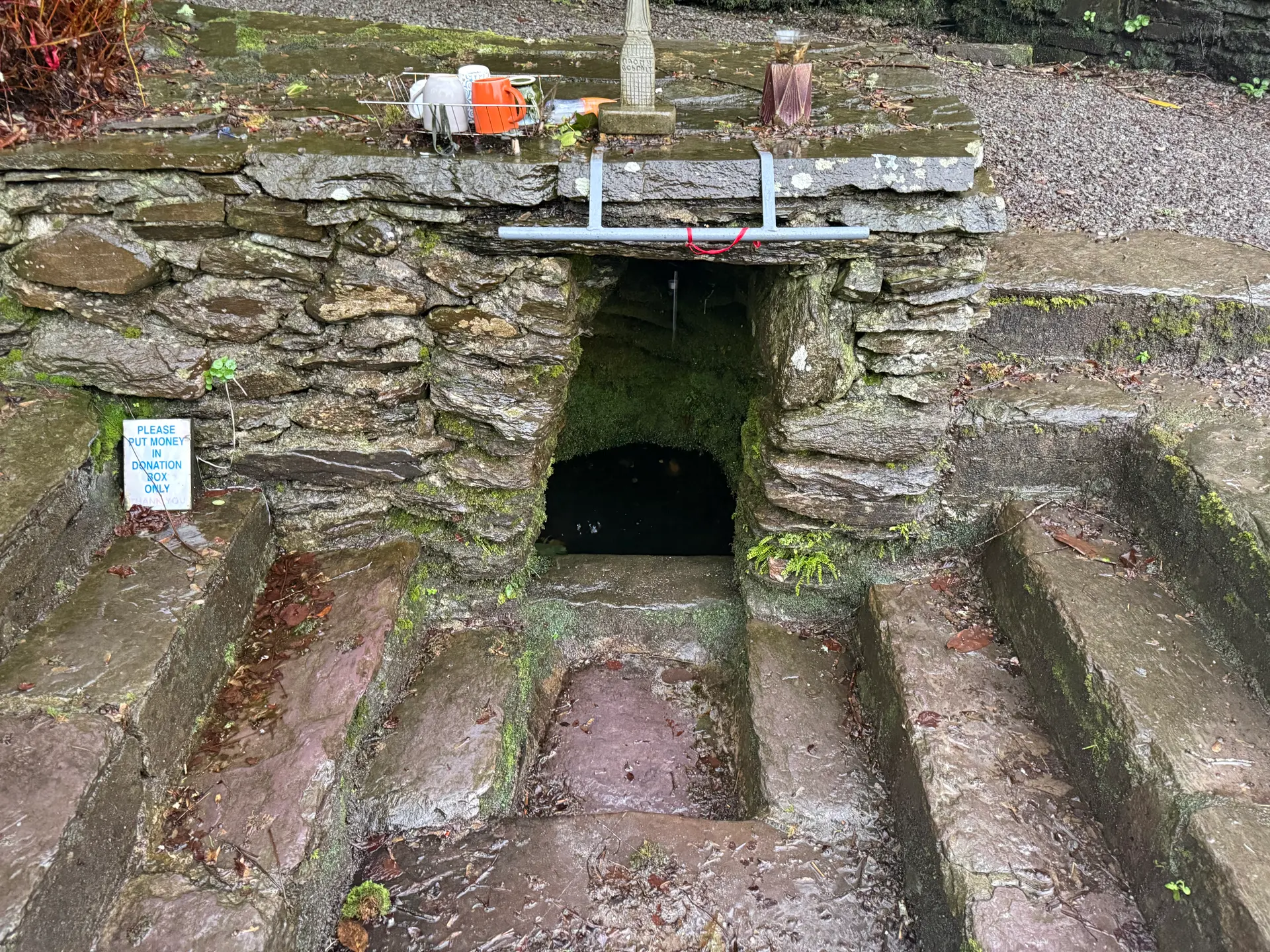
Image of St Gobnait's well (Ballyvourney). Image source · CC-BY-SA-4.0
Visit essentials
A quick read before you go
- Duration
- 1-2 hours for full rounds
- Access
- Ballyvourney, County Cork, Ireland.
Overview
Gobnait fled her home in County Clare in the 6th century. On Inis Oírr in the Aran Islands, an angel appeared. 'Your place is not here. Go until you find nine white deer grazing. There you will find your place of resurrection.'
She traveled. In Clondrohid she saw three deer. In Ballymakeera, six more. Only at Ballyvourney, on a small rise overlooking the River Sullane, did she see all nine together. Here she established her religious community. Here she is buried. Here her well flows and pilgrims walk.
Gobnait became patron saint of beekeepers—tradition says she sent a swarm to chase away cattle rustlers, the bees doing what the sister could not. Her feast day is February 11; Whit Sunday is the other major gathering. On these days, pilgrims walk the rounds to the final station, Tobar Ghobnatan.
A medieval oak statue from the 13th or 14th century is the parish's treasure. Seamus Murphy, one of Ireland's finest sculptors, carved a limestone statue unveiled in 1951. A rag tree bears offerings from those who came seeking healing. The site contains churches, graveyard, and the well that draws pilgrims as it has since at least the 1600s.
Why this place is sacred
What makes St Gobnait's Well thin is living tradition. This is not archaeological curiosity but active pilgrimage—the rounds walked on feast days, the well visited, the rag tree receiving offerings. The 1601 papal indulgence confirms that pilgrimage here was already established; it surely predates documentation by centuries.
The formal structure of the turas (pilgrimage) creates framework for devotion. Five stations, eleven stopping points, specified prayers at each—this is not improvised spirituality but shaped practice handed down across generations. The clockwise walking, ar deiseal, continues the sunwise direction that likely predates Christianity.
Gobnait herself remains present—not only in legend but in the medieval statue treasured by the parish, in the limestone figure that Seamus Murphy carved, in the feast days when the community gathers. Her identification as patron of beekeepers adds earthy dimension: this is a saint who protected practical livelihood, not only souls.
The well, the rag tree, the ruins of early medieval churches—all create a landscape saturated with centuries of devotion. Pilgrims walk where pilgrims have walked, pray where prayers have accumulated, seek healing where healing has been sought.
6th-7th century monastic site founded by St Gobnait where she found the nine white deer
6th-7th century foundation. Medieval churches and graveyard. 1601 papal indulgence confirms established pilgrimage. 13th-14th century oak statue. 1951 limestone statue by Seamus Murphy. Living tradition continues.
Experience and orientation
Begin at the statue of St Gobnait—the Seamus Murphy limestone figure from 1951, standing with the simplicity and beauty for which the sculptor was known. Here the pilgrimage starts.
Five stations await. At each, the pilgrim walks clockwise around a designated point—ruins, grave, monument—while reciting seven Our Fathers, seven Hail Marys, seven Glorias. This takes time. This requires presence. The structure prevents rushing; the repetition creates rhythm; the walking makes prayer physical.
The eleven stopping points distribute across the site: the statue, the churches, the graveyard markers. Each has its place in the sequence. The movement is always clockwise, ar deiseal, the direction of the sun, perhaps older than any saint.
The final station is the well itself, Tobar Ghobnatan. A decade of the Rosary accompanies the walk to reach it. Here is the water that pilgrims have sought for healing across centuries. Near the well stands the rag tree, bearing the offerings of those who came and tied their prayers to its branches.
The major gathering days are February 11 (Gobnait's feast) and Whit Sunday. On these days, the community walks together. Individual rounds can be walked any time.
Come ready to walk and pray. The rounds take 1-2 hours. The structure is the practice; the practice is the point.
Context and lineage
An angel told Gobnait to find where nine white deer grazed—that would be her place of resurrection. She saw three deer in Clondrohid, six more in Ballymakeera. Only at Ballyvourney did she see all nine together. Here she founded her community and here she is buried.
Part of Ireland's rich holy well tradition. Papal indulgence 1601 confirms established pilgrimage. Medieval statue 13th-14th century. Living tradition continues.
St Gobnait
6th-century founder, patron saint of beekeepers
Seamus Murphy
Irish sculptor who carved 1951 limestone statue
Traditions and practice
Turas Ghobnatan: 5 stations, 11 stopping points, clockwise walking, 7 Our Fathers/Hail Marys/Glorias at each station
Pilgrimage on feast days (Feb 11, Whit Sunday), individual rounds any time, leaving offerings on rag tree, taking water from well
Walk the full rounds if time permits. Follow the traditional structure—it creates the experience. Leave an offering on the rag tree if moved to do so. Take some water if you came seeking healing.
Irish Holy Well Pilgrimage
ActiveSt Gobnait followed nine white deer to found her community here. Living pilgrimage tradition with formal rounds since at least 1601. Patron saint of beekeepers. Medieval oak statue. Seamus Murphy limestone statue (1951). Rag tree with votive offerings.
Turas Ghobnatan: 5 stations, 11 points, clockwise walking, prayers at each, final station at well
Perspectives and open questions
St Gobnait's Well can be approached as living Irish pilgrimage tradition, as early medieval monastic site, or as example of how Christian practice adapted to older sacred geography.
Scholarly perspective
Well-documented example of Irish holy well pilgrimage with formal rounds. Archaeological evidence of early medieval monastic settlement. Seamus Murphy statue recognized as significant Irish sculpture.
Living and traditional perspectives
Irish Catholic tradition honors Gobnait as founder and patron saint of beekeepers. The well's water has healing properties. Walking the rounds brings spiritual benefit.
Alternative interpretations
Some see holy wells as pre-Christian sacred sites that Christianity adapted. The nine white deer may connect to older Celtic spirituality.
Open questions
Original appearance of monastic site. Full extent of Gobnait's community. Earlier uses of well site.
Plan your visit
Access and arrival
Ballyvourney, County Cork, Ireland. Well-signed from village. Free access.
Ballyvourney and surrounding villages; Macroom larger town nearby
Respectful visit
Weather-appropriate outdoor clothing
Permitted with respect for those praying
Cloths on rag tree; prayers
Walk clockwise only; respect graves
Rounds take 1-2 hours. Some stations are graveyard and ruins—uneven ground.
Current practical details
Address
5 Bruch An t'Sulain, Glebe, Ballymakeery, Co. Cork, P12 HW93, Ireland
Hours, fees, and access can change — verify on the official source before you travel. Practical details last checked Jun 2026.
Location
Map loads as you approach this section.
Pilgrim reflections
A portrait of encounter, not a score
Pilgrims describe what they felt, how present they could become, and whether the place would shape a journey. There are no stars and no ranking of traditions.
No reviewed reflections yet
The first pilgrims can help describe the character of being here.
Share a reflection
Available after an account-backed “Been there.” Every reflection is reviewed before publication.
Nearby sacred places
Explore other sacred places in the region. Proximity does not establish access or travel time; check each place’s guidance.
References
Sources consulted for this page. Source categories describe the publication, not a guarantee that every claim is verified. Traditional accounts and outside interpretations may differ.
- 01St Gobnait's well — WikipediaSource contextComprehensive overview
- 02Pilgrimage to St Gobnait at Ballyvourney — Pilgrimage in Medieval IrelandacademicScholarly pilgrimage context
- 03St. Gobnait's Holy Well - Ballyvourney — Thin Places TourSource contextThin places context
- 04Ballyvourney Monastic Site — Voices from the DawnSource contextArchaeological context
Photo gallery
2 curated photos
Share a photo
Help visitors recognize St Gobnait's well (Ballyvourney). Every submission is reviewed before publication.