Ale's Stones (Ales Stenar)
Fifty-nine ancient boulders arranged as a stone ship on a clifftop above the Baltic Sea
Understand sacred places, explore living traditions, and learn how to engage respectfully with Pilgrim Map.
Access has not been verified. Check current local guidance before planning a visit.
Ystads kommun, Skåne, Sweden
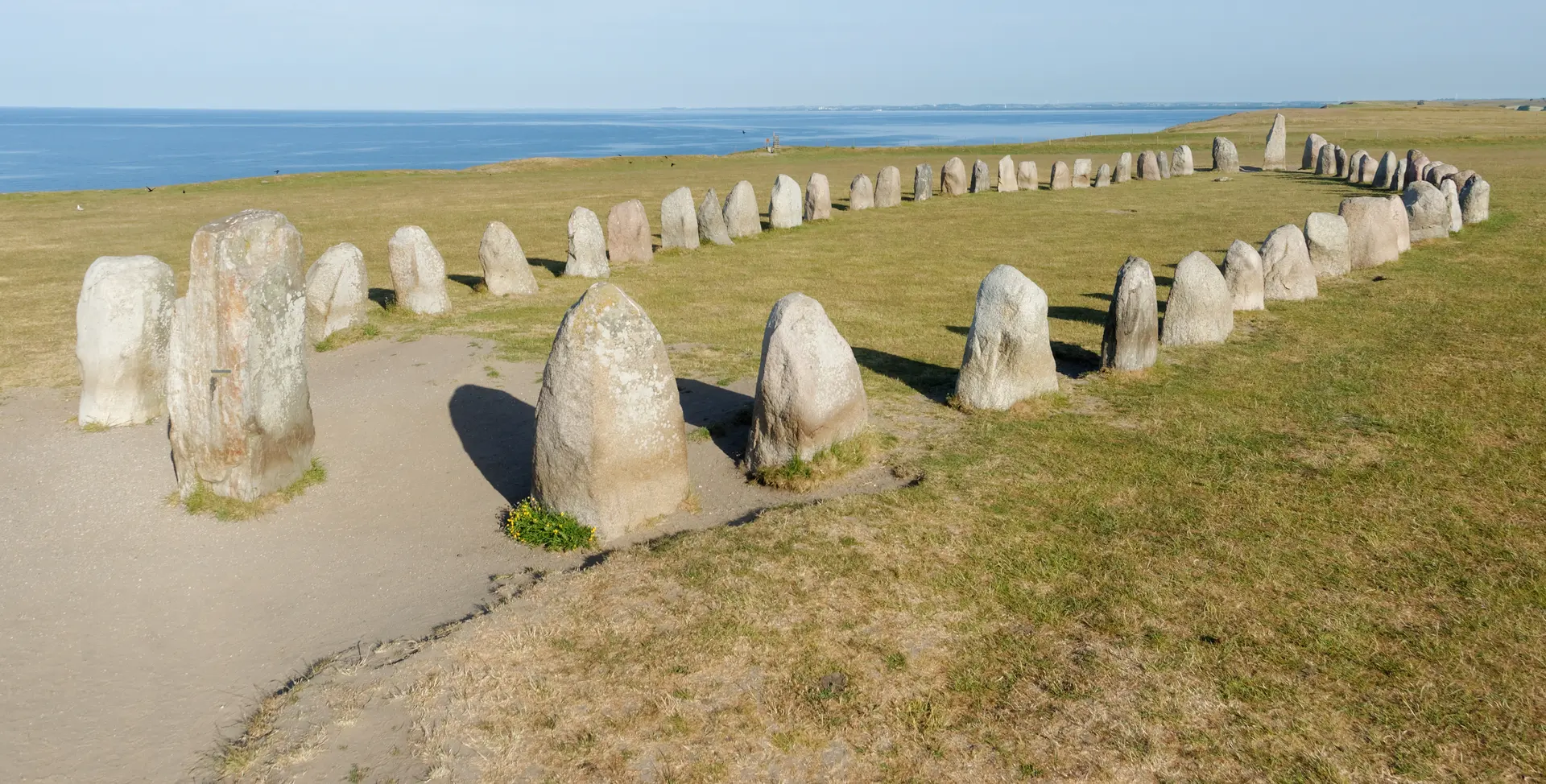
Image of Ale's Stones (Ales Stenar). Image source · CC-BY-SA-4.0
Visit essentials
A quick read before you go
- Duration
- One to one and a half hours, including the walk up from the parking area, time among the stones,…
- Access
- Located at Kaseberga, approximately nineteen kilometres east of Ystad, southeastern Skane.
Overview
Ales Stenar stands on a clifftop thirty-two metres above the Baltic Sea, fifty-nine boulders arranged in the outline of a ship sixty-seven metres long, pointing toward the horizon where the sun sets on the longest day of the year. The monument is Sweden's largest preserved stone ship setting, and one of the country's most visited ancient sites, drawing hundreds of thousands of visitors annually to a ridge where sea, sky, and stone converge.
The Swedish National Heritage Board dates the monument to approximately 600 AD, placing it in the late Iron Age. In 1989, archaeologists discovered a decorated clay pot containing cremated human bones within the stone ship, dating to 330-650 AD. This confirmed what the ship form implied: Ales Stenar is a burial monument, a place where someone of exceptional status was cremated and laid to rest within a landscape-scale stone vessel pointing toward the setting sun.
The ship form carried explicit meaning in Norse tradition. Stone ships represented the vessel that would carry the dead to the afterlife, the physical world providing a permanent replica of the craft needed for the crossing. At Ales Stenar, the symbolism is amplified by the clifftop position. The ship appears to ride the ridge like a wave crest, the Baltic stretching beyond it like an infinite sea.
The central axis aligns with the summer solstice sunset to the northwest and the winter solstice sunrise to the southeast, making the monument a marker of the sun's annual journey.
Scanian folklore associates the stones with King Ale, also known as Ale the Strong, a member of the Danish House of Skjoldung. The name 'Als stene' was first recorded in 1624, establishing that the legendary association was well-rooted by the early modern period. A controversial alternative theory proposes that the monument is actually a Bronze Age astronomical calendar, earning Ales Stenar the popular nickname 'Sweden's Stonehenge.' Academic archaeology rejects this dating, but the debate has amplified public interest.
What requires no theory is the experience. The walk up from Kaseberga harbor, the wind meeting you at the ridge, the stones emerging against the sky, and the horizon wrapping around you in an unbroken arc compose a encounter that operates below the level of interpretation.
Why this place is sacred
The thinness at Ales Stenar is elemental. It operates through exposure. The clifftop ridge offers no shelter, no enclosure, no mediation between the visitor and the raw facts of wind, horizon, and stone. You stand among fifty-nine boulders on an exposed promontory above the Baltic Sea, and the membrane between you and the vastness of the world is exactly as thick as the air.
The stones themselves are massive but not towering: broad, rounded boulders, each weighing approximately 1,800 kilograms, set firmly into the ground. They do not overwhelm by height but by number and arrangement. Walking among them, you are simultaneously inside a structure, enclosed by the ship's outline, and completely exposed to the elements. The walls of this vessel are permeable. The wind passes through. The horizon is visible between every pair of stones.
The solstice alignment adds a temporal dimension to the spatial experience. Whether deliberate or incidental, it means that twice each year the sun's path and the monument's axis coincide, and the ship appears to be sailing toward or from the sun.
On the summer solstice evening, visitors gather to watch the sun descend precisely along the line of the stone ship, and the convergence of celestial and monumental geometry creates a moment of alignment that feels significant regardless of its archaeological status.
The cremation burial within the ship grounds all of this in the literal presence of the dead. Someone's burnt bones rest here, placed in a decorated pot within the stone ship. The ship was not merely a symbol but a container, not merely a monument but a grave. The wind that moves through the stones moves over the dead. The sunset that aligns with the ship's axis sets over the dead.
The thinness is the thinness of the boundary between the living visitor standing in the wind and the dead person resting in the earth beneath the stones.
An Iron Age burial monument, approximately 600 AD, in which a person of exceptional status was cremated and interred within a monumental stone ship setting on a prominent clifftop above the sea.
The monument has stood on the clifftop since at least the seventh century. Scanian folklore associated it with King Ale by the early modern period. The 1989 excavation confirmed the presence of cremated remains. The alternative astronomical calendar theory generated public debate and the 'Sweden's Stonehenge' nickname. Today it is one of Sweden's most visited ancient sites.
Experience and orientation
The approach to Ales Stenar begins at the small fishing village of Kaseberga, nineteen kilometres east of Ystad in southeastern Skane. Parking is available near the harbor, where a kiosk, restaurant, and toilets provide services. The walk to the stones takes ten to fifteen minutes, climbing steadily uphill along a well-maintained path.
The climb is integral to the experience. With each step, the village recedes, the view expands, and the wind strengthens. By the time the stones appear on the ridge, you have undergone a physical transition from sheltered lowland to exposed clifftop that mirrors the symbolic transition the monument itself represents: from the world of the living to the threshold of the dead.
The first sight of the stones against the sky is the moment that anchors the visit. The formation is large enough that you cannot take it in from a single vantage point. Walk the perimeter to register its full extent. Then enter the ship and walk its length, from stem to stern, feeling the scale of the vessel in your body.
The clifftop position places the monument between earth and sky. To the south and east, the Baltic stretches to the horizon. To the north and west, the Skane coastline extends. The wind is constant and sometimes fierce. Dress warmly even in summer.
The solstice alignment is most dramatically visible around the summer solstice, approximately June 21, when the sun sets in precise alignment with the ship's northwestern axis. Visitors gather on this evening to witness the alignment. The experience of watching the sun descend along the line of the stone ship, the ancient and the astronomical converging in real time, is the site's most concentrated moment.
At any time of year, sunset from the clifftop is worth timing your visit around. The western sky fills with color, the stones darken into silhouette, and the transition from day to night unfolds across an unobstructed horizon.
After descending, the harbor village of Kaseberga offers smoked fish and local cuisine. The village itself has a quiet, atmospheric quality that extends the contemplative mood of the clifftop visit.
Ales Stenar is located at Kaseberga, approximately nineteen kilometres east of Ystad in southeastern Skane. Parking near the harbor. The walk to the stones is approximately six hundred metres uphill, taking ten to fifteen minutes.
Context and lineage
Scanian folklore holds that the legendary King Ale, also known as Ale the Strong, lies buried beneath the stones. According to Scandinavian saga tradition, Ale belonged to the Danish House of Skjoldung and fought several battles against King Aun of Uppsala. He ruled in Uppsala for twenty-five years until he was killed by the legendary warrior Starkad the Old. The name 'Als stene' was first recorded in 1624 by the parish vicar of Valleberga.
The archaeological story is more precise but less complete. The Swedish National Heritage Board dates the monument to approximately 600 AD. In 1989, archaeologists discovered cremated human bones in a decorated clay pot within the stone ship, confirming its function as a burial monument. The identity of the cremated individual remains unknown. Whether King Ale is a folk memory of this person or a later legendary attribution cannot be determined.
A geological analysis by Dr. John Faithfull at the University of Glasgow could have settled the question of the stones' origin: they are local boulders, not transported from a distant source. The monument was built with materials available in the immediate landscape.
Ales Stenar belongs to the Scandinavian stone ship tradition, where ship-shaped stone formations marked the graves of significant individuals. The ship symbol in Norse culture represented the journey to the afterlife, connecting death to the sea voyages that defined Scandinavian life. The legendary King Ale connects the monument to the Danish-Swedish power struggles of the saga age. The modern astronomical debate connects it to contemporary questions about how much prehistoric communities knew about celestial mechanics.
King Ale (Ale the Strong)
Legendary Danish king of the House of Skjoldung, traditionally associated with the burial beneath the stones
Bob Lind
Amateur researcher who proposed the astronomical calendar theory, arguing for a Bronze Age date and Stonehenge parallels
Martin Rundkvist
Archaeologist and editor of Fornvannen who has stated the astronomical calendar theory has no support among academic archaeologists
Traditions and practice
Cremation burial with deposition of remains in a decorated clay vessel within the stone ship. Construction of a monumental stone ship on a prominent clifftop as a landscape-scale funerary monument. The ship form symbolized the afterlife journey in Norse tradition.
No formally organized ceremonies at the site. Informal solstice gatherings by individuals and spiritual groups, particularly around the summer solstice. Guided tours available through the Ystad tourist office. The site is one of Sweden's most visited ancient monuments, drawing hundreds of thousands of visitors annually.
Time your visit for late afternoon or evening so that the walk up from the harbor concludes as the sun begins to lower. The stones are most atmospheric when the light falls at an angle, casting shadows that emphasize their forms and the ship's outline.
Once at the ridge, resist the impulse to walk immediately to the stones. Stand at a distance first and take in the full formation against the sky. The ship outline is most clearly readable from outside the formation, particularly from the sides.
Then enter the ship and walk its length slowly. Feel the wind. Register the horizon. Stand at the center and look in all directions: the sea to the south and east, the land to the north and west, the stones surrounding you. This is a place designed to place the dead at the center of a vast panorama, and standing where the dead lie, surrounded by the same stones and the same horizon, creates a direct encounter with that design.
If visiting near the summer solstice, stay for sunset. The sun's descent along the ship's axis is the site's most concentrated experience, a moment where archaeological monument, celestial geometry, and the day's ending converge.
After descending, sit in the harbor village and let the experience settle. The transition from clifftop exposure to sheltered village mirrors the transition from the realm of the dead back to the world of the living.
Iron Age Stone Ship Burial Tradition
HistoricalAles Stenar is the largest preserved stone ship setting in Sweden, consisting of fifty-nine boulders arranged in a sixty-seven-metre ship outline on a clifftop above the Baltic Sea. The 1989 discovery of cremated human remains confirms its function as a burial monument within the Norse stone ship tradition, where the ship form symbolized the journey of the dead to the afterlife.
Cremation of the deceased followed by deposition of remains in a decorated clay vessel within the stone ship outline. The monumental scale of the setting, requiring the transport and positioning of fifty-nine massive boulders on a clifftop, reflects extraordinary communal investment in honoring the dead.
King Ale Legend
HistoricalScanian folklore holds that King Ale, a member of the Danish House of Skjoldung, lies buried beneath the stones. Ale ruled in Uppsala for twenty-five years before being killed by the warrior Starkad the Old. The name was first recorded in 1624, establishing a centuries-old oral tradition connecting the monument to legendary royalty.
The legend functions as an aetiological tradition explaining the origin and significance of the monument. The association with a legendary king reflects how Scandinavian communities interpreted ancient monuments through narratives of heroism and royal power.
Perspectives and open questions
Ales Stenar has generated more interpretive debate than almost any other Swedish archaeological site. The monument sits at the intersection of mainstream archaeology, alternative theory, folk legend, and the direct experience of wind and stone on a Baltic clifftop.
Scholarly perspective
Mainstream archaeology, represented by the Swedish National Heritage Board, dates Ales Stenar to approximately 600 AD and classifies it as an Iron Age burial monument. The 1989 excavation finding of cremated remains in a decorated clay vessel dating to 330-650 AD supports this interpretation.
The astronomical calendar theory proposed by geologist Nils-Axel Morner and amateur researcher Bob Lind, which argues for a Bronze Age date and Stonehenge-like function, has been stated to have 'no supporters among academic archaeologists' by archaeologist Martin Rundkvist, editor of Fornvannen.
Living and traditional perspectives
Scanian folklore preserves the tradition that the legendary King Ale lies buried beneath the stones, connecting the monument to the heroic age of Scandinavian saga literature. The name 'Ales stenar' has been recorded since at least 1624. The folk tradition reflects how communities interpret ancient monuments through their own cultural narratives, anchoring local identity in a legendary past.
Alternative interpretations
The astronomical calendar theory proposes that Ales Stenar is a sophisticated solar observatory with the same geometric principles as Stonehenge, dating to the Bronze Age rather than the Iron Age. While rejected by academic archaeology, this theory has generated significant public interest and shaped popular perception of the site. Modern spiritual practitioners view the solstice alignments as evidence of ancient solar wisdom, regardless of the dating debate.
Open questions
The identity of the person cremated and buried within the stone ship remains unknown. Whether the solstice alignments of the ship's axis are deliberate design features or coincidental has not been conclusively resolved. The source location of the fifty-nine boulders and the logistics of transporting them to the clifftop have not been fully studied. Why this specific clifftop was chosen, and whether it had prior sacred significance, is unknown.
Plan your visit
Access and arrival
Located at Kaseberga, approximately nineteen kilometres east of Ystad, southeastern Skane. By car: follow signs from Ystad. By bus: route 392 from Ystad, three times daily in summer. Parking near the harbor. The walk to the stones is approximately six hundred metres uphill. Kiosk, restaurant, and toilets near the parking area. No admission charge.
Accommodation in Ystad, which offers hotels, guesthouses, and hostels. Limited options in Kaseberga village itself.
Respectful visit
Warm, windproof clothing recommended. The clifftop is significantly more exposed than the harbor village below. Sturdy footwear for the uphill walk.
Photography is permitted throughout the site. The sunset alignment during summer solstice is particularly photogenic.
Do not leave objects at the site.
Do not climb on the stones. No digging or disturbing the archaeological site. Protected under Swedish cultural heritage law (Kulturmiljolagen). Be cautious near cliff edges.
The clifftop is very exposed to wind. Warm, windproof clothing recommended even in summer. Sturdy footwear for the uphill walk. Be cautious near cliff edges. The walk is uphill and may be challenging for those with limited mobility.
Current practical details
Address
Killevägen 52, 271 78 Löderup, Sweden
Phone
Hours
Hours, fees, and access can change — verify on the official source before you travel. Practical details last checked Jun 2026.
Location
Map loads as you approach this section.
Pilgrim reflections
A portrait of encounter, not a score
Pilgrims describe what they felt, how present they could become, and whether the place would shape a journey. There are no stars and no ranking of traditions.
No reviewed reflections yet
The first pilgrims can help describe the character of being here.
Share a reflection
Available after an account-backed “Been there.” Every reflection is reviewed before publication.
Nearby sacred places
Explore other sacred places in the region. Proximity does not establish access or travel time; check each place’s guidance.


Photo gallery
3 curated photos
Share a photo
Help visitors recognize Ale's Stones (Ales Stenar). Every submission is reviewed before publication.