Serabit el-Khadim
Where ancient miners worshipped the goddess of turquoise and invented the alphabet
Understand sacred places, explore living traditions, and learn how to engage respectfully with Pilgrim Map.
Access has not been verified. Check current local guidance before planning a visit.
South Sinai, Egypt
Read the sources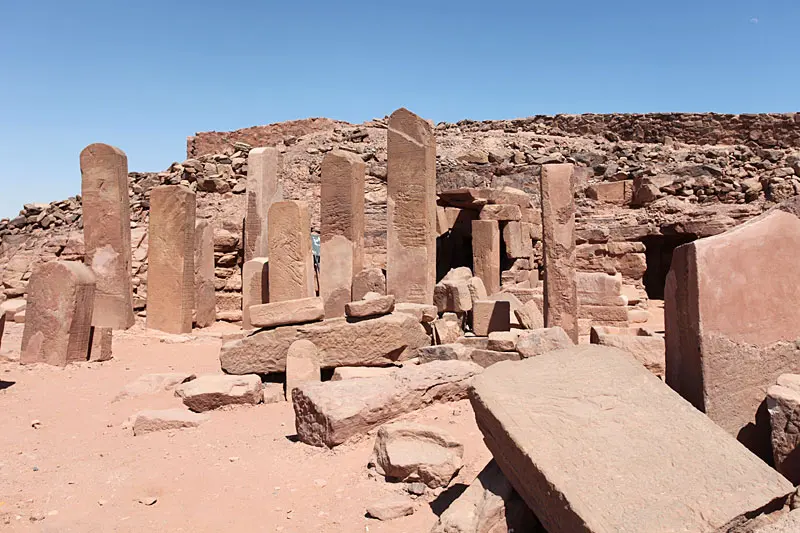
Visit essentials
A quick read before you go
- Duration
- Half-day to full-day excursion.
- Access
- Located approximately 43 km east of Abu Zenima in the South Sinai Governorate.
Overview
Serabit el-Khadim rises from the desert like a reminder of what humans will risk for beautiful things. Here, on a plateau 850 meters above the harsh Sinai landscape, ancient Egyptians built a temple to Hathor, the 'Mistress of Turquoise,' goddess of miners and desert regions. For approximately a thousand years, from the 12th through the 20th Dynasty, expeditions climbed to this remote place, extracted turquoise from the surrounding mountains, and offered the finest specimens to the goddess who protected them.
The temple grew organically, beginning as a simple rock-cut cave and expanding over centuries into a complex of porticos, chambers, halls, and shrines. Over 378 commemorative stelae line the processional routes, recording the names of pharaohs, expedition leaders, and quantities of turquoise extracted. This was not casual worship but systematic devotion, each expedition leaving its mark on walls that became a cumulative record of divine favor and royal accomplishment.
Why this place is sacred
Mining turquoise in the ancient Sinai was dangerous work. The desert climate was brutal. The journey from the Nile was long and difficult. The mines themselves posed risks of collapse, heat exhaustion, and isolation. Workers who came here needed divine protection, and they sought it from Hathor, the goddess who claimed this place.
Hathor's epithet 'Mistress of Turquoise' expressed her dominion over the precious blue-green stone that the Egyptians valued for jewelry, amulets, and ritual objects. The color evoked both sky and water in a land that had little of either. To extract turquoise from the earth was to take something from the goddess's realm. Offerings ensured her continued favor. The temple grew as expeditions added their stelae, their shrines, their gratitude for successful returns.
The site also served as a remote cult center for deified kings. The pharaoh Sneferu, builder of the first true pyramids, was worshipped here as a divine ancestor. His cult at Serabit el-Khadim, far from the Nile Valley, demonstrates the site's importance in Egyptian royal religion. Thutmose III built a 'Shrine of Kings' dedicated to Hathor, Ptah, Sopdu, and the deified Sneferu.
The Proto-Sinaitic inscriptions add the dimension of revolutionary transformation. The Semitic workers who carved these signs were doing something unprecedented. They reduced the hundreds of hieroglyphic signs to approximately thirty consonantal symbols, each representing a single sound. The ox head became 'aleph,' the house became 'beth,' the water became 'mem.' These shapes, modified over three millennia, are the letters you read today.
The inscriptions frequently dedicate themselves 'to Ba'alat,' the Lady. This Canaanite goddess was likely identified with Hathor, creating a syncretic devotion that crossed cultural boundaries. The workers worshipped in their own language but at the same shrine. The temple thus became a meeting place of religions as well as a meeting place of writing systems.
The Temple of Hathor at Serabit el-Khadim served Egyptian mining expeditions as a place of worship, protection, and commemoration. Miners offered turquoise to the goddess who presided over its extraction. Expedition leaders erected stelae recording their accomplishments and royal service. The temple also functioned as a healing sanctuary, evidenced by numerous votive offerings. The associated cult of deified kings, particularly Sneferu, connected the site to broader Egyptian royal religion.
Mining activity at Serabit el-Khadim may extend back to approximately 3500 BCE, though the temple's foundations date to the reign of Senusret I around 1971-1926 BCE. The temple expanded significantly during the 18th Dynasty under Hatshepsut and Thutmose III. Activity continued through the 20th Dynasty until approximately 1136 BCE, when Egyptian presence in the Sinai declined. The site was then abandoned until rediscovery by European explorers in the 19th century.
Flinders Petrie excavated in 1904-1905, discovering the Proto-Sinaitic inscriptions that would reveal the alphabet's origins. Alan Gardiner deciphered these inscriptions in 1916. The site was added to UNESCO's Tentative List in 1994.
Experience and orientation
The journey begins from Abu Zenima on the Sinai coast. A 4x4 vehicle is essential for the approximately 40 kilometers of unpaved track that climbs into the mountains. The landscape shifts from coastal plain to rugged sandstone terrain. The final approach reveals the plateau where the temple stands, 850 meters above sea level, overlooking the harsh beauty of the Sinai desert.
A local Bedouin guide is required for the visit. They know the routes, the history, and the location of features that might otherwise be missed. Their presence connects you to the human presence that has occupied this region for millennia.
Two paths ascend to the temple plateau. The safer route uses stairs constructed by Egypt's Supreme Council of Antiquities, beginning from the plain of el-Tih. The alternative through Wadi Serabit is more hazardous and not recommended. The climb is rated easy to intermediate, covering approximately 5 kilometers round trip with 290 meters of elevation gain.
The temple complex reveals itself gradually. Votive stelae line the processional approach, carved with images of pharaohs, gods, and hieroglyphic texts recording expedition details. Some stelae stand upright; others have fallen. The cumulative effect is of a place where human beings came repeatedly, over centuries, to record their presence and seek divine favor.
The temple itself grew organically from its rock-cut origins. The earliest sanctuary was a simple cave. Successive additions created porticos, chambers, halls, and courts. The structure does not have the monumental unity of Nile Valley temples but rather the accumulated complexity of continuous devotion.
The surrounding landscape tells the other half of the story. Galleries where ancient miners extracted turquoise dot the hillsides. The mines are visible from the temple, a constant reminder of why anyone came to this remote and difficult place. The goddess protected those who worked the mines; the mines provided the turquoise offered to the goddess.
The Proto-Sinaitic inscriptions are scattered throughout the site. Small and easily overlooked, they mark one of the most significant developments in human history. The workers who carved these signs, dedicating their efforts 'to Ba'alat,' created the technology that would eventually make you able to read this sentence.
Serabit el-Khadim sits on a sandstone plateau approximately 850 meters above sea level in the South Sinai Governorate, approximately 43 kilometers east of Abu Zenima. The Temple of Hathor occupies the center of the plateau, surrounded by ancient turquoise mines. The temple complex includes rock-cut chambers, built additions from multiple periods, processional routes lined with stelae, and shrines to various deities. Proto-Sinaitic inscriptions are found on rock faces and small objects throughout the site.
Context and lineage
The temple grew from the practical needs of mining expeditions. Working in one of the most hostile environments the Egyptians encountered, miners required divine protection. Hathor, already associated with foreign lands and mineral wealth, became the patron of this enterprise. Her epithets 'Mistress of Turquoise' and 'Lady of the Distant Land' expressed her connection to the site.
The temple began as a rock-cut cave where Hathor was first worshipped by early expeditions. As royal interest in the mines intensified, the sanctuary expanded. Each dynasty added to the structure, creating the sprawling complex that exists today. The 378 stelae documenting over eight centuries of expeditions transformed the temple into a historical archive as well as a sacred space.
The Semitic workers who developed Proto-Sinaitic script were likely Canaanite laborers or prisoners of war. They adapted Egyptian hieroglyphs using the acrophonic principle: the sign for 'ox' represented the first sound of the word for ox in their language. This allowed them to write their Semitic language with a manageable number of signs. Their inscriptions often invoke Ba'alat, 'the Lady,' probably identifying their goddess with the Egyptian Hathor.
The Temple of Hathor at Serabit el-Khadim is unique: the only temple to Hathor built outside mainland Egypt. It participated in the broader tradition of Egyptian temple architecture but developed its own organic character through a millennium of additions. The Proto-Sinaitic script invented here evolved through Phoenician, Hebrew, Aramaic, Greek, and Latin into virtually every alphabet used today. The site thus stands at the origin of a technological lineage that shaped human civilization.
Hathor
Sneferu
Senusret I
Flinders Petrie
Alan Gardiner
Traditions and practice
Mining expeditions conducted religious observances throughout their stay at Serabit el-Khadim. Upon arrival, expedition leaders would erect commemorative stelae recording the pharaoh's name, the expedition's composition, and prayers for success and divine protection. The finest turquoise specimens were offered to Hathor as acknowledgment of her dominion over the mines.
The temple also served healing functions, evidenced by votive offerings associated with medical conditions. Workers injured in the mines or suffering from desert illnesses sought divine intervention. The goddess who presided over turquoise also presided over their bodies.
The cult of deified kings added another ritual layer. Sneferu, venerated as a divine ancestor, received offerings alongside Hathor. The 'Shrine of Kings' built by Thutmose III formalized this practice, dedicating space to Hathor, Ptah, Sopdu, and the deified Sneferu.
The Semitic workers who carved Proto-Sinaitic inscriptions appear to have worshipped Ba'alat alongside or identified with Hathor. Their dedications suggest syncretic practice that bridged Egyptian and Canaanite religion.
No active religious practices occur at Serabit el-Khadim. The temple is purely an archaeological site visited by those interested in ancient history, the origins of writing, and remote desert landscapes.
Approach the site with awareness of the human effort it represents. People climbed to this remote plateau for a thousand years, labored in dangerous conditions, and sought divine protection. The stelae they left are not merely archaeological artifacts but testimonies of individual presence and devotion.
Seek out the Proto-Sinaitic inscriptions. They are small and easily overlooked, but they represent one of humanity's most significant innovations. The signs carved here by Semitic workers evolved into the letters you use daily.
Take time to appreciate the landscape. The view from the plateau across the Sinai desert helps explain why divine protection felt necessary. This is harsh, beautiful, demanding terrain.
Ancient Egyptian Religion
HistoricalSerabit el-Khadim was a major cult center for Hathor as 'Mistress of Turquoise,' the patron goddess of miners and desert regions. The site also hosted the cult of Sopdu, Lord of the Eastern Desert, and veneration of deified kings including Sneferu. The temple functioned both as a place of worship seeking divine protection and as a commemorative space where expedition leaders recorded their accomplishments.
Offering of turquoise and other precious stones to Hathor. Erection of votive stelae commemorating mining expeditions. Prayer for protection during mining operations. Worship of Hathor, Sopdu, Ptah, and deified kings. Healing rituals evidenced by votive offerings.
Semitic/Canaanite Worship
HistoricalSemitic-speaking workers, likely Canaanites, worshipped Ba'alat at this site. Many scholars believe they identified Ba'alat with the Egyptian Hathor, practicing syncretic worship. The Proto-Sinaitic inscriptions frequently contain dedications 'to Ba'alat.' These workers created the script that would evolve into modern alphabets.
Dedication of inscriptions to Ba'alat using Proto-Sinaitic script. Carving of votive inscriptions on rock faces and small objects. Syncretic worship identifying Ba'alat with Hathor.
Perspectives and open questions
Serabit el-Khadim invites engagement as archaeological site, as testimony to the intersection of labor and devotion, and as birthplace of the technology that enables you to read these words.
Scholarly perspective
Archaeologists and Egyptologists recognize Serabit el-Khadim as a major mining site and the only known temple to Hathor built outside mainland Egypt. The site's importance increased dramatically after Petrie's discovery of Proto-Sinaitic inscriptions. Alan Gardiner's 1916 decipherment identified these as the earliest known alphabetic writing, ancestral to Phoenician, Hebrew, Arabic, Greek, and Latin scripts.
Scholarly debate continues regarding the precise dating of the Proto-Sinaitic inscriptions (ranging from c. 1850-1550 BCE) and the identity of their creators, though consensus holds they were Semitic-speaking workers who adapted Egyptian hieroglyphs using the acrophonic principle. The site demonstrates the intersection of Egyptian state religion with practical industrial enterprise.
Living and traditional perspectives
For ancient Egyptians, Hathor's presence at Serabit el-Khadim was not metaphorical but real. She dwelt in the turquoise-bearing mountains and actively protected those who honored her. The elaborate temple complex, numerous votive stelae, and healing practices evidenced at the site testify to genuine belief in divine presence and intervention.
For Semitic workers, Ba'alat was similarly present, deserving dedication and worship. The site represents a meeting of religious traditions that found common ground in the worship of a protective feminine divine presence.
Alternative interpretations
Some researchers emphasize the site's role as a location where human consciousness made a quantum leap through the invention of alphabetic writing. The ability to record language with simple phonetic signs democratized literacy and preserved knowledge across generations. Others focus on the site's remote desert energy and its function as a thin place where ancient peoples felt closer to the divine.
Open questions
The precise mechanism by which Egyptian hieroglyphs were adapted into Proto-Sinaitic alphabetic script remains reconstructed rather than documented. The identity and social status of the individuals who created these inscriptions is uncertain. The exact religious relationship between Egyptian Hathor worship and Semitic Ba'alat veneration is unclear. Many Proto-Sinaitic inscriptions remain undeciphered. The reasons for the abandonment of mining and temple activities at the end of the New Kingdom are not fully understood.
Plan your visit
Access and arrival
Located approximately 43 km east of Abu Zenima in the South Sinai Governorate. 4x4 vehicle required for unpaved track. Alternative approach via Wadi Feiran and Wadi Mukattab. No public transport. Bedouin guide required. The hike to the temple uses SCA stairs from the plain of el-Tih, approximately 5 km round trip with 290 m elevation gain.
No accommodations at the site. Nearest services in Abu Zenima on the coast. Day trips from Sharm el-Sheikh or Saint Catherine are possible with advance planning.
Respectful visit
Practical desert clothing is essential. Sun protection including hat and sunscreen. Sturdy hiking shoes for uneven terrain. Warm layers for early morning and evening temperature drops.
Photography is generally permitted. Be respectful of any restrictions indicated by guides. Avoid touching or disturbing inscriptions when photographing.
Not applicable. This is an archaeological site with no active religious practice.
Must be accompanied by a local Bedouin guide. Do not touch, climb on, or disturb ancient inscriptions and structures. Do not remove any artifacts or materials. Follow guide instructions. Bring adequate water and supplies.
The site is extremely remote. Bring adequate water and supplies; there are no facilities. A local Bedouin guide is required. Security conditions in the Sinai should be verified before travel. The desert climate is extreme; sun protection is essential.
Current practical details
Address
29°02'12.0"N 0"E, Yehia St, أبو زنيمة، محافظة جنوب سيناء 8720371, Egypt
Hours, fees, and access can change — verify on the official source before you travel. Practical details last checked Jun 2026.
Location
Map loads as you approach this section.
Pilgrim reflections
A portrait of encounter, not a score
Pilgrims describe what they felt, how present they could become, and whether the place would shape a journey. There are no stars and no ranking of traditions.
No reviewed reflections yet
The first pilgrims can help describe the character of being here.
Share a reflection
Available after an account-backed “Been there.” Every reflection is reviewed before publication.
Nearby sacred places
Explore other sacred places in the region. Proximity does not establish access or travel time; check each place’s guidance.

References
Sources consulted for this page. Source categories describe the publication, not a guarantee that every claim is verified. Traditional accounts and outside interpretations may differ.
- 01Serabit el-Khadim, Sinai - Artefacts of Excavation — Griffith Institute, University of OxfordacademicAcademic resource documenting Petrie's excavation artifacts and findings
- 02Hathor Temple at Serabit el-Khadim — Brown University Joukowsky InstituteacademicAcademic analysis of temple architecture and religious significance
- 03Archaeology of Serabit el-Khadim — Beit Hathor / CULTNATacademicDetailed archaeological documentation of the site
- 04Turquoise in Ancient Egypt — The Metropolitan Museum of ArtacademicScholarly analysis of turquoise mining and use in ancient Egypt
- 05Temple of Serabit Khadem - UNESCO World Heritage Centre — UNESCOofficialOfficial UNESCO Tentative List entry
- 06Mining the History of the Alphabet at Serabit el-Khadem — Biblical Archaeology Society LibraryacademicScholarly article on Proto-Sinaitic inscriptions and alphabet origins
- 07Outside the Nile Valley: Serabit el-Khadim as a Remote Cult Centre for the Deified Kings — Ahmed Mansour, American University in CairoacademicAcademic paper on royal cult practices at the site
- 08Serabit el-Khadim, South Sinai Governorate, Egypt — Mindat.orgacademicMineralogical and geological data for the mining site
- 09Serabit el-Khadim - Wikipedia — Wikipedia contributorsacademicComprehensive overview of site history, archaeology, and Proto-Sinaitic inscriptions
- 10The temple of Hathor at Serabit el-Khadim — The Past magazineguideDetailed travel account with historical context and visitor information
- 11Proto-Sinaitic script - Wikipedia — Wikipedia contributorsacademicOverview of Proto-Sinaitic script development and significance
- 12Hathor | Ancient Egypt Online — Ancient Egypt OnlineacademicComprehensive resource on Hathor's roles and epithets
- 13Serabit Al Khadim - Lonely Planet — Lonely PlanetguidePractical visitor information
- 14Sinai: Land of Turquoise — Egypt MuseumacademicOverview of Sinai's significance in ancient Egyptian mining
Share a photo
Help visitors recognize Serabit el-Khadim. Every submission is reviewed before publication.