Red Pyramid
Egypt's first successful true pyramid—where ancient engineers finally achieved perfection after decades of experiment
Understand sacred places, explore living traditions, and learn how to engage respectfully with Pilgrim Map.
Access has not been verified. Check current local guidance before planning a visit.
Dahshur, Giza, Egypt
Read the sources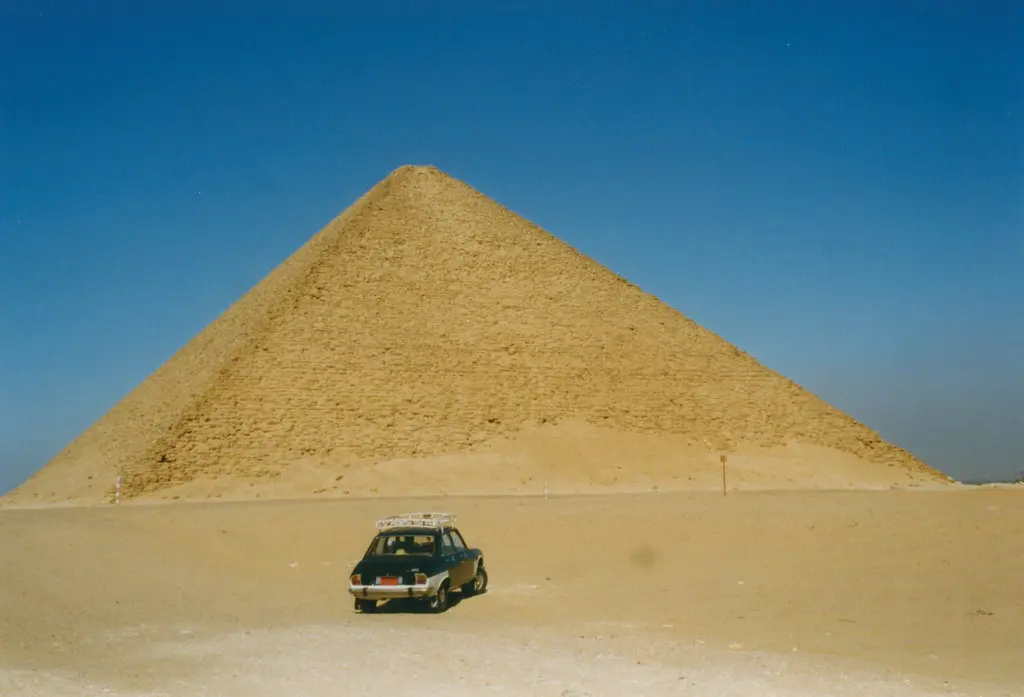
Image of Red Pyramid. Image source
Visit essentials
A quick read before you go
- Duration
- Allow 1-2 hours for the Red Pyramid, including exterior exploration and interior descent.
- Etiquette
- The Red Pyramid is an archaeological monument with no religious restrictions.
Overview
The Red Pyramid is what success looks like after failure. Built by Pharaoh Sneferu at Dahshur around 2590 BCE, it represents the culmination of decades of pyramid-building experiments—the first true pyramid to stand successfully from base to apex without collapse or compromise. Sneferu's previous projects had taught hard lessons. His pyramid at Meidum showed signs of structural instability. His Bent Pyramid at Dahshur required a dramatic mid-construction angle change from 54° to 43° to prevent catastrophe.
With the Red Pyramid, his engineers applied what they had learned, building the entire structure at the proven 43° angle. The result was a pyramid that would serve as the template for all that followed, including the Great Pyramid at Giza built by Sneferu's son Khufu. The rusty red color visible today is the local limestone core, exposed when medieval builders stripped the original white Tura limestone casing for construction in Cairo.
In its original state, this was 'The Shining Pyramid'—gleaming white against the desert sky, a beacon connecting the pharaoh with the sun god Ra. Today, visitors can descend 62 meters through the narrow entrance passage to access three interior chambers, each with corbelled ceilings engineered to withstand the immense weight above. Human remains found in 1950 may belong to Sneferu himself, though this remains unconfirmed.
Whether or not the pharaoh rests within, the Red Pyramid stands as his greatest achievement—the moment when experimentation became mastery.
Why this place is sacred
What makes the Red Pyramid a place of power is its position in the story of human achievement. This is not the most famous pyramid—that distinction belongs to Giza. This is not the most visually distinctive—that would be the Bent Pyramid a kilometer to the south. What the Red Pyramid offers is encounter with the moment when ancient engineers finally got it right. Every pyramid before this one had problems.
The Step Pyramid at Saqqara was not a true pyramid at all. The pyramid at Meidum showed structural instability. The Bent Pyramid required emergency redesign mid-construction. The Red Pyramid was different. Here, Sneferu's builders applied everything they had learned and created a structure that would stand successfully for more than four millennia. The chambers inside demonstrate this mastery most clearly.
Corbelled ceilings—stone blocks stepping gradually inward—distribute the pyramid's immense weight without requiring the impossible: a flat ceiling that could somehow resist two million tons of pressure. These rooms have no cracks. The engineering worked. The 62-meter descent into the pyramid forces physical engagement with what the builders created. You crouch through passages designed not for comfort but for function, then emerge into chambers whose ceilings soar 12 to 15 meters overhead.
The contrast between the confining passages and the vast interior spaces creates its own meditation on the builder's intentions. Dahshur itself contributes to the experience. With far fewer visitors than Giza or even Saqqara, the Red Pyramid offers time and space for actual contemplation. You can stand inside chambers that may have held the body of Sneferu himself without the crowds and noise that characterize more famous sites.
The Red Pyramid was designed as the eternal dwelling place for Pharaoh Sneferu, founder of the Fourth Dynasty. Like all royal pyramids, it served as a vehicle for the pharaoh's transformation from mortal king to immortal deity—a place where his ka (life force) could receive offerings and sustenance for eternity. The ancient name 'Sneferu Shines' captured both its gleaming white appearance and its function as a beacon connecting earth and sky, the pharaoh and the sun god Ra.
The pyramid complex originally included a mortuary temple on the eastern face where priests would perform daily rituals and make offerings to the deceased king.
The Red Pyramid was actively used for royal mortuary cult during and after Sneferu's reign, though the duration of this worship remains unknown. At some point in antiquity, the pyramid was entered and its contents removed—the burial chamber floor bears evidence of disturbance, and the walls are blackened with soot from unknown causes.
During the Middle Ages, the white Tura limestone casing was systematically stripped for building projects in Cairo, exposing the red limestone core that gives the pyramid its modern name. In 1950, human remains were discovered in the entrance passage—possibly Sneferu himself, though the identification remains unconfirmed. The German Archaeological Institute has conducted major excavations since 1982. Today the pyramid functions as an archaeological monument within the UNESCO World Heritage Site, with full interior access for visitors.
Experience and orientation
The Red Pyramid reveals itself gradually. From a distance, its most striking feature is its color—rusty red limestone instead of the golden-beige typical of Egyptian pyramids. This is the exposed core, visible only because medieval builders stripped the original white casing for construction elsewhere. What you see is not what the ancients saw. They saw a gleaming white monument that earned the name 'Sneferu Shines.' The pyramid's profile is noticeably different from Giza's famous monuments.
The 43° angle gives it a squatter appearance—less dramatic than the Great Pyramid's 51°, but proven stable through experience. This is the angle that worked when steeper approaches failed. The entrance lies 28 meters up the northern face, reached by a modern metal staircase. After presenting your ticket, you enter the descending passage. The passage is 62 meters long, just over a meter tall, and just over a meter wide. You will crouch. You will bend.
The descent angle of 27° means you are walking down into the heart of two million tons of stone. The passage is not designed for comfort. It was designed to provide access to chambers meant to last forever. At the bottom, space opens dramatically. The first antechamber measures roughly 3.6 by 8.4 meters with a corbelled ceiling rising 12 meters overhead. Stone blocks step inward in 11 layers, distributing weight that would crush a flat ceiling. There are no cracks.
The second antechamber is nearly identical. A short passage leads to the burial chamber itself, slightly larger, with a corbelled ceiling in 14 layers rising 15 meters. The ceiling here is blackened with soot—from ancient torches, tomb robbers, or some other cause now unknown. The floor is rough and sunken, evidence of disturbance in antiquity. Standing in these chambers, you are surrounded by successful engineering. Every decision that went into this pyramid—the angle, the construction method, the corbelled ceilings—worked.
After the struggles at Meidum and the compromise at the Bent Pyramid, Sneferu's builders created something that would last more than four thousand years. Many visitors report a strong ammonia smell from bat guano in the chambers. This is part of the experience—the pyramid remains an active ecosystem, home to creatures that have found refuge in spaces designed for pharaohs.
Most visitors approach the Red Pyramid as part of a Dahshur day trip, combining it with the Bent Pyramid one kilometer to the south. The Red Pyramid generally receives more visitors because of its accessible interior, so consider starting at the Bent Pyramid for a quieter experience, then ending at the Red Pyramid. After exiting, walk to the pyramid's eastern face to see the reconstructed pyramidion (capstone) on display—though scholars debate whether these fragments actually belonged to this pyramid.
The experience is best understood in context: visit Saqqara first to see where pyramid building began with Djoser's Step Pyramid, then come to Dahshur to see both Sneferu's struggle (Bent Pyramid) and triumph (Red Pyramid). This sequence makes the achievement visible.
Context and lineage
Sneferu came to the throne as the first king of the Fourth Dynasty, inheriting both the ambition and the technology of his Third Dynasty predecessors. His building program would consume more stone than any other pharaoh's, producing three or possibly four pyramids in the course of his reign. The first, at Meidum, was originally a step pyramid that Sneferu later attempted to convert to a true pyramid.
This conversion appears to have caused structural problems—portions of the outer casing collapsed, leaving the peculiar tower-like structure visible today. The second, the Bent Pyramid at Dahshur, began at an ambitious 54° angle but developed problems partway through construction. At the 47-meter mark, the builders made an extraordinary decision: they reduced the angle to 43° and completed the pyramid at this shallower slope. The result was a visually distinctive structure, but not the perfect true pyramid the builders had sought.
The Red Pyramid was Sneferu's third attempt. Using the 43° angle proven stable at the Bent Pyramid's upper section, his builders constructed the entire pyramid at this consistent slope. The gamble paid off. The Red Pyramid stood without problems—the first true smooth-sided pyramid to do so. This success established the engineering knowledge that Sneferu's son Khufu would apply to build the Great Pyramid at Giza.
The Red Pyramid stands at the turning point in pyramid evolution. Understanding its significance requires understanding what came before and what followed. Imhotep built the first pyramid for Djoser at Saqqara around 2670 BCE—a step pyramid, not a true pyramid, rising in six distinct tiers. For roughly seventy years, this stepped form defined royal tombs. Sneferu changed everything. His pyramid at Meidum attempted the transition from step pyramid to true smooth-sided pyramid, but structural problems resulted.
His Bent Pyramid at Dahshur came closer, but required mid-construction compromise. The Red Pyramid was where mastery was achieved—the first true pyramid to stand successfully from base to apex. The angle chosen, 43°22', was conservative by later standards. Sneferu's son Khufu would build the Great Pyramid at 51°50', confident in knowledge his father's struggles had established. Khafre and Menkaure followed with their own pyramids at Giza, all building on what Sneferu had proven at Dahshur.
The Red Pyramid is therefore not just a monument to Sneferu—it is the origin point of the true pyramid form that would define Egyptian royal burial for centuries.
Sneferu (Snofru)
Pharaoh and builder
Traditions and practice
The Red Pyramid complex originally included a mortuary temple on the eastern face where priests performed daily rituals and made offerings to the deceased pharaoh. These ceremonies sustained Sneferu's ka (life force) in the afterlife, ensuring his continued existence as an immortal deity. The three interior chambers likely served specific funerary purposes, though their exact ritual functions remain debated.
No sarcophagus has been found in any chamber, leading to uncertainty about whether Sneferu was actually buried here or whether the burial chamber remains undiscovered. The mortuary temple exists only in fragmentary form today.
No religious practices take place at the Red Pyramid today. The site operates as an archaeological monument within the Dahshur necropolis, part of the UNESCO World Heritage Site that stretches from Giza to Dahshur. Visitors explore the pyramid as a historical and engineering achievement rather than a place of active worship. The German Archaeological Institute has conducted ongoing research since 1982.
Visitors seeking meaningful engagement with the Red Pyramid should consider the physical journey itself as practice. The descent through the 62-meter passage—crouching, bending, moving into darkness—creates embodied encounter with what the builders created. Take time in the chambers. Let the corbelled ceilings demonstrate their achievement: 4,600 years of holding without cracks. The return ascent, climbing back toward daylight, completes the journey.
The recommended sequence for the day—Saqqara's Step Pyramid, then Dahshur's Bent and Red Pyramids—transforms individual monuments into a story of human striving and achievement.
Ancient Egyptian Religion
HistoricalThe Red Pyramid served as the eternal dwelling place of Pharaoh Sneferu, designed to facilitate his transformation from mortal king to immortal deity. The ancient name 'Sneferu Shines' reflected both its gleaming white appearance and its function as a beacon connecting earth and sky. The pyramid was conceived as a machine for eternity—a structure that would house and protect the pharaoh's ka (life force) forever, ensuring his continued existence among the gods. The pyramid's success at standing without the structural problems that plagued earlier projects meant Sneferu's eternal house would last.
The pyramid complex originally included a mortuary temple on the eastern face where priests performed daily rituals of offering and sustenance for the deceased pharaoh. These ceremonies were believed essential to Sneferu's continued existence in the afterlife. The three interior chambers with corbelled ceilings served funerary purposes, though their exact ritual functions remain debated. The care taken in construction—the precise corbelling, the aligned chambers, the careful finishing—reflected the sacred importance of creating a perfect eternal dwelling.
Perspectives and open questions
The Red Pyramid generates less interpretive controversy than many Egyptian monuments—scholars largely agree on its construction, purpose, and significance. The primary debates concern details: how long construction took, whether the reconstructed pyramidion actually belongs to this pyramid, and whether the human remains found in 1950 belong to Sneferu.
Scholarly perspective
Egyptologists agree the Red Pyramid was built by Sneferu as the culmination of his pyramid-building program and represents Egypt's first successful true smooth-sided pyramid. The 43°22' angle was deliberately chosen based on experience with the Bent Pyramid's upper section—a conservative choice that prioritized stability over dramatic profile. Construction estimates range from 10-11 years (Rolf Krauss) to 17 years (Rainer Stadelmann), based on different interpretations of the same quarry marks found within the structure.
The German Archaeological Institute has conducted major excavations since 1982 under Stadelmann's direction. The reconstructed pyramidion on display near the eastern face presents a scholarly puzzle: its angle differs from the pyramid's 43° slope, leading some researchers to question whether these fragments actually belonged to the Red Pyramid or to some other monument. Human remains found in 1950 were examined and determined consistent with Fourth Dynasty mummification techniques, but positive identification as Sneferu has not been achieved.
Living and traditional perspectives
Ancient Egyptian sources identify Sneferu as the builder and provide the name 'Sneferu Shines' for this pyramid—a name that captured its original appearance when clad in white Tura limestone. Later Egyptian texts remember Sneferu as a benevolent ruler whose reign represented a golden age.
The pyramid's role as Sneferu's eternal dwelling was paramount in ancient understanding—the corbelled chambers were designed not merely to last centuries but to endure for eternity, housing and protecting the pharaoh's ka as he joined the gods.
Alternative interpretations
Some alternative researchers propose hidden chambers may exist within the pyramid, noting that Sneferu's confirmed burial remains have never been positively identified and that the burial chamber shows signs of ancient disturbance. The pyramidion's different angle has led some to suggest intentional encoding of mathematical or astronomical information rather than simple construction error. These interpretations lack support from mainstream Egyptology but reflect ongoing public fascination with pyramid mysteries.
The soot blackening in the burial chamber has also generated alternative theories ranging from ancient torch-lit rituals to attempts at destroying evidence.
Open questions
Several genuine mysteries surround the Red Pyramid. Was Sneferu actually buried here? Human remains found in 1950 are consistent with Fourth Dynasty dating but have not been positively identified. If Sneferu lies elsewhere, where? Some scholars have suggested his body may rest in a yet-undiscovered chamber within this pyramid or in one of his other monuments. Why does the pyramidion's angle not match the pyramid?
Was it intended for a different structure, or does its presence represent something scholars do not yet understand? What caused the soot blackening in the burial chamber—ancient tomb robbers with torches, later visitors, or something else entirely? And what was the original function of the three separate chambers? Other pyramids typically have simpler internal arrangements.
Plan your visit
Access and arrival
Most visitors stay in Cairo or Giza and visit Dahshur as a day trip. Hotels near the Giza pyramids (Marriott Mena House, Le Méridien Pyramids) offer convenient bases for exploring all the pyramid fields. Dahshur itself has no tourist accommodation.
Respectful visit
No religious dress requirements apply. Practical clothing is essential: lightweight fabrics for desert heat, sturdy shoes for climbing the exterior staircase and navigating the interior passages, and clothing that allows crouching and bending comfortably. The interior can be warm and humid despite the desert context. Sun protection (hat, sunscreen) is important for the exterior visit.
Photography is generally permitted throughout the site, including interior chambers. Flash photography is typically allowed. Professional equipment or commercial photography may require special permits from Egyptian authorities. The interior lighting is limited; visitors often rely on phone flashlights or headlamps.
Not applicable. No active religious tradition at this site requires or accepts offerings.
Some areas of the complex may be restricted for conservation or ongoing archaeological work. The interior descent is not accessible for those with mobility limitations. The passage requires approximately 15-20 minutes of sustained crouching each way. Those with claustrophobia should carefully evaluate whether interior access is appropriate for them.
The 62-meter descent through a narrow passage is physically demanding and not suitable for everyone. The passage is approximately 1 meter tall and 1.2 meters wide, requiring sustained crouching or bending. Those with claustrophobia should carefully consider whether interior access is appropriate. The burial chamber floor is rough and uneven. Many visitors report strong ammonia smell from bat guano in the chambers. The ascent back to the surface is more physically challenging than the descent.
Current practical details
Address
Red Pyramid, Al Giza Desert, Giza Governorate 3300001, Egypt
Hours
Hours, fees, and access can change — verify on the official source before you travel. Practical details last checked Jun 2026.
Location
Map loads as you approach this section.
Pilgrim reflections
A portrait of encounter, not a score
Pilgrims describe what they felt, how present they could become, and whether the place would shape a journey. There are no stars and no ranking of traditions.
No reviewed reflections yet
The first pilgrims can help describe the character of being here.
Share a reflection
Available after an account-backed “Been there.” Every reflection is reviewed before publication.
Watch deeper
Films, episodes, and recorded talks for visitors who want more context before or after a visit. Speculative and alternative-history entries are labelled as perspectives, not as sources for established claims.
Streaming episode
Alternative-history media
Ancient Apocalypse: Legacy of the Sages
Graham Hancock's Giza/Sphinx-focused episode in Ancient Apocalypse season 1.
Perspective note: Highly contested by mainstream archaeology; included as a perspective, not as evidence.
Open on NetflixVideo resource
Alternative-history media
The Revelation of the Pyramids (La Revelation des Pyramides)
Influential 2010 French documentary on pyramid geometry, alignments, and ancient-site pattern claims.
Perspective note: Controversial and not a source for established archaeological claims.
Open on JustWatch MegalithomaniaUK / YouTube
Alternative-history media
Revelations Beneath Khafre's Pyramid FULL UPDATE
Gaia panel discussion connected to Ancient Civilizations and claims beneath Khafre's Pyramid.
Perspective note: Very speculative; pair with mainstream context before treating any claim as factual.
Open on MegalithomaniaUK / YouTubeNearby sacred places
Explore other sacred places in the region. Proximity does not establish access or travel time; check each place’s guidance.


References
Sources consulted for this page. Source categories describe the publication, not a guarantee that every claim is verified. Traditional accounts and outside interpretations may differ.
- 01North Pyramid | monument, Dahshūr, Egypt — Encyclopaedia BritannicaencyclopediaAuthoritative reference on the pyramid's significance
- 02Snefru | 1st Pharaoh of 4th Dynasty, Builder of Pyramids — Encyclopaedia BritannicaencyclopediaAuthoritative reference on Sneferu and his building programs
- 03Memphis and its Necropolis – the Pyramid Fields from Giza to Dahshur — UNESCO World Heritage CentreofficialOfficial UNESCO documentation for World Heritage listing
- 04Red Pyramid — WikipediaencyclopediaComprehensive overview with dimensions, construction history, and archaeological discoveries
- 05Dashur: Red Pyramid of Sneferu — Ancient Egypt OnlineacademicDetailed architectural and archaeological analysis
- 06Dahshur Pyramids: Complete Guide to Visiting the Red & Bent Pyramids (2025) — Ruins and RemnantsacademicRecent visitor information and practical details
- 07The Red Pyramid of Sneferu at Dahshur — Encounter TravelacademicVisitor experience and interior description
- 08Inside the Red Pyramid of Sneferu — Historical EveacademicInterior exploration details and chamber descriptions
Share a photo
Help visitors recognize Red Pyramid. Every submission is reviewed before publication.