Sedona, Arizona
Where ancient red rock formations hold the memory of First Woman and draw seekers to spiral energy centers
Sedona, Arizona, United States

Visit essentials
Before you go
- Access
- Sedona lies approximately two hours north of Phoenix by car, an easy drive through increasingly…
- Address
- Sedona, AZ 86336, USA
- Duration
- Allow two to four days to meaningfully engage Sedona's sacred sites.
- Etiquette
- Sedona's sacred sites call for the same reverent attention you would bring to any place of…
Overview
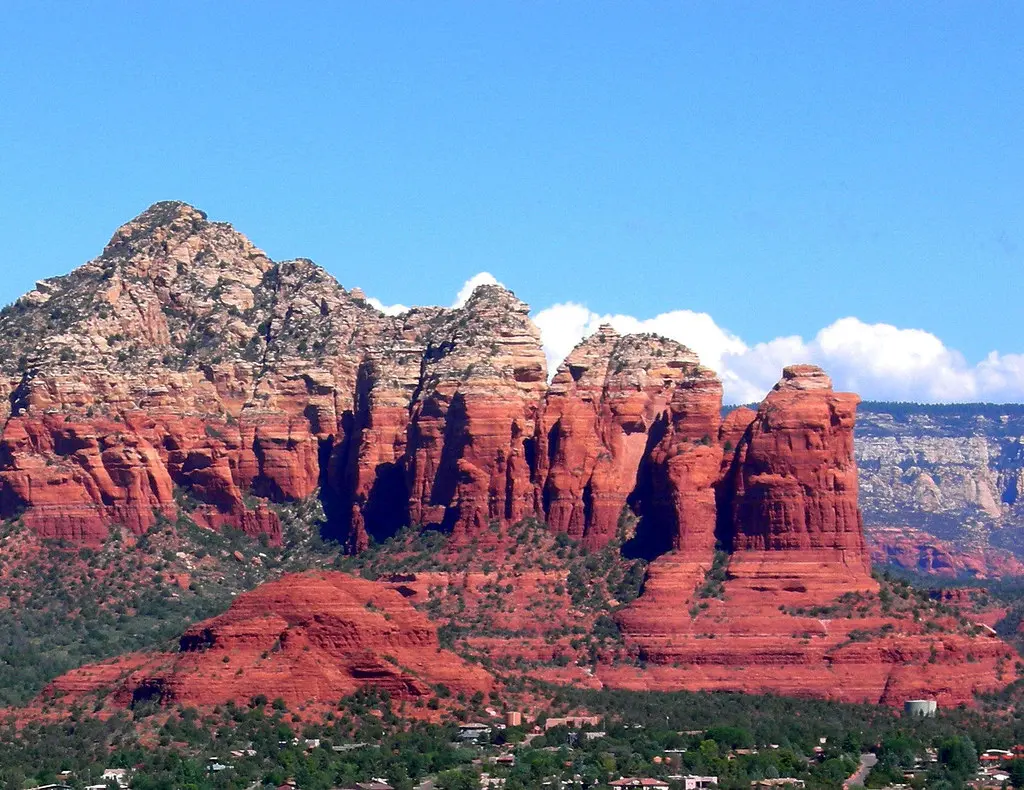
Sedona resists easy explanation. Red formations, colored by iron oxide across more than three hundred million years, rise from the high desert. Indigenous peoples have recognized this land as sacred since time beyond memory. For the Yavapai-Apache, Boynton Canyon holds their creation story, where First Woman bore their nation's ancestors. The Hopi identified crossings of the earth's energetic meridians here, called paatuwvota, or power spots.
A new wave of seekers arrived in the 1980s, drawn by reports of concentrated energy vortexes said to amplify meditation, accelerate healing, and open expanded awareness. Some 3.5 million people now visit annually, many seeking these reported phenomena. Experiences vary: tingling, emotional release, profound stillness, or simply humility before geological time in the striated cliffs.
Whether approached through Indigenous cosmology, New Age metaphysics, or geological wonder, Sedona invites pause without collapsing these distinct understandings.
Why this place is sacred
The concept of thin places—locations where the boundary between ordinary and sacred reality grows permeable—finds vivid expression in Sedona's red rock landscape. Multiple factors converge to create this quality. The iron-rich formations, created from sediments deposited when this land lay at the edge of an ancient sea, contain hematite that some researchers believe may contribute to the unusual electromagnetic readings documented at several sites.
A 2016 study measured subtle but consistent anomalies at Bell Rock and Cathedral Rock, though the relationship between these readings and reported experiences remains unexplained.
More significant may be the convergence of sacred recognition across traditions. The Yavapai-Apache, whose creation story places First Woman at Boynton Canyon, understand the land not as sacred in the sense of set apart, but as inseparable from their very being. As one Yavapai-Apache citizen expressed it: 'We are the land, and the land is us.' The Hopi recognized paatuwvota here—power spots where earth energies concentrate.
The Sinagua, who built cliff dwellings throughout the region from 700 to 1400 AD, clearly chose these specific locations for reasons beyond mere practicality.
When Page Bryant, a metaphysical practitioner trained under Chippewa medicine man Sun Bear, mapped Sedona's vortexes in the early 1980s, she was articulating in modern language what indigenous peoples had long known: certain places here hold unusual potency. The 1987 Harmonic Convergence brought thousands of seekers, establishing Sedona as a center for contemporary spiritual exploration.
What draws people now is what has drawn people for millennia—a felt sense that the ordinary rules relax here, that perception deepens, that something becomes available that remains hidden elsewhere.
For the Yavapai-Apache, these lands served as the literal birthplace of their people and the ongoing foundation of their identity, language, and ceremonies. The Sinagua built communities at locations like Palatki and Honanki, leaving extensive rock art that suggests sophisticated ceremonial life. The Hopi maintained pilgrimage connections to ancestral sites throughout the region.
The forced removal of the Yavapai-Apache in 1875 severed tribal connection to sacred lands, though ceremonies continue and cultural revival efforts are reconnecting younger generations with ancestral sites. The modern town, incorporated only in 1988, developed primarily around spiritual tourism and the vortex phenomenon. Today, the challenge lies in honoring indigenous sacred significance while millions of visitors seek their own encounters with the land's power.
Experience and orientation
The experience of Sedona's energy varies widely among visitors, yet certain themes recur with striking consistency. Many report physical sensations: tingling in the hands or scalp, a sense of warmth rising through the body, pressure at the forehead or heart. Others describe emotional effects—unexpected tears, the surfacing of old grief, or conversely, an inexplicable lightness and joy. Mental clarity features prominently in reports, as does the sense of receiving insight or guidance during meditation.
At Cathedral Rock, often classified as carrying feminine or receptive energy, visitors frequently report a deep calming effect, a drawing inward that supports introspection and emotional processing. Bell Rock's balanced energy reportedly supports grounding and centering. Airport Mesa, with its masculine or projective quality, draws those seeking clarity for decisions or energy for new beginnings. Boynton Canyon combines multiple energetic qualities and carries the additional weight of Yavapai-Apache sacred significance.
Skeptics attribute these experiences to expectation effects, the powerful influence of dramatic natural beauty, or the simple benefit of stepping outside ordinary routine. Practitioners point to the measurable electromagnetic variations and the consistency of reports across diverse populations. The land itself offers no resolution to this debate. What can be said with certainty is that millions of people over thousands of years have recognized something distinctive about this place, and that many who come seeking transformation report finding it.
Approach Sedona's vortex sites with openness rather than expectation. Allow time—rushing from site to site diminishes the possibility of genuine encounter. Choose one or two locations that call to you rather than attempting to check off a list. Arrive early or late in the day when crowds thin and the light transforms the red rocks into living flame. Sit in stillness. Notice what arises in body and psyche without grasping for particular experiences.
Remember that you walk on land sacred to peoples whose connection predates and may outlast modern understandings. Let that awareness inform your presence.
Context and lineage
The Yavapai-Apache tell of a great flood that covered the world. When the waters receded, First Woman made her home in Boynton Canyon, and there she bore the children who became the Yavapai-Apache people. This is not metaphor or distant myth—it is living connection to specific land, a bond that tribal members describe as identity itself.
Both the Yavapai and Apache also hold creation stories connected to Montezuma Well, whose dark waters figure in their accounts of emergence into this world. These narratives establish Sedona not as a place that became sacred through human designation, but as inherently sacred—the very ground from which the people arose.
The lineage of sacred recognition in Sedona passes through multiple streams. Archaeologists document continuous human presence from at least eleven thousand years ago, when nomadic peoples hunted Ice Age animals across this landscape. The Sinagua civilization, emerging around 700 AD, built cliff dwellings at Palatki, Honanki, and numerous other sites, creating rock art that continues to speak across centuries.
When the Sinagua departed around 1400 AD—for reasons scholars still debate—the Yavapai-Apache became the primary inhabitants, maintaining ceremonial connections to the land until the devastating forced march of 1875 removed them from their homeland. The modern spiritual lineage began with Page Bryant's mapping of the vortexes and accelerated through the 1987 Harmonic Convergence, establishing Sedona as a global destination for seekers from diverse backgrounds.
First Woman
Yavapai-Apache ancestral mother who lived in Boynton Canyon and bore the ancestors of the nation
Page Bryant
Metaphysical practitioner who mapped Sedona's vortexes in the early 1980s, introducing terminology and concepts that shaped modern spiritual tourism
Sun Bear
Chippewa medicine man who trained Page Bryant and whose teachings influenced the metaphysical understanding of Sedona's energies
Thomasene Cardona
Former Yavapai-Apache Tribal Councilwoman leading the Yavapai Land and Cultural Collective to reconnect tribal members with ancestral sacred sites
Traditions and practice
The Yavapai-Apache Nation maintains ceremonial connections to their sacred sites, including annual sunrise blessing ceremonies at Boynton Canyon on the last Saturday of February. Exodus Day commemorations honor those who endured the forced removal of 1875, with community members walking from Cliff Castle to the Cultural Resource Center while runners carry prayers from the San Carlos Apache Reservation. These ceremonies are tribal events, not open to tourists, but their continuation represents the living sacred tradition of these lands.
Historically, the Sinagua conducted birthing ceremonies at a cave along Oak Creek Canyon, now known as the Birthing Cave, where pregnant women labored in safety surrounded by the canyon's protective energy.
Modern spiritual practices in Sedona center on engagement with the vortex sites through meditation, yoga, breathwork, and energy work. Guided vortex tours offer structured introduction to the sites, often incorporating sound healing with crystal bowls or drums, movement practices, and guided meditation. Retreat centers throughout the area offer intensive programs ranging from single days to extended immersions, including shamanic journeying, past life regression, psychic development, and various healing modalities.
The night sky, relatively free of light pollution, draws those interested in stargazing and, for some, UFO watching.
For those new to Sedona's energies, begin with simple presence at one of the four main vortex sites. Cathedral Rock offers accessible energy that supports quiet introspection—consider sunrise or sunset for optimal conditions. Find a comfortable seat with good contact to the rock and simply sit, allowing twenty to thirty minutes for the experience to unfold. Notice sensations in the body, thoughts that arise, emotional shifts. No special technique is required; receptivity and patience suffice.
Those with established meditation practices may find their usual methods deepened. Walking meditation on the trails offers another approach, allowing the red rock landscape to work on the senses while maintaining contemplative awareness.
Yavapai-Apache
ActiveSedona represents the ancestral homeland of the Yavapai-Apache people, with Boynton Canyon holding their creation narrative as the place where First Woman bore the ancestral generations. The land is not sacred in the sense of set apart—it is inseparable from identity, language, and being itself.
Annual sunrise blessing ceremonies at Boynton Canyon, Exodus Day commemorations, ongoing cultural revival through the Yavapai Land and Cultural Collective, pilgrimage and ceremonial connections maintained despite loss of territorial control
Hopi
ActiveThe Hopi recognize Sedona as a location where earth's energetic meridians cross, creating what they call paatuwvota—power spots. The Sinagua people who built cliff dwellings throughout the region are understood as Hopi ancestors.
Pilgrimage connections to ancestral sites, ceremonial relationships maintained with discretion
New Age Spirituality
ActiveSince Page Bryant mapped the vortexes in the early 1980s, Sedona has served as a major center for New Age spiritual practice, drawing millions of seekers to its concentrated energy sites.
Vortex meditation, sound healing, breathwork, shamanic journeying, yoga retreats, psychic readings, past life regression, energy healing in numerous modalities, UFO watching, stargazing
Sinagua
HistoricalThe Sinagua civilization flourished in the Verde Valley for nearly eight hundred years, from approximately 700 to 1400 AD. They built sophisticated cliff dwellings at sites including Palatki and Honanki, and created extensive rock art that continues to speak across centuries.
Historical practices included agricultural ceremonies, rock art creation as apparent spiritual and communicative practice, and birthing ceremonies at specific cave sites. Direct ceremonial practice ended with Sinagua departure from the region around 1400 AD.
Perspectives and open questions
Sedona's sacred significance can be understood through multiple lenses, each offering partial truth without claiming the whole. Indigenous perspectives root sacredness in creation stories and ongoing ceremonial relationship. New Age interpretations focus on measurable and felt energy phenomena. Scientific analysis documents geological history and electromagnetic anomalies without reaching spiritual conclusions. The land itself holds all these perspectives without contradiction.
Scholarly perspective
Archaeological evidence confirms continuous human presence in the Sedona region spanning at least eleven thousand years. The Sinagua civilization, which flourished from approximately 700 to 1400 AD, left extensive material evidence including cliff dwellings at Palatki, Honanki, and dozens of smaller sites, along with rock art panels that continue to be studied. Geologically, the formations date to the Permian Period, some three hundred million years ago, when sediments accumulated in a basin at the edge of the supercontinent Pangaea.
Iron oxide (hematite) within the sandstone creates the distinctive red coloration through oxidation—essentially, the rocks rust. The formations visible today resulted from millions of years of uplift and erosion, exposing layer upon layer of ancient seabed.
Living and traditional perspectives
For the Yavapai-Apache, academic language fails to capture what Sedona represents. This is not 'sacred land' in the sense of land designated sacred by human beings—it is the land from which the people themselves emerged, inseparable from identity, language, and ongoing existence. Boynton Canyon holds the story of First Woman; Montezuma Well holds creation narratives. The forced removal of 1875 did not sever this connection but deepened the wound that current cultural revival efforts seek to heal.
When Yavapai-Apache gather for sunrise blessing ceremonies, they do not worship the land—they remember who they are.
Alternative interpretations
New Age interpretations, emerging from Page Bryant's mapping of vortexes in the early 1980s, understand Sedona as a location where earth energy concentrates at specific points. These vortexes are typically classified by energy type: masculine or electric (energizing, projective), feminine or magnetic (calming, receptive), or balanced. Some practitioners understand these as intersections of ley lines—hypothetical energy pathways that some believe connect sacred sites worldwide.
A 2016 study using specialized equipment reportedly measured subtle electromagnetic anomalies at Bell Rock and Cathedral Rock, lending some empirical support to experiential reports, though the relationship between these readings and human experience remains unexplained by conventional science.
Open questions
Significant mysteries remain at Sedona. Why this particular location has been recognized as spiritually significant across such different cultures and time periods—indigenous, New Age, and countless individual visitors—resists simple explanation. The electromagnetic anomalies documented at vortex sites have not been fully characterized or understood. The meaning and purpose of Sinagua rock art, some dating back four thousand years, remains partially undeciphered.
And the fundamental question of what, exactly, millions of visitors experience at these sites—whether understood as earth energy, divine presence, psychological phenomenon, or something else entirely—remains productively open.
Plan your visit
Access and arrival
Sedona lies approximately two hours north of Phoenix by car, an easy drive through increasingly dramatic scenery. Phoenix Sky Harbor International Airport provides the closest major air access. The town itself is walkable in its central areas, but reaching the vortex sites requires vehicle access. Jeep tours offer transportation along with guided interpretation for those without cars.
Sedona offers accommodations ranging from luxury resorts like Enchantment Resort (located at Boynton Canyon) to modest motels and retreat centers. Several facilities specifically serve spiritual seekers, offering packages that combine lodging with guided vortex experiences, healing sessions, and related programs. Camping available at nearby national forest campgrounds for those who wish to sleep close to the land.
Respectful visit
Comfortable hiking attire appropriate to the terrain and season. Sun protection is essential—hat, sunscreen, and adequate water. Closed-toe shoes recommended for most vortex site access. No spiritual dress requirements exist, though some find that simple, natural-fiber clothing supports their practice.
Photography is generally permitted at vortex sites and on trails throughout the region. Exercise discretion around others engaged in spiritual practice—asking permission before photographing people demonstrates basic courtesy. Should you encounter Yavapai-Apache ceremonies, do not photograph. At archaeological sites, remain within designated viewing areas.
Leave no trace principles apply. If you wish to make offerings, prayers or silent dedications leave no physical residue. Avoid leaving crystals, flowers, or other objects at the sites—what feels like sacred gesture becomes litter when multiplied by millions of visitors.
Red Rock Pass required for parking at most trailheads. Archaeological sites protected by federal law—do not enter structures, touch rock art, or remove any objects. Respect private property boundaries, including resort areas adjacent to some sites. Boynton Canyon trail passes through both national forest and resort property. Do not disturb any indigenous ceremonies encountered.
The dramatic beauty and concentrated energy of Sedona's sites can intensify whatever psychological material is ready to surface. Those carrying significant unprocessed grief, trauma, or mental health challenges should approach with appropriate support rather than assuming the vortex energy will provide easy resolution. The intensity some experience—particularly at Boynton Canyon—may feel destabilizing rather than healing without adequate grounding practices.
Respect for indigenous sacred significance requires acknowledging that you visit lands taken from their original stewards; consider how this awareness might inform your practice.
Current practical details
Address
Sedona, AZ 86336, USA
Hours, fees, and access can change — verify on the official source before you travel. Practical details last checked Jun 2026.
Location
Map loads as you approach this section.
Pilgrim reflections
A portrait of encounter, not a score
Pilgrims describe what they felt, how present they could become, and whether the place would shape a journey. There are no stars and no ranking of traditions.
No reviewed reflections yet
The first pilgrims can help describe the character of being here.
Share a reflection
Available after an account-backed “Been there.” Every reflection is reviewed before publication.
Nearby sacred places
Explore other sacred places in the region. Proximity does not establish access or travel time; check each place’s guidance.


References
Sources consulted for this page. Source categories describe the publication, not a guarantee that every claim is verified. Traditional accounts and outside interpretations may differ.
- 01Reading The Landscape from a Yavapai-Apache Perspective — Friends of the Forest SedonaSource contextIndigenous perspective on sacred lands
- 02Ultimate Sedona Vortex Guide — Visit SedonaofficialOfficial tourism bureau with comprehensive vortex information
- 03Examining the origins of Sedona's 'sacred' land — Sedona Red Rock NewsnewsLocal journalism on indigenous perspectives
- 04History and Legends of Sedona Vortexes — Sedona Soul AdventuresspiritualNew Age perspective and vortex history
- 05Exploring the Sedona Native American Heritage — The Sanctuary at Sacred MesaguideOverview of indigenous history
- 06The Rocks in Sedona Are Red Because of Iron Oxide — Solid As RocksSource contextGeological explanation of red rock formations
- 07Ancient Trails — Visit SedonaofficialInformation on archaeological sites
- 08Thomasene Cardona takes Yavapai back to their roots — Sedona Red Rock NewsnewsRecent indigenous cultural revival efforts
Photo gallery
3 curated photos
Share a photo
Help visitors recognize Sedona, Arizona. Every submission is reviewed before publication.