Mt. Humphreys, Arizona
Arizona's highest peak, sacred western boundary mountain for thirteen Indigenous nations
Flagstaff, Arizona, United States
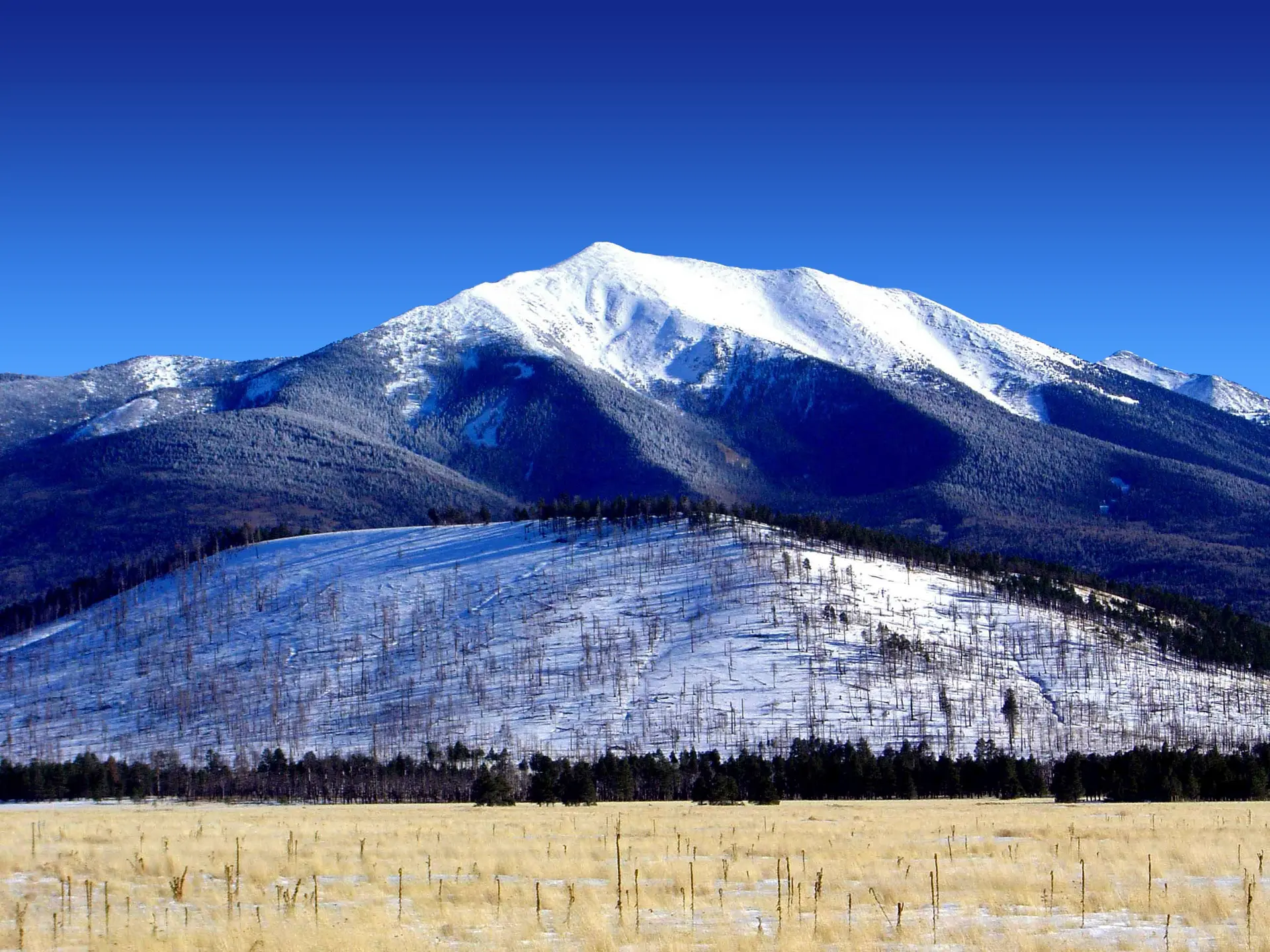
Image of Mt. Humphreys, Arizona. Image source · CC-BY-SA-2.0
Visit essentials
Before you go
- Address
- Humphreys Peak, Arizona 86001, USA
- Duration
- 6-8 hours allowing for altitude adjustment and summit contemplation
- Etiquette
- This is sacred land to thirteen nations.
Overview
The snow-capped San Francisco Peaks dominate a hundred miles of Colorado Plateau horizon. Their highest volcanic remnant, 12,637-foot Humphreys Peak, is Arizona's apex, visible from the Grand Canyon rim and Hopi mesas. Its English name honors a nineteenth-century Army general, but Indigenous names and relationships precede surveyors by thousands of years.
The Navajo call it Dook'o'oosliid, 'its summit never melts,' one of four sacred mountains bounding Dinetah, the Navajo homeland. First Man placed it at the western edge, secured it with a sunbeam, filled it with abalone, and covered it in yellow clouds and evening twilight. For the Hopi, Nuvatukaovi—'the Place of Snow on the Very Top'—houses kachina spirits for half the year.
After July's Going Home ceremony, the katsinam return to summit clouds; properly honored in song and ceremony, they bring the gentle rains that make corn grow on arid mesas eighty miles northeast.
Thirteen Indigenous nations recognize the San Francisco Peaks as sacred, including Navajo, Hopi, Zuni, Apache, Havasupai, and Hualapai, each with distinct relationships and protocols. This is living practice and continuing ceremony. Visitors hiking Arizona's highest point walk on sacred ground whether or not they recognize it.
Why this place is sacred
The Yavapai-Apache elder Vincent Randall described the San Francisco Peaks as one of the sacred places where the Earth brushes up against the unseen world. This is precisely what seekers mean when they speak of thin places—locations where the membrane between ordinary reality and something larger grows permeable. For the Hopi, this thinness is quite literal. The kachina spirits, ancestors who have become clouds, live on these peaks from July to February before descending to dwell in Hopi villages.
The summit exists as a kind of threshold, a doorway through which spirits pass. The clouds that gather around the peaks are not merely weather but presence, the visible form of beings who bring rain and blessing when properly honored. For the Navajo, the mountain's sacredness operates differently but no less powerfully. Dook'o'oosliid is one of four mountains that First Man placed to mark the boundaries of the world suitable for human habitation.
These are not symbols or metaphors—they are structural elements of reality, posts holding up the sacred canopy of Dinetah. Medicine people who climb the slopes to gather herbs and soil report that the plants carry place-specific energy that cannot be replicated elsewhere. The healing power is not in the botanical compounds alone but in the relationship between plant, place, and protocol.
What makes these peaks thin for contemporary visitors may be simpler but no less real: the encounter with a mountain that has been recognized as sacred by continuous human presence for thousands of years. That recognition does something to a place. It creates a kind of depth, a resonance, that the attentive visitor can sense even without understanding its origins.
The San Francisco Peaks have held sacred significance for Indigenous peoples since time immemorial, predating recorded history and certainly predating the volcanic collapse that shaped the current summit. The mountain serves multiple sacred functions: boundary marker of homeland (Navajo), home of kachina spirits (Hopi), dwelling place of mountain spirits (Apache), source of ceremonial materials, destination of pilgrimage, and axis connecting human communities to cosmic order.
The mountain's sacred character has remained constant while the peoples honoring it have adapted to changing circumstances. Spanish colonization, American conquest, and twentieth-century development have all challenged but not extinguished traditional practice. The ongoing controversy over Arizona Snowbowl's use of treated wastewater for snowmaking represents the current chapter of conflict between Indigenous sacred relationship and commercial use. Traditional ceremonies continue, medicine gathering continues, pilgrimage continues—alongside ski lifts and hiking trails.
Experience and orientation
The trail begins in ponderosa pine forest at just over 9,000 feet, already high enough that visitors from lower elevations notice the thin air. The path climbs steadily through spruce and fir, then into the subalpine zone where bristlecone pines cling to exposed slopes. Above treeline, alpine tundra stretches toward the rocky summit, a landscape more typical of the Canadian Rockies than the American Southwest. The physical challenge is considerable.
Nine miles round trip with 3,356 feet of elevation gain demands fitness and preparation. The altitude affects even experienced hikers, slowing pace and requiring more frequent rest. In monsoon season, afternoon thunderstorms roll in with little warning, making early starts essential. But these challenges also focus attention. Each step becomes deliberate. The body's struggle mirrors traditional teaching that ascending a sacred mountain requires prayer and intention, not casual approach.
Near the summit, the views open to reveal an impossible distance: the painted desert to the northeast, the red rocks of Sedona to the south, and on clear days, the rim of the Grand Canyon itself. You stand at the highest point between the Rocky Mountains and the Sierra Nevada, a volcanic apex that once rose even higher before catastrophic collapse.
Below, the ski runs of Arizona Snowbowl cut through the forest, a reminder of the ongoing tension between recreation and reverence. What you cannot see from this height are the shrines and gathering places known to Indigenous peoples, the specific locations where herbs must be gathered for proper ceremonial function, the paths followed by pilgrims for generations. These remain present but hidden, as they should be.
The Humphreys Peak Trail begins at Arizona Snowbowl ski area, approximately 11 miles north of Flagstaff via US 180 and Snow Bowl Road. The 9-mile round-trip trail gains 3,356 feet of elevation. Most hikers require 6-8 hours. Start early, especially in monsoon season (July-September), to avoid afternoon storms. The summit is exposed and weather changes rapidly. Carry more water than you think you need.
Context and lineage
The physical mountain formed between one million and 93,000 years ago as a stratovolcano built layer upon layer of lava and ash. Before the catastrophic collapse that created the current open-bowl shape on the eastern face, the volcano may have risen to 15,000 or 16,000 feet. But the human story is older than any survey.
In Navajo tradition, First Man created the sacred mountains in the time before time, placing Dook'o'oosliid at the western boundary of the land suitable for human habitation. He secured it to earth with a sunbeam, filled it with abalone, and covered it with yellow clouds and evening twilight. The mountain has an inner spiritual form, a bii'istiin, that is not metaphor but reality.
For the Hopi, the peaks have always been the home of the katsinam, the kachina spirits who are both ancestors and cloud beings. The reciprocal relationship between people and spirits, village and mountain, ceremony and rain, has structured Hopi life for as long as memory extends. The peak's English name came in 1870, when surveyors honored General Andrew A. Humphreys, Chief of Engineers of the Army Corps. Humphreys never climbed the mountain that bears his name.
Its name in Navajo had already been spoken for countless generations.
The San Francisco Peaks belong to the sacred geography of the American Southwest, part of a landscape that includes the Four Corners region, the Grand Canyon, the Hopi mesas, and Monument Valley. They are one of four mountains marking the Navajo sacred boundaries, alongside Blanca Peak (east), Mount Taylor (south), and Hesperus Peak (north). The peaks also connect to the broader tradition of volcanic mountains held sacred across many cultures—Mauna Kea, Fuji-san, Popocatepetl—places where earth's fire meets sky.
First Man
Andrew A. Humphreys
Traditions and practice
The Navajo blessing way ceremony incorporates physical elements from all four sacred mountains, including Dook'o'oosliid. Medicine people gather soil and herbs to create medicine bundles, with prayers and songs recited in clockwise fashion according to the mountains' positions. The ceremony gives strength and stability to thinking, planning, and life. Hopi ceremonial life follows the kachina calendar: the spirits descend from the peaks in February and return in July at the Niman ceremony.
Pilgrimages to the peaks leave offerings and connect with kachina energy. The Apache Crown Dance honors mountain spirits who taught the people to live in harmony.
All traditional practices continue, adapted to contemporary circumstances. Medicine gathering, pilgrimage, and ceremony persist alongside tourism and recreation. Some Indigenous practitioners have spoken publicly about the mountain's significance; most maintain appropriate silence about ceremonial details. Contemporary spiritual seekers approach the hike as pilgrimage, bringing personal practice to the mountain without appropriating Indigenous traditions.
Learn about the mountain's significance before you climb. Approach the trail as pilgrimage rather than recreation. Begin early, move slowly, attend to the changing landscape as you ascend through life zones. At the summit, sit in silence rather than immediately photographing. Express gratitude inwardly for the privilege of standing on sacred ground. Descend carefully, recognizing that pilgrimage continues until you leave the mountain.
Navajo (Dine)
ActiveDook'o'oosliid is the sacred mountain of the west, one of four mountains marking Dinetah. Created by First Man with bii'istiin (inner spiritual form), associated with yellow, abalone, sunbeam, and evening twilight. The mountain represents education, home, and community.
Medicine people gather herbs and soil for ceremony. The blessing way incorporates mountain elements in medicine bundles. Ascent requires prayer and song. Traditional protocols govern gathering and visitation.
Hopi
ActiveNuvatukaovi, 'Place of Snow on the Very Top,' is home to kachina spirits for half the year. Ancestors become clouds and bring rain when properly honored. The peaks mark the intercardinal direction southwest and are used to calculate winter solstice.
Katsinam descend to villages in February and return to the peaks at Niman ceremony in July. Pilgrimages leave offerings. Kachina dolls teach children about the spirits. Winter solstice ceremonies set patterns for the new year.
Apache
ActiveThe peaks are home to mountain spirits (Gaans). They are one of the places where Earth brushes against the unseen world.
The Crown Dance honors mountain spirits who taught the people to live in harmony.
Other Indigenous Nations
ActiveTen additional nations hold the peaks sacred: Zuni, Havasupai, Hualapai, Southern Paiute, Yavapai, Acoma, White Mountain Apache, San Carlos Apache, Tonto Apache, and Yavapai-Prescott.
Specific practices vary by nation and are largely not shared publicly. All nations traditionally hold that disturbance of the mountain violates their ways of life.
Perspectives and open questions
Humphreys Peak is simultaneously Arizona's highest point, a geological wonder, and land sacred to more Indigenous nations than almost anywhere in North America. These perspectives coexist, sometimes uncomfortably.
Scholarly perspective
Geologists understand the San Francisco Peaks as remnants of a stratovolcano that collapsed 200,000-400,000 years ago after reaching perhaps 15,000-16,000 feet. The mountain sits within the San Francisco volcanic field, which includes Sunset Crater and some 600 other volcanic vents. Anthropologists document the continuous sacred significance to Indigenous peoples, with particularly detailed knowledge of Navajo and Hopi traditions. The mountain's role in Indigenous cosmology is not disputed by scholars, though the full extent of ceremonial practice remains appropriately private.
Living and traditional perspectives
Indigenous perspectives do not 'view' the mountain as sacred—this language implies interpretation of something that simply is what it is. The peaks are sacred. They are home to spirits, source of healing power, boundary markers of homeland, structural elements of the cosmos. Medicine gathered here works because it comes from here. Ceremonies enacted in relationship with the mountain have effects in the world.
The ongoing use of treated wastewater for snowmaking represents ongoing desecration—not metaphorical offense but actual harm to sacred relationship.
Alternative interpretations
Contemporary spiritual seekers sometimes identify the San Francisco Peaks as a vortex site or energy node, drawing on frameworks similar to those applied in nearby Sedona. These perspectives may align with or appropriate Indigenous understanding depending on approach. Some visitors report feeling particular energy or presence on the mountain that they attribute to its sacred character across multiple traditions.
Open questions
What exactly occurs in ceremonial practice on the mountain is appropriately unknown to outsiders—not failed research but successful protection of sacred knowledge. The specific locations of shrines and gathering places remain unmarked. How thirteen distinct nations came to share reverence for these particular peaks remains a question that may have no single answer.
Plan your visit
Access and arrival
Flagstaff offers the full range of accommodations from budget to boutique. Historic downtown provides character; chains along the interstate offer convenience. Camping available in Coconino National Forest. The town serves as gateway to Grand Canyon and has well-developed tourism infrastructure.
Respectful visit
Dress for mountain conditions. Weather changes rapidly above treeline. Layers, sun protection, rain gear, and sturdy hiking boots are essential. No cultural dress requirements for non-Indigenous visitors.
Photography is permitted throughout the hike. Do not photograph any shrines, offerings, or sacred objects you may encounter. Do not photograph Indigenous people without explicit permission.
Do not leave offerings. This is not your tradition and the practice can actually create problems for ceremonial practitioners. The best offering is attention and respect.
Stay on established trails in the Kachina Peaks Wilderness. Dogs must be leashed. Pack out all trash. Do not pick plants—many have ceremonial significance. Be off the summit before afternoon storms in monsoon season.
Do not attempt to participate in Indigenous ceremonies—these are not for visitors. Do not expect to encounter visible signs of ceremonial activity—sacred sites are intentionally unmarked. Do not leave offerings unless you have legitimate traditional relationship with the mountain. The altitude is challenging; acclimatize before attempting the summit.
Current practical details
Address
Humphreys Peak, Arizona 86001, USA
Hours, fees, and access can change — verify on the official source before you travel. Practical details last checked Jun 2026.
Location
Map loads as you approach this section.
Pilgrim reflections
A portrait of encounter, not a score
Pilgrims describe what they felt, how present they could become, and whether the place would shape a journey. There are no stars and no ranking of traditions.
No reviewed reflections yet
The first pilgrims can help describe the character of being here.
Share a reflection
Available after an account-backed “Been there.” Every reflection is reviewed before publication.
Nearby sacred places
Explore other sacred places in the region. Proximity does not establish access or travel time; check each place’s guidance.


Share a photo
Help visitors recognize Mt. Humphreys, Arizona. Every submission is reviewed before publication.