Sanctuary of São Bento da Porta Aberta
A basilica whose door has never once been locked
Understand sacred places, explore living traditions, and learn how to engage respectfully with Pilgrim Map.
Access has not been verified. Check current local guidance before planning a visit.
Terras de Bouro, Braga, Portugal
Read the sources
Visit essentials
A quick read before you go
- Duration
- A basic visit to the basilica and crypt can be done in under an hour; guided group tours run…
- Access
- By car: roughly 45-60 minutes from Braga or Porto via the EN304 through Rio Caldo, in the…
Overview
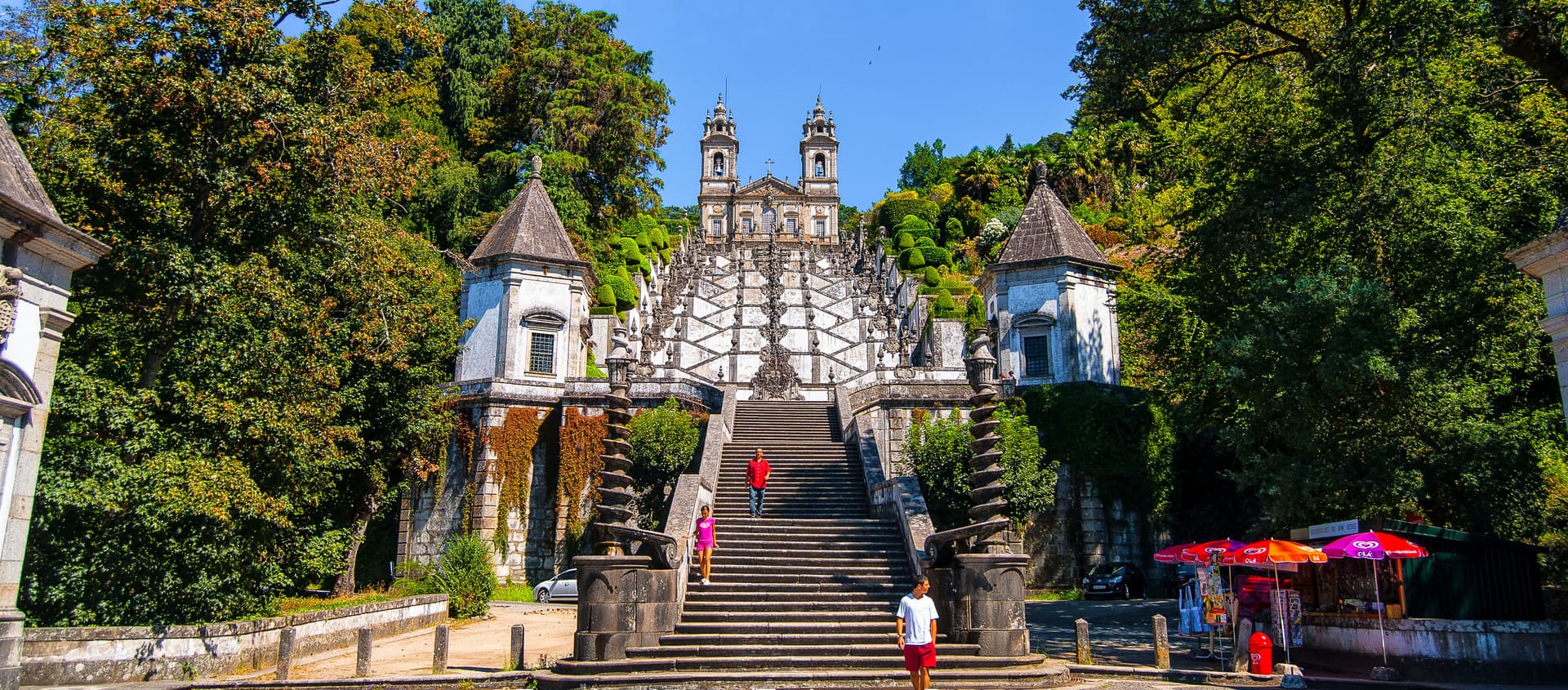
"Porta Aberta" means open door, and at this basilica above Rio Caldo it is policy: from July through mid-September, the area around Saint Benedict's image remains accessible around the clock; otherwise, doors open at 7:30 AM and close at dusk.
In 1614 an Archdiocese of Braga episcopal visitor ordered a hermitage built within a year, giving distant parishioners a nearer place of worship. It was dedicated to Saint Benedict of Nursia in 1615. Regional folklore instead has his statue repeatedly found atop a tree outside the re-locked chapel, as if rejecting stale indoor air; sources explicitly say this story lacks historical foundation and keep it separate from the documented founding.
The hermitage became Portugal's second-most-visited sanctuary after Fátima: a Neoclassical basilica rebuilt in the late 19th century, with a modern crypt added in 1998. Three annual romarias draw hundreds of thousands, many circling the church on their knees to repay promises made in hardship.
Why this place is sacred
The sanctuary's central devotional idea is architectural as much as theological: a door that does not close. During July, August, and through 15 September, the area around the saint's image is accessible 24 hours a day — an unusual, site-specific policy, and a genuine practice, not just a slogan.
Around that openness has accumulated a culture of vow-making and vow-repaying (pedir e pagar a promessa): a promise made to Saint Benedict during hardship, later fulfilled by walking the church's perimeter, often on the knees, on unforgiving polished granite. Folk belief holds the saint to be 'jealous,' even punishing, toward an unpaid vow, which lends the ritual real weight rather than mere custom.
Geography reinforces the theme: historic footpaths from Formigueiro, Pontes, Montalegre, Vilar da Veiga, and Lóbios converge on the sanctuary, as does the coastal Caminho de São Bento tied to the centuries-old salt tithe tradition along the Cávado river. A remote, mountainous location that is nonetheless a historic crossroads on foot underlines the sanctuary's long-standing role as a gathering point for votive journeys arriving from many directions.
The 1614 hermitage was built for a straightforwardly practical reason: parishioners in the area had a distant, difficult walk to their existing parish church, and the Archdiocese of Braga ordered a nearer place of worship built for them. Its devotional dedication to Saint Benedict, and its eventual growth into a major pilgrimage sanctuary, developed afterward.
A modest 1614-1615 hermitage grew, through the influence of Cistercian monks from the nearby Santa Maria de Bouro monastery, into a substantial cult site. The current Neoclassical/Neobarroco temple dates to an 1880-1895 rebuilding; a crypt designed by architect Luís Cunha was added in 1998; and Pope Francis elevated the church to basilica status on 21 March 2015, marking its 400th anniversary.
The confraternity has reportedly been preparing a submission for Portugal's National Intangible Cultural Heritage Inventory, though no completed designation has been confirmed.
Experience and orientation
Journalistic coverage (Público newspaper) has characterized the basilica and its esplanade as 'a basilica that never closes,' emphasizing round-the-clock accessibility, especially in summer. Visitors and pilgrims describe the atmosphere as a continuous, informal flow of devotional activity rather than a fixed 'visiting hours' experience: circling the church, sometimes on the knees, leaving flowers, wax votive limbs, or agricultural produce, and queuing to touch or approach the image of the saint.
During the Grande Romaria Popular each August, that flow intensifies, with the traditional salt-carrying pilgrimage along the Cávado river adding a distinctive procession to the festival crowds. Outside festival dates, the sanctuary offers a quieter version of the same current: daily Mass in the basilica or the 1998 crypt, and individual pilgrims making or fulfilling vows outside the formal festival calendar.
There is no need to time a visit around the romarias to encounter the sanctuary's character — the open-door policy means the atmosphere of continuous, informal devotion is present daily. Visitors curious about the vow-fulfilling rituals should observe from a respectful distance rather than treating knee-walking pilgrims as a photo subject; these are personal, often emotional acts of penance or thanksgiving, not performance.
Context and lineage
In 1614, an episcopal visitor from the Archdiocese of Braga ordered the local parish priest to have a hermitage built within a year, so that parishioners whose parish church lay at an inconvenient distance would have a nearer place of worship. The chapel, dedicated to Saint Benedict, was inaugurated in 1615.
This account was not widely known until 1980, when researcher Cónego Avelino de Jesus Costa located the archival record documenting it; the sanctuary's own institutional history now treats this as the factual founding narrative.
A separate and more colorful story circulates in regional folklore: that the newly installed statue of Saint Benedict was found the morning after inauguration standing atop a tree in the churchyard, despite the chapel having been locked overnight — and that this recurred even after the lock was changed and the door secured with four turns of the key.
Devotees are said to have concluded the saint refused the stale air of the chapel's interior, building an exterior niche in the façade to house his image and thereafter always keeping the door open. Sources that record this story are explicit that it has no historical foundation, distinct from the documented 1614/1615 archival origin — the two are presented here as separate, not sequential, accounts.
From a 1614-1615 rural hermitage, the site grew under the pastoral influence of the nearby Cistercian monastery of Santa Maria de Bouro into one of Portugal's principal pilgrimage destinations. The temple was rebuilt in Neoclassical/Neobarroco style between 1880 and 1895; a modern crypt followed in 1998; and Pope Francis's 2015 basilica elevation marked four centuries of continuous devotion. The Diocese of Braga continues to preside over its three major annual romarias.
Saint Benedict of Nursia
saint
Patron Saint of Europe, to whom the hermitage was dedicated in 1615. The cult's local growth is linked to the influence of Cistercian monks — an order following the Rule of Saint Benedict — from the nearby Santa Maria de Bouro monastery.
Cónego Avelino de Jesus Costa
historian
The researcher who, in 1980, located the archival record of the 1614 episcopal order to build the hermitage — establishing the sanctuary's documented founding date and distinguishing it from the undocumented open-door legend.
Pope Francis
ecclesiastical
Elevated the church to basilica status on 21 March 2015, marking the 400th anniversary of its founding.
Luís Cunha
architect
Designed the modern crypt added to the sanctuary in 1998.
Querubim Lapa
artist
Created the azulejo panels inside the current temple depicting the life of Saint Benedict, part of the 1880-1895 reconstruction.
Traditions and practice
Pilgrims traditionally circle the church five times to receive Saint Benedict's blessing; some complete the circuit on their knees as a specific act of penance or vow-fulfillment, on unforgiving polished granite. Historically, salt workers paid tithes by carrying salt on foot along the Cávado river from coastal Fão to Rio Caldo during the August romaria — a practice preserved today with the rule that the salt must never touch the ground en route.
Ex-voto offerings — multicolored carnations, wax figures representing body parts or petitions, agricultural products, gold, and money — are left in thanksgiving for graces received.
Three major annual romarias structure the devotional calendar: 21 March (anniversary of Saint Benedict's death), 11 July (Solemnity of Saint Benedict, Patron of Europe), and the Grande Romaria Popular from 10-15 August, the largest, drawing many Portuguese emigrants home for the festival alongside the salt-carrying pilgrims. Daily and Sunday Eucharist continues in both the basilica and the crypt outside the festival calendar, and guided group tours are available by appointment.
Visitors without a specific vow to fulfill can still walk the church's perimeter in the traditional five circuits, and take time in the quieter crypt rather than only the more visited basilica above. Arriving on an ordinary weekday, away from festival crowds, gives a clearer sense of what 'the door never closes' actually means in practice.
Roman Catholic Christianity
ActiveCentral devotional site to Saint Benedict of Nursia, Patron Saint of Europe, founded on a documented 1614 order from the Archbishop of Braga's episcopal visitor. The chapel, dedicated to Saint Benedict, was inaugurated in 1615 and grew into one of Portugal's most-visited sanctuaries, elevated to basilica status by Pope Francis on 21 March 2015 to mark the 400th anniversary of its founding.
Daily and Sunday Eucharist in both the basilica and the modern crypt (opened 1998); three major annual romarias (21 March, 11 July, and 10-15 August); walking around the church — traditionally five circuits, sometimes on the knees — as an act of penance or promise-fulfillment; ex-voto offerings; and the centuries-old salt-carrying pilgrimage along the Cávado river during the August romaria.
Perspectives and open questions
São Bento asks visitors to hold two founding stories side by side without collapsing one into the other: a plain, archivally documented 1614 order to build a hermitage, and a vivid folk legend about a statue that refused to stay indoors. Sources are unusually direct in separating the two rather than blending them into a single origin myth.
Scholarly perspective
The documented historical origin — a 1614 episcopal order, discovered archivally in 1980 by researcher Cónego Avelino de Jesus Costa — is treated by the sanctuary's own institutional history and by encyclopedic sources as the factual founding narrative, explicitly distinguished from the more colorful popular legend. The site's architectural and administrative history (1880-1895 reconstruction, 1998 crypt, 2015 basilica elevation) is well documented in municipal and church records.
Living and traditional perspectives
The relevant folk-devotional layer here is Portuguese Catholic popular religion: ex-voto offering, the centuries-old salt-pilgrimage tithe tradition, and knee-walking as penance, all built on top of, rather than replacing, official Church liturgy. Folk belief holds Saint Benedict to be a 'jealous,' even punishing, saint toward those who fail to fulfill a vow made to him — a belief that motivates the scrupulousness with which pilgrims complete their rituals.
Alternative interpretations
According to popular legend, the statue was repeatedly found atop a tree outside a locked, re-keyed chapel, and this account circulates widely in Portuguese folklore and regional blogs as a colorful 'true' origin story. However, more careful sources are explicit that it lacks historical foundation. It is presented here as folklore, distinguished from the documented 1614/1615 archival founding, not as an alternative factual account.
Open questions
No source explains precisely how or why the 'always open door' became formalized institutional policy, as opposed to simply a memorable feature of an early rural hermitage, or exactly when the 24-hour summer access policy for the saint's image was first put in place. These remain undocumented in available sourcing.
Plan your visit
Access and arrival
By car: roughly 45-60 minutes from Braga or Porto via the EN304 through Rio Caldo, in the municipality of Terras de Bouro; on-site parking exists but is constrained during major romarias. By public bus: regional lines including 201, 9601, and 500 connect Braga to Rio Caldo, a journey of roughly 2-2.5 hours, slower but cheaper than driving.
On foot: historic pilgrimage paths converge on the sanctuary from Formigueiro, Pontes, Montalegre, Vilar da Veiga, and Lóbios, as well as the coastal Caminho de São Bento route tied to the Esposende/Cávado valley salt-pilgrimage tradition.
Respectful visit
Standard modest dress expected for entering a functioning Catholic basilica — covered shoulders and knees are recommended; no site-specific dress code beyond general church etiquette was documented in available sources.
No explicit sanctuary-wide photography ban was found in available sources; visitors should be discreet during active Masses and processions, and especially when photographing pilgrims performing penitential acts such as knee-walking, which are personal and often emotional religious observances.
Ex-voto offerings — carnations, wax figures, agricultural produce, gold objects, and money — are a long-established, welcomed practice tied to fulfilling a promessa made to Saint Benedict, typically placed or presented near the saint's image or during the romaria processions.
None beyond normal decorum expected in an active place of worship. The basilica and crypt operate on a published Mass schedule, and the extended 24-hour access to the saint's 'throne' area applies specifically to July, August, and through 15 September.
Knee-walking and other penitential acts are personal religious observances tied to specific vows, not general tourist activities; visitors should observe with discretion rather than photograph pilgrims performing them up close.
Location
Map loads as you approach this section.
Pilgrim reflections
A portrait of encounter, not a score
Pilgrims describe what they felt, how present they could become, and whether the place would shape a journey. There are no stars and no ranking of traditions.
No reviewed reflections yet
The first pilgrims can help describe the character of being here.
Share a reflection
Available after an account-backed “Been there.” Every reflection is reviewed before publication.
Nearby sacred places
Explore other sacred places in the region. Proximity does not establish access or travel time; check each place’s guidance.



References
Sources consulted for this page. Source categories describe the publication, not a guarantee that every claim is verified. Traditional accounts and outside interpretations may differ.
- 01São Bento da Porta Aberta — official sanctuary site — Santuário de São Bento da Porta Aberta / Diocese of Braga administrationofficialOfficial sanctuary page; cites the 1980 archival discovery by Cónego Avelino de Jesus Costa documenting the 1614 order by the Archbishop of Braga's visitor to build a hermitage within a year, confirms 1615 chapel inauguration/dedication to St. Benedict.
- 02How Arrive » São Bento da Porta Aberta — Santuário de São Bento da Porta AbertaofficialOfficial access/directions page.
- 03Festivities » São Bento da Porta Aberta — Santuário de São Bento da Porta AbertaofficialOfficial festivities page listing romaria dates and the salt-offering tradition history (salt-worker tithes dating to the Middle Ages, salt carried on foot along the Cávado river from Fão to Rio Caldo between 10-15 August).
- 04São Bento da Porta Aberta - Gerês, Terras de Bouro — Câmara Municipal de Terras de Bouro (municipal tourism board)officialMunicipal tourism authority page; confirms opening hours (7:30 AM to dusk daily; 24-hour access to the 'throne of S. Bento' during July, August, and through 15 September), address, and proximity to Peneda-Gerês National Park and Caniçada Dam.
- 05Santuário de São Bento da Porta Aberta — Turismo de Portugal (visitportugal.com)officialNational tourism board reference listing for the sanctuary.
- 06Arcebispo Metropolita de Braga preside à grande romaria de S. Bento da Porta Aberta — Arquidiocese de BragaofficialArchdiocese of Braga news item confirming the archbishop's role presiding over the great August romaria; confirms institutional/diocesan oversight of the sanctuary.
- 07Santuário de São Bento da Porta Aberta — Wikipédia, a enciclopédia livre — Wikipedia contributorsSource contextPortuguese Wikipedia entry; confirms founding in 1615, 19th-century reconstruction (1880-1895), 1998 crypt by architect Luís Cunha, basilica elevation by Pope Francis on 21 March 2015, and pilgrim numbers (~2.5 million/year, second-largest sanctuary in Portugal after Fátima).
- 08S. Bento da Porta Aberta — Portugalidade MagazineSource contextPortuguese culture/travel magazine piece; corroborates history, pilgrimage dates, and general devotional context.
- 09Sanctuary of São Bento da Porta Aberta: Guide to Visiting Portugal's 2nd Largest Pilgrimage Site — The Traveler SistersSource contextEnglish-language travel-blog visitor guide; used for practical/access corroboration only, not for uncontested factual claims.
- 10São Bento da Porta Aberta: visitar o santuário no Gerês — Voyageurs GourmandsSource contextDescribes the ritual of circling the church, walking on knees around the perimeter to fulfill promises, and leaving carnations, wax figures, agricultural products, and money as ex-votos; also notes the folk belief that St. Benedict is 'jealous' and punishes unfulfilled promises.
- 11Origem da Lenda da Romaria minhota de S. Bento da Porta Aberta — Olhai os lírios do campo (blog)Source contextPopular blog account of the open-door/tree-top statue legend: the statue of St. Benedict reportedly appeared atop a tree outside the locked chapel on successive nights despite a re-keyed door, leading devotees to build an exterior niche so the saint could 'breathe fresh air.' Presented explicitly elsewhere as folklore without historical foundation, distinct from the documented archival origin.
Share a photo
Help visitors recognize Sanctuary of São Bento da Porta Aberta. Every submission is reviewed before publication.