Sanctuary of Bom Jesus do Monte
A Baroque staircase built to be climbed on the knees, still climbed that way at Easter
Understand sacred places, explore living traditions, and learn how to engage respectfully with Pilgrim Map.
Access has not been verified. Check current local guidance before planning a visit.
Braga, Braga, Portugal
Read the sources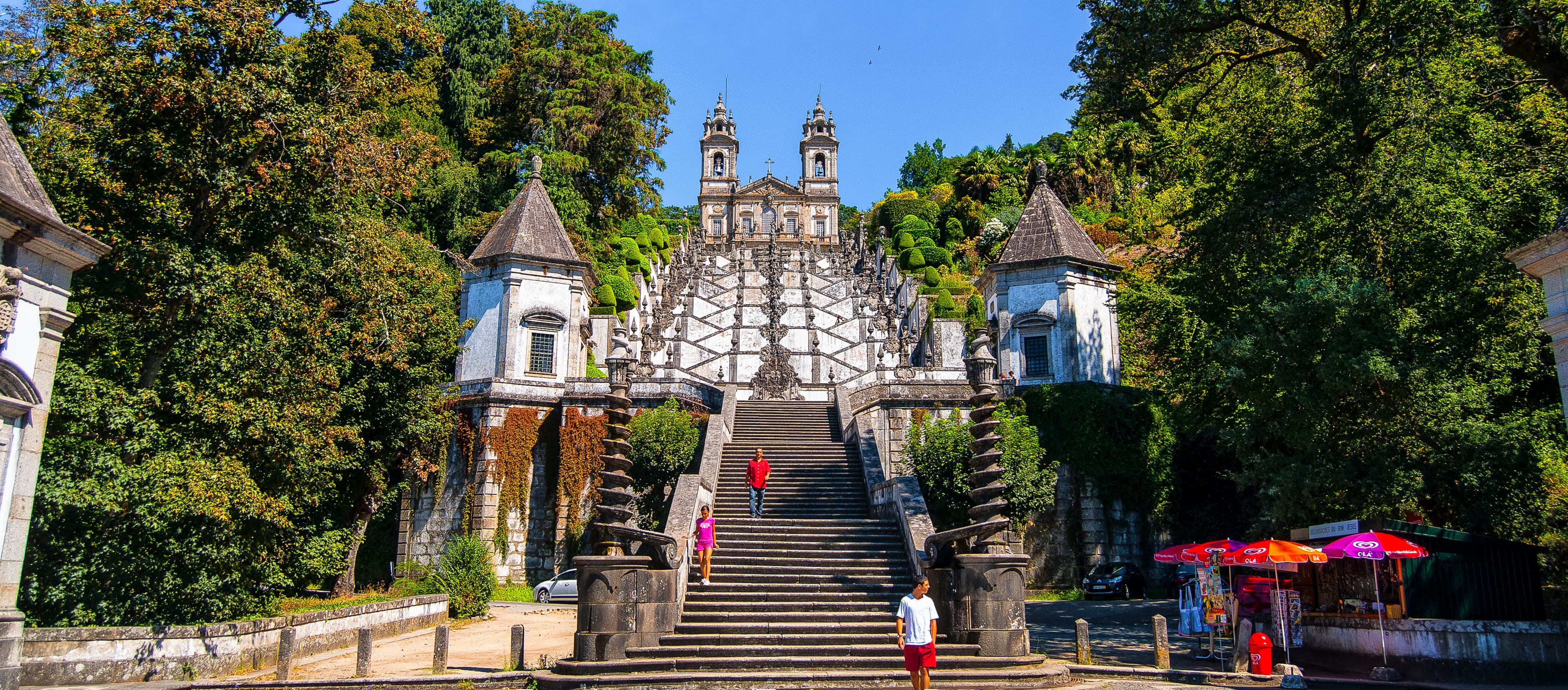
Image of Sanctuary of Bom Jesus do Monte. Image source
Visit essentials
A quick read before you go
- Duration
- A visit to walk the staircase, explore the chapels and fountains, visit the basilica, and take…
- Access
- Located in Tenões parish, just outside the city of Braga in Portugal's Norte region, on the…
Overview
At Bom Jesus do Monte, the staircase performs theology. Each landing stages Christ's Passion; at the Escadório dos Cinco Sentidos, water issues from a sculpted eye, ear, nose, mouth, or hand, contrasting bodily sense with spiritual virtue. Over five hundred steps and eleven decades of construction lead toward the church through a compressed journey to Calvary, as its Baroque architects intended.
A fourteenth-century legend reports a miraculous cross above Monte Espinho after the Battle of Salado, followed by a small chapel by 1373. Today's zigzag stair, fountains, basilica consecrated in 1834, and water-balance funicular added in 1882 form a Counter-Reformation project layered onto that older devotion, making the Passion a physical ascent.
The Confraria do Bom Jesus do Monte, founded in 1629, still manages the sanctuary, a continuity UNESCO cited in its 2019 inscription. During Holy Week and Pentecost, some pilgrims continue the generations-old practice of climbing on their knees.
Why this place is sacred
The mountain's sanctity begins, in local tradition, with an event rather than a design: after the 1340 Battle of Salado, in which Christian forces defeated Moorish armies, a miraculous cross was reported in the sky above Monte Espinho. Archbishop D. Gonçalo Pereira, whose son had reportedly fought in the battle, had a cross erected and a small chapel built around 1373 — the seed of continuous devotional use that a brotherhood statute from that year still attests to.
What happened over the following four centuries turned that seed into something far more architecturally deliberate. Successive archbishops enlarged the chapel — D. Jorge da Costa in 1494, a rebuild under the Dean of Braga Cathedral in 1522 — before Archbishop D.
Rodrigo de Moura Teles began, in 1722, the Baroque transformation that gives the sanctuary its present character: a staircase conceived not as mere access but as a devotional instrument, a Sacro Monte in the pan-European Counter-Reformation tradition, recreating in staged and symbolic form the topography of Christian Jerusalem and the events of Christ's Passion.
The Escadório dos Cinco Sentidos — the Staircase of the Five Senses — is the clearest expression of that theological program: fountains where water issues from carved eyes, ears, a nose, a mouth, and hands, each contrasting bodily sense-experience against the spiritual virtue the ascent is meant to cultivate. Chapels along the route stage individual scenes of the Passion.
The design is meant to ask the body, not belief alone, to take part in the climb toward the basilica — built 1784-1811, consecrated in 1834 — that crowns the mountain.
Art historians generally interpret this as a deliberately constructed theological program rather than an organic accretion of folk devotion, even though it clearly grew out of the earlier, more modest chapel pilgrimage tied to the miraculous-cross legend. Both readings can be held together: a legendary origin, and a four-century architectural elaboration that turned that origin into one of the most sophisticated devotional landscapes in Portugal.
The site began as a small commemorative chapel, built around 1373 under Archbishop D. Gonçalo Pereira following the reported apparition of a miraculous cross above the mountain after the 1340 Battle of Salado. Its transformation into a full Sacro Monte pilgrimage complex — staircase, fountains, chapels, and eventually basilica — began under Archbishop D. Rodrigo de Moura Teles from 1722, continuing through construction of the church (1784-1811, consecrated 1834) and the funicular (1882).
The Confraternity of Bom Jesus do Monte, founded in 1629, has managed the site continuously since — nearly four centuries UNESCO cited as a defining feature of the property when it inscribed the sanctuary as a World Heritage Site on 7 July 2019.
The 1882 water-balance funicular, designed by Raoul Mesnier du Ponsard under Nikolaus Riggenbach's direction, added a second mode of ascent to the original penitential staircase, though the staircase itself remains the devotionally significant route, still climbed on the knees by some pilgrims during Holy Week and Pentecost.
Experience and orientation
The ascent announces its intentions immediately: a switchback staircase in white and granite, each landing opening onto a fountain or a chapel before doubling back toward the next. The Five Senses fountains draw particular attention — water issuing from sculpted eyes, ears, nose, mouth, and hands, a piece of theological programming disguised as garden ornament. Visitors describe the climb as meditative even when undertaken casually, the staged rhythm of ascent and pause doing something a straight path wouldn't.
At the top, the basilica's terrace delivers the payoff most visitors remember longest: a sweeping view over Braga that rewards the climb regardless of why someone made it. For religious pilgrims, particularly during Holy Week and Pentecost, the same climb carries different weight — some still ascend on their knees, an act of penance in keeping with the site's original theological design, contrasting bodily sense-experience against spiritual virtue exactly as the Baroque architects intended.
The 1882 water-balance funicular, the oldest of its kind still operating, gives many visitors a second, entirely different register of experience — a piece of nineteenth-century engineering history riding the same 42-degree incline the staircase climbs, its two water tanks counterbalancing each other's weight across a 274-metre track.
Whether ascended on foot or by funicular, the site rewards visitors who arrive expecting more than a hike; those who slow down at each landing report a gradually unfolding, rather than immediate, sense of the site's significance.
Walk the staircase at least once if you're physically able, even if you plan to descend or return by funicular — the ascent is where the site's theological program actually operates, and skipping it by riding up both ways means missing the Five Senses fountains entirely. Consider pausing at each landing rather than climbing straight through; the pacing is not incidental to the design.
If visiting during Holy Week or Pentecost, expect to share the staircase with penitential pilgrims, some ascending on their knees — a devotional practice, not a spectacle, and one that asks a certain quietness from onlookers.
Context and lineage
Local tradition holds that after the Battle of Salado in 1340, in which Christian forces defeated Moorish armies, a miraculous cross was reported in the sky above Mount Espinho. Archbishop D.
Gonçalo Pereira, whose son had reportedly fought in the battle, led the erection of a cross and the building of a small chapel dedicated to the Holy Cross around 1373 — a date corroborated by a surviving brotherhood statute referencing the chapel — marking the beginning of continuous devotional use. Multiple archbishops sponsored successive enlargements: D. Jorge da Costa in 1494, a further rebuild under the Dean of Braga Cathedral in 1522.
The Confraternity of Bom Jesus do Monte, founded in 1629, formalized ongoing stewardship, and Archbishop D. Rodrigo de Moura Teles began the major Baroque transformation in 1722 that produced the staircase and chapel programme largely recognizable today. The final basilica, attributed to architect Carlos Amarante, was built 1784-1811 and consecrated in 1834.
The precise historical basis for the reported fourteenth-century celestial cross apparition cannot be independently verified and is treated by heritage sources themselves as tradition rather than documented historical fact.
From the 1373 chapel through successive fifteenth- and sixteenth-century enlargements, formal confraternity management began in 1629 and has continued unbroken to the present — the same body overseeing the Baroque staircase's construction from 1722, the basilica's completion in 1834, and the funicular's addition in 1882. This nearly four-hundred-year continuity of a single custodial institution, rare among comparably scaled European pilgrimage sites, was the specific quality UNESCO recognized in inscribing the sanctuary as a World Heritage Site on 7 July 2019.
D. Gonçalo Pereira
founder
Archbishop of Braga credited with erecting the original cross and building the first chapel around 1373, following the reported miraculous cross apparition after the Battle of Salado (1340).
D. Rodrigo de Moura Teles
patron
Archbishop of Braga who began the major Baroque transformation of the site from 1722, commissioning the staircase and chapel programme — including the Escadório dos Cinco Sentidos — that gives the sanctuary its present character.
Carlos Amarante
architect
Architect attributed with the design of the basilica church, built 1784-1811 and consecrated in 1834, crowning the completed staircase.
Raoul Mesnier du Ponsard
engineer
Engineer who designed the 1882 water-balance funicular under the direction of Swiss engineer Nikolaus Riggenbach, financed by Bracarense businessman Manuel Joaquim Gomes; the funicular remains the oldest of its type still operating.
Confraria do Bom Jesus do Monte
steward
The lay confraternity founded in 1629 that has managed the sanctuary continuously since — a near-four-century custodianship UNESCO cited directly as a defining feature of the property's 2019 World Heritage inscription.
Traditions and practice
Historical practice centered on ascending the staircase on the knees as an act of penance, particularly tied to Holy Week and Pentecost, alongside veneration of the Passion chapels staged along the route. Braga's broader Holy Week traditions — the Dos Passos procession from 1597, the Ecce Homo procession from 1513 — intersect with the sanctuary's role as a devotional site for the Passion narrative, with the Farricocos, hooded penitents in purple tunics, taking part in the city's wider observances.
Daily Eucharistic celebration and pastoral activity continue under the Confraria's management. Holy Week brings the solemn Easter Vigil and associated liturgies at the basilica; Pentecost, at the end of May, brings a second major pilgrimage occasion. Both periods see some pilgrims still ascend the staircase on their knees, continuing the historical penitential practice. The site also hosts weddings, baptisms, and other sacramental occasions as a functioning parish and sanctuary church.
Visitors wanting to encounter the site at its devotional peak should time a visit to Holy Week or Pentecost, when the penitential ascent and the basilica's liturgies are at their fullest. Outside those periods, walking the full staircase slowly, pausing at each Passion chapel rather than moving straight through, offers the closest available equivalent to the ascent's intended pacing without requiring religious observance.
Roman Catholicism
ActiveBom Jesus do Monte is one of the foremost Catholic pilgrimage sanctuaries in Portugal, built as a Sacro Monte recreating the topography and devotional experience of Christian Jerusalem and the Passion of Christ, in the Counter-Reformation tradition promoted after the Council of Trent.
Ascent of the Via Sacra staircase, historically made on the knees as an act of penance; veneration of the chapels depicting the Stations of the Cross along the ascent; daily Mass and Eucharistic adoration in the basilica church, built 1784-1811 and consecrated 1834; Holy Week (especially the Triduum) and Pentecost pilgrimages; devotional use of the Escadório dos Cinco Sentidos as a meditative ascent contrasting bodily senses with spiritual virtue.
Perspectives and open questions
Bom Jesus do Monte is read consistently within the mainstream Roman Catholic and art-historical tradition — there is little competing esoteric literature about the site — but even within that consensus, scholars and confraternal tradition differ on how to weigh the legendary origin against the later, deliberate Baroque architecture built on top of it.
Scholarly perspective
Art and architectural historians, and UNESCO's own framing, situate Bom Jesus do Monte within the pan-European Counter-Reformation tradition of Sacri Monti — symbolic sacred mountains built by the Catholic Church following the Council of Trent to provide immersive, theatrical pilgrimage experiences reasserting Catholic devotional practice against Protestant critique.
Its staged, allegorical Baroque staircase, contrasting bodily senses with spiritual virtues, is read as a deliberately constructed theological program rather than an organic development of folk devotion, even though it clearly grew out of an earlier, more modest chapel pilgrimage.
Living and traditional perspectives
Local and confraternal tradition centers on the fourteenth-century legend of a miraculous cross appearing above the mountain after the Battle of Salado, treated within the Confraria's own historical materials as the founding devotional narrative — distinct from, but complementary to, the later Baroque architectural elaboration that the scholarly view emphasizes.
Alternative interpretations
No significant esoteric or alternative-spirituality literature specific to Bom Jesus do Monte was found in research; the site's interpretive discourse is overwhelmingly framed within mainstream Roman Catholic devotional and art-historical or heritage terms.
Open questions
The precise historical basis for the reported fourteenth-century celestial cross apparition, as opposed to its transmission as pious legend recorded in later brotherhood statutes, cannot be independently verified and is treated by heritage sources themselves as tradition rather than documented historical fact.
The exact step count to the church is also debated — some sources count around 573 steps, others as many as 583, likely reflecting different choices about what portion of the ascent to include; this content uses the commonly cited approximate figure of 573 and flags it as such.
Plan your visit
Access and arrival
Located in Tenões parish, just outside the city of Braga in Portugal's Norte region, on the slopes of Monte Espinho, roughly 5 km from central Braga. Reachable by local city bus, taxi, or car, with parking near both the base and the top.
Visitors can ascend on foot via the roughly 573-step Baroque staircase — the Via Sacra — or ride the historic 1882 water-balance funicular, the oldest of its kind still in operation, which covers the 116-metre rise along a 274-metre, 42-degree-incline track in a few minutes.
Respectful visit
No strictly enforced dress code exists for the grounds, but modest dress — shoulders and knees covered — is expected when entering the basilica church, since it remains an active place of worship; visitors are advised to carry a light cover-up.
Photography is generally permitted throughout the grounds and inside the basilica; flash photography inside the church is discouraged out of respect for the space and other worshippers.
No standardized formal offering practice is documented for casual visitors. Pilgrims may light candles or make devotional gestures such as kneeling or prayer as personal acts of piety; donation boxes are typically present to support the Confraria's ongoing maintenance of the sanctuary.
Visitors are asked to maintain quiet, respectful behavior inside the church given ongoing liturgical use. Some garden and boating-lake areas within the grounds may require a small admission fee. Comfortable footwear is strongly recommended given the length of the staircase, widely cited as several hundred steps over a 116-metre rise.
The penitential knee-ascent is a devotional practice undertaken by pilgrims, not a performance for onlookers; visitors witnessing it during Holy Week or Pentecost should observe with the same quiet respect expected inside the church itself. Comfortable, sturdy footwear is strongly advised for the staircase regardless of when you visit, given its length and stone surfaces.
Location
Map loads as you approach this section.
Pilgrim reflections
A portrait of encounter, not a score
Pilgrims describe what they felt, how present they could become, and whether the place would shape a journey. There are no stars and no ranking of traditions.
No reviewed reflections yet
The first pilgrims can help describe the character of being here.
Share a reflection
Available after an account-backed “Been there.” Every reflection is reviewed before publication.
Nearby sacred places
Explore other sacred places in the region. Proximity does not establish access or travel time; check each place’s guidance.


References
Sources consulted for this page. Source categories describe the publication, not a guarantee that every claim is verified. Traditional accounts and outside interpretations may differ.
- 01Sanctuary of Bom Jesus do Monte in Braga — UNESCO World Heritage CentreofficialOfficial UNESCO World Heritage listing page; inscribed 7 July 2019; confirms Sacri Monti tradition, Via Crucis, Baroque staircase, and Confraternity stewardship since 1629.
- 02Sanctuary of Bom Jesus do Monte — Wikipedia — Wikipedia contributorsacademicConsolidated history, architecture, dimensions, funicular, and UNESCO status.
- 03History – Confraria do Bom Jesus do Monte — Confraria do Bom Jesus do Monte (site custodian brotherhood)officialOfficial custodial body (est. 1629) site; primary source for chronology of chapel/staircase/church construction phases.
- 04Staircase of the Five Senses – Confraria do Bom Jesus do Monte — Confraria do Bom Jesus do MonteofficialOfficial explanation of the Escadório dos Cinco Sentidos symbolism, fountains, and theological programme.
- 05Elevator or Funicular – Confraria do Bom Jesus do Monte — Confraria do Bom Jesus do MonteofficialOfficial site on the 1882 water-balance funicular, engineering details, and operation.
- 06Bom Jesus do Monte Funicular — Wikipedia — Wikipedia contributorsacademicConfirms 1882 inauguration, Raoul Mesnier du Ponsard design, Nikolaus Riggenbach direction, water-tank capacities, 274m route, 42º incline.
- 07Legends about the Bom Jesus — Braga City Council — Câmara Municipal de BragaofficialMunicipal heritage authority account of the miraculous-cross origin legend tied to the Battle of Salado (1340) and the 1373 chapel reference.
- 08Holy Week Ceremonies in Braga — Turismo de Portugal (visitportugal.com)officialNational tourism authority description of Holy Week ceremonies in Braga, including penitential ascent of the Bom Jesus staircase during Holy Week and Pentecost.
- 09Braga – European Network of Holy Week and Easter Celebrations — European Network of Holy Week and Easter Celebrations (holyweekeurope.com)officialNetwork of officially recognized European Holy Week celebrations; describes Braga's processions (Dos Passos 1597, Ecce Homo 1513, Farricocos penitents) and Bom Jesus's role in Holy Week liturgy.
- 10How To Visit The Sanctuary of Bom Jesus do Monte, Braga — The Common WandererSource contextTravel guide used for practical visitor details (dress expectations, footwear, step count, photography norms). Cross-checked against official sources where possible.
- 11Braga, Portugal — Catholic Pilgrimage Guide — Destinationes.comSource contextUsed for context on Braga as Portugal's religious capital and proximity/relationship to the Sanctuary of Sameiro and Braga Cathedral (Sé de Braga, consecrated 1089).
Share a photo
Help visitors recognize Sanctuary of Bom Jesus do Monte. Every submission is reviewed before publication.