Sanctuary of Our Lady of Abadia
A sacro-monte ascent to a hidden Virgin, said by local tradition to be one of Portugal's oldest
Understand sacred places, explore living traditions, and learn how to engage respectfully with Pilgrim Map.
Access has not been verified. Check current local guidance before planning a visit.
Amares, Braga, Portugal
Read the sources
Visit essentials
A quick read before you go
- Duration
- Not explicitly stated in sources; the Via Sacra ascent plus a visit to the church, grotto, and…
- Access
- Reachable by car or on foot via rural paths, roughly 27 km from Gerês and positioned between…
Overview
A frequently retold but unverified legend says hermits hid a stone Virgin during an early-medieval Arab incursion; generations later, mysterious light in the gorge revealed it. Local tourism sources therefore call this one of Portugal's oldest Marian sites, dating presence to the seventh or eighth century. This remains tradition, not established fact: academic sources place no foundation before the twelfth century.
Documents begin in 1148, when King Afonso Henriques endowed a Benedictine community. It adopted Cistercian rule in 1195 and grew downhill at Santa Maria do Bouro into one of Entre Douro e Minho's wealthiest abbeys. The hilltop sanctuary, rebuilt in Baroque form in the eighteenth century, outlasted its monastery: monastic life ended in 1834, but the Via Sacra's eight chapels and annual ramp processions continue.
The sanctuary belongs to Amares as well as the Church. A municipal May pilgrimage and older August 15 romaria still carry the image of Our Lady of Abadia between them.
Why this place is sacred
Local tradition traces the sanctuary's origin to hermits who, during an early medieval Arab or Muslim incursion, hid a stone image of the Virgin Mary somewhere in the mountainous terrain above what is now Santa Maria do Bouro.
Generations later, according to the legend, two hermits — named in most retellings as Frei Lourenço and Paio Amado, though an alternate version names 'Pelaio Amado' and an unnamed companion eremite — saw a mysterious light in the gorge one night and, investigating, found the hidden image. They built a chapel on the spot, and the community that gathered around it eventually attracted royal notice.
The legend is worth taking seriously as tradition — but no academic medievalist source located in research substantiates it, and the claim, repeated on several tourism sites, that this makes Abadia one of the oldest Marian sanctuaries in Portugal, with roots in the seventh or eighth century, rests on popular retelling rather than documented history.
What can be dated with more confidence is the 1148 royal donation by King Afonso Henriques that formally established a monastic community here, and the community's 1195 adoption of the Cistercian rule.
A further motif recurs in local tradition: when the monks later relocated the community and its venerated image down to the riverside site of the present monastery, the image was said to repeatedly return on its own to the original hillside — a sign, in the tradition's own telling, that the Virgin wished to remain there.
Whatever the historicity of the motif, tradition uses it to explain why the hillside site, not the valley monastery, has remained the focus of devotion.
The documented foundation is a royal and monastic one: in 1148, King Afonso Henriques endowed a couto (a jurisdictional privilege) establishing a Benedictine community under Abbot D. Paio Nunes, which adopted the Cistercian rule in 1195. The hillside sanctuary itself, distinct from the valley monastery, developed as the pilgrimage focus tied to the image-discovery legend, with the present Baroque church dating to the eighteenth century.
Monastic life at the associated Mosteiro de Santa Maria do Bouro continued from 1148 until the 1834 dissolution of Portugal's religious orders; the former monastery is now the Pousada de Santa Maria do Bouro, a state-run hotel.
The hillside sanctuary appears to have continued as a pilgrimage destination regardless of the monastery's fate, gaining its Baroque Via Sacra with eight chapels and, reportedly, a 2016 'Conjunto de Interesse Público' heritage classification — a claim transmitted only through secondary sources, since the primary registry page could not be retrieved and its content remains unconfirmed.
Experience and orientation
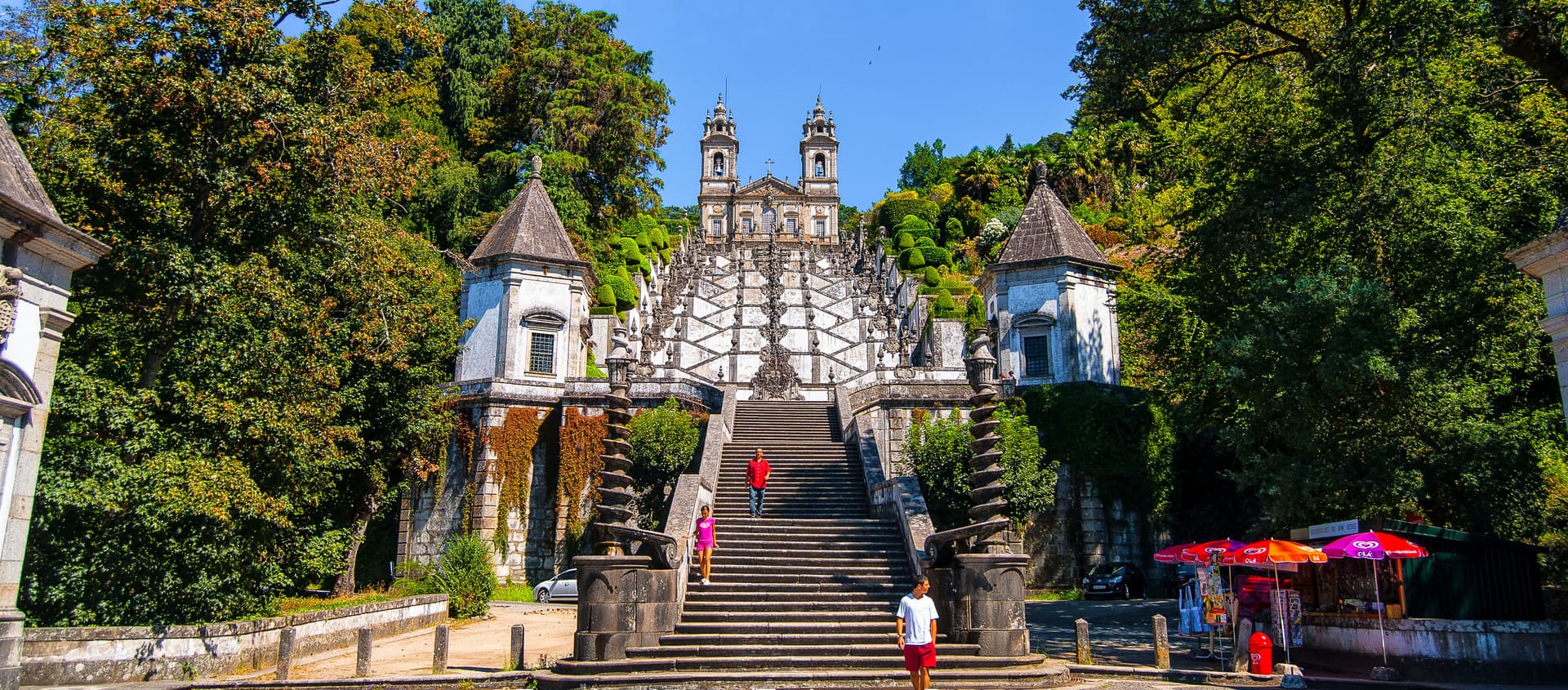
The approach is the point: a steep, ascending ramp lined by eight chapels of the Via Sacra, climbing past a grotto and natural springs before reaching the Baroque church with its granite towers. The Rio Nava runs below, cascading into waterfalls that travel sources single out alongside the sanctuary itself as reasons to make the climb.
This is a sacro-monte in the same tradition as Bom Jesus do Monte and Sameiro nearer Braga — ascent staged as devotion, elevation treated as its own kind of arrival.
At the top, a small Museu de Arte Sacra e Etnográfico occupies former pilgrim lodgings, giving the visit a second register beyond the church and chapels — artifacts and ethnographic material alongside the devotional path. No detailed first-person account of a transformative visit was located in research; the site's reputation, as documented, rests more on its combination of natural setting and sustained devotional use than on any specific reported encounter.
Consider walking the full Via Sacra rather than driving directly to the church — the ramp and its chapels are built to be ascended, and the pace of walking is part of what the sacro-monte design asks of a visitor. The waterfall trails along the Rio Nava extend the visit naturally for those with more time.
Context and lineage
Local tradition holds that hermits hid a stone image of the Virgin during an early medieval Arab incursion, and that it was later rediscovered by two hermits guided by a mysterious light — the founding legend behind the sanctuary's name and devotional character, though unverified by academic sourcing. The documented history proper starts in 1148, when King Afonso Henriques granted a couto establishing a monastic community, formally Benedictine under Abbot D. Paio Nunes, which took the Cistercian rule in 1195.
The community, based downhill at what became Santa Maria do Bouro, grew into one of the wealthiest and most important abbeys of the Entre Douro e Minho region, playing a military role in the 1383-1385 succession crisis before its dissolution in 1834. The standing sanctuary church above the monastery dates to the eighteenth century in its present Baroque form.
The associated monastic community held the site from 1148 (Benedictine, then Cistercian from 1195) until the 1834 dissolution of Portugal's religious orders, after which the monastery building became, eventually, the state-run Pousada de Santa Maria do Bouro. The hillside sanctuary itself continued independently as a pilgrimage destination throughout and after this transition, sustained today by an annual archipresbyteral pilgrimage and an August romaria rather than by any resident religious community.
D. Afonso Henriques
founder
Portugal's first king, whose 1148 donation of the couto de Bouro formally established the monastic community associated with the sanctuary.
D. Paio Nunes
abbot
Recorded as an early abbot of the 1148 Benedictine foundation, before the community's 1195 transition to the Cistercian rule.
Frei Lourenço and Paio Amado
legendary founders
Hermits credited in the most common retelling of the founding legend with rediscovering the hidden Virgin image by a mysterious light; an alternate version names 'Pelaio Amado' and an unnamed companion eremite instead. Their historicity is not independently confirmed.
Our Lady of Abadia
dedicatee
The Marian devotion at the center of the sanctuary, reportedly venerated as a patroness of farmers and domestic animals across the wider Minho countryside.
Traditions and practice
Monastic liturgical life under Benedictine and then Cistercian observance continued at the associated monastery from 1148 until 1834, though this practice belonged to the valley community rather than to the hillside sanctuary itself. The processional carrying of the Virgin's image by relay teams from Amares's twenty-five parishes during the May pilgrimage continues a devotional pattern documented as roughly forty-five years old in its present organized civic form.
The last Sunday of May brings an archipresbyteral and municipal pilgrimage, confirmed as still occurring by the Archdiocese of Braga as recently as 2025 — a roughly four-kilometer procession from the Mosteiro de Santa Maria do Bouro up to the sanctuary. August 15, the Assumption, brings the sanctuary's larger annual romaria. Separately, the venerated image has, as recently as 2024, traveled among the parishes of the Amares and Terras de Bouro deaneries.
A visitor wanting to encounter the sanctuary at its most active should time a visit to the last Sunday of May or to August 15, when the Via Sacra ramp fills with pilgrims rather than solitary visitors. Outside these dates, the ascent rewards a slower, quieter walk past each of the eight chapels in turn.
Roman Catholic Marian devotion (Nossa Senhora da Abadia)
ActiveThe sanctuary is a regional center of Marian veneration in the Minho, described by local tradition — though not by independent academic sourcing — as one of the oldest Marian devotional sites in Portugal. It is reportedly venerated as a patroness of farmers and domestic animals across the wider countryside.
An annual last-Sunday-of-May municipal and archipresbyteral pilgrimage from the Mosteiro de Santa Maria do Bouro to the sanctuary; an August 15 Assumption romaria; periodic tours of the venerated image among the parishes of the Amares and Terras de Bouro deaneries.
Founding legend of the hidden and rediscovered Virgin image
HistoricalLocal tradition traces the sanctuary's sacredness to hermits who hid a stone image of the Virgin during an early medieval incursion; generations later, according to the legend, hermits were led to the buried image by a mysterious light, prompting the chapel's construction and eventually the founding of a monastic community.
No living ritual reenactment identified; the legend functions as foundational lore referenced in tourism and parish literature rather than an enacted rite.
Cistercian and Benedictine monastic stewardship
HistoricalThe sanctuary was historically linked to a monastic community founded under Benedictine observance in 1148, with a formal donation and couto from D. Afonso Henriques, adopting the Cistercian rule in 1195. The associated Mosteiro de Santa Maria do Bouro grew into one of the wealthiest and most important abbeys of the Entre Douro e Minho region before its 1834 dissolution.
Historical only — monastic life ended in 1834; the former monastery building is now a state-run Pousada.
Perspectives and open questions
Abadia holds two accounts of itself side by side without resolving into one: the tradition's account of hermits and a hidden Virgin dating to the early medieval period, and the documentary record's more modest starting point in 1148. Both are presented here, neither privileged as the whole truth.
Scholarly perspective
No dedicated academic study of the sanctuary's origins was located in research. The documented, verifiable history begins with the 1148 royal donation establishing the monastic community and its 1195 transition to the Cistercian rule; claims of a seventh- or eighth-century origin for the sanctuary itself rest on oral tradition and popular tourism retellings rather than an identified scholarly source.
Living and traditional perspectives
In Portuguese Catholic folk tradition, the image-discovery legend — hermits, a hidden Virgin, a mysterious light in the gorge — is the sacred founding narrative, and it continues to sustain active regional devotion: an annually renewed municipal pilgrimage, an August romaria, and periodic tours of the image among neighboring parishes. This tradition does not require the seventh- or eighth-century dating to hold devotional force; the story's authority for practitioners rests on continuity of practice rather than archival proof.
Open questions
The precise dating and historicity of the sanctuary's earliest phase — the seventh- or eighth-century claims, and a reputed circa-883 'Mosteiro das Montanhas' reference — remain unresolved by any source located in research. The identity and chronology of the founding hermits also differs between retellings, Frei Lourenço and Paio Amado in one version, Pelaio Amado and an unnamed eremite in another, leaving the sanctuary's true origin point genuinely uncertain rather than merely under-documented.
Plan your visit
Access and arrival
Reachable by car or on foot via rural paths, roughly 27 km from Gerês and positioned between Braga and the Serra do Gerês. The processional pilgrimage route runs about 4 km from the Mosteiro de Santa Maria do Bouro, the former monastery and now a Pousada, up the hillside to the sanctuary.
Respectful visit
Not specified in sources reviewed; standard modest-dress conventions for active Portuguese Catholic churches and sanctuaries would reasonably apply, though no site-specific guidance was found.
No explicit restriction found in sources reviewed. The on-site sacred-art and ethnographic museum may follow standard no-flash norms typical of small ecclesiastical museums, but this is not confirmed for this site specifically.
None identified beyond ordinary respectful-visitor conduct expected at an active parish and sanctuary site.
No living ritual reenactment of the founding legend was identified in sources reviewed — the story functions as foundational lore referenced in tourism and parish literature, not an enacted rite. Visitors should not expect a specific commemorative ceremony tied to the hidden-image narrative itself.
Location
Map loads as you approach this section.
Pilgrim reflections
A portrait of encounter, not a score
Pilgrims describe what they felt, how present they could become, and whether the place would shape a journey. There are no stars and no ranking of traditions.
No reviewed reflections yet
The first pilgrims can help describe the character of being here.
Share a reflection
Available after an account-backed “Been there.” Every reflection is reviewed before publication.
Nearby sacred places
Explore other sacred places in the region. Proximity does not establish access or travel time; check each place’s guidance.



References
Sources consulted for this page. Source categories describe the publication, not a guarantee that every claim is verified. Traditional accounts and outside interpretations may differ.
- 01Peregrinação à Abadia procurou ser estímulo ao discernimento e à comunhão — Arquidiocese de BragaofficialOfficial Archdiocese of Braga news item confirming the 2025 archipresbyteral pilgrimage to the sanctuary, situating it within active diocesan pastoral life — evidence the site remains an active, church-sanctioned pilgrimage destination.
- 02Ermida de Nossa Senhora da Abadia / Santuário de Nossa Senhora da Abadia (SIPA record id 354) — DGPC / SIPA (Sistema de Informação para o Património Arquitectónico), Portuguese GovernmentofficialEPISTEMIC FLAG: this official Portuguese architectural-heritage registry entry could not be retrieved during this research pass (server connection failed). Cited here as the authoritative record that should be consulted for verification of construction dates and the 2016 heritage-classification claim; its content is not independently confirmed in this file.
- 03Santuário de Nossa Senhora da Abadia – Wikipédia — Wikipedia contributorsSource contextPortuguese Wikipedia entry; covers location, 2016 heritage classification, 18th-century architecture, the founding legend (Frei Lourenço/Paio Amado, Arab-invasion concealment), the eight Via Sacra chapels, and the two annual festival dates (last Sunday of May; August 15).
- 04Abadia de Bouro – Wikipédia — Wikipedia contributorsSource contextCovers the legend of the hermits (Pelaio Amado and a black-habited eremite), the discovery of the stone Virgin image via a mysterious light, D. Afonso Henriques' 1148 donation of the couto de Bouro, the 1159 profession of the eremites, and the tradition of the miraculous image 'returning' to the Abadia site after the monastery relocated to the riverside.
- 05Convento de Santa Maria do Bouro – Wikipédia — Wikipedia contributorsSource contextBackground on the associated monastery: 1148 Benedictine foundation under Abbot D. Paio Nunes, 1195 transition to the Cistercian rule, the abbey's military role in the 1383-1385 crisis, its wealth ranking among Portuguese monasteries, 1834 dissolution of religious orders, and 1994 restoration into the Pousada de Santa Maria do Bouro.
- 06Santuário de Nossa Senhora da Abadia: belo e com séculos de devoção — nCulturaSource contextPortuguese cultural-tourism feature corroborating the sanctuary's antiquity claim, sacro-monte layout, and devotional character.
- 07Santuário de Nossa Senhora da Abadia — Junta de Freguesia de Bouro Santa MariaofficialLocal civil-parish (freguesia) government page describing the sanctuary; closest thing to an official local-authority source found.
- 08Santuario Senhora da Abadia — SerradoGeres.comSource contextRegional tourism site situating the sanctuary within the Gerês landscape context; describes the sacro-monte type, Via Sacra with eight chapels, the Museu de Arte Sacra e Etnográfico, and visitor amenities (picnic areas, waterfall trail).
- 09Peregrinação à Senhora da Abadia, em Amares, a caminho do "interesse municipal" — O MinhoSource contextLocal news source on the annual concelho (municipal) pilgrimage: last Sunday of May, ~4 km processional route from the Mosteiro de Santa Maria de Bouro up to the sanctuary, involving all 25 parishes of Amares carrying the image in relay, roughly 45 years running as a formalized civic-religious event.
- 10Imagem de Nossa Senhora da Abadia vai peregrinar pelos arciprestes de Amares e Terras de Bouro — Terras do HomemSource contextLocal press confirming continued active devotional practice: the image travels among parishes of the Amares/Terras de Bouro deaneries.
Share a photo
Help visitors recognize Sanctuary of Our Lady of Abadia. Every submission is reviewed before publication.