Sanctuary of Santa Luzia
A hilltop basilica for sight and the Sacred Heart, crowning a buried Iron Age town
Understand sacred places, explore living traditions, and learn how to engage respectfully with Pilgrim Map.
Access has not been verified. Check current local guidance before planning a visit.
Viana do Castelo, Viana do Castelo, Portugal
Read the sources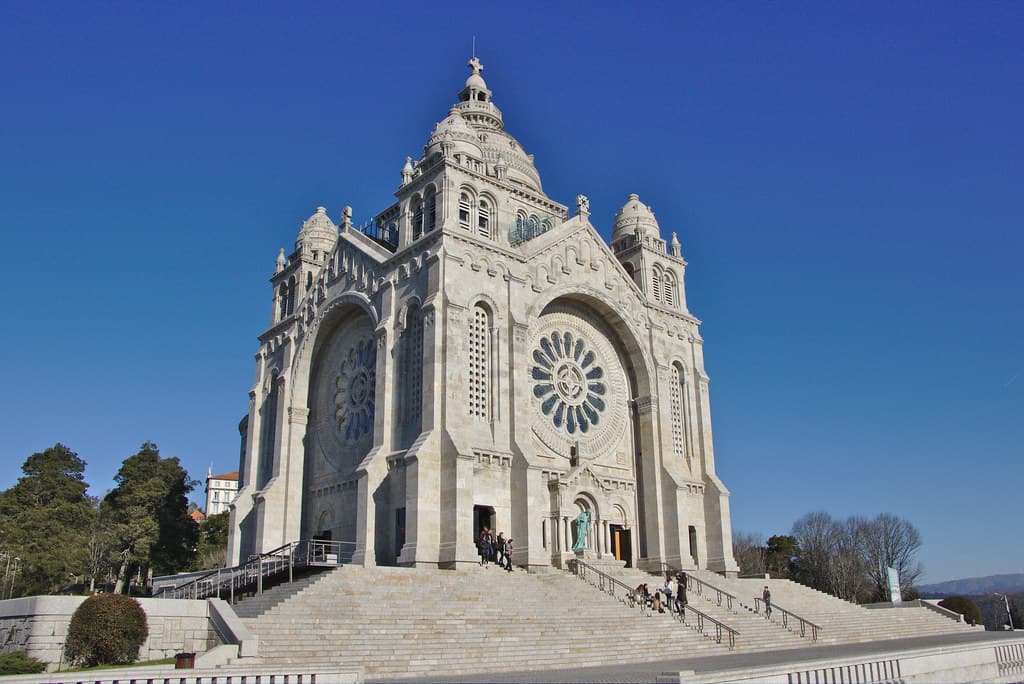
Image of Sanctuary of Santa Luzia. Image source
Visit essentials
A quick read before you go
- Duration
- A visit to the basilica interior and the viewpoint esplanade typically takes 30 to 60 minutes.
- Access
- From central Viana do Castelo, the Elevador de Santa Luzia funicular (a roughly seven-minute,…
Overview
Some twenty-five centuries ago, an Iron Age community fortified this summit above the Lima estuary, building the Citânia de Santa Luzia. Only about a third has been excavated; an early twentieth-century hotel, road, and church cover the rest.
The church is formally dedicated to the Sacred Heart of Jesus, yet inherited the name of a small Santa Luzia hermitage. A cavalry captain credited her with restoring his sight, and the devotion born from his gratitude overtook the official dedication. The basilica's dome and twin rose windows explicitly recall Paris's Sacré-Cœur. Construction lasted decades, and documentary sources disagree on its completion date.
Visitors climb 660 steps or take the funicular to look across river, sea, and mountains from ground successively held sacred, fortified, forgotten, and rebuilt.
Why this place is sacred
Santa Luzia's sacredness is not the product of one founding event but of several unrelated ones stacked on the same summit. First came the Citânia — a fortified proto-historic town, one of many castro settlements across the Alto Minho, occupied from around 500 BCE into the Roman period.
What made this hill worth defending then is not recorded; what is recorded is that when archaeologist Possidónio da Silva began excavating it in 1876, he found three lines of defensive walls, evidence of a community that took the position seriously.
Centuries after the Citânia fell silent, a much smaller and humbler devotion appeared on the same ground: a hermitage, rebuilt in 1664 and again in 1712, carrying a side altar to Santa Luzia. Nothing about this chapel suggested it would become the seed of a basilica visible from most of the city below. A single act of devotional gratitude, detailed elsewhere, is what set that transformation in motion, multiplying a local chapel into a regional devotional landmark within a generation.
The view did the rest. Sources describe the summit's panorama over Viana do Castelo, the Lima river valley, and the Atlantic as central to why people keep climbing, independent of any particular belief. Whether the vantage feels transcendent because of what stands there, or would feel that way regardless, is not a question the sources try to answer — only that the reports of it are consistent, and old.
The Citânia was built as a fortified settlement — defensible, walled, and, on the evidence of what was destroyed to make room for later construction, extensive. Its builders' relationship to the land beyond defense is not documented. The later hermitage and basilica were built for an entirely separate purpose: to house first a modest, then an increasingly elaborate, devotion to Santa Luzia and the Sacred Heart, funded and organized by a lay confraternity rather than by ecclesiastical or state authority.
Iron Age occupation gave way, at some point in the Roman period, to disuse; the settlement's fortunes after that are unrecorded until 1876, when Possidónio da Silva's excavation rediscovered it. Meanwhile, a small hermitage on the same hill had already been rebuilt twice, in 1664 and 1712, before the Confraria de Santa Luzia — founded in 1884 — set out to replace it with something far larger.
Construction of the present basilica began in 1904 under architect Miguel Ventura Terra; after his death in 1919, architect Miguel Nogueira continued the project. Most sources, including Portuguese Wikipedia and DGPC-derived heritage summaries, place its completion in 1959 — a long, interrupted build spanning more than half a century. At least one tourism source states the building was fully completed in 1943 instead.
The 1959 date is better corroborated across the sources consulted, but the discrepancy is not resolved here, and both figures circulate. In 2020, the church was elevated to a minor basilica and formally recognized as a Diocesan Sanctuary.
Experience and orientation
Most accounts of arriving at Santa Luzia begin with the climb, not the church. Whether by the stepped path or the funicular that has carried passengers up this slope since 1923, there is a built-in pause between the city below and the summit — a gaining of altitude that visitors report noticing in a way flat approaches rarely produce.
At the top, the esplanade in front of the basilica is where most people stop first, before the building itself. The view — Viana do Castelo laid out along the Lima estuary, the Atlantic beyond it, hills rising on the other sides — is the detail sources return to most often, sometimes invoking an often-repeated claim that National Geographic ranked it among the world's best views in 1927.
Inside, the basilica's two large rose windows, reportedly the largest in the Iberian Peninsula, fill the interior with a diffused light that visitors describe as part of what makes the space feel larger than its footprint suggests.
Arrive with time to do both things the hill offers rather than rushing between them. Sit on the esplanade before entering the basilica — the view rewards unhurried attention more than a quick photograph does. Once inside, look up before looking around; the rose windows and dome are the building's clearest architectural statement.
If the archaeological ruins of the Citânia are open, walk them separately and slowly, since almost nothing here is signed for a fast pace — this is a summit built and rebuilt by people working at very different speeds than modern visitors.
Context and lineage
According to the account maintained by the Confraria de Santa Luzia and corroborated by Portuguese Wikipedia, Captain of Cavalry Luís de Andrade e Sousa suffered from an eye ailment and prayed at the existing hermitage to Santa Luzia; his eyesight reportedly recovered afterward. In gratitude, he founded the Confraria de Santa Luzia in 1884 to build a larger sanctuary on the site.
This is presented by its custodians as devotional tradition rather than an independently verified medical account, and no clinical record of the ailment or its resolution survives in the sources reviewed. The confraternity's project took on a life well beyond its founder's private vow: within decades it produced one of the region's most recognizable landmarks.
The Iron Age community that built the Citânia left no named successors; its walls stood exposed to later excavation and, in places, to destruction by hotel, road, and church construction before more than a third of the site could be studied. The hermitage devotion that followed much later is likewise a story without a continuous institutional thread until 1884, when the Confraria de Santa Luzia formalized what had been informal local veneration.
That confraternity still stewards the basilica today, and the annual June romaria — begun in 1921 as the fulfillment of a vow made during the 1918 influenza pandemic — continues an unbroken tradition of civic pilgrimage now more than a century old.
Luís de Andrade e Sousa
founder
Cavalry captain whose reported recovery from an eye ailment, attributed by tradition to Santa Luzia's intercession, led him to found the Confraria de Santa Luzia in 1884.
Miguel Ventura Terra
architect
Designed the basilica in 1899; construction began in 1904 under his direction and continued until his death in 1919.
Miguel Nogueira
architect
Continued the basilica's construction after Ventura Terra's death in 1919, seeing the long project toward its eventual completion.
Possidónio da Silva
archaeologist
Conducted the first excavations of the Citânia de Santa Luzia hillfort in 1876, uncovering the Iron Age settlement's defensive walls.
Saint Lucy of Syracuse
saint
Early Christian martyr (c. 283-304 CE) traditionally associated with eyesight and, through the etymological link to the Latin lux, with light; the basilica's popular name and primary devotional focus derive from her.
Traditions and practice
Little is recorded of whatever practices, if any, marked the hermitage that predated the basilica, beyond its side altar to Santa Luzia added in 1712. What can be reconstructed with more confidence is the basilica-era tradition: the 1921 romaria fulfilling a vow made during the 1918 pneumonic-influenza pandemic, and the December 13 Festa de Santa Luzia combining Mass, procession, and community festivity.
Regular Masses continue at the basilica as at any active diocesan sanctuary. The June romaria brings parishes from across Viana do Castelo processing up from the city center on the Sunday nearest the liturgical feast of the Sacred Heart. The December 13 feast draws a mix of devotional and civic participation, with religious observance alongside cultural events.
For the archaeological layer, no ceremony can be recreated, since almost nothing is known of what the Citânia's builders practiced. What remains is the walking itself: move along the exposed wall lines slowly, noting where excavation stopped and later construction begins — the boundary between studied ground and paved-over ground is often visible if you look for it.
Standing at the point where a twenty-five-century-old wall meets a twentieth-century basilica foundation is, for many visitors, a more direct encounter with the hill's layered history than either structure offers alone.
Catholic Christianity
ActiveThe basilica's formal dedication is to the Sacred Heart of Jesus, but it is popularly known and venerated as the church of Santa Luzia, patron of eyesight and the blind, following a 19th-century founding narrative in which a cavalry captain's reported recovery from an eye ailment led to the confraternity that built the present sanctuary. In 2020 the church was elevated to a minor basilica and a Diocesan Sanctuary.
Regular Mass; an annual civic romaria on the Sunday nearest the June feast of the Sacred Heart, continuing a vow made during the 1918 pandemic and first fulfilled in 1921; the Festa de Santa Luzia each 13 December with Mass, procession, and community festivities. Attendance for either occasion is not confirmed by any source consulted.
Archaeological and Heritage Stewardship
ActiveThe Citânia de Santa Luzia, an Iron Age fortified settlement occupied from around 500 BCE, represents a wholly separate layer of the hill's significance — one governed today by ongoing heritage management rather than any continuing ritual practice. State heritage authorities maintain and interpret the site as a protected national monument.
Managed visitor access to the excavated portions of the hillfort; ongoing conservation and, where resources allow, further study of the roughly two-thirds of the settlement not yet excavated.
Perspectives and open questions
Santa Luzia is read differently depending on which layer of the hill one is looking at. Architectural historians situate the basilica within a specific European revivalist moment; the Confraria and diocesan sources describe a living, unbroken devotional lineage; and the hill's much older occupants left no perspective of their own — only walls for archaeologists to interpret without their voice.
Scholarly perspective
Some sources describing the basilica place it within early-20th-century Romanesque-Byzantine revivalism, drawing a direct comparison to the Sacré-Cœur in Paris on the strength of its Greek-cross plan, central dome, and twin rose windows; other, tourism-oriented sources instead describe the style more loosely as neo-Byzantine with Gothic elements. The precise label remains debated and unresolved, although the Sacré-Cœur comparison recurs across both framings.
Archaeologically, the Citânia de Santa Luzia is treated by heritage authorities as a significant, only partially excavated Castro-culture settlement illustrating the transition from Iron Age hillfort life to Roman-period influence in the Alto Minho — a transition documented in the roughly one-third of the site that has been studied, with the remainder lost to later construction rather than to any archaeological choice.
Living and traditional perspectives
Within Catholic popular tradition, the basilica's identity is understood as dominated by the lay-founded cult of Santa Luzia as patron of eyesight — a devotion that, according to that tradition, outweighs in everyday naming and visitation the church's official Sacred Heart dedication. Practitioners hold that this is not a case of two traditions in tension, but one devotion that grew larger than its own institutional label.
Open questions
The basilica's completion date is not settled: most sources place it in 1959, but at least one gives 1943, and the discrepancy is not resolved in the documentation available. Nor is it known how much of the Citânia's original extent has been permanently lost — only that construction of the hotel, church, and access road destroyed portions of it before full excavation was possible, leaving the settlement's fuller layout an open question rather than a recoverable one.
Plan your visit
Access and arrival
From central Viana do Castelo, the Elevador de Santa Luzia funicular (a roughly seven-minute, 650-meter ride) is the most common approach; a road also reaches the summit by car, and a stepped path of about 660 steps offers a walking route. Round-trip funicular fare is reported at €3, single journey €2.
The historic Monte Santa Luzia Hotel formerly occupied part of the summit grounds; sources consulted do not confirm its current operating status. Viana do Castelo, at the base of the hill, offers lodging across a range of price points.
Respectful visit
No specific dress code is documented. Modest dress is the reasonable default inside an active basilica, particularly during Mass, though this is inferred from the site's status rather than a posted rule.
No restriction is documented. Sources describe visitors photographing the exterior, the view, and the interior freely; discretion during an active service is a matter of ordinary courtesy rather than a stated policy.
No specific votive-offering practice is documented for this site beyond the founding legend itself. If a contemporary offering custom exists, it was not captured in the sources consulted.
None specific to casual visits are documented for the basilica. At the Citânia, standard heritage-site protections apply: no removal of stone, no walking on unstable or roped-off wall sections.
The Citânia is a protected national heritage monument; do not walk on or remove stone from the exposed wall sections. Inside the basilica, ordinary church etiquette applies during Mass — remain at the back or outside if a service is in progress and you are visiting only to view the architecture.
Location
Map loads as you approach this section.
Pilgrim reflections
A portrait of encounter, not a score
Pilgrims describe what they felt, how present they could become, and whether the place would shape a journey. There are no stars and no ranking of traditions.
No reviewed reflections yet
The first pilgrims can help describe the character of being here.
Share a reflection
Available after an account-backed “Been there.” Every reflection is reviewed before publication.
Nearby sacred places
Explore other sacred places in the region. Proximity does not establish access or travel time; check each place’s guidance.

Capela das Almas
Viana do Castelo, Viana do Castelo, Portugal
1.1 km away
Church of Nossa Senhora da Agonia
Viana do Castelo, Viana do Castelo, Portugal
1.4 km away

Igreja Matriz de Caminha
Caminha, Viana do Castelo, Portugal
19.6 km away

Matriz Church of Ponte de Lima
Ponte de Lima, Viana do Castelo, Portugal
22.1 km away
References
Sources consulted for this page. Source categories describe the publication, not a guarantee that every claim is verified. Traditional accounts and outside interpretations may differ.
- 01Sanctuary — Confraria de Santa Luzia — Confraria de Santa LuziaofficialOfficial custodial brotherhood site (the body founded in 1884 that built and maintains the sanctuary); primary source on the confraternity's history and stewardship of the monument.
- 02Santuário do Monte de Santa Luzia / Santuário de Santa Luzia e do Sagrado Coração de Jesus (SIPA record) — Direção-Geral do Património Cultural / SIPAofficialOfficial Portuguese cultural heritage inventory (SIPA/DGPC) record for the sanctuary building, used by secondary sources as the basis for architect, dating, and classification details.
- 03Povoado fortificado de Santa Luzia / Ruínas da cidade velha de Santa Luzia (SIPA record) — Direção-Geral do Património Cultural / SIPAofficialOfficial heritage record for the Citânia de Santa Luzia hillfort ruins on the same hill, confirming its status as a protected fortified Iron Age/Romanization-era settlement.
- 04Citânia de Santa Luzia — Bilheteira Património Cultural, I.P. — Patrimonio Cultural, I.P. (Portuguese Ministry of Culture ticketing body)officialOfficial state ticketing/heritage-management page for the Citânia de Santa Luzia archaeological site, confirming its status as a managed national heritage monument.
- 05Festas e romarias — Câmara Municipal de Viana do Castelo — Câmara Municipal de Viana do CasteloofficialMunicipal tourism authority page confirming Viana do Castelo's calendar of religious festivals, including the Santa Luzia observances.
- 06Elevador de Santa Luzia — Câmara Municipal de Viana do Castelo — Câmara Municipal de Viana do CasteloofficialOfficial municipal transport page for the funicular; confirms it is municipally operated public infrastructure serving the sanctuary.
- 07VIANA DO CASTELO: Templo de Santa Luzia — Agência ECCLESIA — Agência ECCLESIA (Portuguese Catholic Church news agency)Source contextOfficial Catholic Church press agency coverage; corroborates the 2020 minor basilica classification and Diocesan Sanctuary elevation by Bishop D. Anacleto Oliveira.
- 08Santuário Diocesano do Sagrado Coração de Jesus (Viana do Castelo) — Wikipédia — Wikipedia contributorsSource contextConfirms founding legend of Luís de Andrade e Sousa and the Confraria de Santa Luzia (1884), the 1899 architectural project by Miguel Ventura Terra, construction 1904-1959, the 2020 minor-basilica classification, and elevation to Diocesan Sanctuary.
- 09Citânia de Santa Luzia — Wikipedia — Wikipedia contributorsSource contextConfirms the Castro-culture hillfort dates from the Iron Age (c. 500 BCE) with Roman-period occupation, three defensive wall lines, first excavated in 1876 by Possidónio da Silva, only ~one third excavated (rest destroyed by later hotel/church/road construction).
- 10The Santuario de Santa Luzia Viana do Castelo - A Tourist Guide — porto-north-portugal.comSource contextTravel guide; corroborates architectural description (neo-Byzantine/Romanesque/Gothic, comparison to Sacré-Cœur), rose windows as largest in Iberian Peninsula, and gives an alternate (1943) completion date — flagged as a conflict with other sources' 1959 date.
- 11Luzia de Siracusa — Wikipédia — Wikipedia contributorsSource contextBackground on Saint Lucy of Syracuse (c. 283-304 CE), her martyrdom, the legendary association with eyes/sight, and etymological link to Latin 'lux' (light).
- 12VIANA | Templo de Santa Luzia exibe a sua imponência após obras de recuperação — Olhar Viana do CasteloSource contextLocal news coverage of restoration works on the temple facade; corroborates ongoing conservation stewardship of the monument.
Share a photo
Help visitors recognize Sanctuary of Santa Luzia. Every submission is reviewed before publication.