Church of Nossa Senhora da Agonia
The Marian shrine where a fishing city's grief becomes gold and procession
Understand sacred places, explore living traditions, and learn how to engage respectfully with Pilgrim Map.
Access has not been verified. Check current local guidance before planning a visit.
Viana do Castelo, Viana do Castelo, Portugal
Read the sources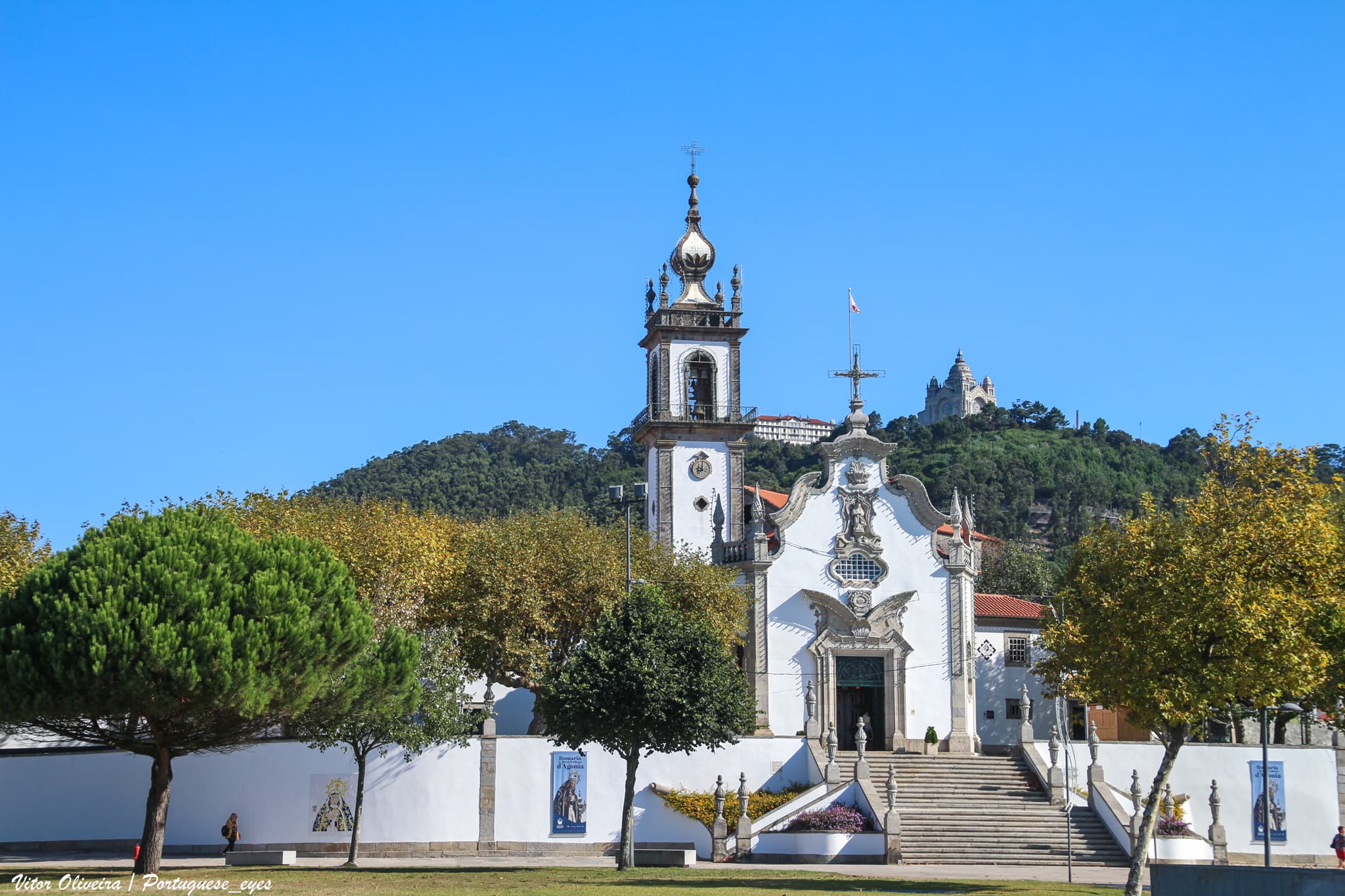
Image of Church of Nossa Senhora da Agonia. Image source
Visit essentials
A quick read before you go
- Duration
- A visit to the church interior alone takes well under an hour.
- Access
- Rua de Monserrate, 12, Viana do Castelo, within walking distance of the historic city center.
Overview
Nossa Senhora da Agonia takes her name from the specific anguish of a fisherman watching weather turn on open water far from Viana do Castelo's harbor. Devotion to her image, installed here in 1674, invokes the Virgin for safe return.
The working parish is open for daily Mass, with ex-votos dating to 1733 as painted testimonies of danger survived. Its detached bell tower accommodates the old custom of devotional circuits around the Baroque church.
Each August the church becomes the fixed point of one of Portugal's largest folk-religious festivals: Solemn Mass on the forecourt leads to a sea procession, while women parade in inherited gold, sustaining a distinct regional identity alongside Marian devotion.
Why this place is sacred
The image entered a modest chapel — the Capela do Bom Jesus do Santo Sepulcro do Calvário — in 1674. Within decades, the enlarged church that replaced it (blessed in 1759) had become a fixed point of appeal for a coastal community whose livelihood depended on a genuinely dangerous stretch of Atlantic water.
Local tradition points to a treacherous run of coastline near a rock known as Penedo Ladrão, the 'Thief's Rock,' where storms drove boats toward the cliffs — an account that should be read as local lore rather than a documented hazard record, since no source in this research independently verifies it.
What can be documented is the accumulation: the oldest surviving ex-voto dates to 1733, and offerings continued long after, each one a discrete act of gratitude for a specific return. That accumulated weight — of fear answered, repeatedly, over centuries — is arguably what gives the site its gravity more than any single founding miracle.
A minority of lower-reliability sources frame the festival's intensity as evidence of a deeper substratum, describing the Romaria as a Christianized continuation of older regional rites with Celtic, Suebi, Visigothic, or Galician roots. This claim is not corroborated by any academic source located in the research for this site, and it should be treated as folk-historical framing rather than an established fact — see perspectives below for how it is handled.
The chapel was built to give the fishing and farming communities of Viana do Castelo a fixed place to direct prayers against shipwreck and hardship at sea. Its function was devotional and protective from the outset — there is no research indicating it served any other original purpose.
From a single small chapel in 1674 to an enlarged 18th-century church (1759) to, by the 20th and 21st centuries, the anchor of a nine-day municipal festival drawing crowds reported in the hundreds of thousands. The devotional core has remained stable even as the surrounding festival has grown into a distinct cultural institution in its own right.
Experience and orientation
Visit on an ordinary day and the church asks little of you beyond the respect due any working place of worship. The ex-votos are worth slowing down for — each one a specific person's specific fear, resolved, and recorded in paint rather than left to memory.
Visit during the Romaria and the experience changes register entirely. Regional coverage of the August 20 Procissão ao Mar describes a crowd carrying the images of Nossa Senhora da Agonia and Nossa Senhora dos Mares down to the water, a movement toward the sea that reverses, symbolically, the church's original purpose — the Virgin going out to meet the danger rather than waiting to receive thanks for surviving it.
Alongside this runs something with a different texture: the Desfile da Mordomia, where women wear multi-generational gold filigree jewelry as a form of display that is at once devotional, familial, and openly competitive in its craftsmanship. Visitors who come only for the religious procession and skip the costume and gold displays miss half of what the festival actually is; the two strands run in parallel rather than one subordinate to the other.
If you can only attend one day, August 20 concentrates the church's full range — Solemn Mass on the forecourt, the sea procession, and the general festival atmosphere all converge. If gold and costume interest you more than liturgy, the Festa do Traje and Desfile da Mordomia days offer that in more concentrated form, with less crowd competition than the 20th itself.
Context and lineage
The devotion's documented chronology is unusually precise for a folk shrine of this age: an image entered the Capela do Bom Jesus do Santo Sepulcro do Calvário in 1674; the primitive chapel was enlarged and the present church blessed in 1759; the annual romaria began in 1772; and in 1783 the Sagrada Congregação dos Ritos granted permission for a Solemn Mass on August 20, fixing the date that still anchors the festival.
One lower-reliability source states the Romaria 'has origins dating to the 15th century' — a claim not corroborated by the church's own documented chronology and likely conflating the general antiquity of Marian devotion in the Minho region with the specific age of this cult. The 1674/1772/1783 sequence, confirmed independently across multiple sources including Portuguese Wikipedia and municipal heritage listings, is treated here as the more reliable account.
The devotion passed from a fishing and farming community's private petitions in the late 17th century to a formally sanctioned annual public romaria by 1772, and from there into the 20th and 21st centuries as one of the largest folk-religious festivals in Portugal, now drawing visitors well beyond the original maritime community it served.
André Soares
artisan
The church's gilded Baroque altarpiece is attributed to Soares by one medium-reliability travel source; this attribution has not been independently corroborated by an academic or official primary source and should be read as probable rather than confirmed.
Pascoal Parente
artisan
Italian painter credited with the church's interior oil paintings.
Traditions and practice
Devotees historically left ex-voto paintings and objects in thanksgiving for safety at sea — the oldest surviving example dates to 1733. Pilgrims traditionally circled the church itself in devotional 'voltas,' a practice significant enough that the 1868 bell tower was deliberately built detached from the main structure to avoid obstructing it.
The modern festival runs roughly nine days bracketing August 20, the fixed feast date. It includes the Festa do Traje (costume festival), the Desfile da Mordomia (parade of women in traditional dress and heirloom gold), the Solemn Eucharistic Celebration and Procissão ao Mar on August 20 itself, the Romaria dos Pequeninos for children, a large Cortejo Histórico e Etnográfico, craft fairs, concertina and folk-song contests, and three nights of fireworks.
Attend the August 20 Mass on the church forecourt if the religious dimension draws you, then follow the crowd down to Cais dos Pilotos for the Procissão ao Mar — the movement from church to water makes the devotion's maritime origins legible in a way reading about it cannot.
If costume and craftsmanship interest you more, the Mordomia parade rewards close attention to the specific categories of dress — bride, mordoma, farmgirl, widow in black — each carrying distinct social meaning within the tradition.
Catholic Christianity
ActiveThe church is dedicated to Nossa Senhora da Agonia, a Marian devotion emerging in 1674 when an image entered the Capela do Bom Jesus do Santo Sepulcro do Calvário. The title reflects the anguish of fishermen and seafarers facing shipwreck; the Virgin was invoked as protector of those in mortal peril at sea. The oldest ex-voto, dated 1733, and the continuous accumulation of votive offerings testify to ongoing lived devotion, particularly among maritime and fishing communities.
Daily Mass and open worship continue year-round. The annual climax on August 20 features a Solemn Eucharistic Celebration on the church's forecourt followed by the Procissão ao Mar, in which the image of Nossa Senhora da Agonia is carried, alongside the image of Nossa Senhora dos Mares, to Cais dos Pilotos for the blessing of the sea and vessels. Votive offerings have historically been left by devotees giving thanks for safety at sea.
Minho Folk and Cultural Heritage
ActiveDistinct from, but intertwined with, the Catholic devotion, the Romaria da Agonia has become the premier living showcase of Alto Minho regional cultural identity: hand-embroidered regional costumes and, above all, the tradition of wearing multi-generational heirloom gold filigree jewelry, worn by women in the Mordomia parade. This dimension carries its own weight as a marker of regional pride, craftsmanship, and inherited material wealth, reportedly recognized locally as Intangible Cultural Heritage of Municipal Interest in 2013, though this specific designation was not independently confirmed against a primary government source in the research available.
The Festa do Traje and Desfile da Mordomia showcase women in wedding, stewardess, farmgirl, and widow/mourning costumes adorned with gold. The Cortejo Histórico e Etnográfico is a large-scale heritage parade, reported to involve thousands of participants, reenacting regional history and rural traditions. Craft fairs, concertina and folk-song competitions, and philharmonic band gatherings round out the program.
Perspectives and open questions
The church's history divides fairly cleanly between a well-documented institutional chronology and a set of popular claims about deeper cultural roots that the available research cannot verify. Holding both without collapsing one into the other is the honest approach here.
Scholarly perspective
The available sources converge on a documented 18th-century institutional origin for this specific cult: the 1674 devotion, the 1759 enlarged church, the 1772 start of the annual romaria, and 1783 permission for Solemn Mass, all tied concretely to a maritime and farming community's piety. No academic archaeological or ethnographic source was located in the research to independently adjudicate deeper claims about the festival's origins beyond this documented chronology.
Living and traditional perspectives
Within local and devotional tradition, the cult is understood squarely around protection from shipwreck and the perils faced by 'mareantes, pescadores, lavradores e gente do mar' — seafarers, fishermen, farmers, and people of the sea. The title 'da Agonia' names that struggle directly rather than softening it.
Alternative interpretations
A minority of lower-reliability sources — a travel blog and one festival-affiliated marketing blog — describe the Romaria as a Christianized continuation of older, pre-Christian regional rites with Celtic, Suebi, Visigothic, and Galician roots, and one of the same sources describes the festival's origins as reaching back to the 15th century. Neither claim is corroborated by an academic source in the research reviewed for this site.
They are presented here as popular folk-historical framing — the kind of story a festival tells about its own depth — rather than as established fact, and readers should weigh them accordingly.
Open questions
Whether any transmission exists between pre-Christian regional ritual practice and the specifically 1674-onward Marian cult remains undocumented. Likewise unresolved is whether the festival's folk-cultural intensity — the gold, the costume, the ethnographic parade — predates the formal Marian devotion, developed alongside it, or grew later as a separate tradition that attached itself to the same calendar date.
The precise identity of the church's architect is also unconfirmed; only the altarpiece has a name attached to it, and even that on a single source's authority.
Plan your visit
Access and arrival
Rua de Monserrate, 12, Viana do Castelo, within walking distance of the historic city center. Viana do Castelo is reachable by train and road from Porto, roughly 1 to 1.5 hours north along the coast.
Viana do Castelo offers lodging across price points in its historic center, a short walk from the church; booking well ahead of the August festival is strongly advised given documented crowd sizes.
Respectful visit
Modest dress is expected inside the church at any time, as at any working Catholic parish. During the festival, elaborate traditional costume is worn by designated parade participants; general visitors are not expected to dress in period or regional costume.
No documented restriction was found; photography is generally permitted and, given the festival's heavy tourism promotion, effectively encouraged. The same discretion expected during any active Mass elsewhere applies here.
Ex-voto offerings have historically been left by devotees, particularly fishermen, in thanksgiving for safety at sea; the oldest recorded example is dated 1733. Contemporary offering customs at the church were not further detailed in the sources reviewed.
None documented beyond standard respectful conduct during Mass and processions.
Direct ritual roles — carrying the processional images, official parade positions — are reserved for local confraternities and designated participants; visitors should not expect to join these directly. During Mass, standard church conduct applies regardless of the festival atmosphere outside.
Location
Map loads as you approach this section.
Pilgrim reflections
A portrait of encounter, not a score
Pilgrims describe what they felt, how present they could become, and whether the place would shape a journey. There are no stars and no ranking of traditions.
No reviewed reflections yet
The first pilgrims can help describe the character of being here.
Share a reflection
Available after an account-backed “Been there.” Every reflection is reviewed before publication.
Nearby sacred places
Explore other sacred places in the region. Proximity does not establish access or travel time; check each place’s guidance.


References
Sources consulted for this page. Source categories describe the publication, not a guarantee that every claim is verified. Traditional accounts and outside interpretations may differ.
- 01Igreja de Nossa Senhora da Agonia — Câmara Municipal de Viana do Castelo — Câmara Municipal de Viana do CasteloofficialOfficial municipal heritage listing: 18th-century Baroque temple, location (Rua de Monserrate), the Procissão ao Mar tradition with Nossa Senhora dos Mares, visiting hours.
- 02Romaria de Nossa Senhora da Agonia — Câmara Municipal de Viana do Castelo (Património Cultural) — Câmara Municipal de Viana do CasteloofficialOfficial municipal cultural-heritage page on the romaria itself, distinct from the church listing.
- 03Festas d'Agonia — Programa 2026 — Festas d'Agonia (official festival organization)officialOfficial current-year festival program; primary source for specific 2026 event dates and schedule of ceremonies.
- 04Romaria de Nossa Senhora da Agonia – Wikipédia, a enciclopédia livre — Wikipedia contributorsacademicConfirms 1674 origin of devotion, 1772 start of annual romaria, 1783 permission for Solemn Mass on August 20; general festival structure.
- 05Capela de Nossa Senhora da Agonia – Wikipédia, a enciclopédia livre — Wikipedia contributorsacademicCorroborates chapel history and octagonal single-nave architecture; site classification as chapel/sanctuary.
- 06Igreja da Senhora da Agonia (Séc. XVIII) — Olhar Viana do CasteloSource contextLocal heritage blog corroborating 18th-century reconstruction, octagonal nave-to-altar design, 1868 detached bell tower built to avoid obstructing the ritual processional 'voltas' around the church.
- 07Church of Our Lady of Agony — Portugal Visitor Travel GuideSource contextDescribes 1674 founding chapel dedicated to Bom Jesus do Santo Sepulcro do Calvário, 1759 blessing of enlarged church, Baroque/Luso-Brazilian gilded altarpiece attributed to André Soares, oil paintings by Pascoal Parente, oldest ex-voto dated 1733, 1868 bell tower.
- 08Romaria de Nossa Senhora da Agonia — AltoMinho (regional tourism entity)officialRegional tourism-board coverage of the sanctuary and romaria, corroborating fishing-community devotional origin.
- 09Romaria d'Agonia 2026 - 07 a 23 de Agosto: Programa Completo — dagonia.ptSource contextDetailed 2026 program: Festa do Traje (Aug 18), Desfile da Mordomia (Aug 19), Eucharistic Solemnity and Procissão ao Mar (Aug 20), Romaria dos Pequeninos (Aug 21), Cortejo Histórico/Etnográfico (Aug 22), three fireworks nights.
- 10Viana: Já há data para a Romaria d'Agonia (e são 8 dias de festa) — O MinhoSource contextRegional press confirming the multi-day (8-9 day) span of the festival bracketing August 20.
- 11Our Lady of the Agony Church - Viana do Castelo — Caminhos da Fé / Paths of FaithspiritualDevotional travel source describing the festival's timing as 'first weekend after the 15th of August' and its connection to seafarer devotion.
- 12Romaria d'Agonia: The most beautiful traditional festival in Portugal — Olá DanielaSource contextTravel blog; used with epistemic caution for descriptive color on the Mordomia parade, costume categories (stewardesses, morgadas, farmgirls, brides in black), and gold-jewelry display customs — corroborated in substance by higher-reliability sources but this specific source is a personal travel blog.
- 13Festas d'Agonia: The pilgrimage that unites tradition and modernity — dagonia.ptSource contextSource of the 'origins dating to the 15th century' and 'declared Intangible Cultural Heritage of Municipal Interest in 2013' claims; used with epistemic caution — the 15th-century claim conflicts with the better-corroborated 1674/1772/1783 chronology (see conflicts_noted). The 2013 municipal ICH designation claim is plausible but not independently corroborated by an official government source in this pass.
Share a photo
Help visitors recognize Church of Nossa Senhora da Agonia. Every submission is reviewed before publication.