Sanctuary of Panóias
Where a Roman senator carved the instructions for entering the underworld
Understand sacred places, explore living traditions, and learn how to engage respectfully with Pilgrim Map.
Access has not been verified. Check current local guidance before planning a visit.
Vila Real, Vila Real, Portugal
Read the sources
Visit essentials
A quick read before you go
- Duration
- 45 minutes to 1.5 hours, including the on-site exhibition and interpretation center.
- Access
- Located in Vale de Nogueiras (Assento), part of the União de Freguesias de Constantim e Vale de…
Overview
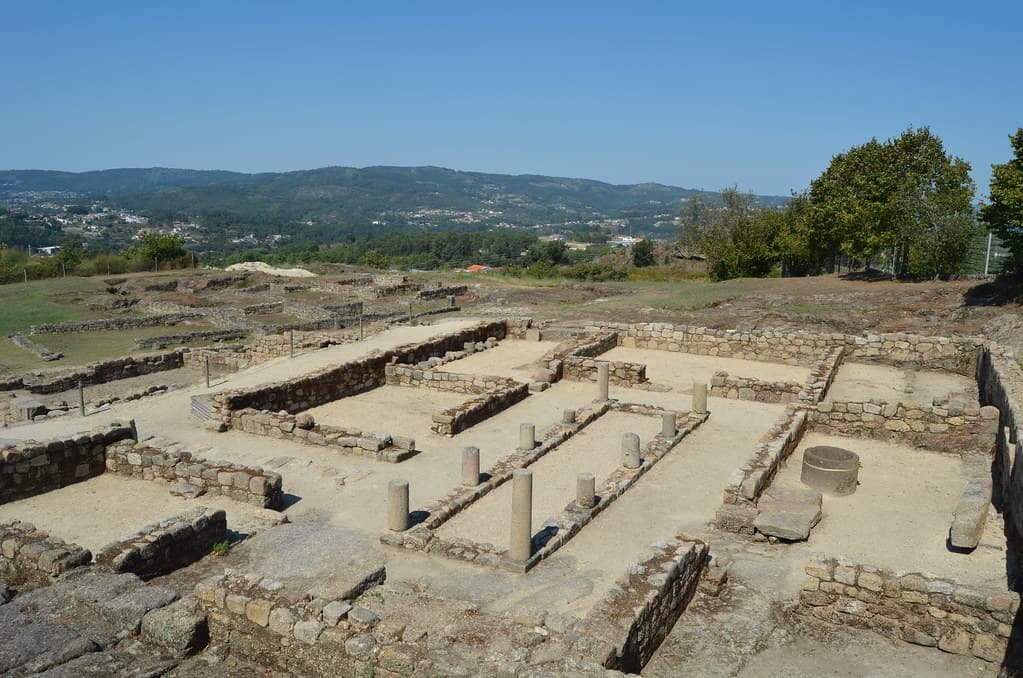
Panóias preserves something like operating instructions for a lost religion. Granite outcrops hold purpose-cut cavities—small ones for collecting blood, larger rectangular ones for burning viscera, and a round hollow for roasting meat—beside Latin and Greek inscriptions that name the god, describe the sequence, and promise initiates a kind of death and return. Few Roman-era religious sites preserve so much of their internal logic.
Its history has two layers. Two altars on the outcrop's eastern side predate Roman contact, showing that the region's Gallaeci population already treated the granite as significant. Around the turn of the 2nd and 3rd centuries CE, Roman senator Gaius Calpurnius Rufinus enlarged and rededicated the site to Serapis—a Greco-Egyptian god joining underworld and healing attributes—and other, harsher gods of that realm.
His inscriptions also named local Lapitean deities, folding indigenous sacred memory into the imported mystery religion rather than erasing it.
Mystery cults were widespread across the Roman world; what distinguishes Panóias is the survival of its own instructions in permanent stone instead of initiation and secrecy alone. Visitors can follow a ritual sequence explained in the dedicator's own words, a rare encounter most Roman sanctuaries do not offer.
Why this place is sacred
The site's natural granite occupies its own category of strangeness before any human intervention: weathered, cavity-pocked outcrops that read as already otherworldly, likely part of why Gallaeci settlers marked the ground sacred with the two altars that predate Rufinus's Roman-era sanctuary. Human hands enlarged the natural hollows into deliberate ritual cavities — laciculi for blood, lacus for burning viscera, a gastra for roasting meat — turning geology into apparatus (see Practices for the sequence itself).
What sets Panóias apart from other Roman religious sites is textual rather than architectural: five inscriptions, three in Latin, one in Greek, and one now lost but reconstructed from earlier scholarly transcription, spell out the ritual in the dedicator's own words rather than through outside description.
One inscription frames initiation explicitly as symbolic death, burial, and resurrection — language that positions the granite outcrop as a literal threshold between the world of the living and the underworld realm of Serapis, who in the Greco-Egyptian tradition merges with Pluto/Hades.
The layering of indigenous and imported sacred claims onto the same stone — Lapitean deities named beside Serapis in the same inscriptions — suggests continuity of purpose across radically different belief systems: whatever the Gallaeci understood about this granite before Rome arrived, Rufinus's dedication did not discard it but absorbed it into his own religious project.
The two pre-Roman altars indicate the outcrop functioned as an indigenous Gallaeci sacred site before Roman contact, though the specific rites performed there are not established in available sources. Rufinus's Roman-era intervention repurposed and formalized this older sacred ground into a mystery-cult sanctuary with an explicit initiatory function: preparing followers, through a sequence of purification, sacrifice, and revelation, to receive the highest name of Serapis.
Panóias functioned as an active initiation sanctuary for some period following Rufinus's dedication, sometime in the late 2nd to early 3rd century CE, though how long the mystery cult continued to draw initiates after his death is not documented. After the decline of Roman religious practice in the region, the site fell out of active use; no medieval or later religious community appears to have repurposed the outcrops for new worship.
Today it survives purely as a state-managed archaeological monument, its meaning accessible only through the inscriptions Rufinus left behind and the interpretive work of modern epigraphers, chief among them Géza Alföldy, whose analysis established the current scholarly reading of the site.
Experience and orientation
The outcrops themselves do much of the work before any inscription is read. Naturally weathered and pocked with hollows, then deliberately enlarged by human hands into cavities of specific size and function, the granite reads as ritual apparatus rather than simple monument — the sequence an initiate might once have followed is traceable simply by moving from cavity to cavity.
The on-site exhibition center supplies what the stone alone cannot: translation of the Latin and Greek inscriptions, context for Rufinus and the cult of Serapis, and explanation of the two much older, plainer altars set apart on the eastern side of the outcrop.
Many visitors report that the sanctuary's explicitness — a religion that usually guarded its mysteries through secrecy here choosing to carve its own instructions into permanent stone — produces something closer to encounter than observation: a rare, close approach to an ancient ritual mindset confronting mortality and transformation in the dedicator's own words, rather than through later description or myth.
The setting itself, an open granite enclosure in the inland hills of Trás-os-Montes, offers little of the drama of a walled temple or grand ruin. What holds attention instead is the density of meaning packed into a relatively small, unassuming outcrop — several inscriptions, dozens of carved features, two belief systems overlapping on one surface.
Panóias rewards attention paid to sequence rather than spectacle. Rather than photographing the outcrops as a single scene, trace the ritual path the inscriptions describe — purification, sacrifice, revelation — cavity by cavity, using the exhibition center's translations as a guide. The site is compact enough to walk in under an hour, but the density of inscribed instruction means a slower pass yields more than a quick circuit.
Visiting outside peak midday hours, when the granite is less harshly lit, also makes the carved cavities and inscriptions easier to read directly off the stone.
Context and lineage
The pre-Roman altars carry no surviving origin myth of their own — whatever story the Gallaeci told about this ground before Rome arrived has not come down to us.
The Roman-era layer, by contrast, wrote its own origin story directly into stone: Rufinus, a man of senatorial rank, personally dedicated the enlarged sanctuary and its rites to Serapis and the other gods he names, effectively authoring the site's founding narrative in the first person rather than leaving it to later tradition or legend.
How long Panóias functioned as an active initiation site after Rufinus's dedication is not established in available sources — the sanctuary may have drawn initiates for a generation or considerably longer before Roman religious practice in the region declined. Unlike many hilltop sacred sites in Iberia, Panóias does not appear to have been reconsecrated by a later Christian community; it simply fell silent.
Modern interest began with 20th-century epigraphic study, reaching its most influential form in Géza Alföldy's analysis, which remains the foundational scholarly reading of the site today.
Gaius Calpurnius Rufinus
historical
Roman senator of clarissimus rank who commissioned, enlarged, and dedicated the Panóias sanctuary to Serapis and the Infernal gods around the turn of the 2nd–3rd century CE, inscribing its ritual sequence directly into the rock.
Géza Alföldy
scholar
Modern epigrapher and historian whose analysis established the foundational scholarly interpretation of Panóias as a mystery-cult initiation sanctuary governed by an inscribed sacred law.
Serapis
deity
Syncretic Greco-Egyptian deity identified with Pluto/Hades, honored at Panóias as god of both the underworld and healing; the sanctuary's principal dedicatee.
The Lapiteas
deity
Indigenous deities named in the Roman-era inscriptions, including a mountain divinity rendered in some sources as Reva Marandiguius, showing that Rufinus's dedication incorporated rather than erased the site's earlier sacred identity.
Traditions and practice
The inscriptions describe a specific sequence. Initiates first underwent purification at ritual ponds called lavacra. Priests wearing white robes and crowns then sacrificed animals — not humans, despite the sanctuary's dramatic reputation — with the blood collected into small carved cavities known as laciculi. Viscera were burned in larger rectangular cavities, the lacus, while meat was roasted in a round cavity called a gastra and ritually consumed.
At some point in the sequence, initiates received revelation of the god's true or highest name. A final purification, using blood, butter, and oil, closed the rite. Indigenous pre-Roman ritual practice at the two earlier altars is not described in comparable detail in available sources.
No community performs this ritual today, and no reenactment or participatory ceremony is offered on-site. Contemporary engagement is entirely interpretive: the on-site exhibition center explains the inscriptions and their translation, and visitors move through the outcrops self-guided, reconstructing the sequence intellectually rather than ritually.
Visitors seeking more than a walk past carved rocks might use the exhibition center's translations to trace the sequence in order — purification, sacrifice, revelation, closing purification — pausing at each cavity to consider what it would have meant to move through this space as an initiate expecting genuine transformation, even symbolic death.
Reading the surviving inscriptions as first-person testimony, rather than archaeological description, changes the encounter: this is one of the only places where an ancient mystery cult explains itself in its own words. Comparing the plain, undecorated pre-Roman altars to Rufinus's elaborately inscribed additions can also sharpen a sense of just how much the Roman-era intervention changed what this ground was asked to do.
Pre-Roman Indigenous Cult (Lapitean/Gallaeci)
HistoricalTwo surviving pre-Roman altars on the eastern side of the site indicate the granite outcrop was already regarded as sacred before the Roman-era sanctuary was constructed, and later Roman-period inscriptions explicitly name the indigenous Lapitean deities alongside Serapis rather than displacing them.
Specific pre-Roman ritual practice at Panóias is not well documented beyond the existence of the two altars.
Mystery Cult of Serapis and the Infernal Gods
HistoricalPanóias is one of only two known sanctuaries for Eastern mystery cults in the Iberian Peninsula. Dedicatory inscriptions commissioned by the senator Rufinus consecrate the site to Serapis and other Infernal gods, with one inscription describing initiates undergoing symbolic ritual death, burial, and resurrection.
A precise sequential initiation ritual carved directly into the rock — see Practices for the full sequence of purification, sacrifice, and revelation.
Heritage Stewardship & Archaeological Research
ActiveSince Alföldy's foundational epigraphic analysis, Panóias has remained a site of active scholarly interest, protected under the Direção-Geral do Património Cultural with an on-site exhibition center supporting ongoing interpretation of its inscriptions.
State-managed conservation, interpretive exhibition, and continued epigraphic and archaeological study of the site's inscriptions and ritual cavities.
Perspectives and open questions
Panóias supports at least three readings that need not resolve into one: mainstream archaeology's confident dating and interpretation of the visible sanctuary, the fragmentary trace of an indigenous sacred layer the Romans absorbed rather than erased, and a popular 'megalithic' framing that overstates the site's antiquity but responds to something real in its atmosphere.
Scholarly perspective
Mainstream archaeology and epigraphy, following Géza Alföldy's foundational analysis, treats Panóias as a genuine Roman-era mystery-cult sanctuary dedicated to Serapis and the underworld gods, built by the senator Rufinus over an earlier indigenous sacred site marked by two pre-Roman altars. The surviving inscriptions are read as an actual sacred law specifying the initiation sequence, making Panóias exceptionally well documented compared to most mystery cults, which are typically known only through outside description rather than their own instructions.
Sources vary slightly on the founding date, giving either the end of the 2nd century or the early 3rd century CE — likely reflecting the same transitional period across the Severan dynasty rather than a genuine disagreement.
Living and traditional perspectives
No continuous indigenous or Gallaeci community survives to offer a present-day traditional perspective on the site. What is known of the pre-Roman layer — including the Lapitean deities and a mountain divinity some sources render as Reva Marandiguius — comes entirely through the same Roman-era inscriptions that name them, meaning even the 'indigenous' voice at Panóias reaches us filtered through Rufinus's Roman project.
Alternative interpretations
Some sources describe Panóias as a 'megalithic sanctuary,' implying prehistoric monumental origins — though this framing is not confirmed by the mainstream dating of the visible sanctuary structure to the Roman period. Alternative interpretations of this kind respond to something genuine: the two pre-Roman altars really do predate Rufinus's intervention, and the outcrop's ancient, strange atmosphere lends itself to framings that stretch its documented age.
Open questions
The full nature and pantheon of the indigenous Lapitean deities remains only partially understood, known solely through the Roman-era inscriptions that reference them. It is not established how continuously or extensively the site was used for cult activity before Rufinus's intervention, nor precisely why this particular outcrop, among many in the region, was chosen for one of only two known Iberian sanctuaries dedicated to Eastern mystery cults.
Plan your visit
Access and arrival
Located in Vale de Nogueiras (Assento), part of the União de Freguesias de Constantim e Vale de Nogueiras, Vila Real municipality, roughly 7 km from the city of Vila Real via the EN 578 road. The visitor address is Lugar do Asseto, 5000-751 Vila Real. No site-specific mobile signal information was documented in research; Vila Real, 7 km away, has reliable coverage should visitors need it.
No specific accommodation information near Panóias was available in research; Vila Real, roughly 7 km away, offers standard regional lodging — check current listings for details.
Respectful visit
No dress code applies. Sturdy footwear is recommended given the uneven granite terrain across the open-air enclosure.
No specific restriction is noted in official visitor materials for the outdoor site; standard heritage-site courtesy applies.
None are appropriate. The sanctuary is a protected archaeological monument rather than an active cult site, whatever its inscribed instructions once prescribed.
Visitors should not climb on, touch invasively, or remove material from the inscribed rock surfaces. The site is closed on January 1, Easter Sunday, May 1, December 25, and the Vila Real municipal holiday of June 13.
Do not climb on, touch invasively, or attempt to interact with the inscribed rock surfaces — the carvings are irreplaceable primary evidence, not props. No offerings or ritual reenactment should be performed on-site; the sanctuary is a protected monument, not a functioning cult site, however evocative its instructions remain.
Location
Map loads as you approach this section.
Pilgrim reflections
A portrait of encounter, not a score
Pilgrims describe what they felt, how present they could become, and whether the place would shape a journey. There are no stars and no ranking of traditions.
No reviewed reflections yet
The first pilgrims can help describe the character of being here.
Share a reflection
Available after an account-backed “Been there.” Every reflection is reviewed before publication.
Nearby sacred places
Explore other sacred places in the region. Proximity does not establish access or travel time; check each place’s guidance.



References
Sources consulted for this page. Source categories describe the publication, not a guarantee that every claim is verified. Traditional accounts and outside interpretations may differ.
- 01Panóias Sanctuary — Bilheteira, Direção-Geral do Património Cultural / Cultura Norte — Direção-Geral do Património Cultural (Portugal)officialOfficial Portuguese government visitor information: opening hours, admission prices, address, closure dates
- 02Panóias Sanctuary — Loja Online, Direção-Geral do Património Cultural — Direção-Geral do Património Cultural (Portugal)officialOfficial Portuguese heritage-body description of the sanctuary, its Oriental cult status, and dedication
- 03Renewing the Past: Rufinus' Appropriation of the Sacred Site of Panóias (Vila Real, Portugal) — ResearchGate contributors (peer-reviewed article)academicAcademic analysis of how the Roman senator Rufinus repurposed a pre-existing indigenous sacred site for the mystery cult of Serapis and the Infernal gods
- 04Panoias Sanctuary — Wikipedia — Wikipedia contributorsSource contextDetailed overview of inscriptions, deities, ritual sequence, Rufinus, and scholarly interpretation (Alföldy); cites primary epigraphic content
- 05Santuário Rupestre de Panóias (Panoias Sanctuary) in Vale de Nogueiras — Atlas ObscuraSource contextVisitor-oriented description including on-site exhibition center and historical note that only part of the originally documented rocks remain accessible
- 06The Roman Sanctuary of Panóias in Portugal, Dedicated to Serapis and the Gods of Hades, Is Unique in the World — HistoryBackSource contextPopular but well-sourced overview of the ritual sequence (sacrifice, blood offering, viscera-burning, revelation, purification) and the site's uniqueness in the Iberian Peninsula
- 07Sanctuary of Panóias — Resources, Eixo Atlántico — Eixo Atlántico do Noroeste PeninsularSource contextRegional cross-border (Galicia-Norte Portugal) cultural tourism description of the sanctuary
- 08Panoias Megalithic Sanctuary in Portugal — The Ancient ConnectionSource contextPopular/alternative-archaeology framing describing the site as 'megalithic'; included to document how the site is discussed outside mainstream scholarship, not as an authoritative dating source
Share a photo
Help visitors recognize Sanctuary of Panóias. Every submission is reviewed before publication.