Tongobriga
A Roman town built over a hillfort, in a village still lived in today
Understand sacred places, explore living traditions, and learn how to engage respectfully with Pilgrim Map.
Access has not been verified. Check current local guidance before planning a visit.
Marco de Canaveses, Porto, Portugal
Read the sources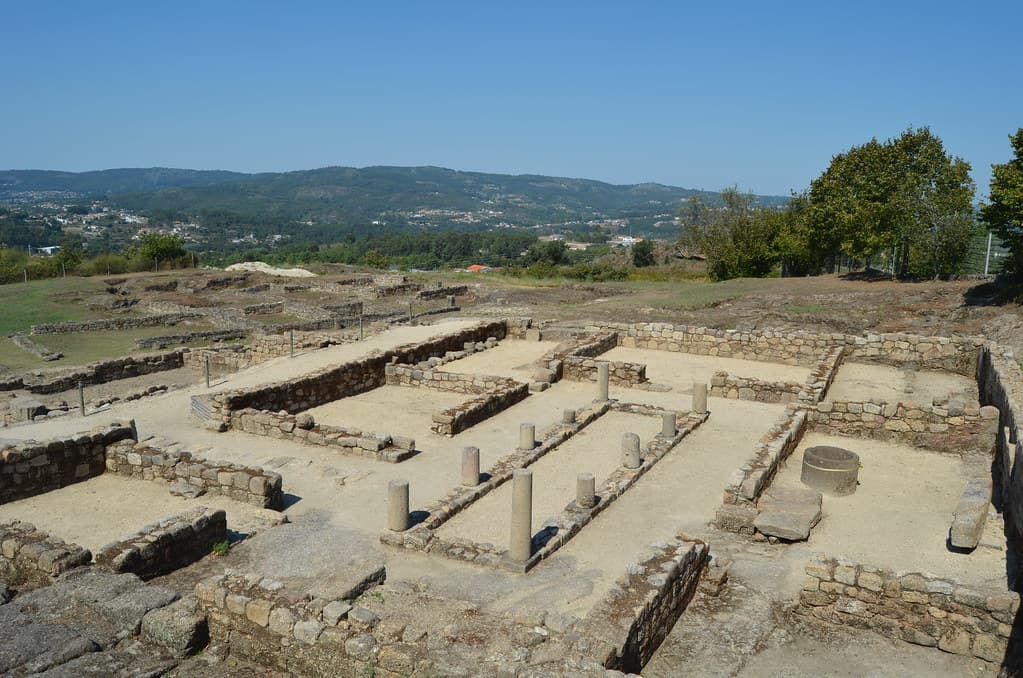
Image of Tongobriga. Image source
Visit essentials
A quick read before you go
- Duration
- Not stated precisely in sources reviewed; a self-guided visit including the interpretive center,…
- Access
- The site is at Rua António Correia Vasconcelos nº 51, 4630-095 Freixo, in the municipality of…
Overview
Tongobriga began as a hillfort of the Castro culture, the Iron Age population of northwestern Iberia. Roughly a century after Rome conquered this part of Lusitania, it was remade as a gridded town in the late 1st or early 2nd century AD. Surviving remains include a forum bordered by administrative, commercial, and religious buildings, a Roman bath complex, and beneath it a pre-Roman rock-cut bath.
A 5th-century Palaeochristian basilica marks the region's Christian turn. Tongobriga retained administrative and ecclesiastical importance into the 7th century as a recorded Suevi-era parish referenced in Visigothic church reorganization under King Wamba.
Excavation began in 1980 at a place locally called "Capela dos Mouros." From 2004 to 2009, a Brown University-led program studied residential architecture in detail. In Freixo, the modern parish church of Santa Maria sits directly above Roman house remains and mosaics, a still-functioning expression of the continuity this place has carried for two thousand years.
Why this place is sacred
Sources confirm that Tongobriga's Roman forum was bordered by religious as well as commercial and administrative buildings, but none of the available research names these structures, describes their architecture in detail, or identifies which deity or deities were honored there.
Regionally, Lusitanian and Gallaecian indigenous gods such as Endovelicus and Bandua were widely syncretized with Roman deities across northwestern Iberia in this period, but no inscription or dedication tying such a cult specifically to Tongobriga has been located in the research gathered for this entry — this is a genuine gap in the record, not an inference to be filled in.
Earlier still, the Castro-culture hillfort that preceded the Roman town built a rock-cut bath, a facility type associated regionally with communal bathing or purification practice among Iron Age hillfort communities in northern Portugal, though no source describes specific ritual content at this site.
What is documented more clearly is the site's Christian layer: a 5th-century Palaeochristian basilica stands within the archaeological area, and historical references place Tongobriga as a Suevi-era parish in the 5th century and within Visigothic ecclesiastical reorganization under King Wamba in the 7th century.
The modern parish church of Santa Maria, built over Roman house remains with surviving mosaics in the overlying village of Freixo, extends that Christian continuity into the present, though it functions as an active local church rather than part of the archaeological site itself.
Castro-culture Iron Age hillfort (undated precisely, pre-Roman) → Roman administrative town built over the hillfort (late 1st-early 2nd c. AD) → Suevi-era parish (5th c.) → Palaeochristian basilica in use (5th c.) → Visigothic ecclesiastical reorganization under King Wamba (7th c.) → National Monument classification (1986) → Brown University collaborative excavation program (2004-2009).
Experience and orientation
Tongobriga is unusual among Roman sites for sitting inside a settlement that never fully emptied out: a dozen or so buildings of the village of Freixo stand among and around the excavated ruins, so a visit involves walking past inhabited houses on the way to the forum rather than approaching an isolated field.
The forum itself, with its bordering religious, commercial, and administrative structures, gives the clearest sense of the town's Roman-era civic scale, while the bath complex and the older, pre-Roman rock-cut bath beneath it let a visitor trace two different populations' use of water on the same ground.
The interpretive center's exhibitions focus on the transition of the indigenous Castro-culture population into Roman life, a framing shaped substantially by the Brown University-led excavations of 2004-2009, which studied named residential structures such as the 'House of the Spiral' and the 'House of Auscus' for evidence of exactly this kind of cultural change.
An auditorium screens documentaries on the site's history, and the surrounding Douro Valley vineyard landscape is visible from the ruins themselves, a reminder that this stretch of countryside has been continuously worked and inhabited since well before Rome arrived.
Start at the interpretive center for the Castro-to-Roman transition narrative, then walk the forum and its bordering buildings before descending to the bath complex, where the pre-Roman rock-cut bath sits beneath the Roman-era facility.
Context and lineage
The name 'Tongobriga' is generally read as Celtic-Iberian in origin, combining 'tong,' meaning a place of gathering or assembly, with 'briga,' meaning a fortified settlement on high ground — suggesting the site was understood by its founders as a communal meeting place rather than named for a person or deity.
The 2nd-century-AD geographer Ptolemy recorded a town called 'Tuntobriga' in the territory of the Callaeci Bracari, between the Douro and Minho rivers, generally identified with this site, giving Tongobriga one of the few ancient literary references to a Roman-era settlement in this part of Lusitania.
Tongobriga's religious lineage moves from an undocumented Castro-culture Iron Age practice, through a Romano-Lusitanian civic religion whose specific site-level cult content was never recorded, to Christianity from the 5th century onward — a regional pattern rather than a lineage unique to this site.
Ptolemy
2nd-century AD geographer whose 'Geography' records a town called Tuntobriga in this region, generally identified with Tongobriga — the earliest surviving documentary reference to the site
Prof. Rolf Winkes
Brown University archaeologist who directed the 2004-2009 collaborative excavation program with the Portuguese Ministry of Culture, the Universidade de São Paulo, and Deree - The American College of Greece, focused on the site's residential architecture and cultural change
The Castro-culture community (unnamed)
The indigenous Iron Age population, estimated at up to 2,000 people, who built the hillfort and its rock-cut bath before Roman redevelopment; no individual names survive
Direção-Geral do Património Cultural / Direção Regional da Cultura do Norte
Portugal's national and regional heritage authorities, responsible for the site's 1986 National Monument classification and its ongoing management, ticketing, and interpretive-center operation
Traditions and practice
Specific ritual practice at Tongobriga itself is not documented for any period. What can be inferred, cautiously, is that the Castro-culture rock-cut bath reflects a regional pattern of communal bathing associated with Iron Age hillfort life in northern Portugal, and that the Roman-era religious buildings bordering the forum served the kind of civic and household religion typical of a Roman provincial town — but no source names a specific deity, festival, or rite tied to this site.
None; the site is a managed archaeological monument and open-air museum. A local hiking trail, PR6 - Caminhos de Tongóbriga, passes through the area, used for recreational and heritage walking rather than any devotional practice.
Walk from the bath complex down to the pre-Roman rock-cut bath beneath it, noting how two different populations, centuries apart, chose the same spot for structures built around water. At the forum, take time to look for where sources describe religious buildings bordering the commercial and administrative ones, even though their specific form is not detailed in available research — the absence of architectural specificity here is itself worth sitting with, rather than resolving into a guess.
Castro culture (indigenous Iron Age religion, pre-Roman)
HistoricalThe hillfort predating the Roman city was home to an Iron Age Castro-culture population, estimated at up to 2,000 people, who built a rock-cut bath facility of a type associated regionally with communal bathing or purification practice at northwestern Iberian hillforts.
Specific ritual practices at this particular site are not documented; broader Castro-culture practice included communal bathing or sweat-bath rites at rock-cut facilities, a pattern attested regionally in northern Portugal.
Romano-Lusitanian religion
HistoricalFollowing Roman conquest, Tongobriga became a Roman administrative center with a forum bordered by religious as well as commercial and administrative buildings. No inscription or dedication specifically tying a cult, Roman or syncretized-Lusitanian, to Tongobriga has been located in available sources.
Early Christianity
HistoricalA 5th-century Palaeochristian basilica within the site marks the region's transition to Christianity following the fall of Roman authority; Tongobriga is also recorded as a Suevi-era parish in the 5th century and referenced in 7th-century Visigothic ecclesiastical reorganization under King Wamba.
Archaeological and heritage-conservation stewardship
ActiveSince excavation began in 1980 and through the sustained 2004-2009 Brown University-led research program, Tongobriga has remained an active site of archaeological study, managed as a National Monument (since 1986) with an interpretive center, auditorium, and ongoing exhibitions — a living tradition of research and stewardship distinct from any of the site's earlier religious identities.
Ongoing archaeological research, conservation, and ticketed heritage-tourism management under DGPC/DRCN.
Perspectives and open questions
Scholarship on Tongobriga centers on what the site demonstrates about Romanization — the process by which an indigenous population adapted to Roman rule — more than on any specific devotional content, which remains largely undocumented.
Scholarly perspective
Archaeologists agree that Tongobriga began as an indigenous Castro-culture hillfort settlement that was redeveloped into a Roman administrative town in the late 1st to early 2nd century AD, following a gridded urban plan while retaining and building over pre-existing native structures, including the rock-cut bath.
The site is treated as a valuable case study in Romanization and cultural change in northwestern Iberia, examined in detail through the 2004-2009 Brown University-led excavation program's focus on domestic architecture as evidence of shifting cultural identity.
Living and traditional perspectives
No living indigenous community or continuous traditional-custodian narrative is associated with the site today; the Castro-culture population's own religious self-understanding is inferred only indirectly, through structures like the rock-cut bath, rather than through any surviving oral tradition.
Open questions
The specific religious identity of the buildings bordering the Roman forum is not detailed with architectural specificity in any source reviewed — no named temple and no confirmed deity dedication exists for the site itself, leaving open which cults, Roman or syncretized-Lusitanian, were actually practiced there. No astronomical alignment has been documented at Tongobriga, though this appears to be an open question that has not been specifically studied, rather than a ruled-out possibility.
Plan your visit
Access and arrival
The site is at Rua António Correia Vasconcelos nº 51, 4630-095 Freixo, in the municipality of Marco de Canaveses, Porto district, about two miles south of the town of Marco de Canaveses in the Douro Valley wine region. Site contact: +351 255 531 090 or +351 934 057 060, email tongobriga@culturanorte.gov.pt. The site is managed by the Direção Regional da Cultura do Norte / DGPC, with ticketed entry offering separate or combined tickets for the interpretive center and the ruins.
Mobile phone signal specific to the site was not documented in sources reviewed; given its location within an inhabited village along a regional road network rather than a remote hillside, signal is likely available but visitors relying on this for navigation should confirm coverage before arrival — check with the Direção Regional da Cultura do Norte for current details if this matters for your visit.
Respectful visit
No specific restriction documented; general respectful-visitor conduct is expected, but no photography ban or permit requirement was found in the sources reviewed.
Standard site-preservation rules apply, such as staying on marked paths and not removing artifacts; no specific restriction list was located in sources reviewed. If current on-site signage states otherwise, follow the posted rules over this summary.
Standard site-preservation conduct applies: stay on marked paths and do not remove or handle loose material, as at any managed archaeological monument.
Location
Map loads as you approach this section.
Pilgrim reflections
A portrait of encounter, not a score
Pilgrims describe what they felt, how present they could become, and whether the place would shape a journey. There are no stars and no ranking of traditions.
No reviewed reflections yet
The first pilgrims can help describe the character of being here.
Share a reflection
Available after an account-backed “Been there.” Every reflection is reviewed before publication.
Nearby sacred places
Explore other sacred places in the region. Proximity does not establish access or travel time; check each place’s guidance.


References
Sources consulted for this page. Source categories describe the publication, not a guarantee that every claim is verified. Traditional accounts and outside interpretations may differ.
- 01Freixo/Tongobriga Archaeological Site — Tickets — Direção-Geral do Património Cultural (DGPC)officialOfficial heritage-body source. Confirms opening hours, ticket prices, address, 15-hectare extent, National Monument status since 1986, dating 'end of 1st century to beginning of 2nd century,' construction over a pre-existing castro/hillfort, and presence of a 5th-century Palaeochristian basilica indicating post-Roman continuity.
- 02Estação Arqueológica do Freixo - Tongobriga — Turismo de Portugal (visitportugal.com)officialNational tourism body source. Confirms site amenities (interpretive center, restaurant, auditorium), 15-hectare extent, National Monument classification, forum and baths dating to 1st-2nd century AD, and that the modern parish church of Santa Maria in Freixo sits atop Roman house ruins with mosaics.
- 03Tongobriga - Área Arqueológica do Freixo — Arquivo da Direção Regional da Cultura do NorteofficialRegional heritage-authority archive page for the site; listed as the managing body (site inaccessible for direct fetch due to certificate error, but corroborated via DGPC and visitportugal.com pages citing the same regional directorate).
- 04Tongobriga Excavations — Joukowsky Institute for Archaeology and the Ancient World — Brown University (Prof. Rolf Winkes, dir.)academicAcademic fieldwork record confirming Brown University's 2004-2009 collaborative excavation program with the Portuguese Ministry of Culture, Universidade de São Paulo, and Deree - The American College of Greece; studies of the 'House of the Spiral' and 'House of Auscus' residential structures.
- 05The Roman houses of Tongobriga: architecture and cultural change — Lab2PT - Landscape, Heritage and Territory Laboratory (CSIC journal, Arqueología de la Arquitectura)academicPeer-reviewed academic article on domestic architecture and Romanization at Tongobriga; listed as a source though full text could not be directly fetched (certificate error) — cited via search-result abstract confirming focus on cultural-change dynamics in Roman-era houses.
- 06Lusitanian mythology — Wikipedia contributorsencyclopediaGeneral background on pre-Roman Lusitanian religion (Endovelicus, Bandua, Ataegina) and its syncretism with Roman deities after conquest. Used only for regional context — no site-specific inscription or dedication at Tongobriga was found linking these deities directly to the site; flagged as a gap.
- 07Freixo, Tongobriga Archaeological Site — Direção-Geral do Património Cultural (DGPC) - Loja OnlineofficialOfficial heritage-body catalogue listing corroborating National Monument status and site identity; used as secondary confirmation.
- 08Off the Grid: Tongobriga, Portugal — Jason Urbanus, Archaeology Magazine (Archaeological Institute of America)academicConfirms Castro-culture Iron Age origins, Roman administrative-center status from late 1st c. AD, forum/theater/amphitheater, 1980 excavation start at 'Capela dos Mouros' revealing baths, pre-Roman rock-cut bath, site naming from an on-site inscription, interpretive center, and 2004 Brown University project under Prof. Rolf Winkes.
- 09Tongobriga: Summary of Brown University's Collaborative Excavations and Studies (2004-2009) — Rolf Winkes et al. (via academia.edu)academicAcademic paper summarizing the Brown-led excavation program; corroborates campaign years and research foci on Roman-era houses and cultural change from Iron Age to Roman occupation.
- 10Aldeia do Freixo / Cidade Romana de Tongobriga — Visit Marco (Município de Marco de Canaveses tourism portal)guideLocal municipal tourism listing for the site; page content could not be fully extracted in this research pass, included as a locator for further verification of local visitor amenities and municipal framing.
Share a photo
Help visitors recognize Tongobriga. Every submission is reviewed before publication.