Church of Santa Maria Madalena da Falperra
A Rococo facade above Braga, watching the city from a mountain of chapels
Understand sacred places, explore living traditions, and learn how to engage respectfully with Pilgrim Map.
Access has not been verified. Check current local guidance before planning a visit.
Braga, Braga, Portugal
Read the sources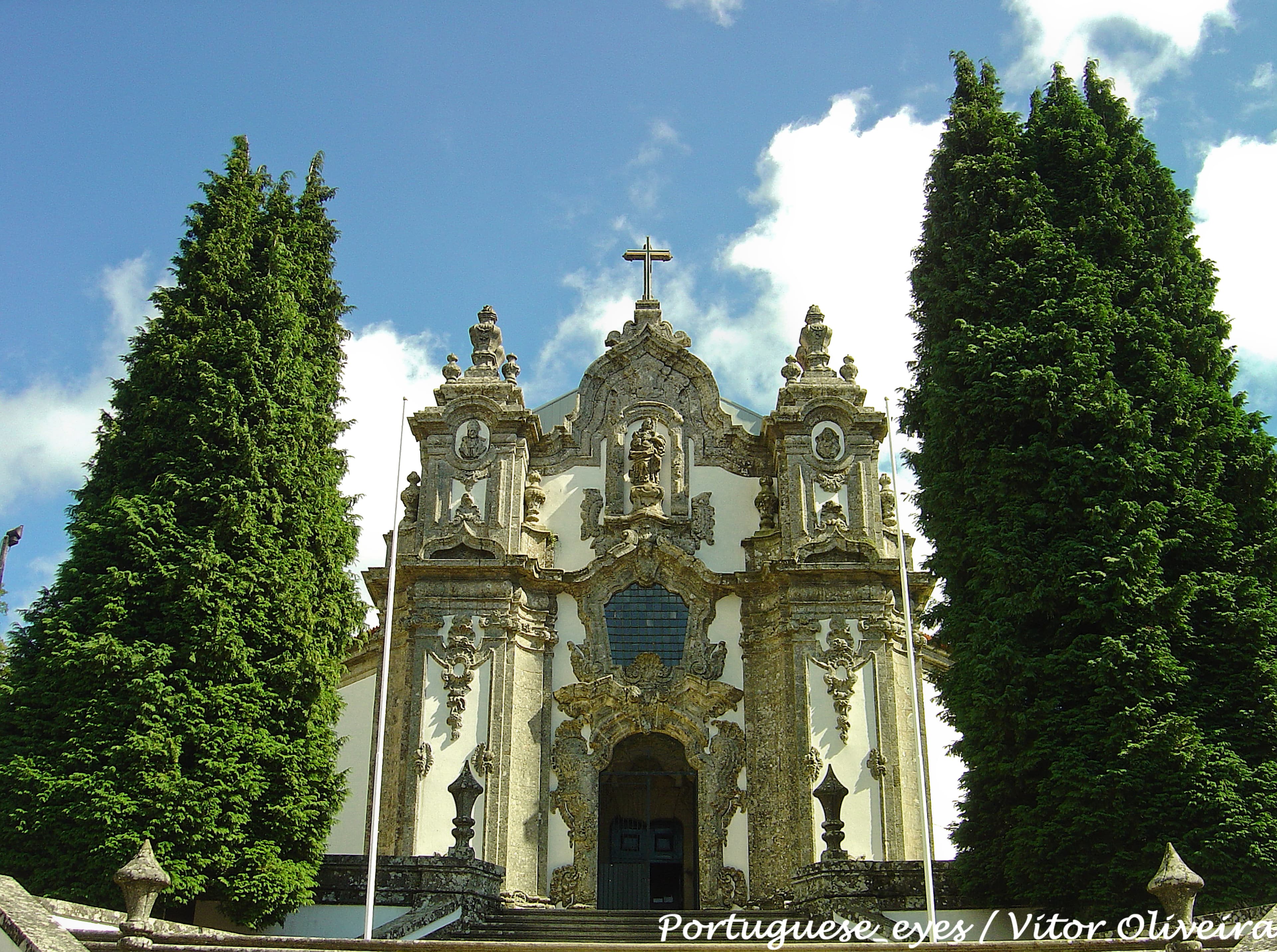
Image of Church of Santa Maria Madalena da Falperra. Image source
Visit essentials
A quick read before you go
- Duration
- Not documented in sources reviewed; as a single hilltop monument with an adjoining viewpoint, a…
- Access
- Reached by car via the N309 road up Serra da Falperra, or on foot along the traditional pilgrim…
Overview
Falperra's granite facade arrives first: rocaille curls frame Mary Magdalene enthroned between her siblings Martha and Lazarus. Braga-born sculptor-architect André Soares created this defining reconstruction after the 1755 earthquake damaged an earlier eighteenth-century church, at a point where Baroque structure gives way to lighter ornament.
The devotion is older. A chapel stood on the ridge under Archbishop D. Diogo de Sousa in the early sixteenth century, continuing a hilltop-veneration pattern later shared with Bom Jesus do Monte and Sameiro, both visible in clear weather.
Most visitors now come first to the adjoining Miradouro da Falperra for golden-hour views over Braga and the Minho countryside, and only second to the church, yet the church still holds Mass, remains in a local brotherhood's care, and gathers pilgrims each July.
Why this place is sacred
Braga's sacred landscape is built on elevation. Three hills ring the city, each crowned with a sanctuary meant to be seen from below: Bom Jesus do Monte to the east, Sameiro nearby, and Falperra to the southwest. Local devotional practice treats the ascent to any of them — on foot, by procession, or simply by looking up from the city streets — as spiritually meaningful in itself, elevation and visibility functioning as their own form of consecration.
Falperra's specific claim within that pattern combines a documented medieval chapel with the artistic weight of its eighteenth-century rebuilding. A chapel here under Archbishop D. Diogo de Sousa in the early sixteenth century passed to the Brotherhood of Falperra in 1676, which decided in 1693 to rebuild in a more visible position — the same visibility logic that shapes its neighboring sanctuaries.
When the 1755 earthquake damaged the resulting church, the Brotherhood turned to André Soares for the reconstruction that gives Falperra its present character, a granite facade regarded as one of the finer expressions of Rococo ornament applied to Northern Portuguese religious architecture.
Folklore attached to the wider mountain — a former haunt of robbers along the old Roman road, according to local retellings, and a nearby fountain said to have been built to frighten off bears — belongs to the landscape around the church rather than to the sanctuary's own founding narrative, and should be read as regional lore rather than documented history.
The Brotherhood of Falperra rebuilt the church at its present, more visible site starting in 1693, continuing construction into the 1730s; this earlier phase is attributed by one detailed source to architect Manuel Fernandes da Silva, while broader coverage credits the overall design to André Soares. After the 1755 earthquake damaged the church, the Brotherhood commissioned Soares for the reconstruction — facade, main altarpiece, and staircase — completed by 1781.
The medieval chapel that preceded the present church, documented under Archbishop D. Diogo de Sousa in the early sixteenth century, gave way in 1676 to Brotherhood stewardship and, from 1693, to outright rebuilding at a more visible position on the ridge. What stands today is substantially the post-1755 reconstruction, with the staircase itself rebuilt again in 1958.
The church was formally classified a Portuguese National Monument in 2016-2017, a recognition of its architectural standing rather than any change in its religious use, which has continued without interruption from the Brotherhood's stewardship to the present.
Experience and orientation
The road up Serra da Falperra switches back repeatedly before opening onto the ridge, and the view arrives before the church fully does — Braga spread out below, the Minho countryside beyond it, distance and haze doing most of the work that makes late afternoon the recommended time to arrive. The church stands just beside this viewpoint, close enough that the two are, in practice, a single stop rather than separate destinations.
Up close, the facade rewards slower attention than a viewpoint visit typically allows: the rocaille carving softening the granite, Mary Magdalene's statue at the center flanked by the smaller figures of Martha and Lazarus, the whole composition legible as a single devotional statement rather than decoration applied afterward.
What happens inside, during an ordinary visit outside Mass or the July romaria, is less documented — no detailed account of the interior's atmosphere was found in research for this site, a gap worth naming rather than filling with invention.
Arrive by the N309 in the late afternoon if the view is the priority; the light is best then, and the road is easiest to drive in daylight. If the church itself is the point of the visit, consider timing it around late July, when the wider Falperra romaria brings the sanctuary and its neighboring chapels back into active, crowded use rather than the quiet of an ordinary weekday.
Context and lineage
Documented history begins with a chapel recorded under Archbishop D. Diogo de Sousa (1461-1532) on Monte da Falperra. One detailed source dates an earlier chapel to the sixteenth century and its transfer to the Brotherhood of Falperra to 1676; the Brotherhood rebuilt at a more visible ridge position from 1693, with construction continuing through 1737, attributed by that source to architect Manuel Fernandes da Silva — though broader coverage credits the church's design generally to André Soares.
The 1755 earthquake damaged this church, and the Brotherhood, with Archbishop D. Rodrigo de Moura Teles, turned to Soares for the reconstructed facade, altarpiece, and staircase standing today, completed by around 1781. Local folklore about the wider mountain pass — a former robbers' haunt, a fountain built to frighten bears — belongs to the landscape rather than the church's founding, and is preserved here as folklore, not history.
The Brotherhood of Falperra has held continuous stewardship of the site since 1676, through its 1693-1737 rebuilding, the post-1755 Soares reconstruction, a 1958 staircase rebuild, and into its 2016-2017 National Monument classification — lay stewardship without interruption by any monastic community, distinguishing Falperra from convent-founded sanctuaries elsewhere in the region.
André Soares
architect
Braga-born sculptor-architect (1720-1769) credited with the church's celebrated granite facade, main altarpiece, retables, and staircase, commissioned after the 1755 earthquake. One of the defining works in the transition from Baroque structure to Rococo ornament in Northern Portuguese religious architecture.
D. Diogo de Sousa
archbishop
Archbishop of Braga (1461-1532) under whom an earlier chapel on the site is documented, establishing the mountain's devotional use well before the present church.
D. Rodrigo de Moura Teles
patron
Archbishop of Braga who commissioned André Soares for the post-earthquake reconstruction, continuing the archdiocese's broader pattern of hilltop sanctuary-building around the city.
Irmandade da Santa Maria Madalena de Falperra
steward
The lay Brotherhood of Falperra, which took charge of the site in 1676, decided in 1693 to rebuild at its present position, and has maintained the sanctuary across its subsequent reconstructions to the present day.
Policarpo de Oliveira Bernardes
artist
Ceramicist reportedly credited with the church's eighteenth-century interior azulejo tilework, according to a single municipal source; the claim is not confirmed by any academic source found.
Traditions and practice
Seventeenth-century Brotherhood records document a campaign of retable gilding and vestment offerings, evidence of active lay stewardship well before the present church existed. That stewardship tradition — rebuilding, regilding, maintaining the sanctuary across generations — continues today in the Brotherhood's ongoing custody of the site, even as the specific devotional acts have changed.
Mass and devotional visits continue at the church today. The wider Monte da Falperra romaria, documented most clearly for July 29 and centered on the neighboring Santa Marta do Leão chapel, draws pilgrims who climb the mountain — often on foot along Avenida da Madalena — visiting the chapels in sequence, with roasted young goat and vinho verde as the traditional festive fare.
Whether a distinct observance tied to Mary Magdalene's own July 22 feast day takes place at this specific church, separate from the July 29 romaria, is not confirmed by sources reviewed.
A visitor drawn to the devotional rather than scenic side of Falperra might time a trip to late July, joining the wider hilltop romaria on foot rather than driving directly to the viewpoint — the ascent itself, past the wayside cross and the Chapel of Santo António, is part of what the pilgrimage asks of those who make it.
Roman Catholic veneration of Saint Mary Magdalene
ActiveThe church is dedicated to Saint Mary Magdalene, whose statue occupies the central throne position of André Soares's granite facade, flanked by busts of Saint Martha and Saint Lazarus — her siblings in Catholic tradition — making this one of the more architecturally prominent Magdalene sanctuaries in the Braga region.
Mass and devotional visits continue at the church; historically, the Brotherhood of Falperra maintained the sanctuary through gilding and vestment offerings recorded from the seventeenth century, a stewardship pattern that continues in different form today.
Hilltop romaria culture of Monte da Falperra
ActiveMonte da Falperra hosts an interconnected complex of chapels — Santa Maria Madalena, Santa Marta do Leão, Santo António — that together form one of the larger traditional romarias of the Minho region, reflecting a regional pattern of combining Catholic devotion with communal outdoor festivity on saints' days.
Pilgrims climb the mountain, often on foot along Avenida da Madalena, visiting the chapels in sequence; traditional festive fare includes roasted young goat and vinho verde, documented mainly around the July 29 observance centered on the Santa Marta chapel.
Perspectives and open questions
Falperra is read most consistently through an architectural lens, as a key work of André Soares; the site's devotional and folkloric dimensions are less thoroughly documented, and honest treatment means naming that gap rather than smoothing over it.
Scholarly perspective
Art-historical sources agree the church's facade is a defining work of André Soares, exemplifying the shift from Baroque structural forms toward Rococo ornamental treatment of granite in Northern Portuguese religious architecture. Sources differ, however, on the precise construction chronology and on how much of the earlier 1694-1737 church — attributed by one detailed source to Manuel Fernandes da Silva — should be credited to Soares personally versus his later post-1755 reconstruction specifically.
Open questions
The scope of André Soares's authorship relative to Manuel Fernandes da Silva for different construction phases remains unresolved across sources. Likewise, whether a distinct festival tied to Mary Magdalene's own July 22 feast day is or was celebrated at this specific church, separate from the July 29 Santa Marta romaria on the same mountain, has not been resolved by sources found in research.
Plan your visit
Access and arrival
Reached by car via the N309 road up Serra da Falperra, or on foot along the traditional pilgrim path (Avenida da Madalena), which also passes a wayside cross, a chapel-oratory, the Chapel of Santo António, and the former Varatojo convent, now a hotel. No entrance fee is required for the exterior or viewpoint area.
Respectful visit
No site-specific dress code was found in sources reviewed; general modest-dress conventions for active Portuguese Catholic churches would reasonably apply, though this is not independently confirmed for Falperra specifically.
No explicit restriction was found. The adjacent Miradouro da Falperra is a popular, unrestricted photography spot, suggesting the exterior and grounds are similarly open; interior photography policy during services is not documented.
None identified beyond standard respectful-visitor conduct expected at an active place of worship.
No specific participatory rituals for tourists, as distinct from romaria pilgrims, are documented in sources reviewed. Visitors should not assume the same access or atmosphere on an ordinary day as during the July romaria, when the mountain draws considerably larger crowds.
Location
Map loads as you approach this section.
Pilgrim reflections
A portrait of encounter, not a score
Pilgrims describe what they felt, how present they could become, and whether the place would shape a journey. There are no stars and no ranking of traditions.
No reviewed reflections yet
The first pilgrims can help describe the character of being here.
Share a reflection
Available after an account-backed “Been there.” Every reflection is reviewed before publication.
Nearby sacred places
Explore other sacred places in the region. Proximity does not establish access or travel time; check each place’s guidance.


References
Sources consulted for this page. Source categories describe the publication, not a guarantee that every claim is verified. Traditional accounts and outside interpretations may differ.
- 01Santuário de Santa Maria Madalena da Falperra — Câmara Municipal de Braga — Câmara Municipal de BragaofficialMunicipal heritage listing; describes medieval-era chapel under Archbishop D. Diogo de Sousa (1461-1532), 17th-century gilding campaign, 1693 decision by the Brotherhood to rebuild in a more visible location, 18th-century construction, earthquake damage, azulejo attribution to Policarpo de Oliveira Bernardes.
- 02Romaria de Santa Marta da Falperra — Câmara Municipal de Braga — Câmara Municipal de BragaofficialDescribes the July 29 romaria on Monte da Falperra, one of the largest in the Minho region, with roasted goat and green wine as traditional pilgrim fare.
- 03Igreja da Falperra / Church of Falperra — Discover Baroque Art (Museum With No Frontiers) — Museum With No FrontiersacademicMost detailed architectural-history source found; gives granular construction chronology (16th c. chapel, 1676 transfer, 1694-1737 church by Manuel Fernandes da Silva, 1737 consecration, 1747 facade, 1755 earthquake, 1755-1781 André Soares reconstruction, 1958 staircase rebuild) and describes rocaille/concheado ornamentation.
- 04Igreja de Santa Maria Madalena (Braga) — Wikipédia — Wikipédia contributorsSource contextPortuguese Wikipedia; covers National Monument classification (2016-2017), location straddling Braga/Guimarães parish border, and pilgrimage path with associated chapels.
- 05Church of Santa Maria Madalena — Wikipedia — Wikipedia contributorsSource contextEnglish Wikipedia; notes the article itself relies largely on a single source. Confirms André Soares' authorship, Archbishop D. Rodrigo de Moura Teles as patron, and the facade's iconography (Mary Magdalene flanked by Martha and Lazarus busts).
- 06Hoje sobe-se à Falperra para o culto à Santa Marta. E há autocarros a 1 euro — O MinhoSource contextRegional news coverage of the annual July 29 pilgrimage up Monte da Falperra, describing crowds converging on the chapels of Santa Maria Madalena, Santa Marta de Leão, and Santa Marta das Cortiças.
- 07Falperra Lookout (Braga), Portugal — Dá nas Vistas — Dá nas VistasSource contextTravel/viewpoint guide describing the Miradouro da Falperra panorama over Braga, access via N309, free entry, best light in late afternoon.
- 08Igreja de Santa Maria Madalena da Falperra, Nogueira — Visitar Portugal — Visitar PortugalSource contextPortuguese travel-guide listing confirming location, dedication, and general visitor-facing description of the sanctuary.
- 09Braga. Falperra: Parte I. A capela de Santa Marta do Leão — Montalvo e as Ciências do Nosso Tempo (blog)Source contextAmateur local-history blog; source for toponymy (Falperra as a former haunt of robbers on the old Roman road) and the Fonte do Leão bear-scaring legend. Used with epistemic caution as folkloric material, not verified fact.
Share a photo
Help visitors recognize Church of Santa Maria Madalena da Falperra. Every submission is reviewed before publication.