Sanctuaire Sainte-Anne-de-Beaupré
North America's oldest pilgrimage site — twin pillars hung with crutches left by pilgrims who claim cures
Understand sacred places, explore living traditions, and learn how to engage respectfully with Pilgrim Map.
Access has not been verified. Check current local guidance before planning a visit.
Sainte-Anne-de-Beaupré, Quebec, Canada
Read the sources
Visit essentials
A quick read before you go
- Duration
- Half a day for the basilica, Chapel of the Relics, museum, and Stations of the Cross.
- Access
- Sainte-Anne-de-Beaupré lies on the Côte-de-Beaupré, about 35 km north-east of Quebec City along…
Overview
Sainte-Anne-de-Beaupré is the oldest continuously functioning Catholic pilgrimage site in North America. The basilica stands on the Côte-de-Beaupré, on the north shore of the Saint Lawrence about thirty-five kilometres north-east of Quebec City. Pilgrimage to Saint Anne — the mother of the Virgin Mary and grandmother of Jesus in the apocryphal Protoevangelium of James — began here in 1658 with a small wooden chapel built by parishioners of the Beaupré seigneury under the parish priest Father Vignal.
Tradition remembers the chapel as a vow of Breton mariners saved from a storm on the Saint Lawrence, drawing on the older Breton devotion at Sainte Anne d'Auray. While the foundations were being laid, the labourer Louis Guimond, suffering from severe lumbago, placed three stones in the foundation and reported immediate healing. Healing reports have continued for more than three centuries.
Twin pillars at the basilica entrance are hung floor to capital with crutches, braces, and prosthetics left by pilgrims who claim cures. The first stone basilica of 1872 was destroyed by fire in 1922; the present monumental neo-Romanesque basilica, designed by Maxime Roisin and Louis-Napoléon Audet, was built between 1923 and 1946 with mosaics by Jean Gaudin, Auguste Labouret, and Pierre Chaumont. The Redemptorist Order has administered the shrine since 1878.
Pope John XXIII donated the Great Relic — a forearm of Saint Anne — in 1960; John Paul II visited in 1984; Pope Francis came in 2022 as part of his penitential pilgrimage for Indigenous residential-school survivors. Mohawk, Wendat, Innu, and Mi'kmaq Catholics have made pilgrimage to Saint Anne since the seventeenth century, and the Indigenous Mass during the July novena is among the largest gatherings of First Nations Catholics in Canada.
Why this place is sacred
Sainte-Anne-de-Beaupré's concentrated thinness is material: three centuries of healing reports embodied in twin entrance pillars hung floor to capital with crutches, braces, and walking sticks left by pilgrims claiming cures. These objects, among the Catholic world's most striking visual statements of a healing shrine, announce that identity while pilgrims wait to enter.
Beyond them, the neo-Romanesque basilica, completed between 1923 and 1946 after fire destroyed its predecessor, carries North America's longest extended pictorial cycle of Saint Anne's life in mosaic, stained glass, and tilework. Near the transept stands her miraculous statue, crowned by Pius X via legate in 1887. In the Chapel of the Relics, a gold reliquary exposes the Great Relic, Saint Anne's forearm donated by John XXIII in 1960.
Life-sized bronze Stations of the Cross climb the wooded hillside above the Saint Lawrence; many pilgrims find them more contemplative than the basilica. The tidal river remains part of pilgrimage's visual and aural setting, as it has for more than three centuries.
Why pilgrims come
Healing and support through illness
Saint Anne is approached as an intercessor. Accounts of healing and the presence of her relic help explain the shrine’s longstanding pilgrimage tradition.
How devotees visit
Pilgrims come to honor Saint Anne and bring their needs into prayer at the basilica. The shrine also receives testimonies of favors that devotees attribute to her intercession.
Reported favors express faith and personal testimony, not a guarantee of recovery.
These are religious traditions and devotional practices, not promises of an outcome. Follow the community’s current guidance.
Healing traditions
Historical devotional healing account
An early account of Sainte-Anne-de-Beaupré tells of Louis Guimont, who suffered severe back pain while the first chapel was being built in 1658. He placed stones in its foundations as an act of devotion and reported that his pain was relieved. Remembered as the shrine's first healing, the story links Saint Anne's intercession with a small contribution to a shared place of prayer.
Ways to participate
Bring an intention to the basilica, pray before Saint Anne, or join a public celebration for the sick when offered. Ask the pastoral team about blessings and accessible participation. A quiet prayer or an act of care for another person can express the same spirit of trust without reenacting Guimont's labor.
These accounts describe religious traditions and reported experiences. They do not promise a cure or replace medical care.
Experience and orientation
The standard route begins outside the main facade with the twin pillars of crutches and braces — an emotional first encounter for most pilgrims, especially for those carrying their own illness or grief. Inside, the long nave opens to the miraculous statue of Saint Anne near the transept; pilgrims light vigil candles and leave written prayer intentions before it.
The Chapel of the Relics, off to the side, exposes the gold reliquary containing the forearm of Saint Anne; touching the reliquary is part of the customary veneration. The basilica's mosaics by Jean Gaudin and Auguste Labouret carry the life of Saint Anne in continuous bands around the upper walls; the stained glass by Labouret picks up the same cycle.
The Way of the Cross on the wooded hillside behind the basilica climbs a slope above the Saint Lawrence with life-sized bronze stations; many pilgrims describe the Stations as the most contemplative part of the visit, especially in the late afternoon when the river light is strongest. The novena Mass for the Sick and the Anointing of the Sick on first Saturdays bring the strongest healing-specific liturgies.
The Indigenous Pilgrimage Mass during the July novena — typically on the Sunday closest to 26 July — is among the largest gatherings of First Nations Catholics in Canada and includes prayer in Indigenous languages, ceremonial drumming, and procession in regalia.
Half a day for the basilica, Chapel of the Relics, museum, and Stations of the Cross. A full day to include the novena Mass, the procession, and walking time. The complete novena runs ten days (17–26 July). The shrine is open year-round but many side services close in winter; pilgrimage season runs from Mother's Day weekend through early October. Avoid 25–26 July if seeking solitude; the feast brings the largest crowd of the year.
Context and lineage
In 1658, parishioners of the Beaupré seigneury, under the parish priest Father Vignal, built a small wooden chapel under the patronage of Saint Anne at Sainte-Anne-du-Petit-Cap. Tradition remembers the chapel as a vow of Breton mariners saved from a storm on the Saint Lawrence, drawing on the older Breton devotion at Sainte Anne d'Auray, where Saint Anne was already a major mariners' patron.
While the foundations were being laid, the labourer Louis Guimond, suffering from severe lumbago, placed three stones in the foundation and reported immediate healing — the first attested cure at the shrine. Pilgrimage grew steadily. Successive churches replaced the original chapel; the wooden church of 1676 received the first wave of Indigenous Catholic pilgrims from the Mohawk, Wendat, and other nations.
A stone basilica was completed in 1872 and raised to a minor basilica by Pope Pius IX in 1876; he also sent a wrist relic of Saint Anne from Rome. The 1872 basilica was destroyed by fire in 1922; the present monumental neo-Romanesque basilica was built between 1923 and 1946 by Maxime Roisin and Louis-Napoléon Audet, with mosaics by Jean Gaudin, Auguste Labouret, and Pierre Chaumont.
Pope John XXIII donated the Great Relic — a forearm of Saint Anne — in 1960. John Paul II made pilgrimage to the basilica during his apostolic visit to Canada on 10 September 1984. Pope Francis visited on 28 July 2022 as part of his 'penitential pilgrimage' for residential-school survivors and met Indigenous pilgrims at the shrine. The Redemptorist Order has administered the shrine since 1878.
Sainte-Anne-de-Beaupré belongs to the Latin Church and is administered by the Redemptorist Order under the Diocese of Quebec. The shrine sits within two parallel devotional traditions: French Canadian habitant pilgrimage, continuous since 1658; and Indigenous Catholic pilgrimage — Mohawk, Wendat, Innu, Mi'kmaq, and other First Nations — also continuous since the seventeenth century and now formally integrated into the shrine's annual cycle through the Indigenous Pilgrimage Mass.
Saint Anne
Mother of the Virgin Mary and grandmother of Jesus in the apocryphal Protoevangelium of James (second century). Veneration of Anne has continued in the Eastern Church since the early Byzantine period and in the Latin Church from the medieval period. She is the patron of mothers, grandmothers, mariners (especially in Brittany), and of Quebec.
Louis Guimond
The labourer who, suffering from severe lumbago, placed three stones in the foundation of the original 1658 chapel and reported immediate healing — the first attested cure at the shrine.
The Redemptorist Order
Congregation of the Most Holy Redeemer (C.Ss.R.), founded by Alphonsus Liguori in 1732, who have administered the shrine since 1878 and remain in charge of liturgy, pilgrim reception, and pastoral care.
Pope John XXIII
Pope who donated the Great Relic (Grande Relique) — a forearm of Saint Anne — to the shrine in 1960, augmenting the wrist relic given by Leo XIII in 1876.
Pope Francis
Pope who visited Sainte-Anne-de-Beaupré on 28 July 2022 as part of his 'penitential pilgrimage' to Canada for the survivors of the residential-school system. The visit recognised the long-standing Indigenous Catholic pilgrimage tradition at the shrine and was widely framed by Indigenous Catholics as a moment of partial repair rather than closure.
Traditions and practice
The core devotional acts are veneration of the Great Relic (the forearm of Saint Anne) at the Chapel of the Relics — touching the gold reliquary is part of the customary veneration — and prayer at the miraculous statue of Saint Anne (crowned by Pius X via legate in 1887).
Pilgrims light vigil candles and write prayer intentions; those who claim healing deposit crutches, braces, or prosthetics at the twin pillars at the basilica entrance, a continuous practice since the eighteenth century. The Way of the Cross on the wooded hillside behind the basilica, with life-sized bronze stations, is walked by most pilgrims.
The annual Novena to Saint Anne (17–26 July), with daily themed Mass and homily, leads to the Solemn Procession of the Statue on the evening of 25 July and the Feast of Saint Anne on 26 July — typically the largest crowd of the year.
Daily Masses are celebrated in French with English and Spanish at peak times; Liturgy of the Hours is sung by the Redemptorist community. The Indigenous Pilgrimage Mass on the Sunday of the novena, with prayer in Indigenous languages and ceremonial drumming, is among the largest gatherings of First Nations Catholics in Canada. The Anointing of the Sick is celebrated during the novena and on first Saturdays through the year.
Special pilgrimages — children's pilgrimage, motorcyclists' blessing, and other group days — are scattered through the warm months. Confession is available in several languages most hours of the day during the pilgrimage season.
Walk slowly past the twin pillars of crutches before entering the basilica — they are the shrine's most direct statement and worth a pause. Venerate the Great Relic at the Chapel of the Relics; touching the reliquary is part of the customary practice. Walk the Stations of the Cross on the wooded hillside in the late afternoon when the river light is strongest; many pilgrims describe the Stations as more contemplative than the basilica itself.
If you can come during the July novena, the Indigenous Pilgrimage Mass on the novena's Sunday is a particularly powerful experience.
Roman Catholicism
ActiveSainte-Anne-de-Beaupré is the oldest pilgrimage site in North America (continuous since 1658) and one of the principal shrines of Saint Anne in the Catholic world. Generations of French Canadians have made annual pilgrimage; the shrine's identity as a healing site is materially attested by the twin pillars at the entrance hung with crutches, braces, and prosthetics left by cured pilgrims. The basilica houses the Great Relic — a forearm bone of Saint Anne donated by Pope John XXIII in 1960 — exposed for veneration on feast days.
Veneration of the Great Relic of Saint Anne at the Chapel of the Relics; vigil candles and written prayer intentions before the miraculous statue of Saint Anne; the annual Novena to Saint Anne, 17–26 July, culminating in her feast on 26 July; the Solemn Procession of the Statue on the evening of 25 July; the Way of the Cross on the wooded hillside; the Anointing of the Sick during the novena and on first Saturdays; deposition of crutches and braces at the twin pillars by those who claim healing.
Indigenous Catholic devotion
ActiveMohawk Catholics from Kahnawake and Akwesasne, Wendat (Huron) from Wendake, Innu, Mi'kmaq, and other First Nations have made pilgrimage to Sainte-Anne-de-Beaupré since the seventeenth century. Saint Anne — Mohawk: Iotsí:tsison, 'the flower' — is widely venerated as a grandmother figure paralleling Indigenous conceptions of the elder matriarch. The Indigenous Pilgrimage and the Indigenous Mass during the July novena are among the largest gatherings of First Nations Catholics in Canada. Pope Francis acknowledged this tradition during his 2022 'penitential pilgrimage' for residential-school survivors.
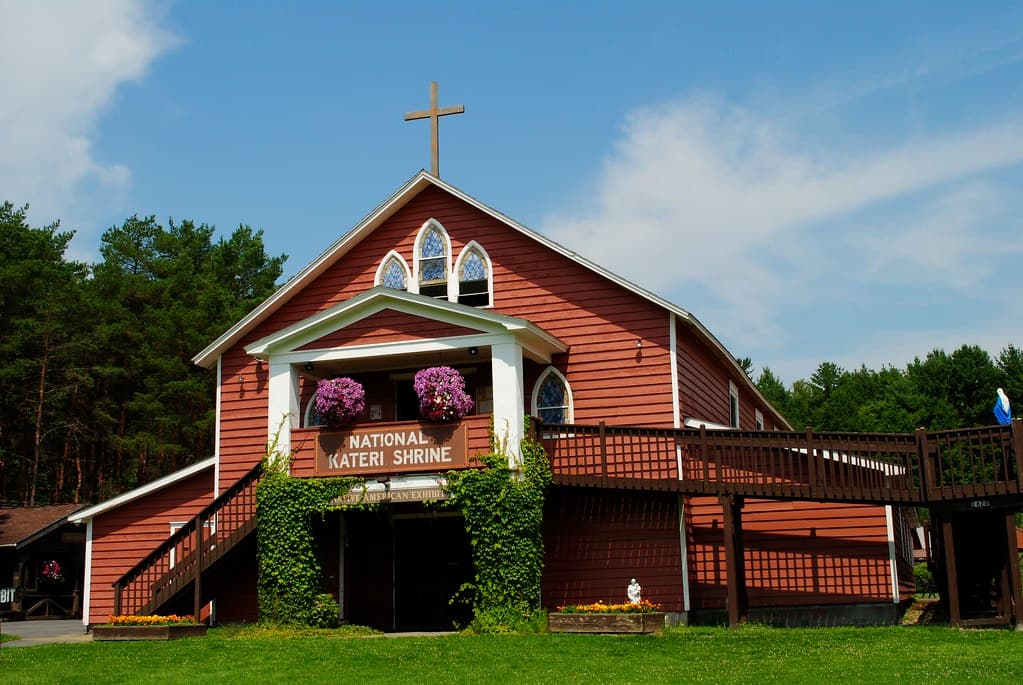
Indigenous Pilgrimage Mass during the July novena (typically the Sunday closest to 26 July); prayer in Indigenous languages and ceremonial drumming during liturgy; procession in regalia and beaded vestments. Many Indigenous pilgrims travel between Sainte-Anne-de-Beaupré and the Kateri Tekakwitha shrine at Kahnawake and the sanctuary at Wendake during the year.
Perspectives and open questions
Sainte-Anne-de-Beaupré is read as North America's oldest continuous Catholic pilgrimage site, as the principal North American shrine of Saint Anne with extensively documented healing reports, and — since Pope Francis's 2022 visit — as a place of partial repair between settler and Indigenous Catholics.
Scholarly perspective
Sainte-Anne-de-Beaupré is the oldest continuous Catholic pilgrimage site in North America, founded in 1658 in the convergence of Breton mariner devotion (Sainte Anne d'Auray) and the spiritual life of the Beaupré seigneury. Its healing reputation, documented from the cure of Louis Guimond in 1658 onward, is supported by an extensive ethnographic and ex-voto record (Pierre Lessard and the Quebec ethnographic school). The current basilica (1923–1946) is one of the great twentieth-century neo-Romanesque churches of the Americas.
Indigenous Catholic participation has been part of the shrine since the seventeenth century and is now formally integrated into its annual cycle.
Living and traditional perspectives
For Mohawk, Wendat, Innu, and Mi'kmaq Catholic communities, Saint Anne — known in Mohawk as Iotsí:tsison, 'the flower' — is the grandmother of the spiritual world, a figure mediating between human and divine in a register closer to Indigenous matriarchal cosmology than to imperial Catholic iconography. The 2022 papal visit was widely framed by Indigenous Catholics as a moment of partial repair rather than closure regarding the residential-school legacy.
For French Canadians, the shrine carries the parish-by-parish pilgrimage histories of Côte-de-Beaupré, Île d'Orléans, Charlevoix, and Gaspé families over many generations.
Alternative interpretations
Some popular religious writing reads Saint Anne through Celtic 'Sant Ana' or Anatolian goddess survivals. Mainstream scholarship considers the Sainte-Anne-de-Beaupré cult continuous with the medieval European Anne devotion that itself derives from the Protoevangelium of James (second century apocryphal Gospel) rather than from pre-Christian substrates.
Open questions
The historicity of the specific 1658 Breton-sailor shipwreck remains uncertain; the tradition appears to aggregate several mariner ex-votos rather than a single attested event. How aggregate healing claims should be statistically evaluated has not been resolved — the shrine has not produced epidemiological data, and Catholic miracle-investigation processes are case-specific. Annual pilgrim figures (cited as 'about one million' in normal years) are pastoral estimates rather than ticketed counts.
Plan your visit
Access and arrival
Sainte-Anne-de-Beaupré lies on the Côte-de-Beaupré, about 35 km north-east of Quebec City along Route 138 — roughly 30 to 45 minutes by car. Public bus services from Quebec City run via the Réseau de Transport de la Capitale and seasonal pilgrim coaches; the village stop is steps from the basilica. Direct VIA Rail service no longer reaches the village; the nearest stations are Quebec City Sainte-Foy or Gare du Palais. The basilica precinct is fully walkable and disability-accessible.
Mobile signal in the village is reliable. The shrine office can answer specific access questions and arrange group pilgrim bookings.
Pilgrim hotels and small inns cluster around the basilica in the village. The Côte-de-Beaupré has motels along Route 138 and the surrounding parish villages. Quebec City, about forty minutes away, offers the full range of accommodation. Book well in advance for the novena and feast (17–26 July); rooms in the village are scarce in those days.
Respectful visit
Modest dress; covered shoulders and knees for the basilica interior. Many pilgrims wear traditional novena medals. Sturdy shoes for the hillside Stations of the Cross. Wet-weather clothing is wise; the Côte-de-Beaupré weather changes quickly.
Permitted in the basilica outside of liturgy. Be discreet around the pillars of crutches and during healing services; respect pilgrim privacy. No flash in the chapels. The Indigenous Mass should not be photographed without permission from participants.
Candles, written prayer intentions, votive offerings (including, for those who claim healing, crutches and braces left at the pillars), and monetary donations to the Redemptorist mission. Many pilgrims commission Mass intentions.
Silence in the Chapel of the Relics. Respect for pilgrims experiencing emotional moments around the pillars and at the relic veneration. Do not remove crutches or ex-votos from the displays. Do not climb onto the bronze Stations of the Cross.
The crutch and ex-voto displays may not be removed. Photography of healing services should respect pilgrim privacy. Avoid 25–26 July if you are seeking solitude — the feast brings the largest crowd of the year. The Saint Lawrence's tidal estuary means tide-table-aware walks along the shore are possible morning and evening; the shore itself is slippery and not advised in winter.
Current practical details
Address
10018 Ave Royale, Sainte-Anne-de-Beaupré, QC G0A 3C0, Canada
Phone
Hours
Hours, fees, and access can change — verify on the official source before you travel. Practical details last checked Jun 2026.
Location
Map loads as you approach this section.
Pilgrim reflections
A portrait of encounter, not a score
Pilgrims describe what they felt, how present they could become, and whether the place would shape a journey. There are no stars and no ranking of traditions.
No reviewed reflections yet
The first pilgrims can help describe the character of being here.
Share a reflection
Available after an account-backed “Been there.” Every reflection is reviewed before publication.
Nearby sacred places
Explore other sacred places in the region. Proximity does not establish access or travel time; check each place’s guidance.

References
Sources consulted for this page. Source categories describe the publication, not a guarantee that every claim is verified. Traditional accounts and outside interpretations may differ.
- 01Sainte Anne de Beaupré — historical Catholic Encyclopedia accountencyclopediaSupports the attributed account or visitor practice in the healing section; not evidence of clinical efficacy.
- 02Devotion to Saint Anne — Marist BrothersspiritualSupports the attributed account or visitor practice in the healing section; not evidence of clinical efficacy.
Photo gallery
3 curated photos
Share a photo
Help visitors recognize Sanctuaire Sainte-Anne-de-Beaupré. Every submission is reviewed before publication.