Saint Joseph's Oratory of Mount Royal
A working-brother's wooden chapel grew into Canada's largest church and its quietest place of asking
Understand sacred places, explore living traditions, and learn how to engage respectfully with Pilgrim Map.
Access has not been verified. Check current local guidance before planning a visit.
Montreal, Quebec, Canada
Read the sources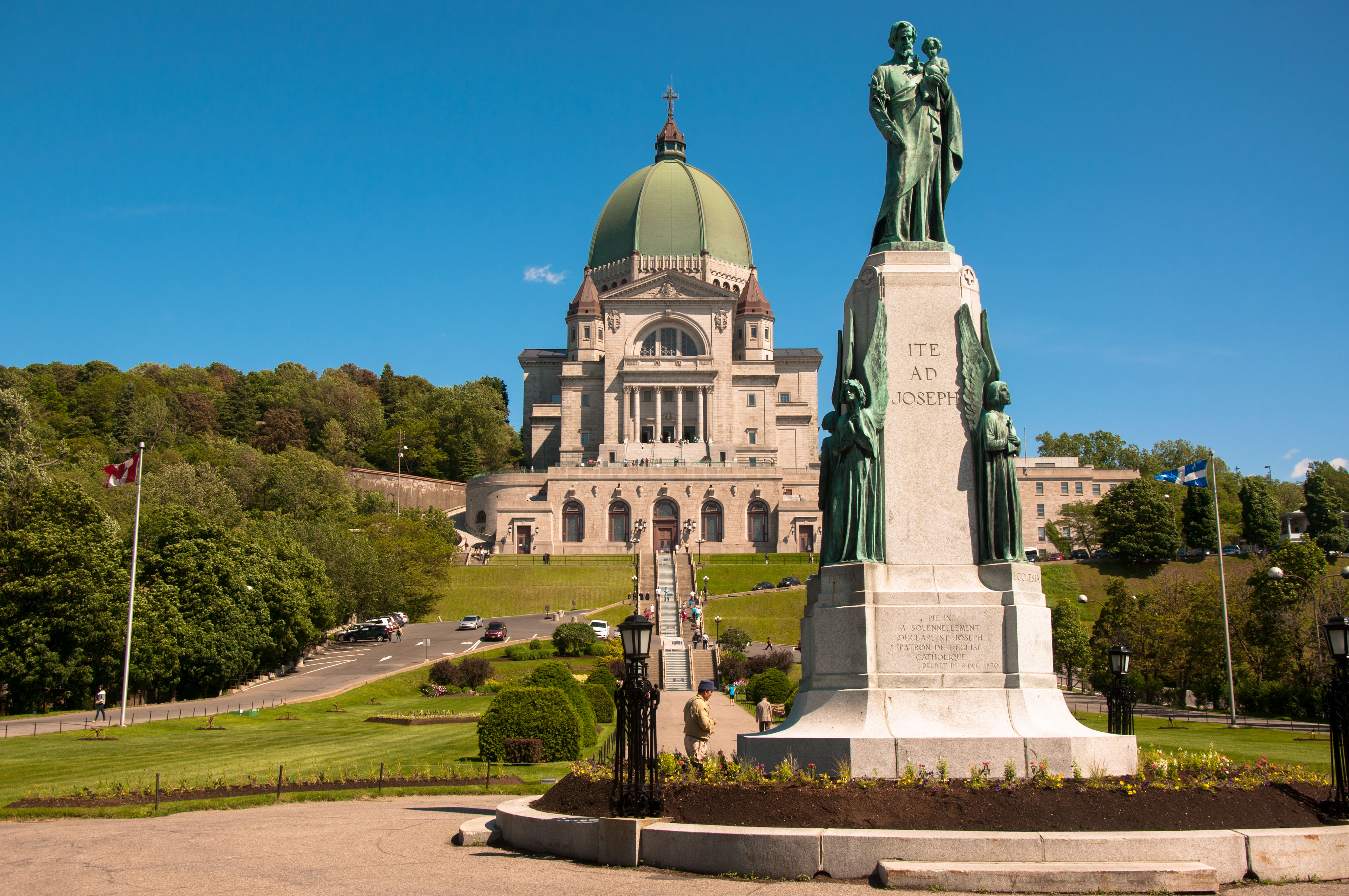
Visit essentials
A quick read before you go
- Duration
- Two to four hours for a full visit including the Basilica, Crypt Church, votive chapel, Brother…
- Access
- 3800 Queen Mary Road, Montréal, Québec H3V 1H6.
Overview
Saint Joseph's Oratory, on Mount Royal's western flank in Montreal, is the world's largest shrine to Saint Joseph and Canada's largest church by interior volume. Its copper dome ranks among the largest church domes on earth.
The Oratory began in 1904 as Brother André Bessette's small wooden chapel. A Holy Cross brother rejected by other congregations for fragile health, André was assigned as doorkeeper at Collège Notre-Dame across the road. He greeted the sick, urged prayer to Saint Joseph, and applied oil from the lamp before the saint's statue. Reports of healings spread from Montreal across North America. When André died in 1937, a million people filed past his coffin.
The basilica around his tomb took six decades to complete in stages and was consecrated in 2004. Roughly two million pilgrims and visitors now come annually.
The original 1904 chapel remains near the entrance. The Crypt Church holds the quietest daily Masses, the votive chapel walls are dense with ex-votos, and the upper Basilica's vast modernist nave receives high, cold light through the dome. Most visitors do not climb the central staircase on their knees, but some still do; their passage has worn the steps smooth.
Why this place is sacred
The Oratory's thinness gathers around a specific intuition: that Saint Joseph — the quiet, working-class father of the Holy Family — hears the prayers of the small, the sick, and the burdened. Brother André spent his life refusing personal credit, redirecting visitors toward the saint whose statue stood by his door. Pilgrims still arrive with the same kind of asking: a sick child, a marriage in trouble, work lost, a diagnosis they have not yet told the family.
They write intentions on slips of paper, light candles in the great Chapelle des lampions, and walk slowly past the wall of crutches in the votive chapel. The walls hold canes, leg braces, plaster casts, and small enamel plaques inscribed with names and dates. Whether these objects testify to documented miracles, to perceived healings, or to the simpler experience of being heard is left for each pilgrim to weigh.
What is unmistakable is the density of attention concentrated here — over a century of grief and gratitude pressed into the same air.
Brother André built a small wooden chapel on the mountainside in 1904 as a place where the sick could come to pray to Saint Joseph; he did not anticipate, or particularly want, the basilica that grew from it.
Successive expansions — the Crypt Church in 1917, the basilica begun in 1924, the dome completed in 1937, the interior largely finished in 1967, and consecration in 2004 — have layered the Oratory upward without dislodging the original devotional core.
Healing traditions
Healing ministry and devotional oil tradition
The Oratory remembers Brother André welcoming people who were ill, listening to them, and encouraging prayer to Saint Joseph. He used oil from a lamp before Joseph's image as a gesture of faith, and reports of healing spread with his ministry. The Oratory explicitly explains that Saint Joseph oil is neither a medical remedy nor a magical rite; its meaning lies in prayer and trust.
Ways to participate
Pray at Brother André's tomb or in the votive chapel, remembering both the sick and their caregivers. If you wish to use Saint Joseph oil, obtain the Oratory's guidance and treat it as a devotional gesture, not a treatment. A pastoral conversation or a moment of quiet attention is also a way to engage with André's legacy of listening.
These accounts describe religious traditions and reported experiences. They do not promise a cure or replace medical care.
Experience and orientation
The approach is part of the encounter. Outside, 283 steps rise from Queen Mary Road to the Basilica entrance, with a central wooden staircase reserved for pilgrims climbing on their knees. Inside, the Crypt Church is usually the first space pilgrims enter — low-ceilinged, candle-warm, and frequently the quietest spot on the mountain even when buses arrive at the lower plaza.
The votive chapel, just off the Crypt, is where the walls are dense with crutches and ex-votos; many visitors weep here without quite knowing why. Brother André's tomb is a black sarcophagus in a side chapel of the Crypt; a reliquary in a separate chapel holds his heart.
The upper Basilica opens dramatically after the closeness of the Crypt — a vast modernist interior with the great Beckerath organ above the entrance and Henri Charlier's enormous painted stations of the cross set into the walls. The dome's interior, finished in mosaic, sits like a high open sky over the altar. Most pilgrims do not stay long upstairs; the felt center of the site is downstairs, with the candles and the crutches.
Begin at the lower entrance and move upward at your own pace. The Crypt Church and votive chapel reward unhurried time before any climb to the Basilica.
Context and lineage
Alfred Bessette was born in 1845 in a Québécois village south of Montreal, orphaned young, and rejected by several religious congregations because of his persistent ill health. The Congregation of Holy Cross accepted him in 1870 and gave him the name Brother André. They made him porter at Collège Notre-Dame, on the slope facing Mount Royal. He kept a lamp burning before a statue of Saint Joseph and rubbed sick visitors with the oil.
Reports of healings — first quiet, then steady, then voluminous — accumulated for thirty years before he obtained permission, in 1904, to build a small wooden chapel on the mountainside. He lived another thirty-three years, dying in 1937 at the age of ninety-one. Pope John Paul II beatified him in 1982; Pope Benedict XVI canonized him in 2010.
The Congregation of Holy Cross, a French-founded apostolic community that arrived in Canada in 1847, has staffed the Oratory continuously since its founding and continues to do so today.
Traditions and practice
The Oratory's signature practices have remained largely stable since Brother André's lifetime. Pilgrims venerate the reliquary of his heart, preserved in a chapel near the Crypt. They receive the Oil of Saint Joseph — pressed from the same olive oil tradition Brother André used — and apply it themselves or have it administered. They light votive candles in the Chapelle des lampions, the great glass-walled candle chapel, leaving written intentions in racks beside the candles.
The annual nine-day novena leading to the feast of Saint Joseph (19 March) draws large crowds, as does the feast of Saint André Bessette on 6 January. During Lent the outdoor stations of the cross, set among the gardens above the basilica, are walked by pilgrims and groups.
Daily Masses are offered in French, English, and Spanish; confessions are heard in the Crypt Church most hours of the day. Eucharistic adoration runs in the Adoration Chapel. The Pierre-Béique Grand Organ by Rudolf von Beckerath, installed in 1960, is used for liturgy and for free recitals advertised on the Oratory's calendar. The carillon is heard at intervals over the gardens.
For first-time visitors, the most honest sequence is downward into the Crypt before upward into the Basilica. Spend unhurried time in the votive chapel before reading anything about the place. Light a candle if you wish. Receive the Oil of Saint Joseph if you wish. Sit with Brother André's tomb. Climb the steps to the Basilica afterward.
Roman Catholicism (Congregation of Holy Cross)
ActiveThe Oratory is the world's largest shrine dedicated to Saint Joseph, foster-father of Jesus and patron of the Universal Church. It was founded and is staffed by the Congregation of Holy Cross, the religious community of Saint Brother André Bessette, whose body lies in the basilica complex and whose heart is preserved in a reliquary. Pilgrims come both to ask the intercession of Saint Joseph and to honor Brother André himself, whose hidden life of work and prayer is a touchstone of contemporary Québécois Catholic identity.
Daily Mass in the Crypt Church and Basilica; Eucharistic adoration; veneration of Saint Joseph and Saint Brother André; application and free distribution of the Oil of Saint Joseph; ascent of the central wooden staircase on the knees (a penitential practice still observed by some pilgrims); lighting of votive candles in the Chapelle des lampions; and solemn liturgies on the Feast of Saint Joseph (19 March) and the Feast of Saint Brother André (6 January).
Perspectives and open questions
The Oratory invites multiple readings — as a major work of 20th-century ecclesiastical architecture, as a defining institution of Québécois popular religion, as a thin place organized around the intercession of a saint, and as a site whose claimed healings have always been a matter of devotion rather than empirical proof.
Scholarly perspective
Historians of Canadian Catholicism treat the Oratory as the most significant 20th-century Catholic shrine in North America and as a defining institution of Québécois popular religion. Architectural historians regard Dom Paul Bellot's dome — the third-largest church dome in the world by exterior measurement — as a masterwork of 20th-century ecclesiastical design, integrating Beaux-Arts massing with a restrained modernist interior.
Living and traditional perspectives
The Oratory sits on the unceded traditional territory of the Kanien'kehá:ka (Mohawk) Nation; the institution has in recent years acknowledged this in public liturgies and has welcomed Indigenous pilgrims, including those drawn by the 2012 canonization of Saint Kateri Tekakwitha.
Alternative interpretations
Some popular spirituality literature classifies Mount Royal itself as a 'sacred mountain' on energetic grounds. The Catholic tradition does not endorse such claims, but it has long recognized elevated sites as symbolically appropriate for shrines of ascent and intercession.
Open questions
The mechanism and scope of healings attributed to Brother André remain subjects of devotion rather than empirical demonstration. The Church accepts a small number of formally investigated cases as miraculous — two were used for beatification in 1982 and canonization in 2010 — while leaving the wider phenomenon to the faith of pilgrims.
Plan your visit
Access and arrival
3800 Queen Mary Road, Montréal, Québec H3V 1H6. Reached by Côte-des-Neiges Metro (Blue Line) with a short walk uphill, or by bus 165/166. On-site parking is available. Wheelchair access is provided via interior elevators that connect all main levels; the central staircase is not the only path to the Basilica.
Montreal offers a full range of hotels and pilgrim houses. The Oratory itself operates a Maison Saint-Joseph for retreatants and groups; book directly through the Oratory's pastoral office.
Respectful visit
Modest dress appropriate to a working basilica; shoulders and knees covered.
Permitted in most spaces without flash. Avoid photographing pilgrims at prayer, particularly at the tomb and in the votive chapel. No photography during Mass.
Votive candles, written intentions, and donations are customary. The Oil of Saint Joseph is offered freely with a suggested donation.
Silence in the Crypt Church, votive chapel, and Adoration Chapel; mobile phones silenced; no eating or drinking inside the church spaces.
Reception of Communion at Mass is reserved to Catholics in accordance with sacramental discipline; non-Catholic pilgrims are warmly welcomed to all liturgies and devotions and frequently leave with a small vial of oil or a holy card. The healings associated with the Oratory have always been treated by the Church as matters of devotion rather than guaranteed outcome; the language used here is the language of asking, not of transaction.
Current practical details
Address
3800 Ch. Queen Mary, Montréal, QC H3V 1H6, Canada
Phone
Hours
Hours, fees, and access can change — verify on the official source before you travel. Practical details last checked Jun 2026.
Location
Map loads as you approach this section.
Pilgrim reflections
A portrait of encounter, not a score
Pilgrims describe what they felt, how present they could become, and whether the place would shape a journey. There are no stars and no ranking of traditions.
No reviewed reflections yet
The first pilgrims can help describe the character of being here.
Share a reflection
Available after an account-backed “Been there.” Every reflection is reviewed before publication.
Nearby sacred places
Explore other sacred places in the region. Proximity does not establish access or travel time; check each place’s guidance.

References
Sources consulted for this page. Source categories describe the publication, not a guarantee that every claim is verified. Traditional accounts and outside interpretations may differ.
- 01Spirituality and Saint Joseph oil — Saint Joseph's OratoryofficialSupports the attributed account or visitor practice in the healing section; not evidence of clinical efficacy.
Photo gallery
2 curated photos
Share a photo
Help visitors recognize Saint Joseph's Oratory of Mount Royal. Every submission is reviewed before publication.
Key questions
What pilgrims usually ask
When is the best time to visit Saint Joseph's Oratory of Mount Royal?
Avoid: Late mornings on summer weekends bring the largest crowds. The Basilica during Sunday late-morning Mass is crowded; consider an early weekday Mass in the Crypt for a quieter encounter.