San Giovanni Battista
The Franciscan Sinai, where Saint Francis wrote the Rule in a mountain cave
Understand sacred places, explore living traditions, and learn how to engage respectfully with Pilgrim Map.
Access has not been verified. Check current local guidance before planning a visit.
Cervo, Savona, Italy
Read the sources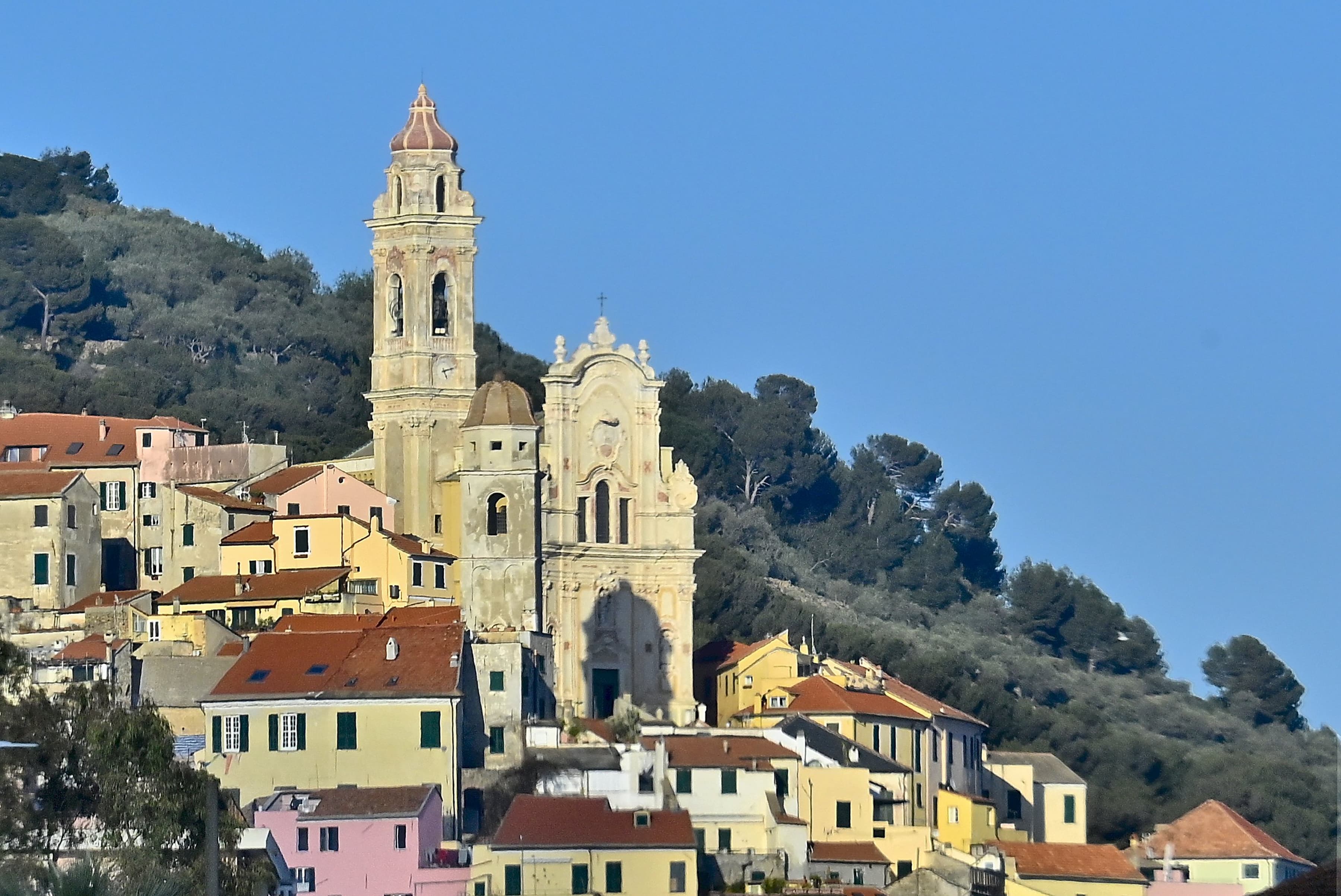
Image of San Giovanni Battista. Image source · CC-BY-SA-4.0
Visit essentials
A quick read before you go
- Duration
- 1-2 hours for the full sanctuary visit including church, cloister, Sacred Cave, and forest.
- Access
- By car: approximately 5 km south of Rieti on a paved road that becomes a path near the…
Overview
There is a reason Fontecolombo is called the Franciscan Sinai. As Moses withdrew to a mountain cave and received the Law that would govern his people, Francis withdrew to a cave on Monte Rainiero and received, through prayer and fasting, the Rule that would govern his. The parallel was not lost on his contemporaries, and it has shaped the way the Franciscan tradition understands this place ever since.
The sanctuary sits five kilometers from Rieti, immersed in a forest of centuries-old holm oaks on the slopes of Monte Rainiero. The original Latin name, Fons Colombarum, was reportedly given by Francis himself, who saw white doves drinking at a clear spring and named the place for them. The spring still flows. The doves are part of the legend.
What is documented is Francis's presence here in the summer of 1223, when he spent forty days in the Sacred Cave, fasting and praying, writing the text that would become the third and final version of the Franciscan Rule.
The Regula Bullata, solemnly approved by Pope Honorius III on November 29, 1223, was the document that transformed a charismatic movement into a sustainable institution. It codified the Franciscan commitment to poverty, obedience, and preaching. It set the framework within which hundreds of thousands of friars would live across the following eight centuries.
That this transformative document was written in a cave, by a man who had retreated to the forest to pray, says something essential about the Franciscan understanding of how wisdom comes: not through institutional deliberation but through solitary encounter with the divine.
The sanctuary that grew around the cave preserves both the austerity of Francis's retreat and the beauty of the landscape that drew him. The church, consecrated by Cardinal Nicholas of Cusa on July 19, 1450, and dedicated to Saint Francis and Saint Bernardine of Siena, anchors the complex.
The Renaissance cloister, the refectory with its fresco of the miracle of the vine, and the Sacred Cave itself with its chapel of Saint Michael form a pilgrimage circuit that descends from the institutional to the personal, from the church to the cave where one man's forty days changed the shape of Western spirituality.
Why this place is sacred
The Sacred Cave is the heart of Fontecolombo's thinness. It is a small, rough space in the rock of Monte Rainiero, the kind of cave that offers shelter without comfort, that forces the occupant into the essential conditions of prayer: darkness, stone, cold, and silence. Here, Francis withdrew from the disputes and negotiations that had attended earlier versions of his Rule, seeking in solitary prayer the clarity that communal discussion had not provided.
The hagiographic tradition reports that Francis received a vision confirming his mission during this retreat, and that the Rule he brought down from the cave carried the authority of divine inspiration. Whatever one makes of the visionary claims, the historical fact is that the Regula Bullata emerged from this cave and was approved within months, becoming the foundational document of the largest religious order in the Catholic Church.
The Franciscan Sinai analogy captures something true about the experience of Fontecolombo. The ascent from Rieti through changing vegetation, the transition from cultivated land to forest, the progressive withdrawal from human settlement into holm oak and stone, recapitulates the biblical pattern of ascent to the place of revelation. The cave, when you reach it, is exactly what a cave should be: small, dark, unadorned, a place where the human meets the earth.
The surrounding forest deepens the thinness. The centuries-old holm oaks create a canopy that filters light and sound, producing a quality of enclosure that the Franciscan tradition has always associated with contemplative prayer. The spring, clear and constant, provides the element of water that so many sacred places require. The combination of cave, forest, and spring creates an environment that would be charged with spiritual possibility even without the Franciscan history.
With it, the place carries a weight of significance that eight centuries of continuous prayer have only deepened.
Place of retreat for Saint Francis, where he wrote the definitive Franciscan Rule in 1223
From hermitage and cave to a sanctuary complex including church (consecrated 1450), cloister, refectory, and the Sacred Cave with its chapel of Saint Michael. Active Franciscan community (Friars Minor) in continuous residence.
Experience and orientation
The approach to Fontecolombo sets the register. Whether arriving by car or on foot from Rieti, the transition from the valley floor to the sanctuary on the slopes of Monte Rainiero involves a passage through landscape that becomes progressively wilder, quieter, more enclosed. The centuries-old holm oaks close overhead, filtering the Lazio sunlight into shifting patterns of green and gold.
The sanctuary complex appears within the forest: a modest collection of buildings in local stone, without the grandeur of a major basilica or the fortress-like aspect of larger monastic foundations. The scale is human. The Franciscan commitment to simplicity is visible in every proportion.
The visit begins at the church, consecrated in 1450 and dedicated to Saint Francis and Saint Bernardine of Siena. From the church, the route descends through the Renaissance cloister with its central well, past the refectory where a fresco depicts the miracle of the vine, and down toward the Sacred Cave.
The descent to the cave is the spiritual crescendo of the visit. The Chapel of Saint Michael marks the entrance to the Sacro Speco, the Sacred Cave where Francis spent his forty days. The cave is small, rough, utterly without decoration beyond what later centuries have added. Standing here, one encounters the material conditions of the Rule's creation: stone, darkness, the smell of earth, the silence of the mountain.
The spring that gave Fontecolombo its name still flows nearby. The water is clear and cold. Francis is said to have named the place Fons Colombarum when he saw white doves drinking here. Whether the story is literally true or not, it captures the quality of the site: a place where nature and prayer converge, where the simplest elements, water, stone, and light, are sufficient.
The friars who maintain the sanctuary carry forward the presence that Francis established. Their community life, their reception of pilgrims, and their maintenance of the liturgical hours ensure that Fontecolombo remains what it was for Francis: a place where withdrawal from the world enables encounter with the sacred.
Fontecolombo sits on the slopes of Monte Rainiero, approximately 5 km south of Rieti in the Lazio region. The sanctuary is surrounded by ancient holm oak forest. The Sacred Cave is below the main church level, accessed by a descending path through the complex.
Context and lineage
Francis is traditionally believed to have first come to Fontecolombo in 1217, drawn by the forested slopes and the clear spring. The decisive event came in the summer of 1223, when Francis, having struggled with earlier versions of his Rule through years of internal debate within the growing order, retreated to the cave on Monte Rainiero for forty days of prayer and fasting.
He emerged with the text of the Regula Bullata, which Pope Honorius III solemnly approved on November 29, 1223. Francis returned in 1225 for a painful eye operation performed at the sanctuary, testimony to the physical suffering that marked his later years.
Franciscan Order (Order of Friars Minor). One of four sanctuaries forming the Valle Santa cross, alongside Greccio, Poggio Bustone, and La Foresta.
Saint Francis of Assisi
Wrote the Regula Bullata in the Sacred Cave
Pope Honorius III
Approved the Regula Bullata on November 29, 1223
Cardinal Nicholas of Cusa
Consecrated the sanctuary church on July 19, 1450
Traditions and practice
The Franciscan community has maintained liturgical life here since the thirteenth century. The Divine Office, Mass, and communal prayer follow the Franciscan tradition.
The friars maintain the sanctuary, receive pilgrims individually and in groups, and offer guided visits. The Cammino di Francesco walking pilgrimage route passes through. The sanctuary sells products made by the community.
Walk from Rieti if possible; the one-hour approach through the landscape prepares the spirit. Begin at the church and descend through the cloister to the Sacred Cave. Sit in the cave for a time, allowing the silence and darkness to work. Drink from the spring. If timing allows, attend one of the community's liturgical hours. Walk in the holm oak forest.
Roman Catholicism - Franciscan
ActiveThe site where Saint Francis wrote the Regula Bullata (1223), the definitive Rule of the Franciscan Order. Known as the 'Franciscan Sinai.' One of four sanctuaries forming the Valle Santa cross.
Divine Office, Mass, pilgrim reception, Cammino di Francesco pilgrimage route
Perspectives and open questions
Fontecolombo invites interpretation as a Franciscan holy site, as a place where the natural environment enables spiritual encounter, and as the birthplace of a document that shaped Western religious life.
Scholarly perspective
Franciscan scholars consider Fontecolombo one of the most important sites in the order's history. The writing of the Regula Bullata here in 1223 is documented in contemporary and near-contemporary sources. The sanctuary's claim to be the 'Franciscan Sinai' reflects a theological interpretation of Francis's retreat that dates to the medieval period.
Living and traditional perspectives
Within the Franciscan tradition, Fontecolombo holds a place analogous to Mount Sinai in Judaism: the place where the foundational law was received through divine inspiration. The Sacred Cave is understood as a place where the barrier between human and divine became thin enough for the transmission of a governing wisdom.
Alternative interpretations
The sanctuary's elements, the cave, the spring, and the ancient forest, resonate with universal archetypal patterns of sacred place. The cave as womb and tomb, the spring as purification, the forest as enchanted enclosure: these elements transcend specifically Christian interpretation and connect to broader patterns of human sacred geography. The Franciscan emphasis on creation as sacred makes Fontecolombo particularly accessible to ecological and nature-based spiritualities.
Open questions
The process by which the Regula Bullata was composed in the cave, the relationship between earlier rejected drafts and the final text, and the nature of any visionary experiences Francis may have had during his retreat remain subjects of scholarly discussion. The site's pre-Franciscan history, if any, is not documented.
Plan your visit
Access and arrival
By car: approximately 5 km south of Rieti on a paved road that becomes a path near the sanctuary. On foot from Rieti: approximately 1 hour, 1,900 meters with 160 meters of elevation gain. Part of the Cammino di Francesco pilgrimage route.
The sanctuary may offer pilgrim hospitality; contact the community in advance. Hotels and guest houses in Rieti (5 km). Some agriturismo properties in the surrounding countryside.
Respectful visit
Modest dress appropriate to a religious house.
Generally permitted in exterior areas. Interior and cave photography may be restricted. Check with the community.
Donations appreciated for sanctuary maintenance. Products made by the community are available for purchase.
Monastic enclosure areas reserved for the friars | Silence in the Sacred Cave and church | No photography during liturgical celebrations | Follow guidance of the community
The descent to the Sacred Cave involves steps and uneven surfaces. Respect the monastic enclosure areas. The sanctuary is a place of prayer; maintain appropriate silence.
Location
Map loads as you approach this section.
Pilgrim reflections
A portrait of encounter, not a score
Pilgrims describe what they felt, how present they could become, and whether the place would shape a journey. There are no stars and no ranking of traditions.
No reviewed reflections yet
The first pilgrims can help describe the character of being here.
Share a reflection
Available after an account-backed “Been there.” Every reflection is reviewed before publication.
Nearby sacred places
Explore other sacred places in the region. Proximity does not establish access or travel time; check each place’s guidance.


References
Sources consulted for this page. Source categories describe the publication, not a guarantee that every claim is verified. Traditional accounts and outside interpretations may differ.
- 01Chiesa di S. Giovanni Battista - Italia.it — Italia.itofficialOfficial Italian tourism portal entry
- 02Cervo International Chamber Music Festival — Cervo FestivalSource contextOfficial festival site; concerts held on the church forecourt since 1964
- 03Chiesa di San Giovanni Battista (Cervo) - Wikipedia (Italian) — Wikipedia contributorsencyclopediaItalian Wikipedia article on history, architecture, and coral fishermen connection
- 04Church of San Giovanni Battista - Liguria Wow — Liguria WowofficialRegional tourism site with architectural and historical details
- 05Cervo, a small piece of heaven in Liguria - That's Liguria — That's LiguriaguideVisitor-focused guide to Cervo and the church
- 06Cervo: La chiesa di San Giovanni Battista - Tesori del Ponente — Tesori del PonenteSource contextDetailed architectural and art historical account
Share a photo
Help visitors recognize San Giovanni Battista. Every submission is reviewed before publication.