San Augustin Terrace C
Part ofSan Agustín Archaeological Park
Forty-nine tombs, fifteen statues, each one a personal response to a personal loss
Understand sacred places, explore living traditions, and learn how to engage respectfully with Pilgrim Map.
Access has not been verified. Check current local guidance before planning a visit.
Huila, Huila, Colombia
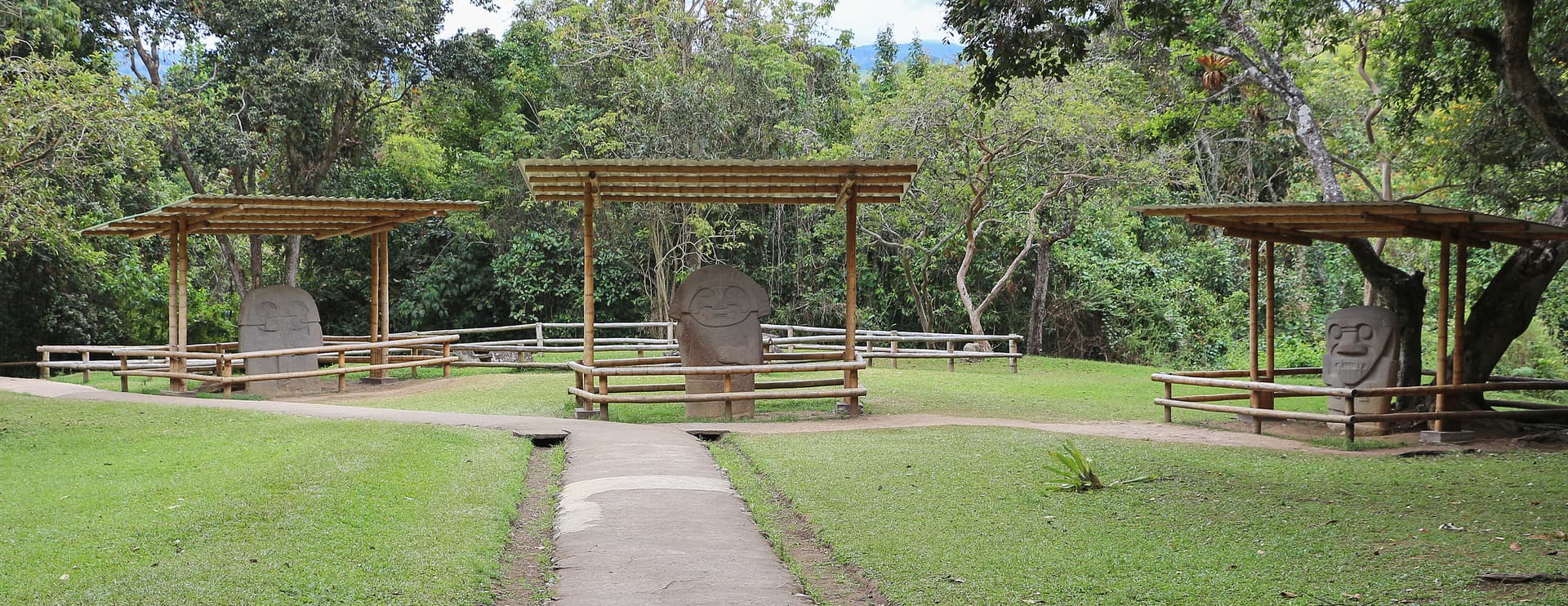
Image of San Augustin Terrace C. Image source · CC-BY-SA-4.0
Visit essentials
A quick read before you go
- Duration
- Fifteen to twenty minutes for Mesita C alone.
- Access
- Within San Agustin Archaeological Park, Huila Department, Colombia.
Overview
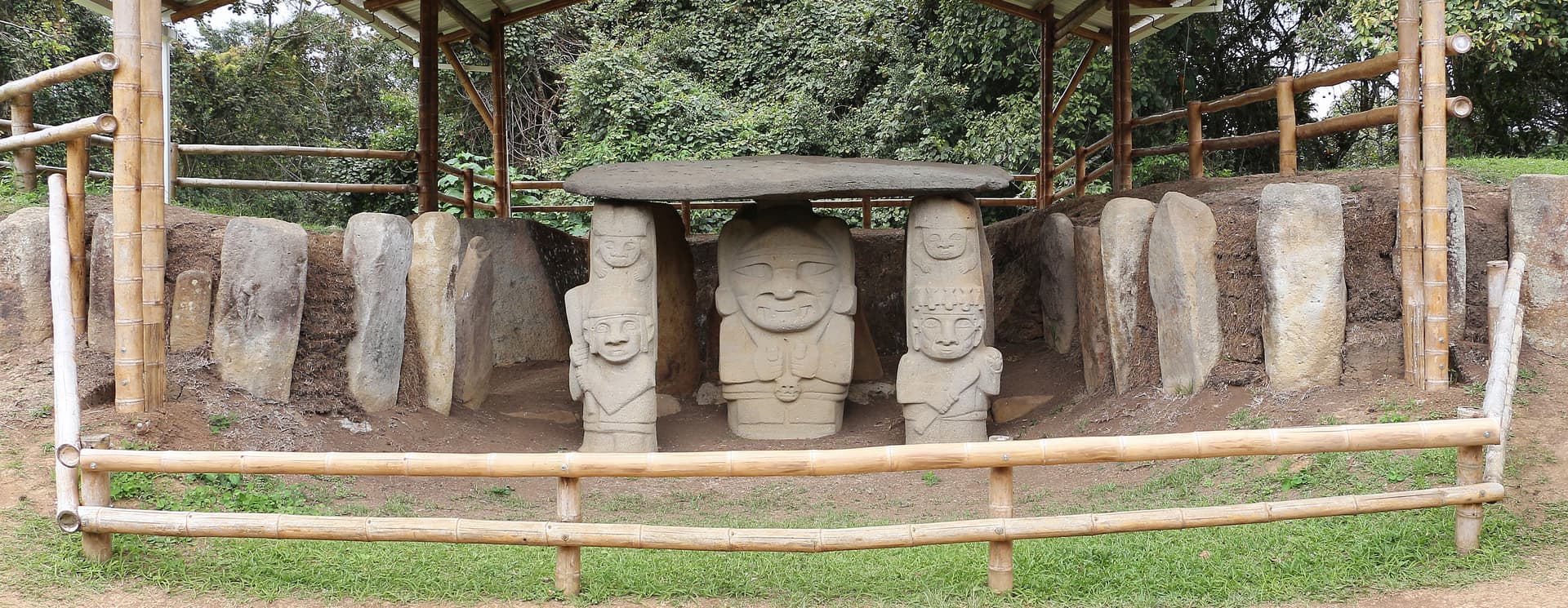
Mesita C recalibrates San Agustin. After Mesita A's monumental warriors and Mesita B's cosmic grammar, this single mound with fifteen statues and forty-nine tombs offers personal rather than programmatic scale. Its statues are smaller, finer, and more stylistically varied than those of other Mesitas. They follow no single iconographic system or unified architectural function; each appears a response to its own occasion.
Beside Mesita B's systematic cosmology, Mesita C shows individual expression within the system. Different styles, subjects, and levels of refinement suggest different hands across decades or centuries, each imagining a guardian differently.
The forty-nine tombs, each stone-slab covered, held individual dead. Specific statue-tomb relationships remain unanswered, but the one-to-one scale suggests personal dedication: a statue for a person, placed at a grave by someone who knew them. Adjacent residential remains, as at Mesita A, show elite families living beside the dead. Across the Mesitas, living and dead formed one settlement spanning both states of being.
One of the complex's oldest sites and contemporary with Mesita A, this modest mound may preserve some of the earliest San Agustin people expressing cosmology in stone, one statue and death at a time.
Why this place is sacred
There is something in the smallness of scale at Mesita C that the larger sites cannot offer. Mesita B's sixty-three statues constitute a cosmological encyclopedia. Mesita A's caryatid warriors perform structural guardianship. Mesita C's fifteen statues simply stand beside the dead, each in its own way.
The diversity of these carvings resists the idea that the San Agustin culture was a monolithic tradition operating from a single artistic center. Here, different styles coexist within a single mound: some statues formal and hieratic, others more naturalistic, some technically refined, others rougher. This variety may reflect different time periods, different families, different individual artists, or all three. Whatever the explanation, the effect is of a tradition that allowed room for personal expression within its shared cosmological framework.
Each of the forty-nine tombs was someone's death. Each stone slab was placed by someone's hands. The statues that were carved, smaller and more personal than the grand guardians of the other Mesitas, were carved by someone who had lost someone. The accumulation over centuries, tomb upon tomb, statue beside statue, creates a record of grief and devotion that operates at a human scale.
The frontal positioning of the statues adds an interpretive element. The figures face outward, toward the living, maintaining a visual connection between the dead within the mound and the community that continued to live beside it. This is consistent with the broader San Agustin understanding that death was not a departure but a change of state: the dead remained present, visible through their stone representatives, part of the ongoing community.
Mesita C served as a communal burial site for what appears to be a community or extended family group over many centuries. The individually conceived statues suggest a more personal approach to funerary commemoration than the programmatic arrangements at the other Mesitas.
As one of the oldest sites in the complex, Mesita C's development parallels Mesita A. Burials accumulated from approximately the first through the ninth centuries CE, with statues carved in diverse styles across that span. The site may represent the earliest phase of San Agustin sculptural expression, when the tradition was still developing its vocabulary and individual artists had more latitude. After the ninth century, the sculptural tradition ceased. Modern documentation began with Preuss in 1914.
Experience and orientation
After the density of Mesita B, the arrival at Mesita C feels like a shift in register. The single mound is more modest in scale. The statues are smaller, fewer, more individually present. The site is less visited, which means the quiet is more complete.
The fifteen statues reward close looking. Where the grand statues of the other Mesitas communicate their meaning across distance, these smaller figures require proximity. Their details emerge in close observation: the individual treatment of facial features, the variations in carving technique, the differences in subject matter. Each statue has its own personality, which is another way of saying each statue had its own occasion.
The stone-covered tombs are visible, each slab marking an individual burial. Walk among them and consider the arithmetic of grief: forty-nine deaths over centuries, each marked by stone, many accompanied by a carved guardian. This was not a culture that processed death efficiently. This was a culture that stopped for each death and carved a response in stone.
The residential remains, if visible and marked, add the same dimension as at Mesita A: elite families choosing to live beside their dead, maintaining a community that included both the living and the ancestors. At Mesita C, the personal scale of the statues makes this choice feel more intimate. These were not people living beside a monument. They were people living beside their family's dead, guarded by statues that individual hands had carved.
Mesita C is part of the Mesitas circuit within the park. It can be visited in fifteen to twenty minutes but benefits from unhurried attention. Consider visiting it after Mesitas A and B, when the contrast in scale and quality will be most apparent. If the site is quiet, sit near the mound and observe the frontal positioning of the statues: they face the living, maintaining the connection between worlds that the San Agustin culture considered essential.
Context and lineage
Mesita C developed alongside Mesita A as one of the earliest burial sites in the San Agustin complex. Over centuries, individual dead were placed in stone-covered tombs within the mound, each burial accompanied by a statue carved for the occasion. Unlike the systematic programs of the other Mesitas, the statues at Mesita C show diverse styles and subjects, suggesting that individual artists or families were responsible for each carving rather than a centralized workshop.
The result is a mound that reads as a communal record of individual loss rather than a unified cosmological statement.
Mesita C's lineage is one of accumulation rather than systematic development. Unlike Mesita B's programmatic tradition, Mesita C grew one death and one statue at a time over centuries. The diversity of styles suggests that the tradition of funerary sculpture was widely practiced rather than monopolized by a specialist class. Modern custodianship follows the same pattern as the other Mesitas: Preuss's documentation, ICANH management, UNESCO protection.
San Agustin individual sculptors
original artists
The diverse artists whose individual styles are preserved in the fifteen statues at Mesita C. Their variety suggests that the San Agustin tradition accommodated personal expression within its shared cosmological framework.
Konrad Theodor Preuss
archaeologist
Documented Mesita C in 1914 as part of his systematic survey, noting the diversity of sculptural styles within the single mound.
Traditions and practice
Individual burials in stone-covered tombs within the mound, each accompanied by a personally carved statue. The diversity of sculptural styles suggests that ceremonies may have varied by family, period, or the nature of the deceased. The frontal placement of statues suggests they were positioned to face the living, maintaining a visual bridge between the community of the dead and the community of the living.
Mesita C is included in the park's trail system with interpretive signage. Guided tours typically visit it as part of the Mesitas circuit. The site's quieter atmosphere makes it suited to personal reflection.
Give Mesita C the time that its personal scale deserves. Choose one statue and observe it closely. Note the individual treatment of the face, the carving technique, the subject. Consider that this statue was carved for one person, by one artist, in response to one death. Then look at the others and note how different they are. This diversity is the point: the San Agustin tradition held room for the personal within the cosmic.
The stone-covered tombs beneath these statues contained individuals, not categories. If the site is quiet, and it often is, sit near the mound and let the frontal gaze of the statues reach you. They were placed to face the living. They are facing you.
San Agustin Personal Funerary Tradition
HistoricalMesita C preserves the personal dimension of the San Agustin funerary tradition. The individually varied statues demonstrate that the culture's cosmological framework accommodated individual artistic and devotional expression.
Individual burials with personally carved statues, frontal positioning of guardians to face the living, stone-covered tombs within a communal mound.
Archaeological Conservation
ActiveModern documentation and preservation ensure that the individual character of Mesita C's statues survives for future engagement.
Archaeological documentation, conservation, interpretive programs, and guided tours within the park system.
Perspectives and open questions
Mesita C reveals the personal dimension of a culture more often discussed in cosmological terms. The individual statues, individually conceived, speak of a tradition that held room for personal grief within its shared understanding of death as transformation.
Scholarly perspective
Archaeologists recognize Mesita C as one of the oldest burial sites in the complex alongside Mesita A. Its distinction lies in the artistic quality and diversity of its smaller statues, interpreted as evidence of either a longer time span of use or the presence of multiple artistic traditions within the San Agustin culture. The stone-covered tomb construction technique has been compared to funerary practices across the Andes.
The site provides evidence that the San Agustin sculptural tradition was not monopolized by a specialist class but practiced by diverse hands.
Living and traditional perspectives
Local communities regard Mesita C's statues as individual expressions of ancestral devotion, complementing the more monumental programs of the other Mesitas. The diversity of sculptural styles is understood as reflecting the richness of the ancestral tradition and the personal nature of the relationship between the living and the dead.
Alternative interpretations
The iconographic diversity of Mesita C has been interpreted as evidence that the San Agustin cosmological system allowed for individual spiritual expression within a shared framework. This balance between communal belief and personal practice resonates with spiritual traditions worldwide that maintain orthodoxy while allowing personal devotional expression.
Open questions
Do the different sculptural styles represent different time periods, different families, or different individual artists? Were the forty-nine tombs all from the same community, or did people from different settlements bring their dead here? What is the significance of the frontal positioning of the statues? How does the artistic program of Mesita C relate chronologically to those of Mesitas A and B?
The diversity that makes Mesita C distinctive also makes it harder to interpret: each statue raises its own questions.
Plan your visit
Access and arrival
Within San Agustin Archaeological Park, Huila Department, Colombia. Same access as the main park. Included in the combined ticket valid for forty-eight hours.
San Agustin town provides the nearest accommodation, approximately three kilometers from the park.
Respectful visit
Comfortable walking shoes for the park trails.
Photography permitted. The individual character of each statue rewards close-up photography.
Not customary.
Stay on marked paths. Do not touch statues or the burial mound.
The statues are smaller and more delicate than those at the other Mesitas. The injunction against touching is especially important here. The site is a burial ground; treat it accordingly.
Current practical details
Address
vía al parque arqueológico, Km 2, San Agustín, Huila, Colombia
Phone
Hours
Hours, fees, and access can change — verify on the official source before you travel. Practical details last checked Jun 2026.
Location
Map loads as you approach this section.
Pilgrim reflections
A portrait of encounter, not a score
Pilgrims describe what they felt, how present they could become, and whether the place would shape a journey. There are no stars and no ranking of traditions.
No reviewed reflections yet
The first pilgrims can help describe the character of being here.
Share a reflection
Available after an account-backed “Been there.” Every reflection is reviewed before publication.
Nearby sacred places
Explore other sacred places in the region. Proximity does not establish access or travel time; check each place’s guidance.

Share a photo
Help visitors recognize San Augustin Terrace C. Every submission is reviewed before publication.