Saidai-ji (Okayama)
Twelve centuries of Senju Kannon devotion at the temple where Hadaka Matsuri began
Understand sacred places, explore living traditions, and learn how to engage respectfully with Pilgrim Map.
Access has not been verified. Check current local guidance before planning a visit.
Okayama, Okayama Prefecture, Japan
Read the sources
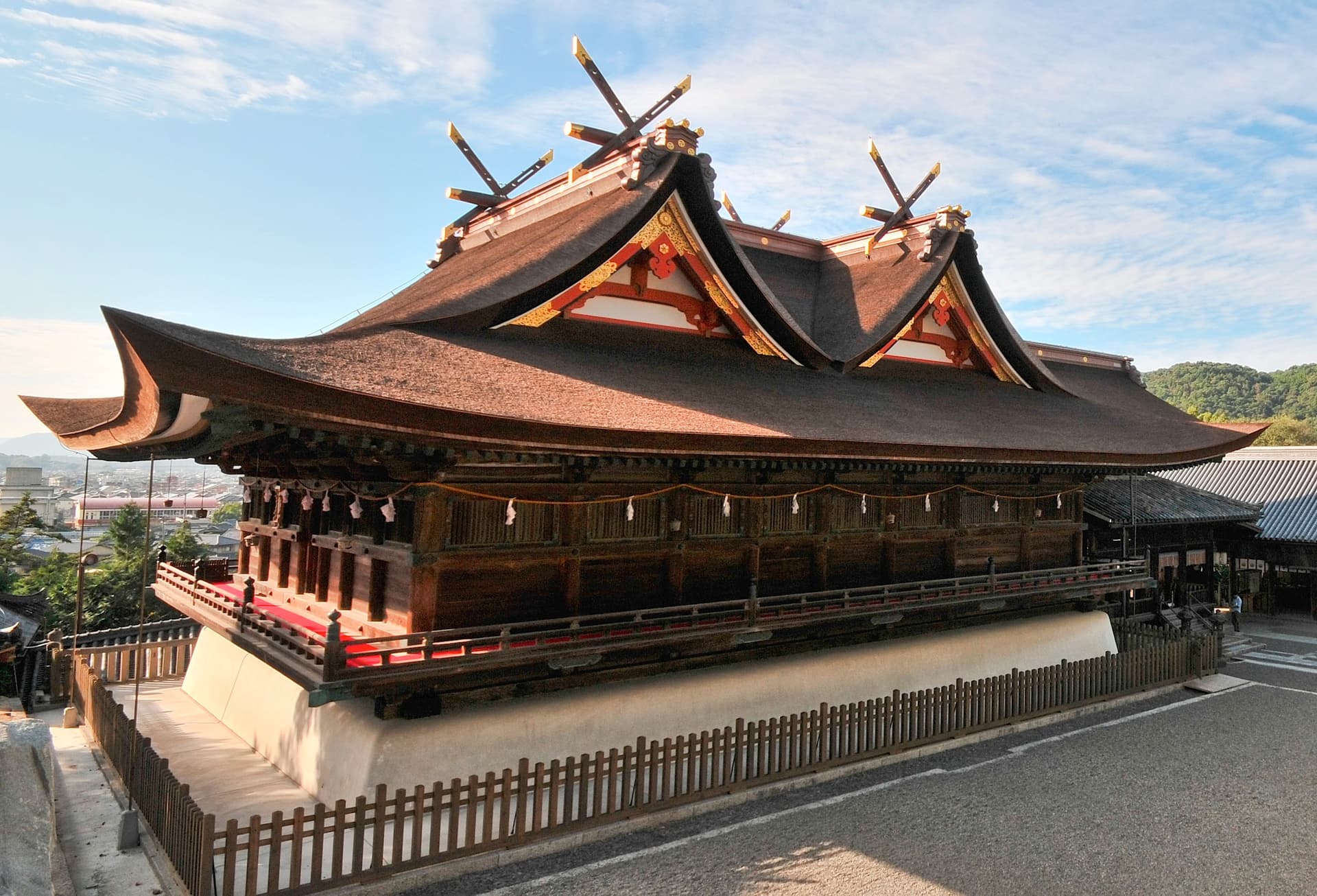
Image of Saidai-ji (Okayama). Image source · CC-BY-SA-3.0
Station 1 of 33
Chūgoku 33 Kannon PilgrimageVisit essentials
A quick read before you go
- Duration
- 1–2 hours for an unhurried pilgrim visit; an entire evening if attending Eyō.
- Access
- Twenty-minute walk south of JR Saidaiji Station on the Akō Line; about 20 minutes by train from…
Overview
Saidai-ji stands on the Yoshii River plain east of Okayama City as head temple of the Kōyasan Shingon school's eastern outpost and first station of the modern Chūgoku 33 Kannon Pilgrimage. Its honzon, a Thousand-Armed Kannon kept hibutsu, has centered devotion for over twelve hundred years. A main hall, three-story pagoda, sutra repository, and great Niō gate occupy a precinct quiet between festivals and overwhelmingly alive on February's third Saturday.
Founding tradition tells that Minato no Fujiwara-hime, a Suō noblewoman, commissioned a Kannon image from a Hase-dera carver. When her boat would not pass this river stretch, she understood the resistance as Kannon's choice and built a hut here. Saidai-ji became a major regional temple by the late thirteenth century, while Edo patronage from the Ikeda lords sustained it through decline.
The Eyō festival traces to 1510, when chief priest Chū-a distributed paper talismans. Paper became wood and demand became contest. Ordinary-season pilgrims meet a contemplative Kannon precinct; on Eyō night, participants describe controlled chaos and a brief collapse between human striving and the bodhisattva's grace. These registers belong to one shaped landscape, twelve centuries of attention directed toward a concealed image.
Why this place is sacred
What makes Saidai-ji feel thin is partly continuity and partly concealment. The Senju Kannon honzon has been the focal point of esoteric Shingon practice on this site since at least the late Heian period and is shown publicly only at decade-spanning intervals — most recently scheduled for Reiwa 10 (2028). The temple's claim that Kannon herself chose this place by halting the founder's boat reframes the ground itself as consecrated territory.
On Eyō night, this layered sense of presence becomes embodied: tens of thousands of participants describe a momentary thinning of the boundary between effort and grace, struggle and reception.
An eighth-century Kannon enshrinement site established by lay devotion and developed into an esoteric Buddhist temple under monastic guidance. The early structures supported daily liturgy to the bodhisattva and provided pilgrims with a fixed point for Kannon-focused practice in the Bizen region.
From a Heian-period hut to a Kamakura-era multi-building complex, then through Edo restoration under Ikeda patronage, Saidai-ji has continuously housed Kannon devotion while accreting folk-religious functions — most strikingly the Eyō festival's transformation from a paper-talisman distribution into the modern shingi rite. The 1981 establishment of the Chūgoku 33 Kannon Pilgrimage made the temple the formal opening station for a five-prefecture circuit.
Experience and orientation
Approach the temple from JR Saidaiji Station on foot, walking through a quiet shop street that opens onto the Niō gate. The transition is unceremonious — no long stone approach, just street and then sacred precinct. Inside, the main hall holds the concealed Senju Kannon, a rebuilt three-story pagoda anchors the southwest, and the sutra repository preserves a complete Buddhist canon. The scale is human; nothing announces itself.
For the Eyō observer, the experience reorganises completely. Crowds gather from late afternoon. By 10 p.m., the temple yard is shoulder-to-shoulder with men in white fundoshi, lit by floodlights and steam rising from chilled bodies. Two shingi sticks are released into the throng; the resulting compression is both physically dangerous and ritually exact. Spectators in the paid viewing stands report being moved by the scale and discipline beneath the apparent chaos.
Solo pilgrims who arrive in March or April find a temple recovering its quiet, with the festival's residue still tangible in the worn wood and packed earth of the inner courtyard.
Begin at the Niō gate, then enter the main hall to face the concealed honzon. Walk the precinct counter-clockwise to take in the pagoda and sutra hall. Ten minutes at the goshuin reception, fifteen at the main hall, and the rest as walking attention is enough for a first pilgrim visit.
Context and lineage
Temple tradition holds that Minato no Fujiwara-hime, a noblewoman of Suō (modern Yamaguchi), commissioned a Senju Kannon image from a Hase-dera sculptor. When her vessel refused to move further on the journey home, she interpreted this as the bodhisattva's wish to remain at this spot on the Yoshii River and built a small hut around the image. The hut grew into a hall, the hall into a temple complex.
A separate strand of the tradition credits Anryū Shōnin with constructing permanent buildings on the present site in 777 CE.
Kōyasan Shingon-shū bekkaku honzan (special head temple). Within the broader Shingon tradition, Saidai-ji sits in the esoteric mikkyō lineage that traces from Kūkai through the medieval Mt. Kōya monastic system. The Chūgoku 33 circuit grafts a modern pilgrimage logic onto this older esoteric foundation.
Traditions and practice
Daily liturgy to Senju Kannon includes recitation of the Senju-darani and offerings of incense, candles, and water. Goma fire rites in the Shingon esoteric mode are performed for protective and purificatory ends. The Eyō festival on the third Saturday in February reaches its peak around 10 p.m. with the release of two shingi sticks into the contestant crowd; the rite is preceded by purification training and follows a strict ceremonial sequence.
Modern pilgrim reception, goshuin issuance, memorial services, and ancestral kuyō continue alongside the older liturgical cycle. Saidai-ji opens daily and hosts both individual pilgrims walking the Chūgoku 33 and group tours making the 108 Kannon circuit.
Light incense at the main hall and pause facing the concealed honzon. Read or chant a passage of the Kannon-kyō if you carry one. Walk the precinct slowly, then receive the goshuin as a record of arrival. For Eyō, choose your role in advance — participant registration, paid stand, or street-side observation — and arrive several hours before the 10 p.m. peak.
Kōyasan Shingon-shū Buddhism
ActiveSaidai-ji is a bekkaku honzan (special head temple) of the Kōyasan Shingon school. The Senju Kannon honzon anchors esoteric Kannon devotion in eastern Okayama, and the temple maintains the full liturgical and ceremonial life of the Shingon mikkyō tradition.
Chūgoku 33 Kannon Pilgrimage
ActiveSaidai-ji is Temple #1 of the modern Chūgoku 33 Kannon circuit established in 1981/1982 across Okayama, Hiroshima, Yamaguchi, Shimane, and Tottori prefectures. As the opening station, it sets the rhythm and devotional logic for the full pilgrimage.
Perspectives and open questions
Saidai-ji invites multiple readings: as a continuously practising esoteric Buddhist temple, as a folk-religious site whose Eyō festival is nationally designated cultural property, and as the formal opening station of a five-prefecture Kannon pilgrimage. Each frame highlights different facts; together they describe a single living place.
Scholarly perspective
Japanese Buddhist and folkloric scholarship treats Saidai-ji as a long-established Bizen-region Kannon temple with documented presence by the late thirteenth century and a strong Edo-period revival under Ikeda patronage. The Eyō festival's evolution from paper-talisman distribution to the modern shingi rite is well documented, and the festival's status as one of three nationally designated 'kihatsu matsuri' (eccentric festivals) marks it as a primary case in Japanese folk-religion studies.
Living and traditional perspectives
Temple tradition reads the founding as Kannon's own choice — the halted boat is not a coincidence but a sign. The Eyō festival is framed as a ritual purification: through stripping and struggle, devotees enact the eradication of worldly defilement so that they may be worthy of the bodhisattva's grace. Within this frame, the chaos of festival night is not unruly but exact.
Alternative interpretations
Within Shingon mikkyō, Senju Kannon's thousand arms symbolise the bodhisattva's capacity to reach every suffering being. Saidai-ji's role as Chūgoku 33 #1 frames the pilgrimage as a mandala-walking practice through Kannon's compassionate field, where each subsequent station deepens the pilgrim's encounter with a single bodhisattva refracted across thirty-three forms.
Open questions
Original eighth-century structures have not been archaeologically verified; early history rests on later engi texts dated 1507. The hibutsu Senju Kannon's iconographic details remain partially undocumented due to its long concealment.
Plan your visit
Access and arrival
Twenty-minute walk south of JR Saidaiji Station on the Akō Line; about 20 minutes by train from JR Okayama Station. On-site parking. Open daily.
Standard business and ryokan accommodation in Okayama City (~20 minutes by train); pilgrim-oriented stays are limited. For Eyō, book accommodation in Okayama or Saidaiji several months in advance.
Respectful visit
Modest, covered clothing for daily visits. Cold-weather layers for Eyō. Pilgrim white-shirt and stole if formally walking the Chūgoku 33.
Generally permitted in outer precincts. Not allowed inside the hibutsu sanctum or during liturgy. Eyō photography is welcome from designated zones; flash photography on participants is discouraged.
Saisen (small monetary offerings) at the main hall, incense and candles at the appropriate stands, pilgrim stamp fee at the goshuin office.
Inner sanctum closed except during designated honzon openings | Eyō inner contest area is male-only by tradition | Quiet expected during sutra services
The Eyō inner contest is traditionally male-only and physically demanding; observers should respect the safety perimeter. Hibutsu sanctum is not open in ordinary seasons. Photography is restricted near the inner hall during liturgy.
Current practical details
Address
3-chōme-8-8 Saidaijinaka, Higashi-ku, 岡山市東区 Okayama 704-8116, Japan
Phone
Hours, fees, and access can change — verify on the official source before you travel. Practical details last checked Jun 2026.
Location
Map loads as you approach this section.
Pilgrim reflections
A portrait of encounter, not a score
Pilgrims describe what they felt, how present they could become, and whether the place would shape a journey. There are no stars and no ranking of traditions.
No reviewed reflections yet
The first pilgrims can help describe the character of being here.
Share a reflection
Available after an account-backed “Been there.” Every reflection is reviewed before publication.
Nearby sacred places
Explore other sacred places in the region. Proximity does not establish access or travel time; check each place’s guidance.


References
Sources consulted for this page. Source categories describe the publication, not a guarantee that every claim is verified. Traditional accounts and outside interpretations may differ.
- 01Special head temple Kinryozan Saidaiji Kannon-in — Okayama Prefecture Official Tourism GuideofficialOfficial tourism page with founding history, festival info, access
- 02本堂の仏さま | 西大寺(観音院) — Saidaiji temple official siteofficialTemple's own page on Senju Kannon honzon
- 03西大寺縁起 | 西大寺(観音院) — Saidaiji temple official siteofficialOfficial engi (founding legend) text
- 04Receive the gift of good fortune at Okayama's Hadaka Matsuri — Japan National Tourism Organization (japan.travel)officialJNTO feature on the festival
- 05西大寺 (岡山市) - Wikipedia — Wikipedia (Japanese)academicCites Kinryōzan Kohon Engi 1507; useful chronology
- 06Chūgoku 33 Kannon Pilgrimage - Wikipedia — WikipediaacademicPilgrimage was established 1981/1982; 33 sites across five Chūgoku prefectures
- 07Saidaiji Eyo (Naked Festival) — japanistry.comguideFestival history, shingi tradition, 3rd Saturday of February
- 08Saidaiji Kannon-in Temple — Japan ExperienceguideFounding legend in English, festival overview
Pilgrim glossary
- Honzon
- The principal Buddhist deity enshrined as a temple's central object of worship.
- Kannon
- The bodhisattva of compassion, central to many East Asian pilgrimage routes.
- Bodhisattva
- An enlightened being who postpones full nirvana to help others toward awakening.
- Mandala
- A symbolic diagram of the cosmos used in meditation and ritual.
- Sutra
- A canonical Buddhist scripture, often chanted as part of practice.
- Shingon
- An esoteric Japanese Buddhist school emphasizing ritual, mantra, and mandala practice.
Share a photo
Help visitors recognize Saidai-ji (Okayama). Every submission is reviewed before publication.